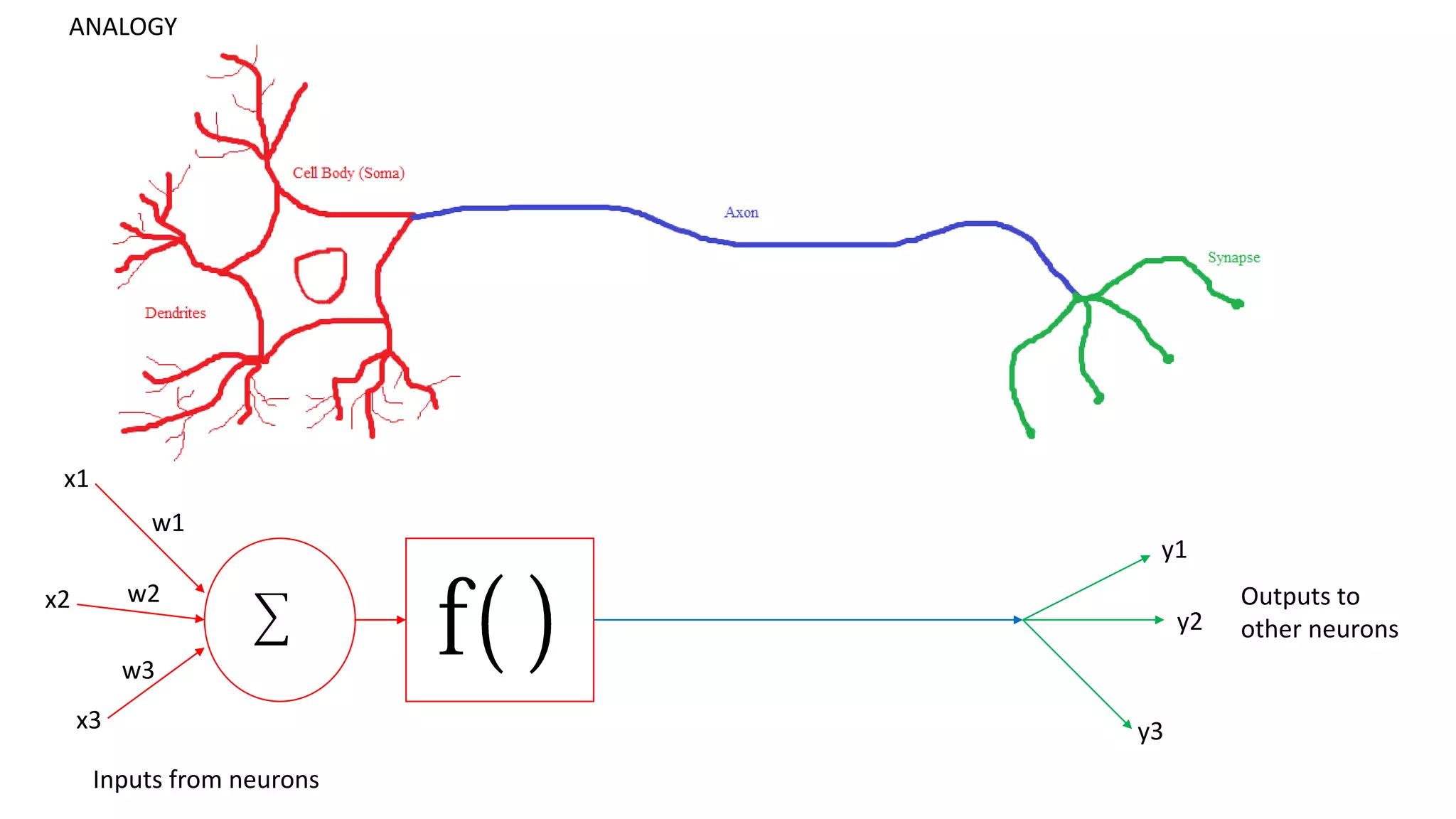
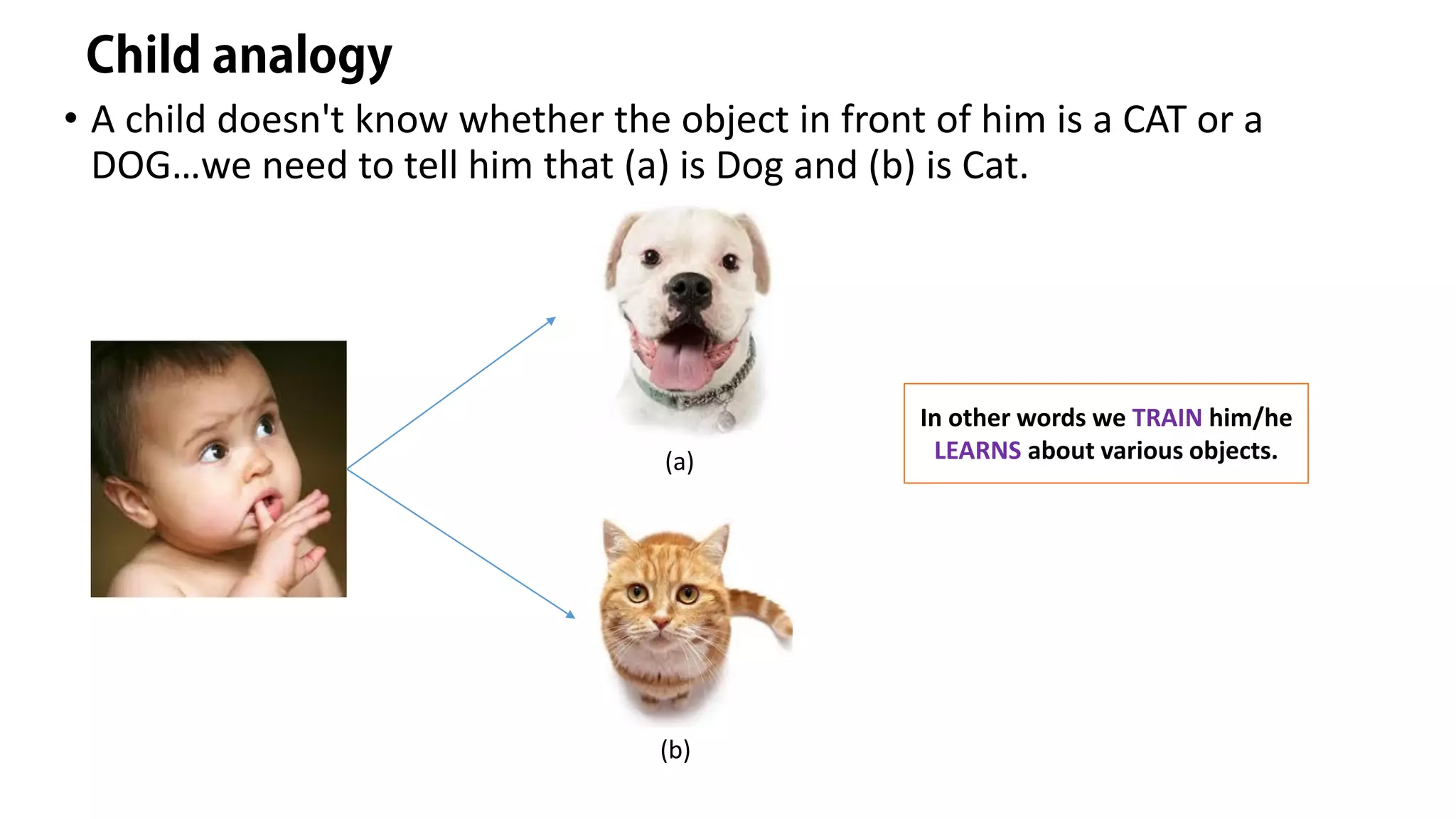
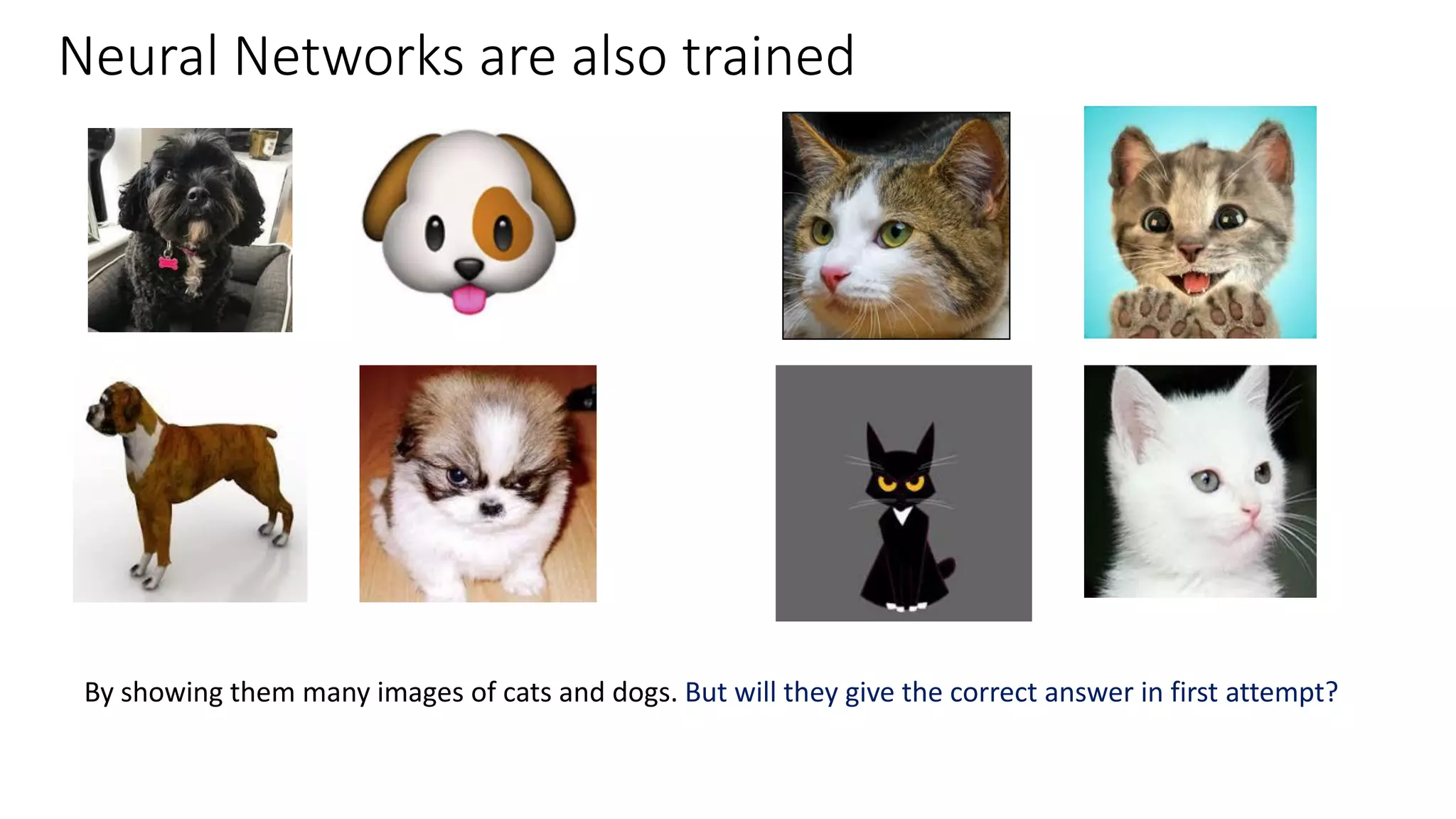
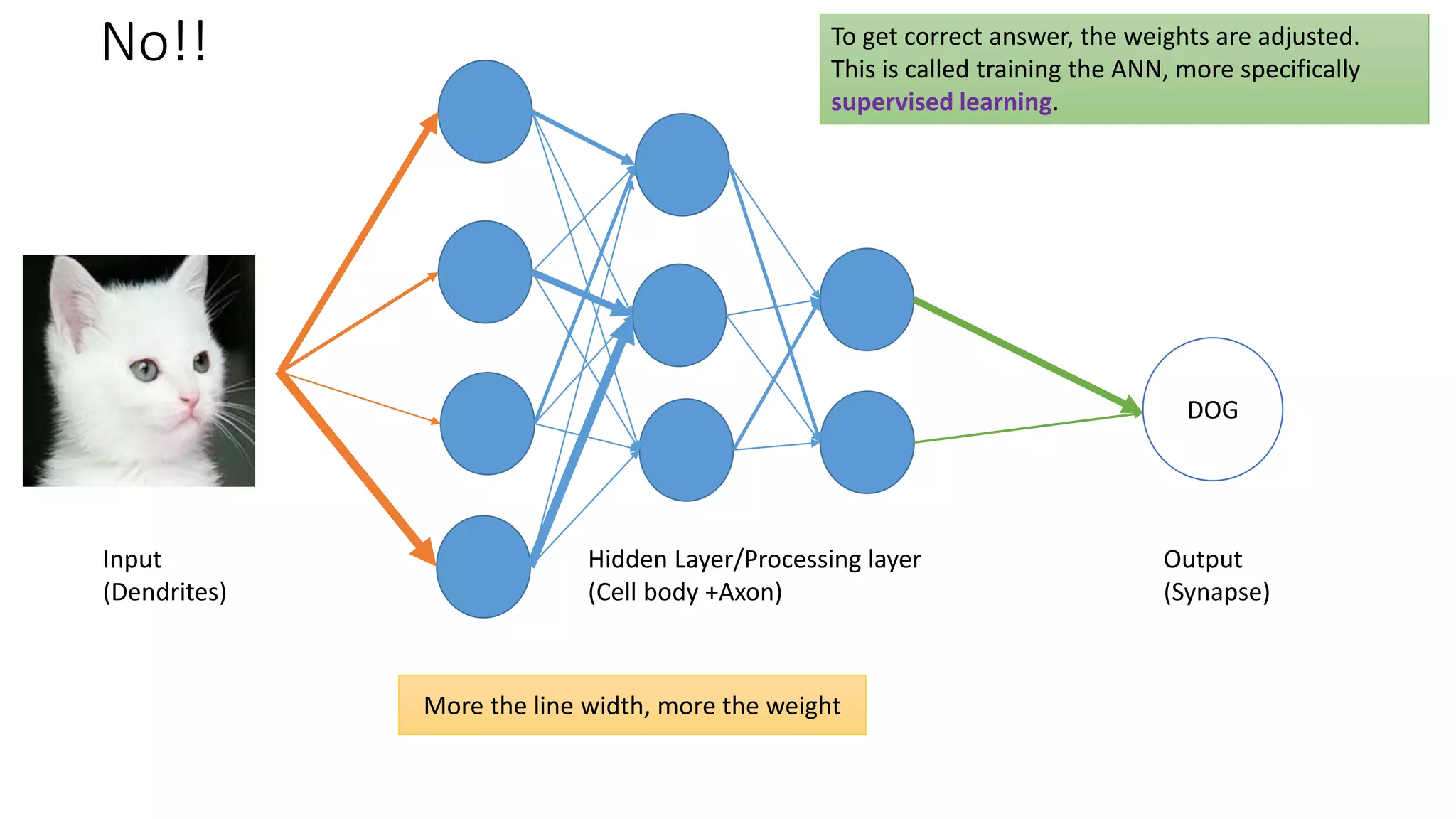
This document provides an introduction to artificial neural networks and how they are used for object recognition problems. It explains that neural networks are trained by showing them many images of different objects labeled with the correct category, just like a child learns to identify objects. The weights between neurons in the network are then adjusted during training so that the network outputs the right category when shown a new image. After training, the network can correctly identify objects it was not shown during training.

![Correct output is obtained after the learning process
Picture ref.[1]](https://image.slidesharecdn.com/introductiontoartificialneuralnetworks-170805061219/75/Introduction-to-artificial-neural-networks-6-2048.jpg)
![Convolutional neural networks
Picture ref.[2]](https://image.slidesharecdn.com/introductiontoartificialneuralnetworks-170805061219/75/Introduction-to-artificial-neural-networks-7-2048.jpg)
![Summary- The Big Picture
• Imagine the box below to be our brain. Our brain contains billions of neuron.
• Each neurons contains weights and thresholds (W & T).
W
T
T
W
W
W
W
W
T
T
T
T
T
W
W
T T
T
W
W
W
Ref.[3]
X1
Xm
Z1
Zm
Z=f(x,w,t)
• Output Z is a function of inputs ‘x’, weights ‘w’ and thresholds ‘t’.
• We have to adjust the weights and thresholds so that what we get out is what we want.](https://image.slidesharecdn.com/introductiontoartificialneuralnetworks-170805061219/75/Introduction-to-artificial-neural-networks-8-2048.jpg)
![References
[1] The art of neural networks, Mike Tyka, TEDXTUM,
https://youtu.be/0qVOUD76JOg
[2] Introduction to Deep Learning: What Are Convolutional Neural
Networks? MATLAB, https://youtu.be/ixF5WNpTzCA
[3] 6.034, Fall 2015, Artificial Intelligence, Patrick H. Winston, Lec 12a,
MIT OCW, https://youtu.be/uXt8qF2Zzfo](https://image.slidesharecdn.com/introductiontoartificialneuralnetworks-170805061219/75/Introduction-to-artificial-neural-networks-9-2048.jpg)


![[PR12] Capsule Networks - Jaejun Yoo](https://cdn.slidesharecdn.com/ss_thumbnails/pr12capsulenetworks-jaejunyoo-171217144319-thumbnail.jpg?width=640&height=640&fit=bounds)


