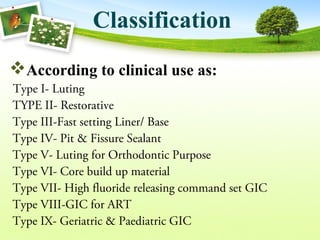
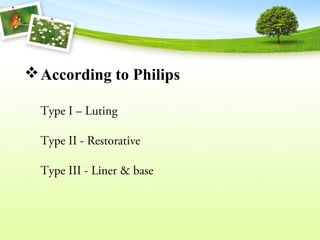
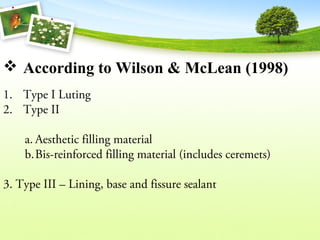
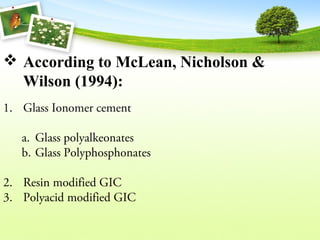
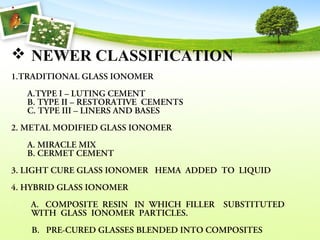
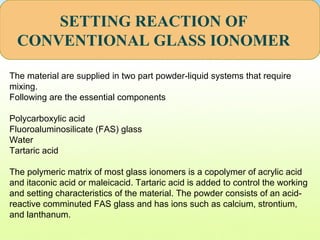
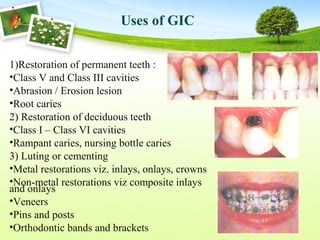
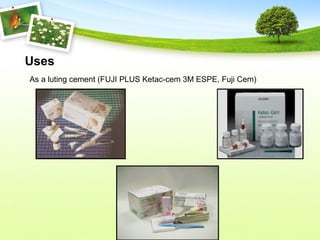
Glass ionomer cement was developed in the 1970s as a dental restorative material. It consists of a powder made of glass particles containing fluoride and an acidic liquid such as polyacrylic acid. The powder and liquid react via an acid-base reaction during setting to form the cement. The cement releases fluoride over time and bonds chemically to tooth structure. It has advantages such as fluoride release, adhesion to tooth, and biocompatibility, though it is more brittle than dental composites. Many variations of glass ionomer cement have since been developed.
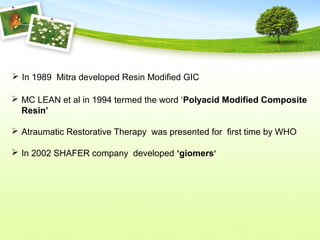
![ In1975 they discovered ASPA 4 which contained co polymers of acrylic
acid and itaconic acid
FORSTEN studied the pattern of fluoride release from GIC
CRISP ABEL AND WILSON in 1979 discovered ASPA-X which had
excellent translucency
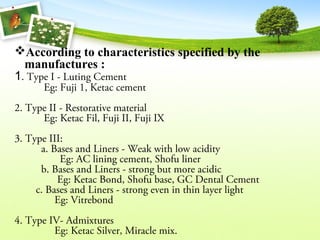
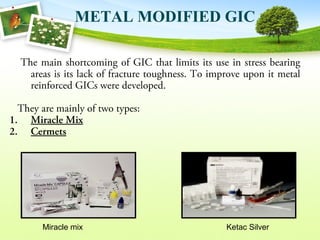
AD WILSON AND SIMMONS [1983]developed ‘Miracle Mix’ cement by
incorporating metal oxide metal alloy filler in gic for improving strength
Prosser et al in 1984 developed ASPA 5 which contained poly acrylic acid
in dry powder form blended with glass powder mixed with water /tartaric
acid](https://image.slidesharecdn.com/gic-150818155450-lva1-app6891/85/GLASS-INOMER-CEMENT-GIC-11-320.jpg)
![Modifications in liquid
- Only water and tartaric acid[anhydrous cement]
-Hema [light cure components]
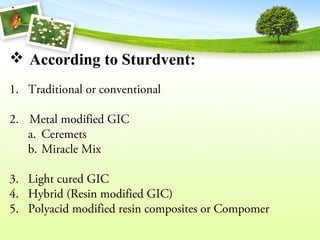
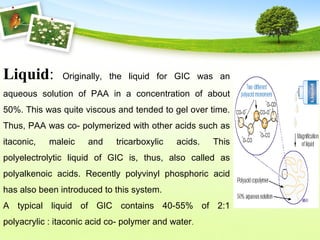
Recently polyvinyl phosphonic acid has been added
Modifications in Powder
* Dried Poly Acrylic Acid (anhydrous GIC).
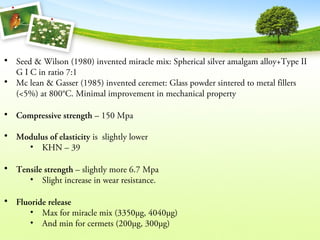
* Silver-Tin alloy (Miracle Mix).
* Silver-Palladium/Titanium (Cermet cement).
* BiSGMA, TEGDMA and HEMA (Light/Dual cure GIC).](https://image.slidesharecdn.com/gic-150818155450-lva1-app6891/85/GLASS-INOMER-CEMENT-GIC-34-320.jpg)

![INDICATIO
NS
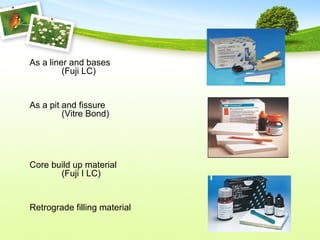
I] As a Restorative Material
a.Restoration of erosion / abrasion lesion – Class V lesion.
b.Anterior restorations.
c.Sealing and filling of occlusal pits and fissures.
d.Restoration of Class III carious lesions, preferably using a lingual
approach.
e.Restoration of deciduous teeth Class I and Class II.
f.Repair of defective margins in restoration or temporary coverage of
fractured teeth](https://image.slidesharecdn.com/gic-150818155450-lva1-app6891/85/GLASS-INOMER-CEMENT-GIC-72-320.jpg)
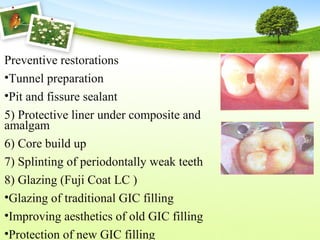
![a. Core build-up.
b. Provision restorations where future veneer crowns are contemplated.
c. Sealing of root surfaces for overdentures.
II] Fast Setting lining cements and base
a.Lining of all types of cavities where a biological seal and cariostatic
action are required.
b.Dentine substitute in laminate techniques.
c.Sealing and filling of occlusal fissures showing early signs of caries.](https://image.slidesharecdn.com/gic-150818155450-lva1-app6891/85/GLASS-INOMER-CEMENT-GIC-73-320.jpg)




![Recent advances in direct tooth coloured restoration [autosaved]](https://cdn.slidesharecdn.com/ss_thumbnails/recentadvancesindirecttoothcolouredrestorationautosaved-210612091304-thumbnail.jpg?width=640&height=640&fit=bounds)


