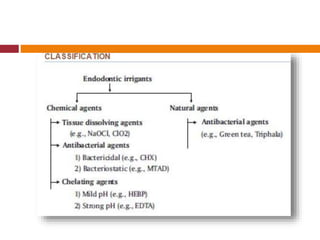
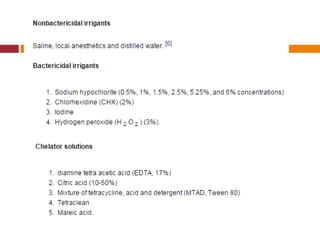
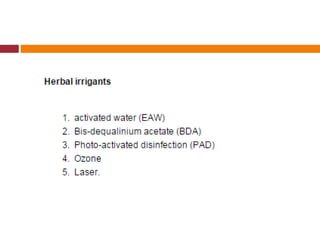
ENDODONTIC IRRIGANTS
 Endodontic success depends on the triad of
biomechanical preparation, pulp space sterilization, and
three-dimensional obturation.
 Complete disinfection of the pulp space cannot be
achieved with instrumentation techniques alone.
 The use of adjunctive aids like endodontic irrigants in
achieving this goal is essential.
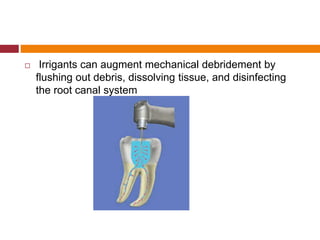
 Irrigants can augment mechanical debridement by
flushing out debris, dissolving tissue, and disinfecting
the root canal system
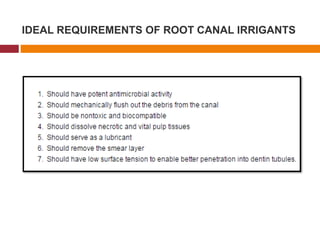
IDEAL REQUIREMENTS OF ROOT CANAL IRRIGANTS
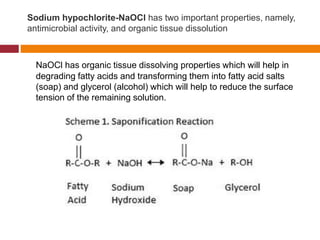
Sodium hypochlorite-NaOCl has two important properties, namely,
antimicrobial activity, and organic tissue dissolution
NaOCl has organic tissue dissolving properties which will help in
degrading fatty acids and transforming them into fatty acid salts
(soap) and glycerol (alcohol) which will help to reduce the surface
tension of the remaining solution.
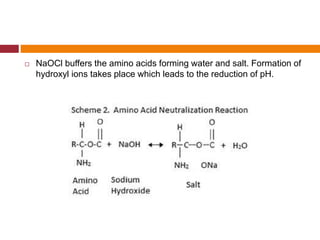
 NaOCl buffers the amino acids forming water and salt. Formation of
hydroxyl ions takes place which leads to the reduction of pH.
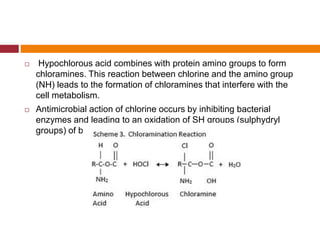
 Hypochlorous acid combines with protein amino groups to form
chloramines. This reaction between chlorine and the amino group
(NH) leads to the formation of chloramines that interfere with the
cell metabolism.
 Antimicrobial action of chlorine occurs by inhibiting bacterial
enzymes and leading to an oxidation of SH groups (sulphydryl
groups) of bacterial enzymes
Methods to increase the efficacy of NaOCl
1. Temperature
Warming of low concentration NaOCl solution increases the efficacy of
tissue dissolution and its antibacterial properties
Recent studies showed that a temperature rise of 25°C increased
NaOCl efficacy by 100 times.
2. Ultrasonic agitation
The ultrasonic agitation with a small file (mostly ISO no. 15) in canals
filled with NaOCl lead to the development of ultrasonic energy
which warms the solution in the canal.
The vibrations cause movement of aqueous NaOCl into the
ramifications in the canal, this effect being called as "acoustic
streaming."
 3. Use of fresh solution
Freshly prepared NaOCl solutions have better antimicrobial and
tissue dissolving effects. Since NaOCl decomposes quickly, it is
stored in opaque containers.
4. Increasing the volume and the duration of the irrigation.
Quick points
 NaOCl is an efficient organic solvent that causes dentin degeneration
because of the dissolution of collagen
 Busslinger and Barbakow evaluated corrosion of endodontic files caused
by NaOCl solutions of different concentrations from 0.5% to 5.5%, and
concluded that the quantities of ions released by the corrosion process
into the NaOCl solutions were insignificant
 NaOCl irrigation leads to decreased bond strength between dentin and
resin cements and may require a reversal agent because of its ability to
affect the polymerization of the resin sealer
 Ascorbic acid or sodium ascorbate have been shown to completely
reverse this reduction in bond strength.
 The reaction between NaOCl and CHX produces a carcinogenic product,
parachloroanaline (PCA). This reaction coats the canal surface and
significantly occludes the dentinal tubules and affects the seal of the root
canal
CHX
 It belongs to the poly biguanide family, substances which have a
positive charge.
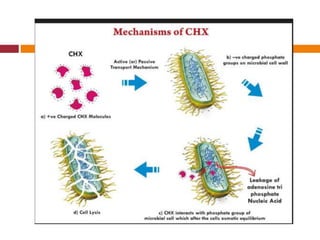
 The antibacterial effect of CHX is due to its positive charge, which
is attracted to the negatively charged bacterial cell wall and
increases the permeability of bacterial contents.
 It shows increased antimicrobial activity against endodontic
pathogens like Staphylococcus aureus, Porphyromonas
endodontalis, Porphyromonas gingivalis, Prevotella intermedia, E.
faecalis, C. albicans, and Streptococcus mutants
Quick points
 CHX can bind phosphate, which leads to release of small amounts
of calcium from the root canal dentin.
 When CHX and EDTA interact, a precipitate is formed that is over
90% CHX and EDTA. No clinical significance
 Antimicrobial substantivity of a 2% CHX solution as an endodontic
irrigant and reported that the substantivity lasted 72 h
 Antimicrobial substantivity depends on the number of CHX
molecules available to interact with the dentine
 Because of its broad-spectrum MMP-inhibitory effect, CHX can
significantly improve the resin–dentine bond stability
Iodine
 Iodine is bactericidal, fungicidal, virucidal, sporicidal,
degrades proteins, nucleotides, and fatty acids, leading to
bacterial cell death.
 The advantages of iodine over the other irrigants is that 2%
of preparations are shown to be less irritating, poisonous, and
rapidly reduces the bacterial load
 Two percent IKI needs 1-2 h to inhibit the development of E.
faecalis and C. albicans.
 Iodine has the capability to penetrate all the way through
dentinal tubules and destroy bacteria, though the period of its
antimicrobial action is less.
 It has the disadvantage of staining dentin tissue.
Ethylene diamine tetra acetic acid
 It is available in concentrations of 17% as a root canal irrigant with a
pH of 7.
 It kills microbes by chelating with metallic ions needed for growth of
bacteria.
 The concentrations of 15-17% eliminates calcium from dentine
leaving an organic matrix and removes the smear layer.
 Application of EDTA in the root canal system is done for 1-5 min to
get the optimum effect.
 It has been reported that EDTA decalcified dentin to a depth of 20–
30 μm in 5 min
 The addition of a quaternary ammonium bromide (Cetavlon)
increases the action of EDTA by decreasing its surface tension. This
combination is called as EDTAC, and it is effective in smear layer
removal and increasing the diameter of opened dentin tubules
Citric acid
 It is available in 10-50% concentration which is a demineralizing
solution that is used during the endodontic therapy to remove the
smear layer from the prepared root canal.
 Citric acid interferes with the mechanism of action of NaOCl
 Citric acid 10% is more biocompatible and effective in removing
smear layer than 17% of EDTA
 10% citric acid has proven to be more biocompatible than 17%
EDTA-T and 17% EDTA
Mixture of tetracycline, acid, and detergent-MTAD
 It is a mixture of an antibiotic, a chelating agent , and a detergent
 Tetracycline has many unique properties of low pH and thus can act
as a calcium chelator and cause enamel and root surface
demineralization
 MTAD is a mixture of 3% doxycycline, 4.25% citric acid, and
detergent (Tween-80)
 Citric acid eliminates the smear layer, allowing the doxycycline to
pass into the dentinal tubules and cause an antibacterial effect.
 The protocol for clinical use of MTAD is 1.3% NaOCl for 20 min
followed by 5 min application of MTAD.
 A final rinse with MTAD might have a negative effect on the bonding
ability of both resin-based and calcium hydroxide–based sealers
due to the precipitate formation
 There may be a risk of development of bacterial resistance, intrinsic
staining of dentine, and sensitivity of tooth.
 Torabinejad et al. showed that the effectiveness of the MTAD was
enhanced when low concentration of NaOCl is used as an
intracanal irrigant before the use of MTAD as a final rinse. MTAD
does not seem to significantly change the structure of the dentinal
tubules
 MTAD can be a useful irrigant due to its antimicrobial property, less
cytotoxic, but its effectiveness against fungi and value in the apical
one third need to be assessed further.
Tetraclean
 Tetraclean is similar to MTAD, the only difference being the addition
of doxycycline-50 mg/ml-(at a lower concentration than in MTAD),
and a detergent (polypropylene glycol).
 It is effective against both anaerobic and facultative bacteria.
 It is able to eliminate microorganisms and smear layer in dentinal
tubules of infected root canals with a final 5-min rinse
 It removes the smear layer and opens up the dentinal tubule
orifices.
 It has shown low surface tension which allows better penetration of
the solution into the dentinal tubule.
 In vitro studies have proved that Tetraclean is more efficient than
MTAD against E. faecalis.
Maleic acid
Maleic acid is a mild organic acid used as an acid conditioner in
adhesive dentistry at 5-7% concentration.
Final irrigation with 7% of maleic acid is more efficient than 17% of
EDTA in the removal of smear layer from the apical third of the root
canal system, which is a crucial area for disinfection.
7% of maleic acid produces maximum surface roughness on root canal
walls as compared to 17% of EDTA.
This surface roughness provides an important role in micromechanical
bonding of resin sealers.
Bis-dequalinium Acetate
 BDA, a dequalinium compound and an oxine derivative with the
trade name Salvizol has been shown to remove the smear layer
throughout the canal, even in the apical third.
 BDA is well-tolerated by periodontal tissues and has a low surface
tension allowing good penetration.
 It is considered less toxic than NaOCl and can be used as a root
canal dressing.
 Salvizol (Ravens Gmbh, Konstanz, Germany) is a commercial
brand of 0.5% BDA and possesses the combined actions of
chelation and organic debridement.
Triclosan and Gantrez®
 Triclosan is a broad spectrum antimicrobial agent, active against
gram-positive and gram-negative bacteria as well as some fungi
and viruses
 Nudera et al evaluated the minimum inhibitory concentrations (MIC)
and minimum bactericidal concentrations (MBC) of triclosan and
triclosan with Gantrez® against P intermedia, F nucleatum, A
naeslundii, P gingivalis, and E faecalis.

 HEBP (1-hydroxyethylidene- 1, 1-bisphosphonate), also known as
etidronic acid or etidronate, has been proposed as a potential
alternative to EDTA or citric acid because this agent shows no
short-term reactivity with NaOCl.
Chlorine dioxide-Chlorine dioxide (ClO 2) is chemically similar to
chlorine or hypochlorite, the familiar household bleach. An In vitro
study compared organic tissue dissolution capacity of NaOCl and
ClO2. It was concluded that ClO2and NaOCl are equally efficient for
dissolving organic tissue
Photo-activated Disinfection
PAD is the placement of a dye (toluidine blue or methylene blue) into the root
canals which is then activated by the laser radiation emitted from a low power (100
mW) laser device, causing interference with the microbial cell walls and bacterial
death.
After normal irrigation, the canals are washed with sterile water, and they are
dried by sterilized paper points before the application of the PAD solution into the
canals.
The photosensitizer molecules will attach to the membrane of the microorganisms
and the irradiation with a precise wavelength coordinated to the absorption of the
photosensitizer will form singlet oxygen which causes cell wall rupture and death
of the microbes.
The benefit of PAD is that the dye is only poisonous to bacteria, and there are no
side effects to adjacent tissues.
ozone
 It occurs in the environment either in gaseous form or as ozonated
water.
 It is an antiseptic, powerful oxidant, and antibacterial agent.
 It is a strong oxidizer of cell walls and the cytoplasmic membranes
of microorganisms, making it a bactericidal, antiviral, and antifungal
agent
 Electronically Activated Water
 EAW is also recognized as oxidative potential water.
 It is an electrolyzed saline solution and usually utilized to remove
the microbial contamination and biofilm
 It is able to disturb biofilms by reducing the adhering capability of
bacteria to the canal walls by generating a negative isotonic
pressure.
Herbal Irrigants
 Triphala
 Triphala consists of dried and powdered fruits of three medicinal
plants Terminalia bellerica, Terminalia chebula, and Emblica
officinalis.
 Triphala achieved 100% killing of E. faecalis at 6 min.
 Triphala contains fruits that are rich in citric acid, which may aid in
removal of the smear layer.
 The major advantages of using herbal alternatives are easy
availability, cost-effectiveness, longer shelf life, low toxicity, and lack
of microbial resistance
 Green tea
 Green tea polyphenols, the traditional drink of Japan and China is
prepared from the young shoots of the tea plant Camellia sinensis
 Green tea polyphenols showed statistically significant antibacterial
activity against E faecalis biofilm formed on tooth substrate.
 It takes 6 min to achieve 100% killing of E faecalis
 Morinda citrifolia juice
 Morinda citrifolia juice (MCJ) has a broad range of therapeutic
effects, including antibacterial, antiviral, antifungal, antitumor,
antihelmintic, analgesic, hypotensive, anti-inflammatory, and
immune-enhancing effects.
 MCJ is a biocompatible antioxidant
 MCJ contains the antibacterial compounds L-asperuloside and
alizarin
 Azadirachta indica
 Azadirachta indica , commonly known as Neem, is an evergreen
tree, cultivated in several parts of the Indian subcontinent.
 Every part of the tree is used as traditional medicine for the
household remedy against various human ailments, from the
ancient period.
 Neem has been proved to be effective against E. faecalis and C.
albicans. Its antioxidant and antimicrobial properties makes it a
potential agent for root canal irrigation as an alternative to sodium
hypochlorite

Endodontic irrigants

  • 1.
  • 2.
     Endodontic successdepends on the triad of biomechanical preparation, pulp space sterilization, and three-dimensional obturation.  Complete disinfection of the pulp space cannot be achieved with instrumentation techniques alone.  The use of adjunctive aids like endodontic irrigants in achieving this goal is essential.
  • 3.
     Irrigants canaugment mechanical debridement by flushing out debris, dissolving tissue, and disinfecting the root canal system
  • 4.
    IDEAL REQUIREMENTS OFROOT CANAL IRRIGANTS
  • 8.
    Sodium hypochlorite-NaOCl hastwo important properties, namely, antimicrobial activity, and organic tissue dissolution NaOCl has organic tissue dissolving properties which will help in degrading fatty acids and transforming them into fatty acid salts (soap) and glycerol (alcohol) which will help to reduce the surface tension of the remaining solution.
  • 9.
     NaOCl buffersthe amino acids forming water and salt. Formation of hydroxyl ions takes place which leads to the reduction of pH.
  • 10.
     Hypochlorous acidcombines with protein amino groups to form chloramines. This reaction between chlorine and the amino group (NH) leads to the formation of chloramines that interfere with the cell metabolism.  Antimicrobial action of chlorine occurs by inhibiting bacterial enzymes and leading to an oxidation of SH groups (sulphydryl groups) of bacterial enzymes
  • 11.
    Methods to increasethe efficacy of NaOCl 1. Temperature Warming of low concentration NaOCl solution increases the efficacy of tissue dissolution and its antibacterial properties Recent studies showed that a temperature rise of 25°C increased NaOCl efficacy by 100 times. 2. Ultrasonic agitation The ultrasonic agitation with a small file (mostly ISO no. 15) in canals filled with NaOCl lead to the development of ultrasonic energy which warms the solution in the canal. The vibrations cause movement of aqueous NaOCl into the ramifications in the canal, this effect being called as "acoustic streaming."
  • 12.
     3. Useof fresh solution Freshly prepared NaOCl solutions have better antimicrobial and tissue dissolving effects. Since NaOCl decomposes quickly, it is stored in opaque containers. 4. Increasing the volume and the duration of the irrigation.
  • 13.
    Quick points  NaOClis an efficient organic solvent that causes dentin degeneration because of the dissolution of collagen  Busslinger and Barbakow evaluated corrosion of endodontic files caused by NaOCl solutions of different concentrations from 0.5% to 5.5%, and concluded that the quantities of ions released by the corrosion process into the NaOCl solutions were insignificant  NaOCl irrigation leads to decreased bond strength between dentin and resin cements and may require a reversal agent because of its ability to affect the polymerization of the resin sealer  Ascorbic acid or sodium ascorbate have been shown to completely reverse this reduction in bond strength.  The reaction between NaOCl and CHX produces a carcinogenic product, parachloroanaline (PCA). This reaction coats the canal surface and significantly occludes the dentinal tubules and affects the seal of the root canal
  • 14.
    CHX  It belongsto the poly biguanide family, substances which have a positive charge.  The antibacterial effect of CHX is due to its positive charge, which is attracted to the negatively charged bacterial cell wall and increases the permeability of bacterial contents.  It shows increased antimicrobial activity against endodontic pathogens like Staphylococcus aureus, Porphyromonas endodontalis, Porphyromonas gingivalis, Prevotella intermedia, E. faecalis, C. albicans, and Streptococcus mutants
  • 16.
    Quick points  CHXcan bind phosphate, which leads to release of small amounts of calcium from the root canal dentin.  When CHX and EDTA interact, a precipitate is formed that is over 90% CHX and EDTA. No clinical significance  Antimicrobial substantivity of a 2% CHX solution as an endodontic irrigant and reported that the substantivity lasted 72 h  Antimicrobial substantivity depends on the number of CHX molecules available to interact with the dentine  Because of its broad-spectrum MMP-inhibitory effect, CHX can significantly improve the resin–dentine bond stability
  • 17.
    Iodine  Iodine isbactericidal, fungicidal, virucidal, sporicidal, degrades proteins, nucleotides, and fatty acids, leading to bacterial cell death.  The advantages of iodine over the other irrigants is that 2% of preparations are shown to be less irritating, poisonous, and rapidly reduces the bacterial load  Two percent IKI needs 1-2 h to inhibit the development of E. faecalis and C. albicans.  Iodine has the capability to penetrate all the way through dentinal tubules and destroy bacteria, though the period of its antimicrobial action is less.  It has the disadvantage of staining dentin tissue.
  • 18.
    Ethylene diamine tetraacetic acid  It is available in concentrations of 17% as a root canal irrigant with a pH of 7.  It kills microbes by chelating with metallic ions needed for growth of bacteria.  The concentrations of 15-17% eliminates calcium from dentine leaving an organic matrix and removes the smear layer.  Application of EDTA in the root canal system is done for 1-5 min to get the optimum effect.  It has been reported that EDTA decalcified dentin to a depth of 20– 30 μm in 5 min  The addition of a quaternary ammonium bromide (Cetavlon) increases the action of EDTA by decreasing its surface tension. This combination is called as EDTAC, and it is effective in smear layer removal and increasing the diameter of opened dentin tubules
  • 19.
    Citric acid  Itis available in 10-50% concentration which is a demineralizing solution that is used during the endodontic therapy to remove the smear layer from the prepared root canal.  Citric acid interferes with the mechanism of action of NaOCl  Citric acid 10% is more biocompatible and effective in removing smear layer than 17% of EDTA  10% citric acid has proven to be more biocompatible than 17% EDTA-T and 17% EDTA
  • 20.
    Mixture of tetracycline,acid, and detergent-MTAD  It is a mixture of an antibiotic, a chelating agent , and a detergent  Tetracycline has many unique properties of low pH and thus can act as a calcium chelator and cause enamel and root surface demineralization  MTAD is a mixture of 3% doxycycline, 4.25% citric acid, and detergent (Tween-80)  Citric acid eliminates the smear layer, allowing the doxycycline to pass into the dentinal tubules and cause an antibacterial effect.  The protocol for clinical use of MTAD is 1.3% NaOCl for 20 min followed by 5 min application of MTAD.  A final rinse with MTAD might have a negative effect on the bonding ability of both resin-based and calcium hydroxide–based sealers due to the precipitate formation  There may be a risk of development of bacterial resistance, intrinsic staining of dentine, and sensitivity of tooth.
  • 21.
     Torabinejad etal. showed that the effectiveness of the MTAD was enhanced when low concentration of NaOCl is used as an intracanal irrigant before the use of MTAD as a final rinse. MTAD does not seem to significantly change the structure of the dentinal tubules  MTAD can be a useful irrigant due to its antimicrobial property, less cytotoxic, but its effectiveness against fungi and value in the apical one third need to be assessed further.
  • 22.
    Tetraclean  Tetraclean issimilar to MTAD, the only difference being the addition of doxycycline-50 mg/ml-(at a lower concentration than in MTAD), and a detergent (polypropylene glycol).  It is effective against both anaerobic and facultative bacteria.  It is able to eliminate microorganisms and smear layer in dentinal tubules of infected root canals with a final 5-min rinse  It removes the smear layer and opens up the dentinal tubule orifices.  It has shown low surface tension which allows better penetration of the solution into the dentinal tubule.  In vitro studies have proved that Tetraclean is more efficient than MTAD against E. faecalis.
  • 23.
    Maleic acid Maleic acidis a mild organic acid used as an acid conditioner in adhesive dentistry at 5-7% concentration. Final irrigation with 7% of maleic acid is more efficient than 17% of EDTA in the removal of smear layer from the apical third of the root canal system, which is a crucial area for disinfection. 7% of maleic acid produces maximum surface roughness on root canal walls as compared to 17% of EDTA. This surface roughness provides an important role in micromechanical bonding of resin sealers.
  • 24.
    Bis-dequalinium Acetate  BDA,a dequalinium compound and an oxine derivative with the trade name Salvizol has been shown to remove the smear layer throughout the canal, even in the apical third.  BDA is well-tolerated by periodontal tissues and has a low surface tension allowing good penetration.  It is considered less toxic than NaOCl and can be used as a root canal dressing.  Salvizol (Ravens Gmbh, Konstanz, Germany) is a commercial brand of 0.5% BDA and possesses the combined actions of chelation and organic debridement.
  • 25.
    Triclosan and Gantrez® Triclosan is a broad spectrum antimicrobial agent, active against gram-positive and gram-negative bacteria as well as some fungi and viruses  Nudera et al evaluated the minimum inhibitory concentrations (MIC) and minimum bactericidal concentrations (MBC) of triclosan and triclosan with Gantrez® against P intermedia, F nucleatum, A naeslundii, P gingivalis, and E faecalis. 
  • 26.
     HEBP (1-hydroxyethylidene-1, 1-bisphosphonate), also known as etidronic acid or etidronate, has been proposed as a potential alternative to EDTA or citric acid because this agent shows no short-term reactivity with NaOCl. Chlorine dioxide-Chlorine dioxide (ClO 2) is chemically similar to chlorine or hypochlorite, the familiar household bleach. An In vitro study compared organic tissue dissolution capacity of NaOCl and ClO2. It was concluded that ClO2and NaOCl are equally efficient for dissolving organic tissue
  • 27.
    Photo-activated Disinfection PAD isthe placement of a dye (toluidine blue or methylene blue) into the root canals which is then activated by the laser radiation emitted from a low power (100 mW) laser device, causing interference with the microbial cell walls and bacterial death. After normal irrigation, the canals are washed with sterile water, and they are dried by sterilized paper points before the application of the PAD solution into the canals. The photosensitizer molecules will attach to the membrane of the microorganisms and the irradiation with a precise wavelength coordinated to the absorption of the photosensitizer will form singlet oxygen which causes cell wall rupture and death of the microbes. The benefit of PAD is that the dye is only poisonous to bacteria, and there are no side effects to adjacent tissues.
  • 28.
    ozone  It occursin the environment either in gaseous form or as ozonated water.  It is an antiseptic, powerful oxidant, and antibacterial agent.  It is a strong oxidizer of cell walls and the cytoplasmic membranes of microorganisms, making it a bactericidal, antiviral, and antifungal agent  Electronically Activated Water  EAW is also recognized as oxidative potential water.  It is an electrolyzed saline solution and usually utilized to remove the microbial contamination and biofilm  It is able to disturb biofilms by reducing the adhering capability of bacteria to the canal walls by generating a negative isotonic pressure.
  • 29.
    Herbal Irrigants  Triphala Triphala consists of dried and powdered fruits of three medicinal plants Terminalia bellerica, Terminalia chebula, and Emblica officinalis.  Triphala achieved 100% killing of E. faecalis at 6 min.  Triphala contains fruits that are rich in citric acid, which may aid in removal of the smear layer.  The major advantages of using herbal alternatives are easy availability, cost-effectiveness, longer shelf life, low toxicity, and lack of microbial resistance
  • 30.
     Green tea Green tea polyphenols, the traditional drink of Japan and China is prepared from the young shoots of the tea plant Camellia sinensis  Green tea polyphenols showed statistically significant antibacterial activity against E faecalis biofilm formed on tooth substrate.  It takes 6 min to achieve 100% killing of E faecalis  Morinda citrifolia juice  Morinda citrifolia juice (MCJ) has a broad range of therapeutic effects, including antibacterial, antiviral, antifungal, antitumor, antihelmintic, analgesic, hypotensive, anti-inflammatory, and immune-enhancing effects.  MCJ is a biocompatible antioxidant  MCJ contains the antibacterial compounds L-asperuloside and alizarin
  • 31.
     Azadirachta indica Azadirachta indica , commonly known as Neem, is an evergreen tree, cultivated in several parts of the Indian subcontinent.  Every part of the tree is used as traditional medicine for the household remedy against various human ailments, from the ancient period.  Neem has been proved to be effective against E. faecalis and C. albicans. Its antioxidant and antimicrobial properties makes it a potential agent for root canal irrigation as an alternative to sodium hypochlorite