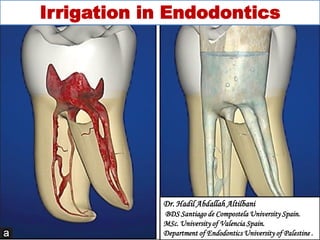
Irrigation in Endodontics
Dr. Hadil Abdallah Altilbani
BDS Santiago de Compostela University Spain.
MSc. University of Valencia Spain.
Department of Endodontics University of Palestine .
Correct diagnosis
Complete obturation Cleaning and Debridement
SUCCESFULL
RCT
The goal of endodontic therapy is the prevention and/or elimination
of pathosis of endodontic origin
Introduction
• Success or failure in root canal therapy is depending on the
removal of all or most of infective agents and necrotic material
from the entire root canal system.
• The purpose of root canal instruments is to create sufficient space
for the ingress of effective irrigant solutions.
Failure of root canal treatment is likely caused by the inability to eliminate
bacteria from the root canal system.
cleaning and shaping of the root canal system is able to reduce the number
of bacteria, however complete disinfection of the canal is difficult
The challenge is still to penetrate, reach, and kill bacteria, which are
well-known to protect themselves within dentinal mud, their own secretions, and
biofilms.
Compounding The challenge to kill micro-organisms is their ability to hide within an
anatomically complex space.
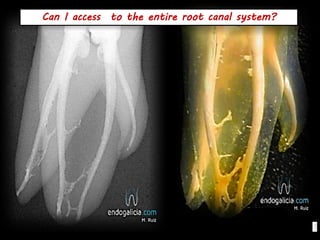
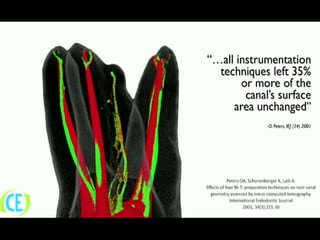
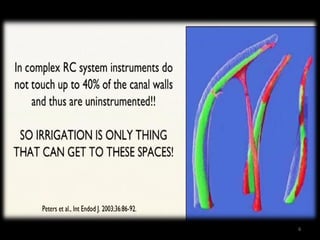
Can I access to the entire root canal system?
6
7
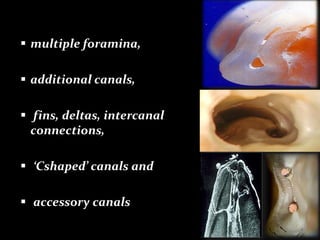
 multiple foramina,
 additional canals,
 fins, deltas, intercanal
connections,
 ‘Cshaped’ canals and
 accessory canals
9
The canal is
 Cleansed primarily by
irrigation
 Shaped primarily by
instrumentation
Chemo-Mechanical
PreparationofRoot
Canals
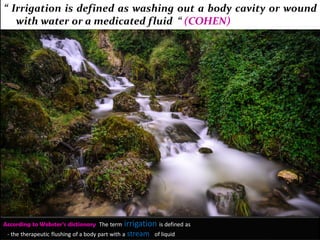
According to Webster’s dictionary The term irrigation is defined as
- the therapeutic flushing of a body part with a stream of liquid
“ Irrigation is defined as washing out a body cavity or wound
with water or a medicated fluid “ (COHEN)
Rinsing of debris
Penetrating into areas inaccessible to instruments,
thereby extending the cleaning process.
Lubrication of the canal system which facilitates
instrumentation
Dissolution of remaining organic matter
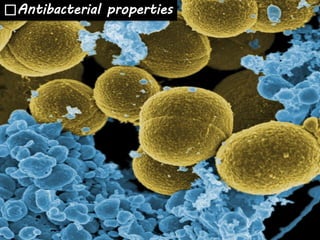
Antibacterial properties
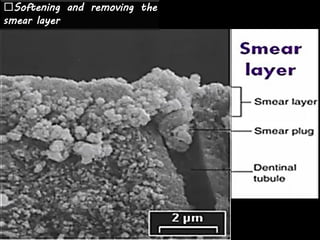
Softening and removing the smear layer
European Society of Endodontology, Int Endo J, 2006
The objectives of irrigation are to:
Rinsing of debris
Penetrating into areas
inaccessible to instruments,
thereby extending the cleaning
process.
Lubrication of the
canal system which
facilitates
instrumentation
1. Facilitate the mechanical action of endodontic
hand or rotary files
2. Increase cutting efficiency → better removal
of debris
3. Reduce torque → the files and reamers are
less likely to break (Weine)
Functions of lubricants (Pathway)
Dissolution of remaining
organic matter
Antibacterial properties
Softening and removing the
smear layer
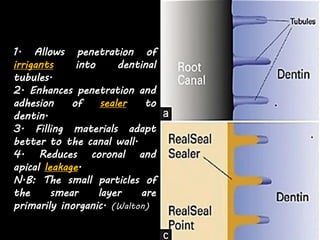
Advantages of smear layer removal
(Walton & Weine)
21
1. Allows penetration of
irrigants into dentinal
tubules.
2. Enhances penetration and
adhesion of sealer to
dentin.
3. Filling materials adapt
better to the canal wall.
4. Reduces coronal and
apical leakage.
N.B: The small particles of
the smear layer are
primarily inorganic. (Walton)
Requirements and functions of irrigants:
1. Dissolve organic and inorganic tissue.
2. Remove smear layer. (Pathway)
Disinfecting and cleaning areas inaccessible to
endodontic instruments. (pathway)
3. Flush out and remove debris → prevent apical
blockage by debris. (Ingle)
4. Antimicrobial
5. Lubricant
6. Low surface tension
7. Don't weaken the tooth structure
8. Non-toxic and non-irritantgle)
HOWEVER…..
No single irrigant fulfills all of these
desired properties, more than one solution
are required each with an adequate
concentration, formulation, volume and
time to act.
Variables affecting the irrigation
 Concentration
 Volume
 Canal diameter
 The viscosity or surface tension of the solution
 The diameter and depth of penetration of the irrigating
needle
 Anatomy of the canal
 The method of delivering the irrigant
 Contact time with the tissue
 Temperature of the irrigant
 Ultrasonic activation
 The effect of combining different types of solutions
Optimizing the chemical aspect of root canal irrigation
Irrigating solutions
26
Chemically non active solution
I. Chlorine releasing agents
potassium hypochlorite
sodium hypochlorite
sodium dichloro isocyarunate
chloramine –T
II. Oxidizing agents
Hydrogen peroxide
Urea peroxide
Glyoxide
III. CHELATING AGENTS
EDTA
EDTAC
RC-Prep
IV. ORGANIC ACIDS
Citric acid
Maleic acid
Tannic acid
lactic acid
V. Inorganic acids
H2SO4 50%
HCL 30%
NITRIC ACID
Chemically
active
materials
VI. Detergents
Zephiran chloride
Endoquil
VII. Others
Chlorhexidine
Glutaraldehyde
Bis- dequalinium acetate
Antibiotics
NISIN
MTAD
Carisolv
Electrochemically activated water
Oxidative potential water
Propolis
Ozone
Photodynamic therapy
Lasers
Electronic sterilization
Sodium
hypochlorite
(NaOCl)
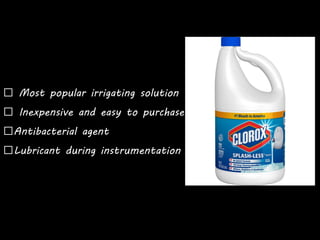
Most popular irrigating solution
Inexpensive and easy to purchase
Antibacterial agent
Lubricant during instrumentation
NaOCl is the only rootcanal
irrigant that dissolves Necrotic
and Vital Organic tissue
(unique property).
Unpleasant taste
Inability to completely remove smear layer
Toxicity Irritant to periapical tissues,mucous
membrane and skin. (Ingle)
Pain and periapical injury
Decrease dentin elasticity and strength →
risk of fracture
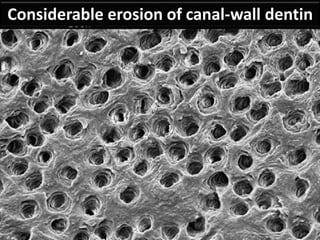
Do not use as final rinse → severe erosion
of canal-wall
 Can damage clothes.
DISADVANTAGE
Considerable erosion of canal-wall dentin
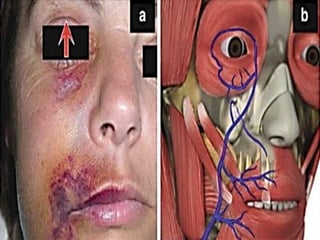
NaOCL accidents
• Palatal mucosa necrosis because of accidental sodium
hypochlorite injection instead of anaesthetic solution.
• Causes haemolysis & ulceration, inhibits neutrophil
migration and damages endothelial & fibroblast cells.
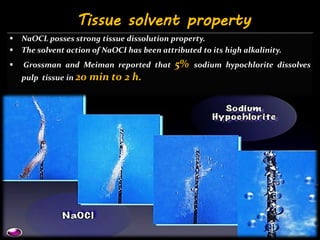
 NaOCL posses strong tissue dissolution property.
 The solvent action of NaOCI has been attributed to its high alkalinity.
 Grossman and Meiman reported that 5% sodium hypochlorite dissolves
pulp tissue in 20 min to 2 h.
Tissue solvent property
 Percentages contact time
 5.25% o.5 min
 2.5 % 10 min
 1.0 % 20 min
 0.5% 30 min
The lower and higher concentrations are equally efficient in reducing the
number of bacteria in infected root canal
Time
ANTIMICROBIAL ACTION
 Baumgartner and Cuenin commented
that-
The effectiveness of low concentrations
of NaOCl may be improved by using
larger volumes of irrigant and
replenishing fresh solutions into the
canal more frequently.
Volume
The volume of the irrigant has a
greater potential to significantly
reduce bacteria colonies in root canal.
Volume
Baker et al. 1975, Brown and Doran 1975,
Cunningham 1982, Cunningham et al.1982,
Siqueira at al.2000, Sedgley et al.2005.
38
Refreshment
EXPOSUR E TO L IGHT
Light speeds up the decomposition of
sodium hypochlorite solutions.
Modern packaging methods and use of
polyethylene bottles have practically
eliminated the influence of light on
bleach stability.
The use of green or amber glass
bottles will also materially reduce
decomposition caused by light.
40
Sodium hypochlorite solution must be kept alkaline at a pH
value between 10.5 and 11.5
41
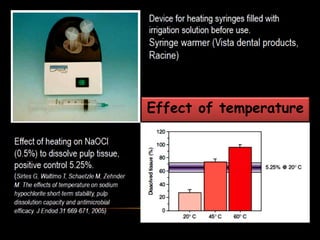
Effect of temperature
42
• pH of 5.5 – 7
• Concentration 2% , 2-3 minutes
• Low toxic irrigant
• Does not cause dentin erosion
• A good choice for final rinse
• Cannot remove biofilm, smear layer and
organic matter
• Effectiveness greatly reduce by the
presence of organic matter
• No tissue dissolving ability (necrotic
tissue, etc)
CHLORHEXIDINE DIGLUCONATE (CHX)
 Broad spectrum antimicrobial substantive
activity (continued antimicrobial effect),
because chlorhexidine (CHX) binds (is
adsorped) and released gradually from the
hydroxyapatite surfaces.
 2% CHX has similar antimicrobial action as
5.25% NaOCl and is more effective against
Enterococcus faecalis. (Walton)
Indications of CHX
1) 2ry endodontic infections.
2) At the end of chemomechanical
preparation, because CHX doesn't cause
erosion of dentin like NaOCl does as
the final rinse after EDTA.
CHX + NaOCl CHX + EDTA/CA
INTERACTION BETWEEN
IRRIGATION SOLUTIONS
EDTA
EDTA (15 - 17%, pH 7)
EDTA is available in a liquid form for
irrigation and a gel form for lubrication
It effectively removes smear layer by
chelating the inorganic component of
the dentine.
Aid in mechanical canal shaping.
Used for 2-3 minutes after NaOCl
irrigation and rinsing solution in
between
Ethylenediaminetetraacetic acid (EDTA)
EDTA has little if any antibacterial activity.
It also emulsifies soft tissue and removes the smear
layer with no deleterious effect to periapical tissues.
Eliyas S et al. 2010
EDTA has been shown to be a faster chelating
agent than cetric acid.
Gonzalez-Lopez S, et al 2006
17% EDTA for 1 min remove inorganic components.
• EDTA is effective in smear layer removal only in coronal
& middle thirds, but not in the apical third.
N.B: NaOCl is necessary for removal of organic component.
* EDTA has little effect on periapical tissue.
INTERACTION BETWEEN
IRRIGATION SOLUTIONS
LOSS OF NaOCl ACTIVITY
NaOCl + EDTA
Disadvantage of EDTA
Deactivation of NaOCl by reducing the available
chlorine. (Walton)
Indication of EDTA
The best use of chelating agents is to
aid and simplify preparation for very
sclerotic canals after the apex has
already been reached with a fine
instrument.
Precaution
EDTA will remain active within the canal
for 5 days if not inactivated.
If the apical constriction has been opened,
the chelate may seep out & damage the
periapical bone.
For this reason, at the completion of the
appointment, the canal must be irrigated
with NaOCl to inactivate EDTA.
(Weine page 226)
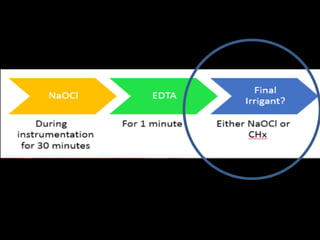
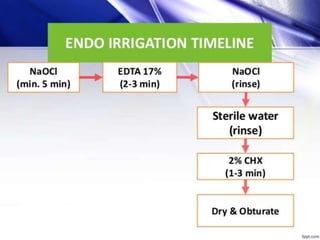
FOR ROOT
CANAL
IRRIGANTS
PROTOCOL
56
Activation
Endodontic disinfection-
Tsunami irrigation
PASSIVE/ACTIVE IRRIGATION
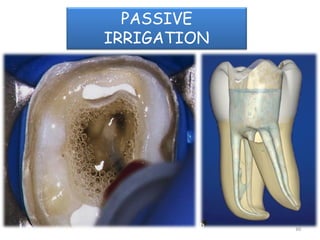
Passive irrigation is initiated by slowly injecting
an irrigant into a canal.
Slowly injecting irrigant in combination with
continuous hand movement will virtually
eliminate NaOCl accidents.
Passive irrigation has limitations because a static
reservoir of irrigant restricts the potential for
any reagent to penetrate, circulate, and clean
into all aspects of a root canal system.
60
PASSIVE
IRRIGATION
Evidence suggests that
irrigant does not move
further than 1−2 mm
beyond the needle tip in
the canal irrespective of
the pressure applied.
Beyond this there is a
‘dead zone’ and irrigant
exchange does not occur,
thus consideration must
also be given to mode of
delivery.
65
Irrigation Force in Nature :Hydrodynamics
66
Irrigants must be brought
into direct contact with the
entire canal wall surfaces for
effective action
(Al-Hadlaq SM JOE 2006)
particularly for the apical
portions of small root canals.
68
With all the methods identified, the
challenge is still to penetrate, reach,
and kill bacteria, which are well-known
to protect themselves within dentinal
mud, their own secretions, and
biofilms.
Compounding the challenge to kill
micro-organisms is their ability to hide
within an anatomically complex space.
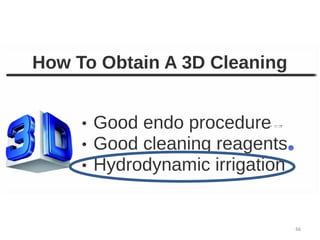
The hydrodynamic phenomenon
Has been identified as perhaps the only way to
induce biofilm adherence failure.
The goal of fluid agitation is to safely generate
cavitation, acoustic streaming, and
microstreaming within any given intracanal
solution.
75
76
• It should be bent approximately 30degrees in the
center of the needle to allow easier delivery of the
solution and to prevent deep penetration of the
needle or probe.
79
To control the depth of insertion, the needle is bent slightly at the appropriate
length or a rubber stopper is placed on the needle. (Walton)
80
81
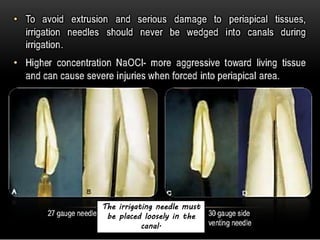
The irrigating needle must
be placed loosely in the
canal.
82
• The needle is moved up and down constantly to
produce agitation & prevent binding or wedging of the
needle. (Walton)
N.B: Severe complications have been reported from
forcing irrigating solutions beyond the apex by wedging
the needle in the canal and not allowing an adequate
backflow. (Ingle)
84
Squeezing the plunger with the
thumb may result in more
rapid delivery Of irrigant and
possible extrusion
Using a forefinger to depress the
plunger gives greater control of
irrigant delivery
85
• No single irrigating solution covers all of
the functions required from an irrigant.
* The alternating use of different irrigants
in the correct sequence contributes to a
successful treatment outcome.
• The irrigant doesn't move apically more than 1 mm beyond the irrigation
tip. (Walton)
• The closer the needle tip to the apex, the greater the potential for
damage to the periradicular tissues.
• The volume of irrigant is more important than the concentration or type
of irrigant. (Ingle page 502)
• The apical 5 mm are not flushed until they have been enlarged to size 30
and more often size 40 file. (Ingle)
• Separate syringes should be used for each irrigant to avoid chemical
reactions between them. (Review)
• N.B: Ultrasonics proved superior effect to syringe irrigation alone when the
canal narrowed to 0.3 mm (size 30 instrument) or less. (Ingle)
* N.B: The US Army reported the importance of recapitulation–re-
instrumentation with a smaller instrument following each irrigation. (Ingle
page 503)

Irrigation in Endodontics.pdf

  • 1.
    Irrigation in Endodontics Dr.Hadil Abdallah Altilbani BDS Santiago de Compostela University Spain. MSc. University of Valencia Spain. Department of Endodontics University of Palestine .
  • 2.
    Correct diagnosis Complete obturationCleaning and Debridement SUCCESFULL RCT The goal of endodontic therapy is the prevention and/or elimination of pathosis of endodontic origin
  • 3.
    Introduction • Success orfailure in root canal therapy is depending on the removal of all or most of infective agents and necrotic material from the entire root canal system. • The purpose of root canal instruments is to create sufficient space for the ingress of effective irrigant solutions. Failure of root canal treatment is likely caused by the inability to eliminate bacteria from the root canal system. cleaning and shaping of the root canal system is able to reduce the number of bacteria, however complete disinfection of the canal is difficult The challenge is still to penetrate, reach, and kill bacteria, which are well-known to protect themselves within dentinal mud, their own secretions, and biofilms. Compounding The challenge to kill micro-organisms is their ability to hide within an anatomically complex space.
  • 4.
    Can I accessto the entire root canal system?
  • 6.
  • 7.
    7  multiple foramina, additional canals,  fins, deltas, intercanal connections,  ‘Cshaped’ canals and  accessory canals
  • 9.
    9 The canal is Cleansed primarily by irrigation  Shaped primarily by instrumentation Chemo-Mechanical PreparationofRoot Canals
  • 10.
    According to Webster’sdictionary The term irrigation is defined as - the therapeutic flushing of a body part with a stream of liquid “ Irrigation is defined as washing out a body cavity or wound with water or a medicated fluid “ (COHEN)
  • 11.
    Rinsing of debris Penetratinginto areas inaccessible to instruments, thereby extending the cleaning process. Lubrication of the canal system which facilitates instrumentation Dissolution of remaining organic matter Antibacterial properties Softening and removing the smear layer European Society of Endodontology, Int Endo J, 2006 The objectives of irrigation are to:
  • 12.
  • 13.
    Penetrating into areas inaccessibleto instruments, thereby extending the cleaning process.
  • 14.
    Lubrication of the canalsystem which facilitates instrumentation
  • 15.
    1. Facilitate themechanical action of endodontic hand or rotary files 2. Increase cutting efficiency → better removal of debris 3. Reduce torque → the files and reamers are less likely to break (Weine) Functions of lubricants (Pathway)
  • 16.
  • 17.
  • 18.
    Softening and removingthe smear layer
  • 20.
    Advantages of smearlayer removal (Walton & Weine)
  • 21.
    21 1. Allows penetrationof irrigants into dentinal tubules. 2. Enhances penetration and adhesion of sealer to dentin. 3. Filling materials adapt better to the canal wall. 4. Reduces coronal and apical leakage. N.B: The small particles of the smear layer are primarily inorganic. (Walton)
  • 22.
    Requirements and functionsof irrigants: 1. Dissolve organic and inorganic tissue. 2. Remove smear layer. (Pathway) Disinfecting and cleaning areas inaccessible to endodontic instruments. (pathway) 3. Flush out and remove debris → prevent apical blockage by debris. (Ingle) 4. Antimicrobial 5. Lubricant 6. Low surface tension 7. Don't weaken the tooth structure 8. Non-toxic and non-irritantgle)
  • 23.
    HOWEVER….. No single irrigantfulfills all of these desired properties, more than one solution are required each with an adequate concentration, formulation, volume and time to act.
  • 24.
    Variables affecting theirrigation  Concentration  Volume  Canal diameter  The viscosity or surface tension of the solution  The diameter and depth of penetration of the irrigating needle  Anatomy of the canal  The method of delivering the irrigant  Contact time with the tissue  Temperature of the irrigant  Ultrasonic activation  The effect of combining different types of solutions Optimizing the chemical aspect of root canal irrigation
  • 25.
  • 26.
  • 27.
    I. Chlorine releasingagents potassium hypochlorite sodium hypochlorite sodium dichloro isocyarunate chloramine –T II. Oxidizing agents Hydrogen peroxide Urea peroxide Glyoxide III. CHELATING AGENTS EDTA EDTAC RC-Prep IV. ORGANIC ACIDS Citric acid Maleic acid Tannic acid lactic acid V. Inorganic acids H2SO4 50% HCL 30% NITRIC ACID Chemically active materials
  • 28.
    VI. Detergents Zephiran chloride Endoquil VII.Others Chlorhexidine Glutaraldehyde Bis- dequalinium acetate Antibiotics NISIN MTAD Carisolv Electrochemically activated water Oxidative potential water Propolis Ozone Photodynamic therapy Lasers Electronic sterilization
  • 29.
  • 30.
    Most popular irrigatingsolution Inexpensive and easy to purchase Antibacterial agent Lubricant during instrumentation
  • 31.
    NaOCl is theonly rootcanal irrigant that dissolves Necrotic and Vital Organic tissue (unique property).
  • 32.
    Unpleasant taste Inability tocompletely remove smear layer Toxicity Irritant to periapical tissues,mucous membrane and skin. (Ingle) Pain and periapical injury Decrease dentin elasticity and strength → risk of fracture Do not use as final rinse → severe erosion of canal-wall  Can damage clothes. DISADVANTAGE
  • 33.
    Considerable erosion ofcanal-wall dentin
  • 34.
    NaOCL accidents • Palatalmucosa necrosis because of accidental sodium hypochlorite injection instead of anaesthetic solution. • Causes haemolysis & ulceration, inhibits neutrophil migration and damages endothelial & fibroblast cells.
  • 35.
     NaOCL possesstrong tissue dissolution property.  The solvent action of NaOCI has been attributed to its high alkalinity.  Grossman and Meiman reported that 5% sodium hypochlorite dissolves pulp tissue in 20 min to 2 h. Tissue solvent property
  • 36.
     Percentages contacttime  5.25% o.5 min  2.5 % 10 min  1.0 % 20 min  0.5% 30 min The lower and higher concentrations are equally efficient in reducing the number of bacteria in infected root canal Time ANTIMICROBIAL ACTION  Baumgartner and Cuenin commented that- The effectiveness of low concentrations of NaOCl may be improved by using larger volumes of irrigant and replenishing fresh solutions into the canal more frequently. Volume
  • 37.
    The volume ofthe irrigant has a greater potential to significantly reduce bacteria colonies in root canal. Volume Baker et al. 1975, Brown and Doran 1975, Cunningham 1982, Cunningham et al.1982, Siqueira at al.2000, Sedgley et al.2005.
  • 38.
  • 39.
    Refreshment EXPOSUR E TOL IGHT Light speeds up the decomposition of sodium hypochlorite solutions. Modern packaging methods and use of polyethylene bottles have practically eliminated the influence of light on bleach stability. The use of green or amber glass bottles will also materially reduce decomposition caused by light.
  • 40.
    40 Sodium hypochlorite solutionmust be kept alkaline at a pH value between 10.5 and 11.5
  • 41.
  • 42.
  • 44.
    • pH of5.5 – 7
  • 45.
    • Concentration 2%, 2-3 minutes • Low toxic irrigant • Does not cause dentin erosion • A good choice for final rinse • Cannot remove biofilm, smear layer and organic matter • Effectiveness greatly reduce by the presence of organic matter • No tissue dissolving ability (necrotic tissue, etc) CHLORHEXIDINE DIGLUCONATE (CHX)
  • 46.
     Broad spectrumantimicrobial substantive activity (continued antimicrobial effect), because chlorhexidine (CHX) binds (is adsorped) and released gradually from the hydroxyapatite surfaces.  2% CHX has similar antimicrobial action as 5.25% NaOCl and is more effective against Enterococcus faecalis. (Walton)
  • 47.
    Indications of CHX 1)2ry endodontic infections. 2) At the end of chemomechanical preparation, because CHX doesn't cause erosion of dentin like NaOCl does as the final rinse after EDTA.
  • 48.
    CHX + NaOClCHX + EDTA/CA INTERACTION BETWEEN IRRIGATION SOLUTIONS
  • 49.
    EDTA EDTA (15 -17%, pH 7) EDTA is available in a liquid form for irrigation and a gel form for lubrication It effectively removes smear layer by chelating the inorganic component of the dentine. Aid in mechanical canal shaping. Used for 2-3 minutes after NaOCl irrigation and rinsing solution in between Ethylenediaminetetraacetic acid (EDTA)
  • 50.
    EDTA has littleif any antibacterial activity. It also emulsifies soft tissue and removes the smear layer with no deleterious effect to periapical tissues. Eliyas S et al. 2010 EDTA has been shown to be a faster chelating agent than cetric acid. Gonzalez-Lopez S, et al 2006 17% EDTA for 1 min remove inorganic components. • EDTA is effective in smear layer removal only in coronal & middle thirds, but not in the apical third. N.B: NaOCl is necessary for removal of organic component. * EDTA has little effect on periapical tissue.
  • 51.
    INTERACTION BETWEEN IRRIGATION SOLUTIONS LOSSOF NaOCl ACTIVITY NaOCl + EDTA Disadvantage of EDTA Deactivation of NaOCl by reducing the available chlorine. (Walton)
  • 52.
    Indication of EDTA Thebest use of chelating agents is to aid and simplify preparation for very sclerotic canals after the apex has already been reached with a fine instrument.
  • 53.
    Precaution EDTA will remainactive within the canal for 5 days if not inactivated. If the apical constriction has been opened, the chelate may seep out & damage the periapical bone. For this reason, at the completion of the appointment, the canal must be irrigated with NaOCl to inactivate EDTA. (Weine page 226)
  • 54.
  • 56.
  • 58.
  • 59.
    PASSIVE/ACTIVE IRRIGATION Passive irrigationis initiated by slowly injecting an irrigant into a canal. Slowly injecting irrigant in combination with continuous hand movement will virtually eliminate NaOCl accidents. Passive irrigation has limitations because a static reservoir of irrigant restricts the potential for any reagent to penetrate, circulate, and clean into all aspects of a root canal system.
  • 60.
  • 62.
    Evidence suggests that irrigantdoes not move further than 1−2 mm beyond the needle tip in the canal irrespective of the pressure applied. Beyond this there is a ‘dead zone’ and irrigant exchange does not occur, thus consideration must also be given to mode of delivery.
  • 65.
    65 Irrigation Force inNature :Hydrodynamics
  • 66.
  • 67.
    Irrigants must bebrought into direct contact with the entire canal wall surfaces for effective action (Al-Hadlaq SM JOE 2006) particularly for the apical portions of small root canals.
  • 68.
  • 73.
    With all themethods identified, the challenge is still to penetrate, reach, and kill bacteria, which are well-known to protect themselves within dentinal mud, their own secretions, and biofilms. Compounding the challenge to kill micro-organisms is their ability to hide within an anatomically complex space.
  • 74.
    The hydrodynamic phenomenon Hasbeen identified as perhaps the only way to induce biofilm adherence failure. The goal of fluid agitation is to safely generate cavitation, acoustic streaming, and microstreaming within any given intracanal solution.
  • 75.
  • 76.
  • 78.
    • It shouldbe bent approximately 30degrees in the center of the needle to allow easier delivery of the solution and to prevent deep penetration of the needle or probe.
  • 79.
    79 To control thedepth of insertion, the needle is bent slightly at the appropriate length or a rubber stopper is placed on the needle. (Walton)
  • 80.
  • 81.
    81 The irrigating needlemust be placed loosely in the canal.
  • 82.
  • 83.
    • The needleis moved up and down constantly to produce agitation & prevent binding or wedging of the needle. (Walton) N.B: Severe complications have been reported from forcing irrigating solutions beyond the apex by wedging the needle in the canal and not allowing an adequate backflow. (Ingle)
  • 84.
    84 Squeezing the plungerwith the thumb may result in more rapid delivery Of irrigant and possible extrusion Using a forefinger to depress the plunger gives greater control of irrigant delivery
  • 85.
  • 88.
    • No singleirrigating solution covers all of the functions required from an irrigant. * The alternating use of different irrigants in the correct sequence contributes to a successful treatment outcome.
  • 89.
    • The irrigantdoesn't move apically more than 1 mm beyond the irrigation tip. (Walton) • The closer the needle tip to the apex, the greater the potential for damage to the periradicular tissues. • The volume of irrigant is more important than the concentration or type of irrigant. (Ingle page 502) • The apical 5 mm are not flushed until they have been enlarged to size 30 and more often size 40 file. (Ingle) • Separate syringes should be used for each irrigant to avoid chemical reactions between them. (Review) • N.B: Ultrasonics proved superior effect to syringe irrigation alone when the canal narrowed to 0.3 mm (size 30 instrument) or less. (Ingle) * N.B: The US Army reported the importance of recapitulation–re- instrumentation with a smaller instrument following each irrigation. (Ingle page 503)