D E E P T H I P . R .
I I I Y E A R M D S
D E P T . O F C O N S S E R V A T I V E D E N T I S T R Y & E N D O D O N T I C S
TECHNIQUES OF
OBTURATION
INTRODUCTION
• Many methods: old & new
• Plasticity/ flow of GP
• Flow into the RC
• Compress against the walls
• Fill fine tortuous canals
• Seal various exits
• Compact into a solid core filling
DIFFERENT TECHNIQUES
1. Cold Lateral Compaction
2. Warm Compaction (warm GP)
A. Vertical
B. Lateral
3. Continuous wave Compaction technique
4. Thermoplasticized GP injection
5. Carrier- based GP
A. Thermafil thermoplasticized
B. SimpliFill sectional obturation
6. McSpadden thermomechanical compaction
7. Chemically plasticized GP
8. Custom cone
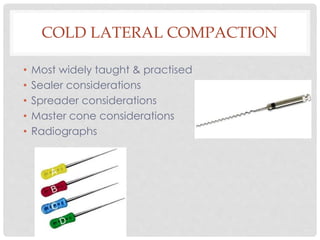
COLD LATERAL COMPACTION
• Most widely taught & practised
• Sealer considerations
• Spreader considerations
• Master cone considerations
• Radiographs
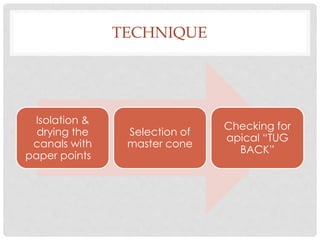
TECHNIQUE
Isolation &
drying the
canals with
paper points
Selection of
master cone
Checking for
apical “TUG
BACK”
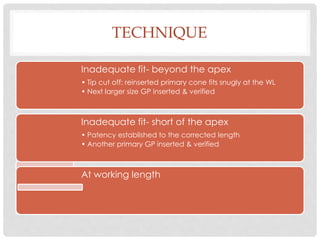
TECHNIQUE
Inadequate fit- beyond the apex
• Tip cut off: reinserted primary cone fits snugly at the WL
• Next larger size GP inserted & verified
Inadequate fit- short of the apex
• Patency established to the corrected length
• Another primary GP inserted & verified
At working length
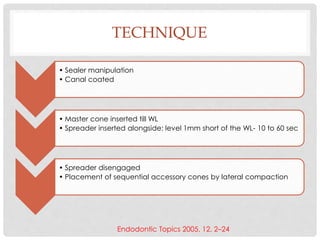
TECHNIQUE
• Sealer manipulation
• Canal coated
• Master cone inserted till WL
• Spreader inserted alongside: level 1mm short of the WL- 10 to 60 sec
• Spreader disengaged
• Placement of sequential accessory cones by lateral compaction
Endodontic Topics 2005, 12, 2–24
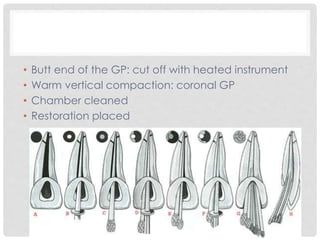
• Butt end of the GP: cut off with heated instrument
• Warm vertical compaction: coronal GP
• Chamber cleaned
• Restoration placed
COLD LATERAL COMPACTION
Advantages
• “ Deep spreader
penetration”: minimize
apical leakage/
percolation
• Positive dimensional
stability of the root
canal filling
• Less likelihood of
carrying filling material
beyond the root apex
Limitations
• Presence of voids
• Increased sealer : GP
ratio
• Less able to seal
intracanal defects &
lateral canals
• Less homogeneous
mass
• Time consuming
JOE—Volume 32, Number 4, April 2006
Endodontic Topics 2005, 12, 2–24
VARIANTS ON COLD LATERAL
COMPACTION
• Warming spreaders before each use in a hot bead
sterilizer
• Softening gutta percha with heat before insertion
of the cold spreader
• Mechanical activation of finger spreaders in an
endodontic reciprocating handpiece
• Application of an ultrasonically energized spreader
• Application of an engine-driven
thermomechanical compactor which creates
frictional heat and advances the material apically
within the canal
Endodontic Topics 2005, 12, 2–24
STUDIES
• Bal et al.
• Hembrough et al.
• Wilson & Baumgartner
• Better results with warm techniques: Collins et al.
• Da Silva et al.
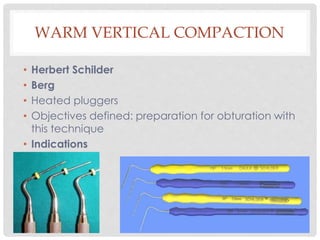
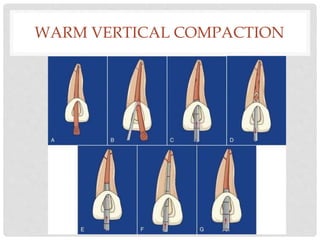
WARM VERTICAL COMPACTION
• Herbert Schilder
• Berg
• Heated pluggers
• Objectives defined: preparation for obturation with
this technique
• Indications
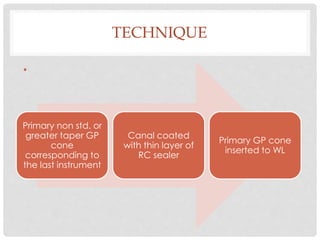
TECHNIQUE
•
Primary non std. or
greater taper GP
cone
corresponding to
the last instrument
Canal coated
with thin layer of
RC sealer
Primary GP cone
inserted to WL
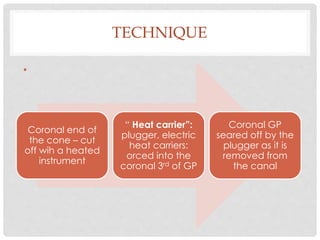
TECHNIQUE
•
Coronal end of
the cone – cut
off wih a heated
instrument
“ Heat carrier”:
plugger, electric
heat carriers:
orced into the
coronal 3rd of GP
Coronal GP
seared off by the
plugger as it is
removed from
the canal
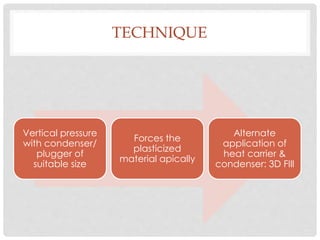
TECHNIQUE
Vertical pressure
with condenser/
plugger of
suitable size
Forces the
plasticized
material apically
Alternate
application of
heat carrier &
condenser: 3D FIll
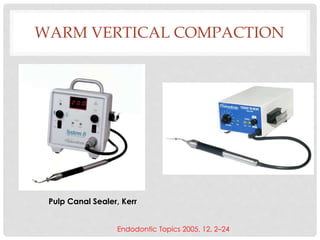
WARM VERTICAL COMPACTION
Pulp Canal Sealer, Kerr
Endodontic Topics 2005, 12, 2–24
WARM VERTICAL COMPACTION
Advantges
• Irregularities &
accessory canals
better filled
• Excellent seal of the
canal laterally &
apically
Disadvantages
• Time consuming
• Risk of vertical fracture
from undue force
• Less length control
• Overfiling with GP or
sealer that cannot be
retrieved from
periradicular tissues
• Difficult in curved
canals
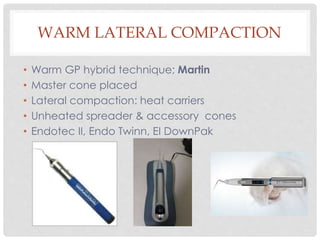
WARM LATERAL COMPACTION
• Warm GP hybrid technique; Martin
• Master cone placed
• Lateral compaction: heat carriers
• Unheated spreader & accessory cones
• Endotec II, Endo Twinn, EI DownPak
WARM LATERAL COMPACTION
Endo Tec II:
• Liewehr et al. Increased weight of GP: 14.63%
• Kersten et al.
• Collins et al.
Endo Twinn:
• Kulid et al.
JOE—Volume 32, Number 8, August 2006
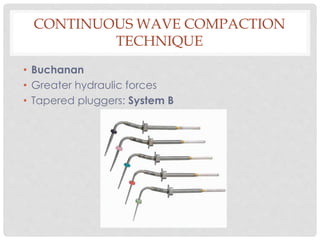
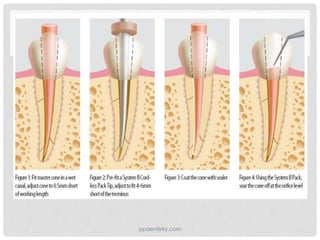
CONTINUOUS WAVE COMPACTION
TECHNIQUE
• Buchanan
• Greater hydraulic forces
• Tapered pluggers: System B
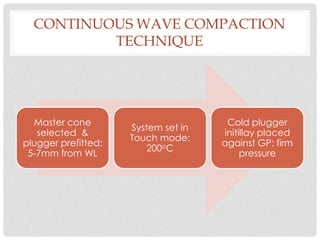
CONTINUOUS WAVE COMPACTION
TECHNIQUE
Master cone
selected &
plugger prefitted:
5-7mm from WL
System set in
Touch mode:
200oC
Cold plugger
initillay placed
against GP; firm
pressure
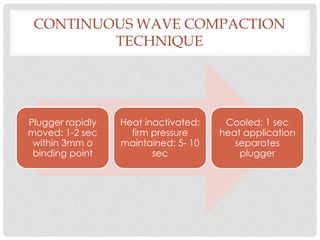
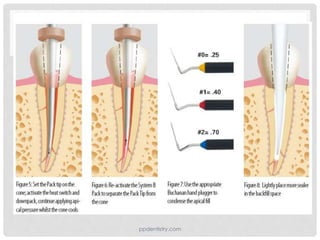
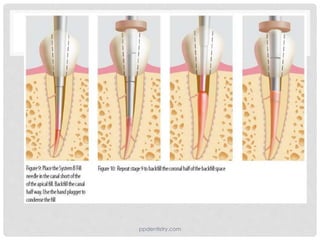
CONTINUOUS WAVE COMPACTION
TECHNIQUE
Plugger rapidly
moved: 1-2 sec
within 3mm o
binding point
Heat inactivated;
firm pressure
maintained: 5- 10
sec
Cooled; 1 sec
heat application
separates
plugger
ppdentistry.com
ppdentistry.com
ppdentistry.com
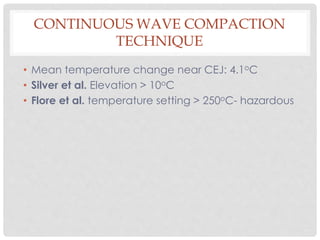
CONTINUOUS WAVE COMPACTION
TECHNIQUE
• Mean temperature change near CEJ: 4.1oC
• Silver et al. Elevation > 10oC
• Flore et al. temperature setting > 250oC- hazardous
THERMOPLASTIC INJECTION
TECHNIQUES
• Harvard/ Forsythe Institute: 1977
• Obtura III
• Calamus
• Elements
• HotShot
• Ultrafil 3D- 90oC
• Obtura II- 160oC
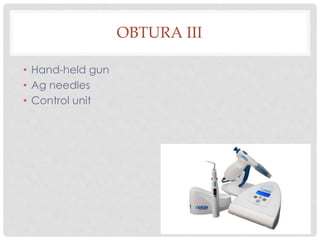
OBTURA III
• Hand-held gun
• Ag needles
• Control unit
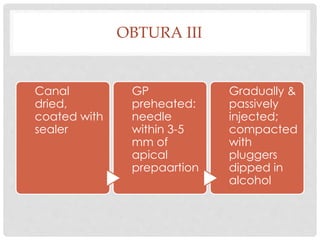
OBTURA III
Canal
dried,
coated with
sealer
GP
preheated:
needle
within 3-5
mm of
apical
prepaartion
Gradually &
passively
injected;
compacted
with
pluggers
dipped in
alcohol
OBTURA III
• Length control: Hybrid technique
• Tani- Ishii et al.
• Weller et al.
• Jacobsen et al.
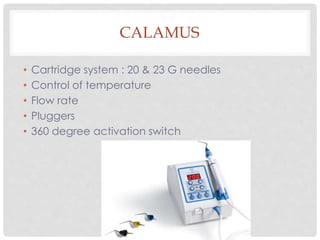
CALAMUS
• Cartridge system : 20 & 23 G needles
• Control of temperature
• Flow rate
• Pluggers
• 360 degree activation switch
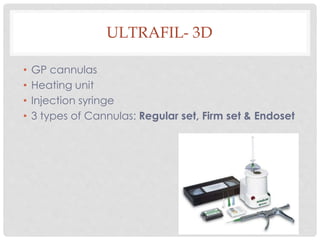
ULTRAFIL- 3D
• GP cannulas
• Heating unit
• Injection syringe
• 3 types of Cannulas: Regular set, Firm set & Endoset
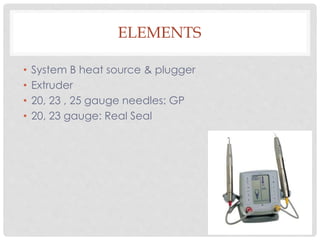
ELEMENTS
• System B heat source & plugger
• Extruder
• 20, 23 , 25 gauge needles: GP
• 20, 23 gauge: Real Seal
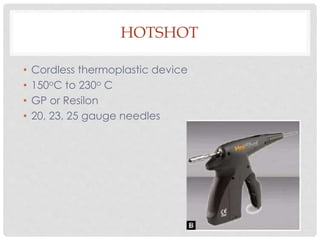
HOTSHOT
• Cordless thermoplastic device
• 150oC to 230o C
• GP or Resilon
• 20, 23, 25 gauge needles
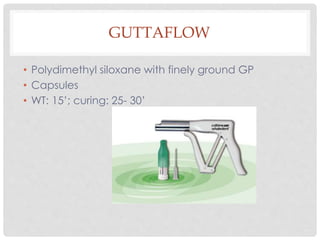
GUTTAFLOW
• Polydimethyl siloxane with finely ground GP
• Capsules
• WT: 15’; curing: 25- 30’
CARRIER- BASED GP
• Thermafil
• Profile GT obturators
• GT Series X Obturators
• ProTaper Universal Obturators
• Successfil
• SimpliFill
• JS Quick-Fill
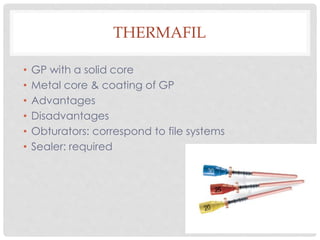
THERMAFIL
• GP with a solid core
• Metal core & coating of GP
• Advantages
• Disadvantages
• Obturators: correspond to file systems
• Sealer: required
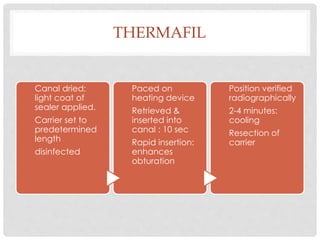
THERMAFIL
Canal dried;
light coat of
sealer applied.
Carrier set to
predetermined
length
disinfected
Paced on
heating device
Retrieved &
inserted into
canal : 10 sec
Rapid insertion:
enhances
obturation
Position verified
radiographically
2-4 minutes:
cooling
Resection of
carrier
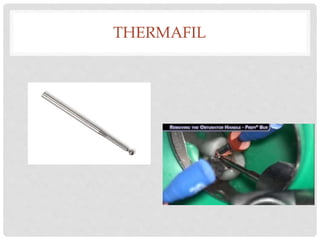
THERMAFIL
THERMAFIL
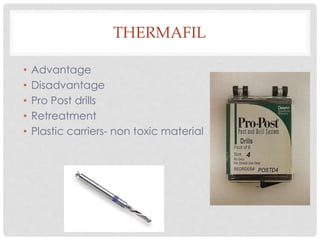
• Advantage
• Disadvantage
• Pro Post drills
• Retreatment
• Plastic carriers- non toxic material
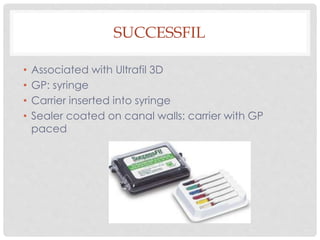
SUCCESSFIL
• Associated with Ultrafil 3D
• GP: syringe
• Carrier inserted into syringe
• Sealer coated on canal walls: carrier with GP
paced
TRIFECTA TECHNIQUE
• Hygenic Corporation
• Succesfil GP injected onto sterile K-file tip
• Carried into most apical part: turned counter-
clockwise
• Soft GP condensed
• Remainder: Ultrafil GP
• Modified Trifecta: rest with lateral condensation
Chandra & Shetty. Endodontology.
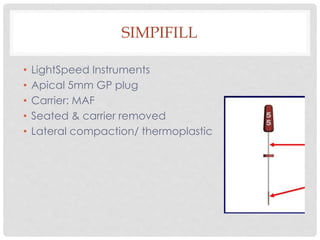
SIMPIFILL
• LightSpeed Instruments
• Apical 5mm GP plug
• Carrier: MAF
• Seated & carrier removed
• Lateral compaction/ thermoplastic
JS QUICKFIL
• Alpha phase GP coated Ti cores
• ISO: 15 to 60
• Spun into the canal at low speed
• Maybe left behind or removed
THERMOMECHANICAL COMPACTION
• McSpadden compactor
• H- file in reverse
• Slow speed handpiece
• Advantage
• Disadvantages
• Microseal condensers
SOLVENT TECHNIQUES
• CHCl3 , Eucalyptol, xylol.
• Disadvantages
• Callahan- Johnson technique
• 95% ethyl alcohol solution, chlorosin solution
• Nygard- Ostby technnique
JOE — Volume 32, Number 4, April 2006
SOLVENT TECHNIQUES
• A small amount of chloropercha is streaked onto
the walls of the dry root canal with a fine root canal
spreader or other suitable instrument.
• The apical third of the master cone is dipped into
the chloropercha paste, and the entire master
cone is gently repositioned into the canal.
• The material in the canal is now forced laterally with
root canal spreaders, making room for additional
GP cones which are added repeatedly in sufficient
number to provide a dense root canal filling.
JOE — Volume 32, Number 4, April 2006
• Each piece of GP blends with the GP &
chloropercha already in the canal to form a
homogeneous mass which conforms quite
adequately to the configuration of the root canal
system.
• The lateral pressure on the plastic GP– chloropercha
mixture automatically imparts a small vertical
component of pressure, owing to the shape of most
prepared canals.
• The entire mass moves apically during lateral
condensation with any solvent technique.
JOE — Volume 32, Number 4, April 2006
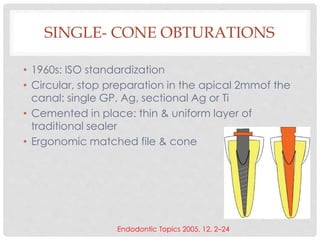
SINGLE- CONE OBTURATIONS
• 1960s: ISO standardization
• Circular, stop preparation in the apical 2mmof the
canal: single GP, Ag, sectional Ag or Ti
• Cemented in place: thin & uniform layer of
traditional sealer
• Ergonomic matched file & cone
Endodontic Topics 2005, 12, 2–24
CONCLUSION
• Wide array of options and materials
• Wisely chosen & applied depending on the clinical
situation
Thank you!!

Techniques of Root Canal Obturation

  • 1.
    D E EP T H I P . R . I I I Y E A R M D S D E P T . O F C O N S S E R V A T I V E D E N T I S T R Y & E N D O D O N T I C S TECHNIQUES OF OBTURATION
  • 2.
    INTRODUCTION • Many methods:old & new • Plasticity/ flow of GP • Flow into the RC • Compress against the walls • Fill fine tortuous canals • Seal various exits • Compact into a solid core filling
  • 3.
    DIFFERENT TECHNIQUES 1. ColdLateral Compaction 2. Warm Compaction (warm GP) A. Vertical B. Lateral 3. Continuous wave Compaction technique 4. Thermoplasticized GP injection 5. Carrier- based GP A. Thermafil thermoplasticized B. SimpliFill sectional obturation 6. McSpadden thermomechanical compaction 7. Chemically plasticized GP 8. Custom cone
  • 4.
    COLD LATERAL COMPACTION •Most widely taught & practised • Sealer considerations • Spreader considerations • Master cone considerations • Radiographs
  • 5.
    TECHNIQUE Isolation & drying the canalswith paper points Selection of master cone Checking for apical “TUG BACK”
  • 6.
    TECHNIQUE Inadequate fit- beyondthe apex • Tip cut off: reinserted primary cone fits snugly at the WL • Next larger size GP inserted & verified Inadequate fit- short of the apex • Patency established to the corrected length • Another primary GP inserted & verified At working length
  • 7.
    TECHNIQUE • Sealer manipulation •Canal coated • Master cone inserted till WL • Spreader inserted alongside: level 1mm short of the WL- 10 to 60 sec • Spreader disengaged • Placement of sequential accessory cones by lateral compaction Endodontic Topics 2005, 12, 2–24
  • 8.
    • Butt endof the GP: cut off with heated instrument • Warm vertical compaction: coronal GP • Chamber cleaned • Restoration placed
  • 9.
    COLD LATERAL COMPACTION Advantages •“ Deep spreader penetration”: minimize apical leakage/ percolation • Positive dimensional stability of the root canal filling • Less likelihood of carrying filling material beyond the root apex Limitations • Presence of voids • Increased sealer : GP ratio • Less able to seal intracanal defects & lateral canals • Less homogeneous mass • Time consuming JOE—Volume 32, Number 4, April 2006 Endodontic Topics 2005, 12, 2–24
  • 10.
    VARIANTS ON COLDLATERAL COMPACTION • Warming spreaders before each use in a hot bead sterilizer • Softening gutta percha with heat before insertion of the cold spreader • Mechanical activation of finger spreaders in an endodontic reciprocating handpiece • Application of an ultrasonically energized spreader • Application of an engine-driven thermomechanical compactor which creates frictional heat and advances the material apically within the canal Endodontic Topics 2005, 12, 2–24
  • 11.
    STUDIES • Bal etal. • Hembrough et al. • Wilson & Baumgartner • Better results with warm techniques: Collins et al. • Da Silva et al.
  • 12.
    WARM VERTICAL COMPACTION •Herbert Schilder • Berg • Heated pluggers • Objectives defined: preparation for obturation with this technique • Indications
  • 13.
    TECHNIQUE • Primary non std.or greater taper GP cone corresponding to the last instrument Canal coated with thin layer of RC sealer Primary GP cone inserted to WL
  • 14.
    TECHNIQUE • Coronal end of thecone – cut off wih a heated instrument “ Heat carrier”: plugger, electric heat carriers: orced into the coronal 3rd of GP Coronal GP seared off by the plugger as it is removed from the canal
  • 15.
    TECHNIQUE Vertical pressure with condenser/ pluggerof suitable size Forces the plasticized material apically Alternate application of heat carrier & condenser: 3D FIll
  • 16.
  • 17.
    WARM VERTICAL COMPACTION PulpCanal Sealer, Kerr Endodontic Topics 2005, 12, 2–24
  • 18.
    WARM VERTICAL COMPACTION Advantges •Irregularities & accessory canals better filled • Excellent seal of the canal laterally & apically Disadvantages • Time consuming • Risk of vertical fracture from undue force • Less length control • Overfiling with GP or sealer that cannot be retrieved from periradicular tissues • Difficult in curved canals
  • 19.
    WARM LATERAL COMPACTION •Warm GP hybrid technique; Martin • Master cone placed • Lateral compaction: heat carriers • Unheated spreader & accessory cones • Endotec II, Endo Twinn, EI DownPak
  • 20.
    WARM LATERAL COMPACTION EndoTec II: • Liewehr et al. Increased weight of GP: 14.63% • Kersten et al. • Collins et al. Endo Twinn: • Kulid et al. JOE—Volume 32, Number 8, August 2006
  • 21.
    CONTINUOUS WAVE COMPACTION TECHNIQUE •Buchanan • Greater hydraulic forces • Tapered pluggers: System B
  • 22.
    CONTINUOUS WAVE COMPACTION TECHNIQUE Mastercone selected & plugger prefitted: 5-7mm from WL System set in Touch mode: 200oC Cold plugger initillay placed against GP; firm pressure
  • 23.
    CONTINUOUS WAVE COMPACTION TECHNIQUE Pluggerrapidly moved: 1-2 sec within 3mm o binding point Heat inactivated; firm pressure maintained: 5- 10 sec Cooled; 1 sec heat application separates plugger
  • 24.
  • 25.
  • 26.
  • 27.
    CONTINUOUS WAVE COMPACTION TECHNIQUE •Mean temperature change near CEJ: 4.1oC • Silver et al. Elevation > 10oC • Flore et al. temperature setting > 250oC- hazardous
  • 28.
    THERMOPLASTIC INJECTION TECHNIQUES • Harvard/Forsythe Institute: 1977 • Obtura III • Calamus • Elements • HotShot • Ultrafil 3D- 90oC • Obtura II- 160oC
  • 29.
    OBTURA III • Hand-heldgun • Ag needles • Control unit
  • 30.
    OBTURA III Canal dried, coated with sealer GP preheated: needle within3-5 mm of apical prepaartion Gradually & passively injected; compacted with pluggers dipped in alcohol
  • 31.
    OBTURA III • Lengthcontrol: Hybrid technique • Tani- Ishii et al. • Weller et al. • Jacobsen et al.
  • 32.
    CALAMUS • Cartridge system: 20 & 23 G needles • Control of temperature • Flow rate • Pluggers • 360 degree activation switch
  • 33.
    ULTRAFIL- 3D • GPcannulas • Heating unit • Injection syringe • 3 types of Cannulas: Regular set, Firm set & Endoset
  • 34.
    ELEMENTS • System Bheat source & plugger • Extruder • 20, 23 , 25 gauge needles: GP • 20, 23 gauge: Real Seal
  • 35.
    HOTSHOT • Cordless thermoplasticdevice • 150oC to 230o C • GP or Resilon • 20, 23, 25 gauge needles
  • 36.
    GUTTAFLOW • Polydimethyl siloxanewith finely ground GP • Capsules • WT: 15’; curing: 25- 30’
  • 37.
    CARRIER- BASED GP •Thermafil • Profile GT obturators • GT Series X Obturators • ProTaper Universal Obturators • Successfil • SimpliFill • JS Quick-Fill
  • 38.
    THERMAFIL • GP witha solid core • Metal core & coating of GP • Advantages • Disadvantages • Obturators: correspond to file systems • Sealer: required
  • 39.
    THERMAFIL Canal dried; light coatof sealer applied. Carrier set to predetermined length disinfected Paced on heating device Retrieved & inserted into canal : 10 sec Rapid insertion: enhances obturation Position verified radiographically 2-4 minutes: cooling Resection of carrier
  • 40.
  • 41.
    THERMAFIL • Advantage • Disadvantage •Pro Post drills • Retreatment • Plastic carriers- non toxic material
  • 42.
    SUCCESSFIL • Associated withUltrafil 3D • GP: syringe • Carrier inserted into syringe • Sealer coated on canal walls: carrier with GP paced
  • 43.
    TRIFECTA TECHNIQUE • HygenicCorporation • Succesfil GP injected onto sterile K-file tip • Carried into most apical part: turned counter- clockwise • Soft GP condensed • Remainder: Ultrafil GP • Modified Trifecta: rest with lateral condensation Chandra & Shetty. Endodontology.
  • 44.
    SIMPIFILL • LightSpeed Instruments •Apical 5mm GP plug • Carrier: MAF • Seated & carrier removed • Lateral compaction/ thermoplastic
  • 45.
    JS QUICKFIL • Alphaphase GP coated Ti cores • ISO: 15 to 60 • Spun into the canal at low speed • Maybe left behind or removed
  • 46.
    THERMOMECHANICAL COMPACTION • McSpaddencompactor • H- file in reverse • Slow speed handpiece • Advantage • Disadvantages • Microseal condensers
  • 47.
    SOLVENT TECHNIQUES • CHCl3, Eucalyptol, xylol. • Disadvantages • Callahan- Johnson technique • 95% ethyl alcohol solution, chlorosin solution • Nygard- Ostby technnique JOE — Volume 32, Number 4, April 2006
  • 48.
    SOLVENT TECHNIQUES • Asmall amount of chloropercha is streaked onto the walls of the dry root canal with a fine root canal spreader or other suitable instrument. • The apical third of the master cone is dipped into the chloropercha paste, and the entire master cone is gently repositioned into the canal. • The material in the canal is now forced laterally with root canal spreaders, making room for additional GP cones which are added repeatedly in sufficient number to provide a dense root canal filling. JOE — Volume 32, Number 4, April 2006
  • 49.
    • Each pieceof GP blends with the GP & chloropercha already in the canal to form a homogeneous mass which conforms quite adequately to the configuration of the root canal system. • The lateral pressure on the plastic GP– chloropercha mixture automatically imparts a small vertical component of pressure, owing to the shape of most prepared canals. • The entire mass moves apically during lateral condensation with any solvent technique. JOE — Volume 32, Number 4, April 2006
  • 50.
    SINGLE- CONE OBTURATIONS •1960s: ISO standardization • Circular, stop preparation in the apical 2mmof the canal: single GP, Ag, sectional Ag or Ti • Cemented in place: thin & uniform layer of traditional sealer • Ergonomic matched file & cone Endodontic Topics 2005, 12, 2–24
  • 52.
    CONCLUSION • Wide arrayof options and materials • Wisely chosen & applied depending on the clinical situation
  • 53.