IRRIGANTS
AND
INTRACORONAL MEDICAMENTS
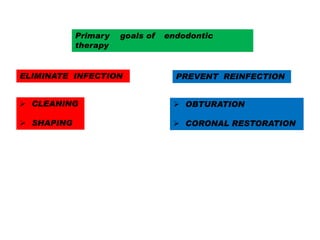
Primary
therapy

goals of

ELIMINATE INFECTION

endodontic

PREVENT REINFECTION

 CLEANING

 OBTURATION

 SHAPING

 CORONAL RESTORATION
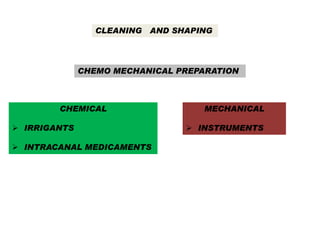
CLEANING AND SHAPING

CHEMO MECHANICAL PREPARATION

CHEMICAL
 IRRIGANTS

 INTRACANAL MEDICAMENTS

MECHANICAL
 INSTRUMENTS
Objectives

 Removal of organic debris

 Elimination of bacteria
IRRIGANTS
Properties of an ideal irriganting solution
1.Organic tissue solvent
2.Inorganic tissue solvent
3.Antimicrobial action

4.Non – toxic
5.Low surface tension
6.Lubricant


Should be non irritating to periapical tissue



Should be an effective germicide and fungicide



Should be stable in solution



Should have prolonged antimicrobial effect



Should be active in presences of blood, serum proteins
derivatives of Tissue.


Should have low surface tension



Should not interfere with repair of periapical tissues



Should not stain tooth structure .



Should not induce a cell mediated immune response
 Irrigation solutions
 Lubricants
 Decalcifying / chelating agents
SODIUM HYPOCHLORITE

[ NaOCl ]

Commonly used household bleach [ Clorox ]
Most common and popular irrigant in endodontics
Advantages:
 Mechanical flushing of debris from the canal
 Tissue dissolving capacity → Vital + Non vital [necrotic]
 Antimicrobial action
 Lubrication
 Inexpensive
 Easily available
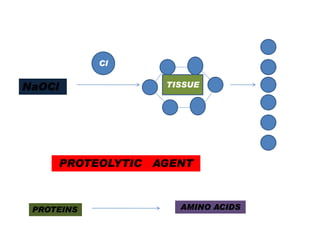
Cl

NaOCl

TISSUE

PROTEOLYTIC AGENT

PROTEINS

AMINO ACIDS
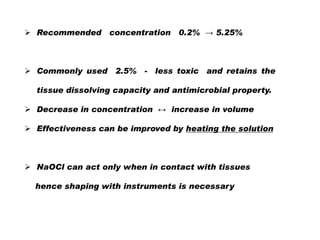
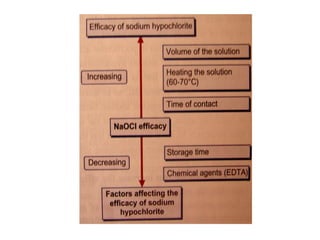
 Recommended concentration 0.2% → 5.25%

 Commonly used 2.5% - less toxic and retains the
tissue dissolving capacity and antimicrobial property.
 Decrease in concentration ↔ increase in volume
 Effectiveness can be improved by heating the solution

 NaOCl can act only when in contact with tissues
hence shaping with instruments is necessary
Sodium hypochlorite accident

Extrusion of the irrigant beyond the apical foramen causes
extensive tissue damage.
Preventive measures:
 The needle of the irrigating syringe should be placed loosely
within the canal
 The irrigant should not be pushed with force.
 The needle should not be introduced to the apex
 Side vented irrigating needle is used.
 The needle is agitated or moved up and down loosely to
agitate the liquid
NaOCl beyond root apex causes
•

Pain

•

Hematoma

•

Swelling

•

Hemorrhage

•

Inflammation of gingival tissue
Limitations


Toxic



Not active against E. faecalis



Ineffective at low concentrations.



Not substantive



Corrodes




Unpleasant odor.
Ineffective in smear layer removal.
CHLORHEXIDINE
 It is a Bisguanide
 It has a broad spectrum of anti microbial action
 Effective on a wide range of bacterial strains
E. faecalis
 Less toxicity
 NaOCl + CHX → increased effectiveness
Anti microbial action :
Adsorption to the surface of bacteria [due to cationic-anionic
electrostatic attraction]

Increase the membrane permeablility
Results in micro leakage of intracellular components leading
to cell death

CHX
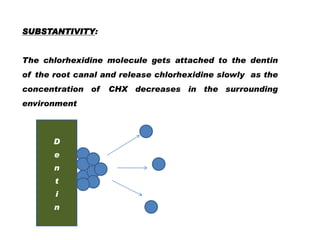
SUBSTANTIVITY:

The chlorhexidine molecule gets attached to the dentin
of the root canal and release chlorhexidine slowly as the
concentration of
environment

D
e
n
t
i

n

CHX decreases in the surrounding


Normally used in concentrations between 0.12 and 2.0%



Extremely low level of tissue toxicity



Allergic reaction to CHX are rare
Disadvantages:

 Lack of tissue dissolving capacity

 Inability to remove the smear layer
SODIUM HYPOCHLORITE +CHLORHEXIDINE

It is seen that when a combination 2.5% NaOCl & 0.2 % CHX is
used in root canal could gain
1) an additive antimicrobial action
2) a tissue dissolving property that is better than that

obtained with
use of CHX alone
3) a solution less toxic then NaOCl
OTHER IRRIGATING SOLUTIONS
HYDROGEN PER OXIDE

[ H2O2 ]

It is an oxidizing agent .
It is almost used in conjunction with NaOCl
It acts by two mechanisms
1. The reaction with NaOCl produces effervescence
which mechanically pushes the debris out of the

canal
2. The nascent oxygen released acts as a powerful
antimicrobial agent especially for the anaerobic
organisms
Advantages:
 It produces less damage to the periapical tissues
 It is a good anti anaerobic agent
 The nascent oxygen produced tends to penetrate deeper into the tubules. Hence
very effective on bacteria residing deeper in the dentinal tubules.
 When used along with CHX, hydrogen peroxide dislodges the smear layer

allowing the CHX to be more effective
 A side effect which is beneficial is that it causes bleaching
Other agents:
•

SAVLON : Combination of 0.3% cetrimide and
0.03% CHx

•

OXIDATIVE POTENTIAL WATER

• SALVIZOL : root canal chelating irrigant
•

BDA (bis-dequalinium acetate): recommended as an
excellent substitute for sodium hypochlorite in those patients who
are allergic to the latter.

•

ELECTRO CHEMICALLY ACTIVATED WATER
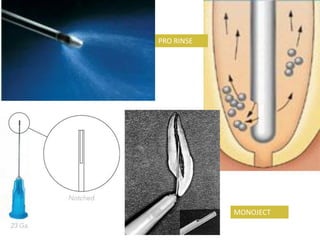
PRO RINSE

MONOJECT
Ultrasonics [passive ultrasonic irrigation]

 Most of the dentine debris is inorganic
matter that cannot be dissolved by
NaOCl. Therefore, removal of dentine
debris relies mostly on the flushing
action of irrigant.
 The ultrasound device allow the
endodontic irrigant to pass along the
ultrasonic files. The irrigant is activated

by the ultrasonic energy imparted from
the energized instruments producing
acoustic streaming and cavitation
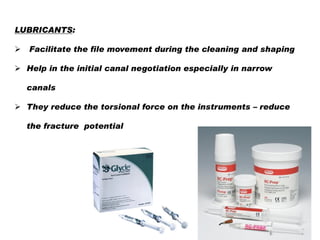
LUBRICANTS:


Facilitate the file movement during the cleaning and shaping

 Help in the initial canal negotiation especially in narrow
canals
 They reduce the torsional force on the instruments – reduce
the fracture potential
Commonly used lubricants;

 Glycerin

 Glycol + urea peroxide + EDTA

 EDTA 19% + 10 %
GEL]

[ RC PREP]

carbamide peroxide [DOLO ENDO
Disadvantages:
 EDTA compounds may cause deactivation of
NaOCl by reducing the available chlorine
 Toxic by product
SMEAR LAYER:
Cleaning and shaping → layer of

organic pulpal material
+
inorganic dentin debris

The layer may contain microorganisms
The smear layer may be 1 to 5 μ
Smear layer removal ?????????
Removal of the smear layer is the better option
 Enhance the irrigants to penetrate the dentinal tubules
 Enhance the penetration and adhesion of sealers
DECALCIFYING / CHELATING AGENTS
Agents that dissolve or dissolute the inorganic portions of the
root dentine [ calcified portions]

Ethylene di-amine tetra acetic acid [ EDTA]

Helps in the removal of the smear layer

Irrigation with 17% EDTA followed by the final rinse with
NaOCl is recommended
Chelators remove the inorganic portion of the debris leaving
behind the organic portions which can be dissolved or
removed with NaOCl

 Effect of EDTA is dependant on the time of contact with the
debris and the concentration
 Recommended time for the removal of the smear layer is 1 min

 EDTA supplied as a
•

liquid

•

paste
MTAD [ BIOPURE MTAD]
MTAD was developed by Mohmand Torabinajed et al
MTAD contains mixture of :
•

tetracycline isomer doxy cycline

•

acid- citric acid

•

a detergent - Tween 80

Antimicrobial activity of MTAD
MTAD has superior antimicrobial activity than 5.25% sodium

hypochlorite. The efficiency of MTAD in disinfecting surface of
the roots is a result of the presence of doxycycline.
 Generally used as a final rinse to remove the smear layer
 Effectiveness is enhanced when the canal is irrigated with
low concentration of NaOCl before the use of MTAD.
 1.3% recommended concentration
 Superior than NaOCl in antimicrobial action
 Doxycycline has the ability to bind the tubules and
gradually released over time
 Effective in killing E.faecalis
 Biocompatible
 Does not alter the properties of dentin
 Enhances the bond strength
INTRA CANAL MEDICAMENTS
PHENOLICS

ALDEHYDES



Eugenol



Formocresol



Camphorated monoparachloro phenol



Glutaraldehyde

[CMCP]


Parachlorophenol [PCP]

HALIDES



Camphorated parachloro phenol [CPC]



Sodium hypochlorite



Metacresylacetate



Iodine – potassium iodide



Cresol



Creosote [ beechwood]



Thymol

STERIODS
CALCIUM HYDROXIDE

ANTIBIOTICS
COMBINATION
MAIN PURPOSE FOR INTRACANAL MEDICAMENT
 To reduce interappointment pain
 To decrease the bacterial count and regrowth
 To render the canal contents inert
Physico-chemical properties



pH



Viscosity [Viscosity changes over time ]



Adhesion



Solubility



Radio-opacity



Working time



Sealing ability
Phenols and Aldehydes :
 Non specific in action
Destroy both

HOST TISSUES + MICRO-ORGANISMS

 Toxic
 Aldehydes fix the tissues
 May reach the periapical tissues → systemic circulation

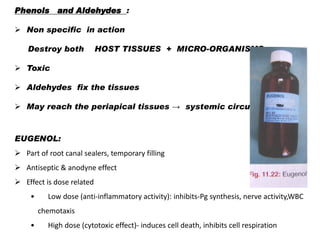
EUGENOL:
 Part of root canal sealers, temporary filling
 Antiseptic & anodyne effect

 Effect is dose related
•

Low dose (anti-inflammatory activity): inhibits-Pg synthesis, nerve activity,WBC
chemotaxis

•

High dose (cytotoxic effect)- induces cell death, inhibits cell respiration
Calcium hydroxide


Ca(OH)2 widely used as an IM



pH 12 to 13



Antimicrobial activity is due to the high alkalinity



May aid in dissolving the tissue remnants, bacteria
and their by-products.



Recommended as an IM in root canals with necrotic
tissue and infected tissue



Little benefit with vital pulp
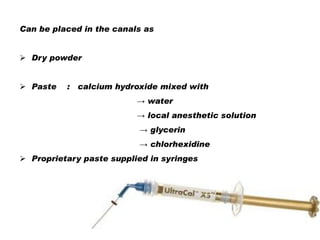
Can be placed in the canals as
 Dry powder
 Paste

: calcium hydroxide mixed with
→ water
→ local anesthetic solution
→ glycerin
→ chlorhexidine

 Proprietary paste supplied in syringes
The material is carried into the canal with the help of


lentulo spiral



using a file



injecting
Corticosteroids

 Anti-inflammatory agents
 Proposed to decrease Post operative pain and suppress
inflammation

 Can be used in patients with acute apical periodontitis
 Hydrocortisone + antibiotics
Chlorhexidine
 2% chlorhexidine gel
 When mixed with calcium hydroxide the antimicrobial
effect is greater
 Disadvantage :

does not remove the smear layer
COMBINATION

Corticosteroid + antibiotic

 Use of corticosteroid: reduces pain in inflamed tissue
and gives instant

relief
 Use of antibiotic: prevents overgrowth of bacteria
when the inflammation

subsides
Eg. Corti-sporin,Tetra-Cortil
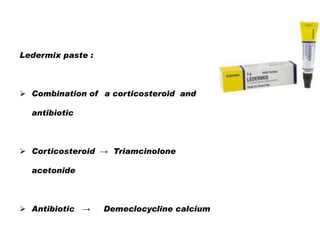
Ledermix paste :

 Combination of a corticosteroid and
antibiotic

 Corticosteroid → Triamcinolone
acetonide

 Antibiotic →

Demeclocycline calcium


Frequency of placement:



Disinfectant dressing should be preferably
renewed in a week and not longer than 2 weeks



Medicaments used for apexification are used for
3-6 months

Irrigation

  • 1.
  • 2.
    Primary therapy goals of ELIMINATE INFECTION endodontic PREVENTREINFECTION  CLEANING  OBTURATION  SHAPING  CORONAL RESTORATION
  • 3.
    CLEANING AND SHAPING CHEMOMECHANICAL PREPARATION CHEMICAL  IRRIGANTS  INTRACANAL MEDICAMENTS MECHANICAL  INSTRUMENTS
  • 4.
    Objectives  Removal oforganic debris  Elimination of bacteria
  • 5.
    IRRIGANTS Properties of anideal irriganting solution 1.Organic tissue solvent 2.Inorganic tissue solvent 3.Antimicrobial action 4.Non – toxic 5.Low surface tension 6.Lubricant
  • 6.
     Should be nonirritating to periapical tissue  Should be an effective germicide and fungicide  Should be stable in solution  Should have prolonged antimicrobial effect  Should be active in presences of blood, serum proteins derivatives of Tissue.
  • 7.
     Should have lowsurface tension  Should not interfere with repair of periapical tissues  Should not stain tooth structure .  Should not induce a cell mediated immune response
  • 8.
     Irrigation solutions Lubricants  Decalcifying / chelating agents
  • 9.
    SODIUM HYPOCHLORITE [ NaOCl] Commonly used household bleach [ Clorox ] Most common and popular irrigant in endodontics Advantages:  Mechanical flushing of debris from the canal  Tissue dissolving capacity → Vital + Non vital [necrotic]  Antimicrobial action  Lubrication  Inexpensive  Easily available
  • 10.
  • 11.
     Recommended concentration0.2% → 5.25%  Commonly used 2.5% - less toxic and retains the tissue dissolving capacity and antimicrobial property.  Decrease in concentration ↔ increase in volume  Effectiveness can be improved by heating the solution  NaOCl can act only when in contact with tissues hence shaping with instruments is necessary
  • 13.
    Sodium hypochlorite accident Extrusionof the irrigant beyond the apical foramen causes extensive tissue damage. Preventive measures:  The needle of the irrigating syringe should be placed loosely within the canal  The irrigant should not be pushed with force.  The needle should not be introduced to the apex  Side vented irrigating needle is used.  The needle is agitated or moved up and down loosely to agitate the liquid
  • 14.
    NaOCl beyond rootapex causes • Pain • Hematoma • Swelling • Hemorrhage • Inflammation of gingival tissue
  • 15.
    Limitations  Toxic  Not active againstE. faecalis  Ineffective at low concentrations.  Not substantive  Corrodes   Unpleasant odor. Ineffective in smear layer removal.
  • 16.
    CHLORHEXIDINE  It isa Bisguanide  It has a broad spectrum of anti microbial action  Effective on a wide range of bacterial strains E. faecalis  Less toxicity  NaOCl + CHX → increased effectiveness
  • 17.
    Anti microbial action: Adsorption to the surface of bacteria [due to cationic-anionic electrostatic attraction] Increase the membrane permeablility Results in micro leakage of intracellular components leading to cell death CHX
  • 18.
    SUBSTANTIVITY: The chlorhexidine moleculegets attached to the dentin of the root canal and release chlorhexidine slowly as the concentration of environment D e n t i n CHX decreases in the surrounding
  • 19.
     Normally used inconcentrations between 0.12 and 2.0%  Extremely low level of tissue toxicity  Allergic reaction to CHX are rare
  • 20.
    Disadvantages:  Lack oftissue dissolving capacity  Inability to remove the smear layer
  • 21.
    SODIUM HYPOCHLORITE +CHLORHEXIDINE Itis seen that when a combination 2.5% NaOCl & 0.2 % CHX is used in root canal could gain 1) an additive antimicrobial action 2) a tissue dissolving property that is better than that obtained with use of CHX alone 3) a solution less toxic then NaOCl
  • 22.
    OTHER IRRIGATING SOLUTIONS HYDROGENPER OXIDE [ H2O2 ] It is an oxidizing agent . It is almost used in conjunction with NaOCl It acts by two mechanisms 1. The reaction with NaOCl produces effervescence which mechanically pushes the debris out of the canal 2. The nascent oxygen released acts as a powerful antimicrobial agent especially for the anaerobic organisms
  • 23.
    Advantages:  It producesless damage to the periapical tissues  It is a good anti anaerobic agent  The nascent oxygen produced tends to penetrate deeper into the tubules. Hence very effective on bacteria residing deeper in the dentinal tubules.  When used along with CHX, hydrogen peroxide dislodges the smear layer allowing the CHX to be more effective  A side effect which is beneficial is that it causes bleaching
  • 24.
    Other agents: • SAVLON :Combination of 0.3% cetrimide and 0.03% CHx • OXIDATIVE POTENTIAL WATER • SALVIZOL : root canal chelating irrigant • BDA (bis-dequalinium acetate): recommended as an excellent substitute for sodium hypochlorite in those patients who are allergic to the latter. • ELECTRO CHEMICALLY ACTIVATED WATER
  • 26.
  • 27.
    Ultrasonics [passive ultrasonicirrigation]  Most of the dentine debris is inorganic matter that cannot be dissolved by NaOCl. Therefore, removal of dentine debris relies mostly on the flushing action of irrigant.  The ultrasound device allow the endodontic irrigant to pass along the ultrasonic files. The irrigant is activated by the ultrasonic energy imparted from the energized instruments producing acoustic streaming and cavitation
  • 28.
    LUBRICANTS:  Facilitate the filemovement during the cleaning and shaping  Help in the initial canal negotiation especially in narrow canals  They reduce the torsional force on the instruments – reduce the fracture potential
  • 29.
    Commonly used lubricants; Glycerin  Glycol + urea peroxide + EDTA  EDTA 19% + 10 % GEL] [ RC PREP] carbamide peroxide [DOLO ENDO
  • 30.
    Disadvantages:  EDTA compoundsmay cause deactivation of NaOCl by reducing the available chlorine  Toxic by product
  • 31.
    SMEAR LAYER: Cleaning andshaping → layer of organic pulpal material + inorganic dentin debris The layer may contain microorganisms The smear layer may be 1 to 5 μ Smear layer removal ?????????
  • 32.
    Removal of thesmear layer is the better option  Enhance the irrigants to penetrate the dentinal tubules  Enhance the penetration and adhesion of sealers
  • 33.
    DECALCIFYING / CHELATINGAGENTS Agents that dissolve or dissolute the inorganic portions of the root dentine [ calcified portions] Ethylene di-amine tetra acetic acid [ EDTA] Helps in the removal of the smear layer Irrigation with 17% EDTA followed by the final rinse with NaOCl is recommended
  • 34.
    Chelators remove theinorganic portion of the debris leaving behind the organic portions which can be dissolved or removed with NaOCl  Effect of EDTA is dependant on the time of contact with the debris and the concentration  Recommended time for the removal of the smear layer is 1 min  EDTA supplied as a • liquid • paste
  • 35.
    MTAD [ BIOPUREMTAD] MTAD was developed by Mohmand Torabinajed et al MTAD contains mixture of : • tetracycline isomer doxy cycline • acid- citric acid • a detergent - Tween 80 Antimicrobial activity of MTAD MTAD has superior antimicrobial activity than 5.25% sodium hypochlorite. The efficiency of MTAD in disinfecting surface of the roots is a result of the presence of doxycycline.
  • 36.
     Generally usedas a final rinse to remove the smear layer  Effectiveness is enhanced when the canal is irrigated with low concentration of NaOCl before the use of MTAD.  1.3% recommended concentration  Superior than NaOCl in antimicrobial action  Doxycycline has the ability to bind the tubules and gradually released over time  Effective in killing E.faecalis  Biocompatible  Does not alter the properties of dentin  Enhances the bond strength
  • 37.
  • 38.
    PHENOLICS ALDEHYDES  Eugenol  Formocresol  Camphorated monoparachloro phenol  Glutaraldehyde [CMCP]  Parachlorophenol[PCP] HALIDES  Camphorated parachloro phenol [CPC]  Sodium hypochlorite  Metacresylacetate  Iodine – potassium iodide  Cresol  Creosote [ beechwood]  Thymol STERIODS CALCIUM HYDROXIDE ANTIBIOTICS COMBINATION
  • 39.
    MAIN PURPOSE FORINTRACANAL MEDICAMENT  To reduce interappointment pain  To decrease the bacterial count and regrowth  To render the canal contents inert
  • 40.
    Physico-chemical properties  pH  Viscosity [Viscositychanges over time ]  Adhesion  Solubility  Radio-opacity  Working time  Sealing ability
  • 41.
    Phenols and Aldehydes:  Non specific in action Destroy both HOST TISSUES + MICRO-ORGANISMS  Toxic  Aldehydes fix the tissues  May reach the periapical tissues → systemic circulation EUGENOL:  Part of root canal sealers, temporary filling  Antiseptic & anodyne effect  Effect is dose related • Low dose (anti-inflammatory activity): inhibits-Pg synthesis, nerve activity,WBC chemotaxis • High dose (cytotoxic effect)- induces cell death, inhibits cell respiration
  • 42.
    Calcium hydroxide  Ca(OH)2 widelyused as an IM  pH 12 to 13  Antimicrobial activity is due to the high alkalinity  May aid in dissolving the tissue remnants, bacteria and their by-products.  Recommended as an IM in root canals with necrotic tissue and infected tissue  Little benefit with vital pulp
  • 43.
    Can be placedin the canals as  Dry powder  Paste : calcium hydroxide mixed with → water → local anesthetic solution → glycerin → chlorhexidine  Proprietary paste supplied in syringes
  • 44.
    The material iscarried into the canal with the help of  lentulo spiral  using a file  injecting
  • 45.
    Corticosteroids  Anti-inflammatory agents Proposed to decrease Post operative pain and suppress inflammation  Can be used in patients with acute apical periodontitis  Hydrocortisone + antibiotics Chlorhexidine  2% chlorhexidine gel  When mixed with calcium hydroxide the antimicrobial effect is greater  Disadvantage : does not remove the smear layer
  • 46.
    COMBINATION Corticosteroid + antibiotic Use of corticosteroid: reduces pain in inflamed tissue and gives instant relief  Use of antibiotic: prevents overgrowth of bacteria when the inflammation subsides Eg. Corti-sporin,Tetra-Cortil
  • 47.
    Ledermix paste : Combination of a corticosteroid and antibiotic  Corticosteroid → Triamcinolone acetonide  Antibiotic → Demeclocycline calcium
  • 48.
     Frequency of placement:  Disinfectantdressing should be preferably renewed in a week and not longer than 2 weeks  Medicaments used for apexification are used for 3-6 months