APEX LOCATOR
DEEPAK NEUPANE
DEPARTMENT OF CONSERVATIVE DENTISTRY AND ENDODONTICS
UCDS,BHAIRAHAWA
Electronic Apex Locators
 These are the electronic devices that have been developed for
determining the working length of a root canal without resorting to
radiography.
 Currently, Electronic Apex Locator (EAL) is the most optimal and
accurate method to establish the root canal working length
 Electronic apex locator (EAL) is used to locate the apical constriction
or cementodentinal junction, apical foramen, but not the
radiographic apex. Hence, the term apex locator is a misnomer one.
DEVELOPMENT
 CLUSTER (1918) : Proposed the concept of
measuring the canal length electronically.
 SUZUKI (1942) : Principle and design of EAP.
 SUNADA (1962) : Introduction of first
commercial EAL
 INOVE (1969) : Significant contribution in
evolution of EAL.
 PRATTEN AND McDONALD (1996) : Compared the
efficacy of three parallel radiographs and Endex
apex locators in Cadaver.
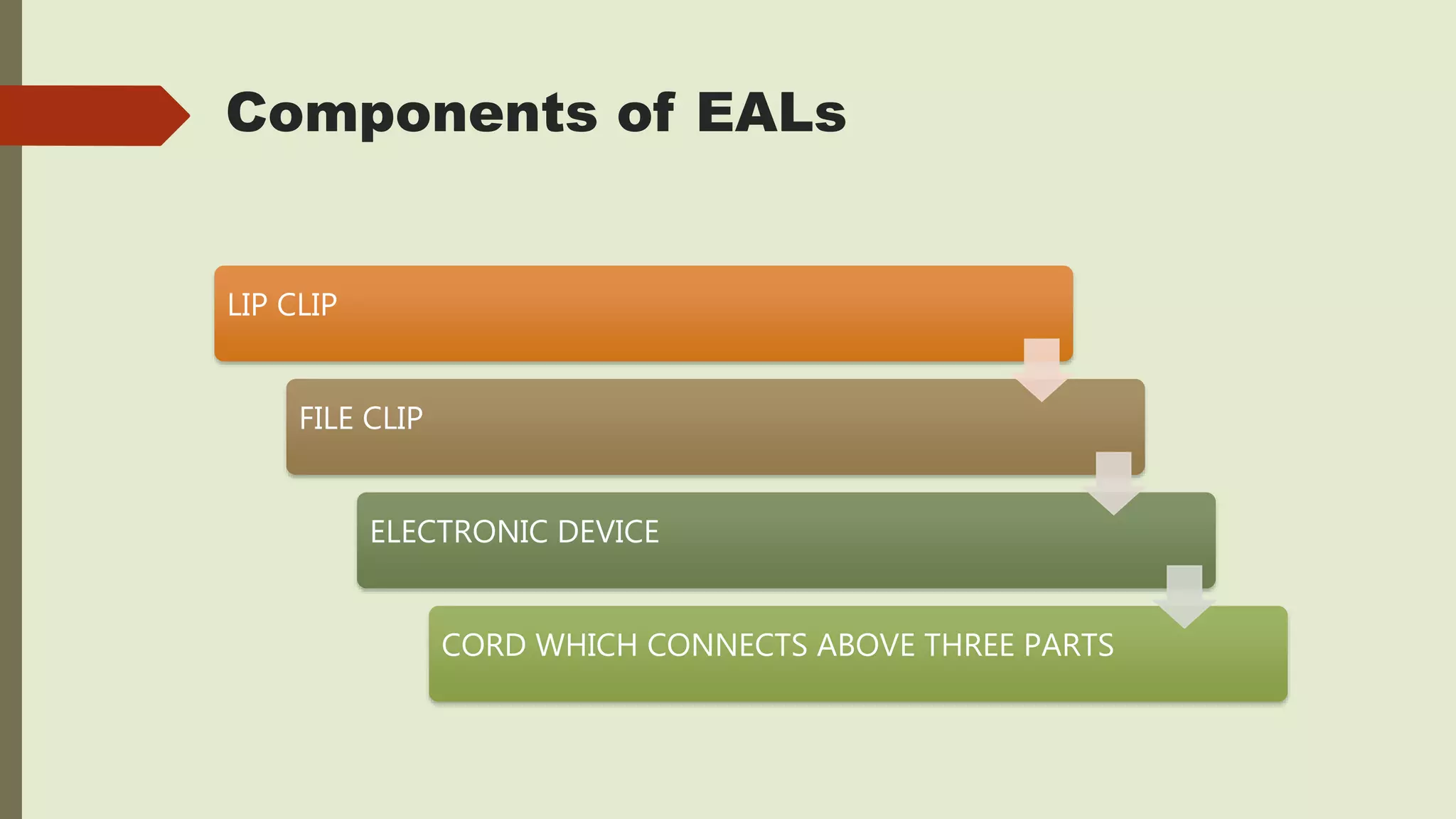
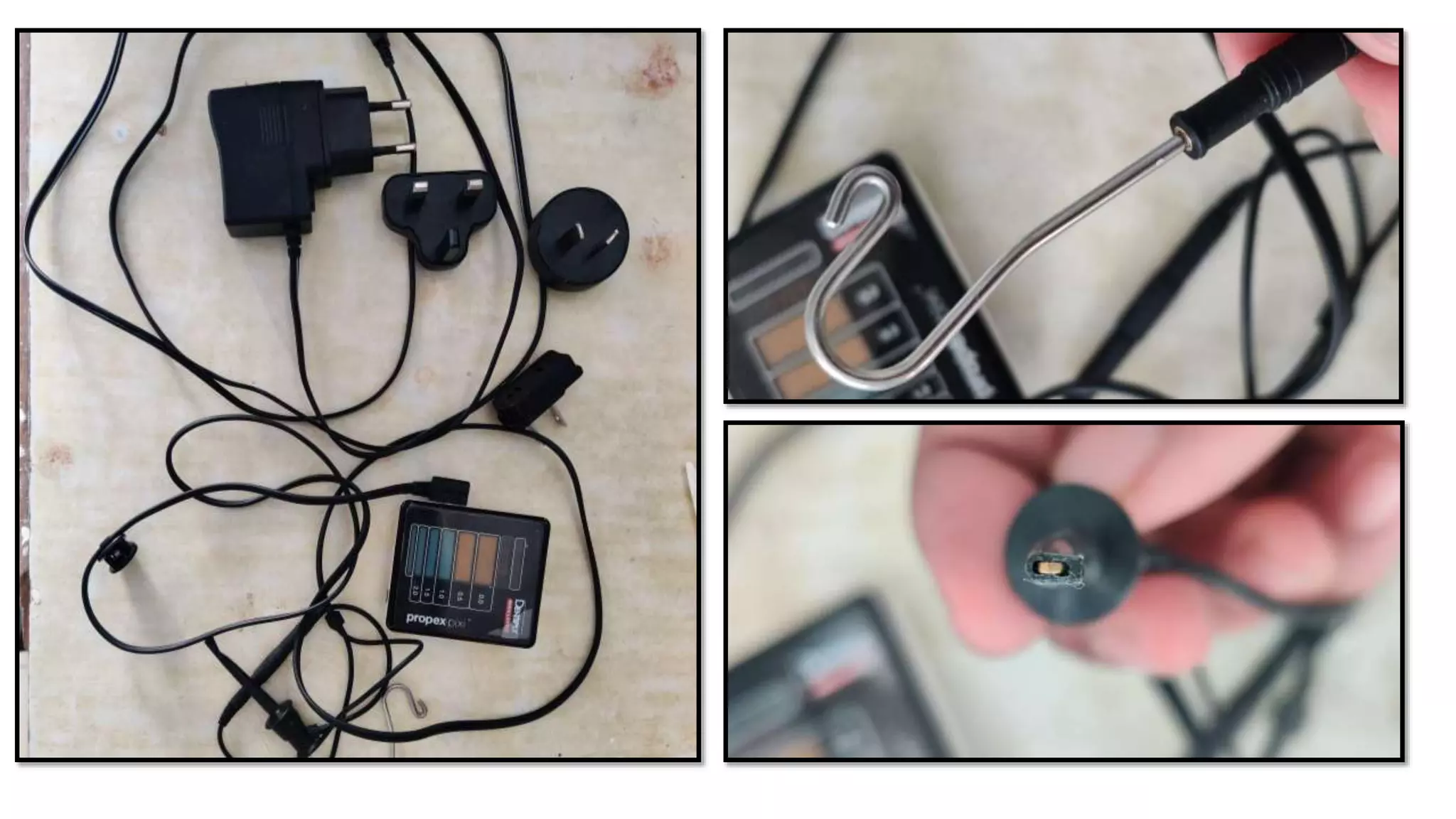
Components of EALs
LIP CLIP
FILE CLIP
ELECTRONIC DEVICE
CORD WHICH CONNECTS ABOVE THREE PARTS
Classification
According to Generations of EALs (Evolution of
EALs)
First-generation apex
locator (resistance based
apex locator)
Second-generation apex
locator (impedance-based
apex locator)/low-
frequency apex locator
Third-generation apex
locator(high-frequency
apex locator)
Fourth-generation apex
locator(multiple frequency
ratio based apex locator)
Fifth-generation EALs
(dual-frequency ratio
type)
Sixth-generation EALs
(adaptive apex locators)
McDonald's Classification
(On the basis of type of current flow)
TYPES OF APEX LOCATOR
vvvO
Based on Direct Current Based on alternating current
Frequency Type
Original OHM meter
Used by Suzuki and Sunada
Resistance Type
-Root canal meter
-Endodontic meter
Impedence type
-sonoexplorer
Subtraction type
-Endex
-Neosonaultima EZ
Ratio Type
2 Frequencies
5 Frequencies
USES OF APEX LOCATORS
‰
Provide objective information with high degree of accuracy
‰
Useful in conditions where apical portion of canal system is obstructed by
• Impacted teeth
• Zygomatic arch
• Tori
• Excessive bone density
• Overlapping roots
• Shallow palatal vault
‰
Useful in patients who cannot tolerate X-ray film placement because of gag reflex
‰
Useful in pregnant patients, to reduce the radiation exposure
‰
Useful in children who may not tolerate taking radiographs, disabled patients and
patients who are heavily sedated
‰
Valuable tool for
• Detecting site of root perforations
• Diagnosis of external and internal resorption which have penetrated root surface
• Detection of horizontal and vertical root fracture
• Determination of perforations caused during postpreparation
• Testing pulp vitality
ContraIndications
Older apex locators were contraindicated in the patients who
have cardiac pacemaker functions. Electrical stimulation to such
patients could interfere with pacemaker function. But this
problem has been overcome in newer generation of apex
locators.
MECHANISM OF ACTION OF APEX LOCATOR
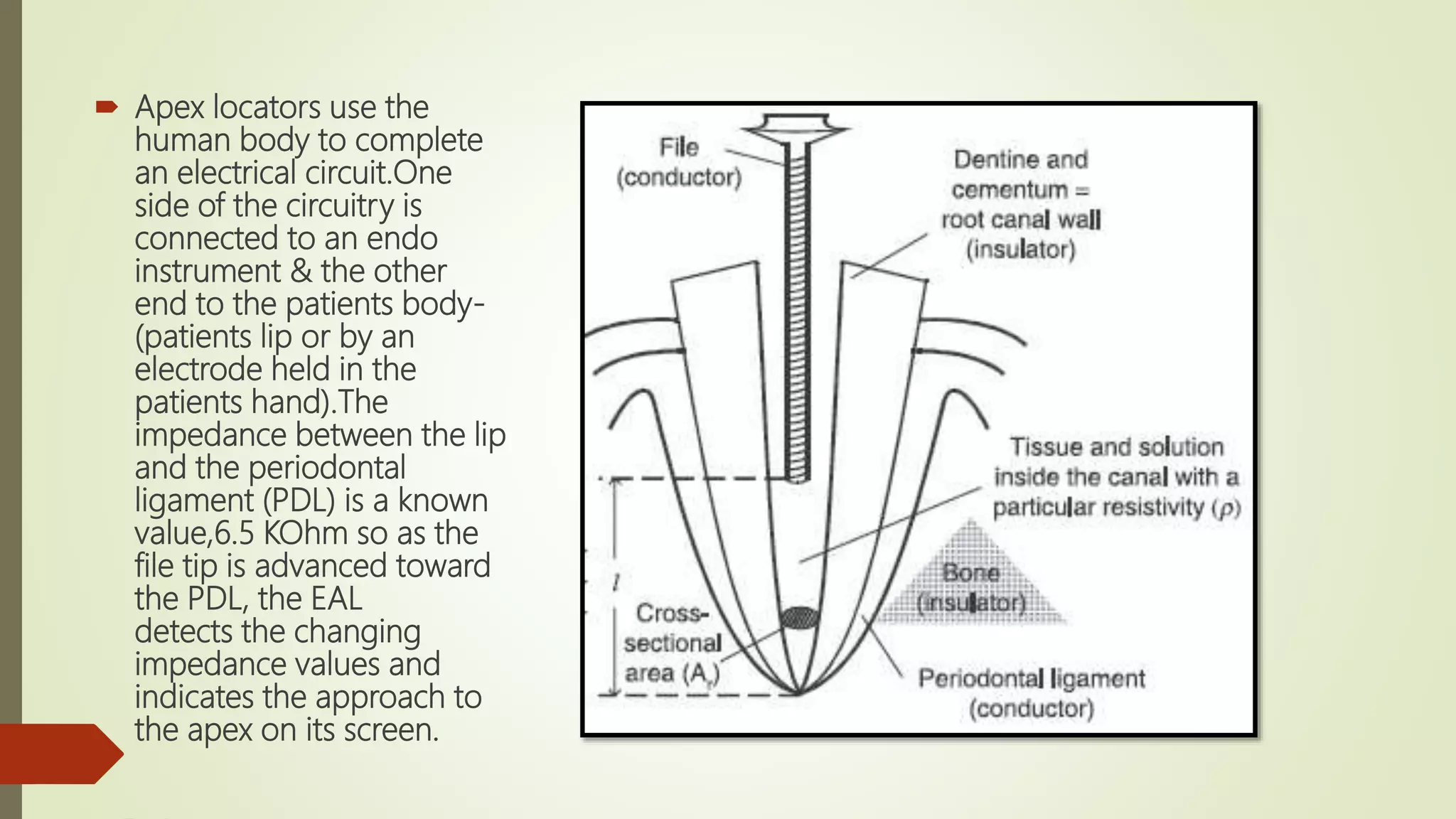
 Root canals are surrounded by dentine and cementum that are
insulators to electric current. At the apical foramen there is a
small hole in which conductive materials within the canal are
electrically connected to the periodontal ligament that is a
conductor of electric current. The resistive material of the canal
(dentine, tissue, fluid) with a particular resistivity forms a resistor,
the value of which depends on the length, cross-sectional area
and the resistivity of the materials .
 If an endodontic file penetrates inside the canal, and approaches
the canal terminus, the resistance between the end of the
instrument and the apical portion of the canal decreases,
because the effective length of the resistive material inside the
canal decreases .
 Apex locators use the
human body to complete
an electrical circuit.One
side of the circuitry is
connected to an endo
instrument & the other
end to the patients body-
(patients lip or by an
electrode held in the
patients hand).The
impedance between the lip
and the periodontal
ligament (PDL) is a known
value,6.5 KOhm so as the
file tip is advanced toward
the PDL, the EAL
detects the changing
impedance values and
indicates the approach to
the apex on its screen.
1. First-generation apex locator (resistance
apex locator)
• It is also known as resistance apex locator which measures opposition to
flow of direct current, that is, resistance
• It is based on the principle that resistance offered by periodontal
ligament, and oral mucous membrane is the same, that is, 6.5 kΩ
• Examples of 1st generation apex locators are root canal meter, endometric
meter (Onuki Medical Co., Japan), Dentometer, Endo Radar.
ADVANTAGES
• Easily operated
• Digital read out
• Audible indication
• Detect perforation
• Can be used with K-file
• May incorporate pulp tester
DISADVANTAGES
• Requires a dry field
• Patient sensitivity
• Requires calibration
• Requires good contact with lip clip
• Cannot estimate beyond 2 mm
•File should fit snugly in the canal
• File should not contact metal restorations
2. Second-generation apex locator
(impedance-based apex locator)/low-frequency
apex locator
• Inoue introduced the concept of impedance-based apex locator which
measure opposition to flow of alternating current or impedance
• This apex locator indicates the apex when two impedance values
approach each other. Examples of second-generation apex locators are:
– Sonoexplorer
– Apex finder
– Exact-A-Pex
– Endoanalyzer (combination of apex locator and pulp tester)
ADVANTAGES
• Does not require lip clip
• No patient sensitivity
• Analog meter
• Detects perforations
DISADVANTAGES
• No digital read out
• Difficult to operate
• Canal should be free of electroconductive irrigants and tissue fluids
• Requires coated probes
3. Third-generation apex locator/high-
frequency apex locator
• It is based on the fact that different sites in canal give difference in impedance
between high (8 kHz) and low (400 Hz) frequencies
Various thirdgeneration apex locators are:
– Endex (Original third-generation apex locator)
– Neosomo ultimo EZ apex locator
– Mark V plus
– Root ZX
– Root ZX II
– Root ZX mini
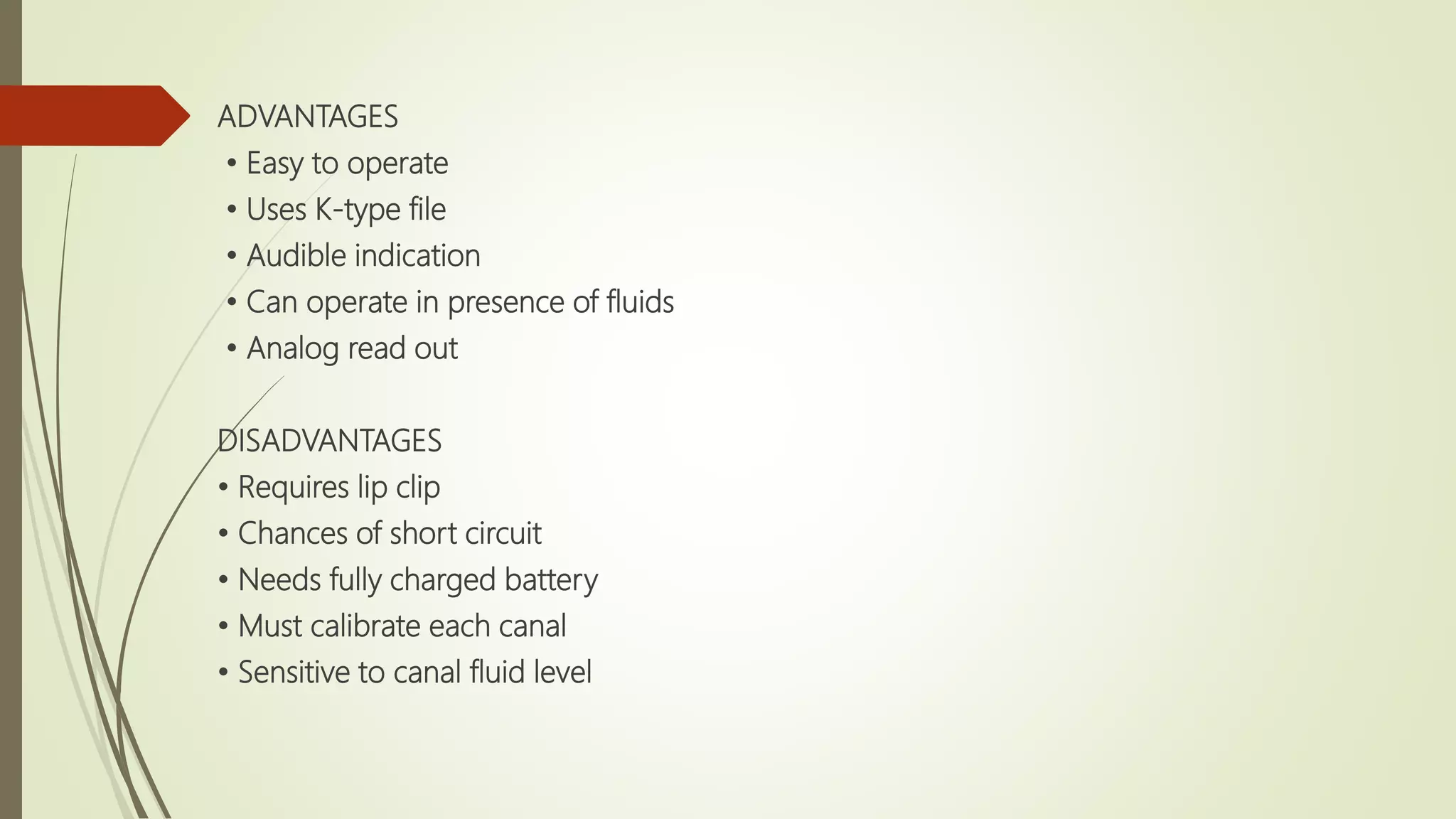
ADVANTAGES
• Easy to operate
• Uses K-type file
• Audible indication
• Can operate in presence of fluids
• Analog read out
DISADVANTAGES
• Requires lip clip
• Chances of short circuit
• Needs fully charged battery
• Must calibrate each canal
• Sensitive to canal fluid level
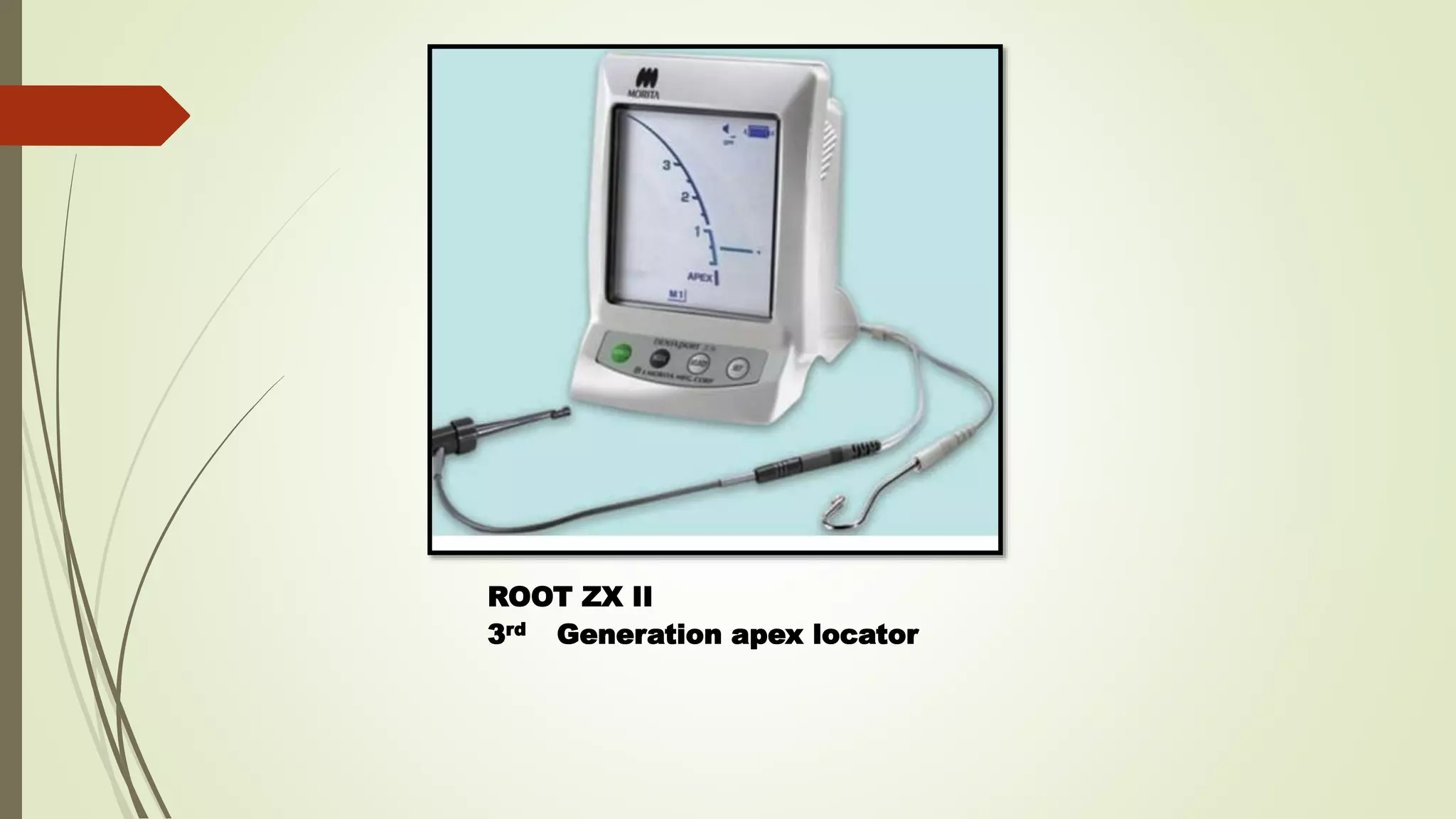
ROOT ZX II
3rd Generation apex locator
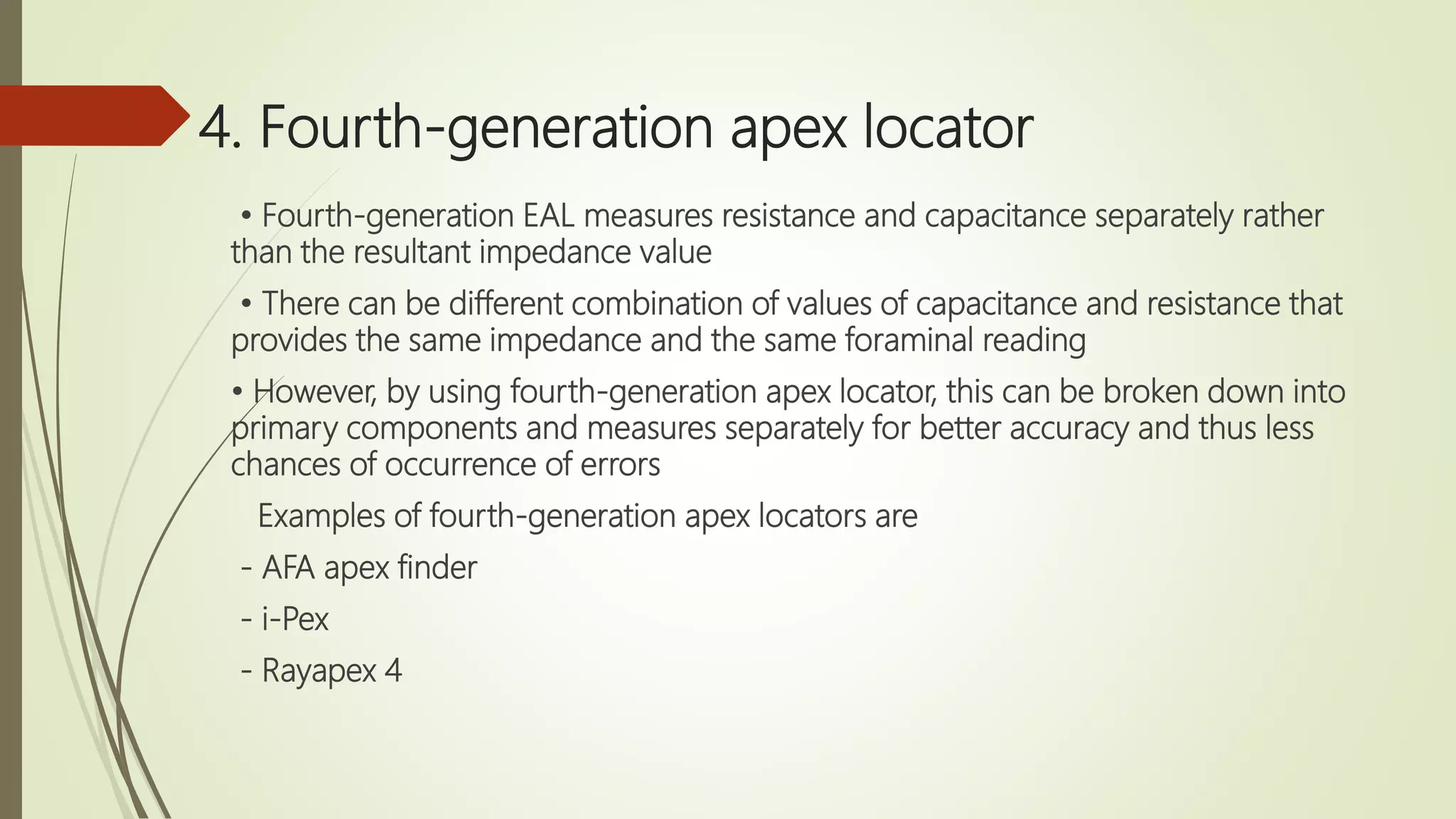
4. Fourth-generation apex locator
• Fourth-generation EAL measures resistance and capacitance separately rather
than the resultant impedance value
• There can be different combination of values of capacitance and resistance that
provides the same impedance and the same foraminal reading
• However, by using fourth-generation apex locator, this can be broken down into
primary components and measures separately for better accuracy and thus less
chances of occurrence of errors
Examples of fourth-generation apex locators are
- AFA apex finder
- i-Pex
- Rayapex 4
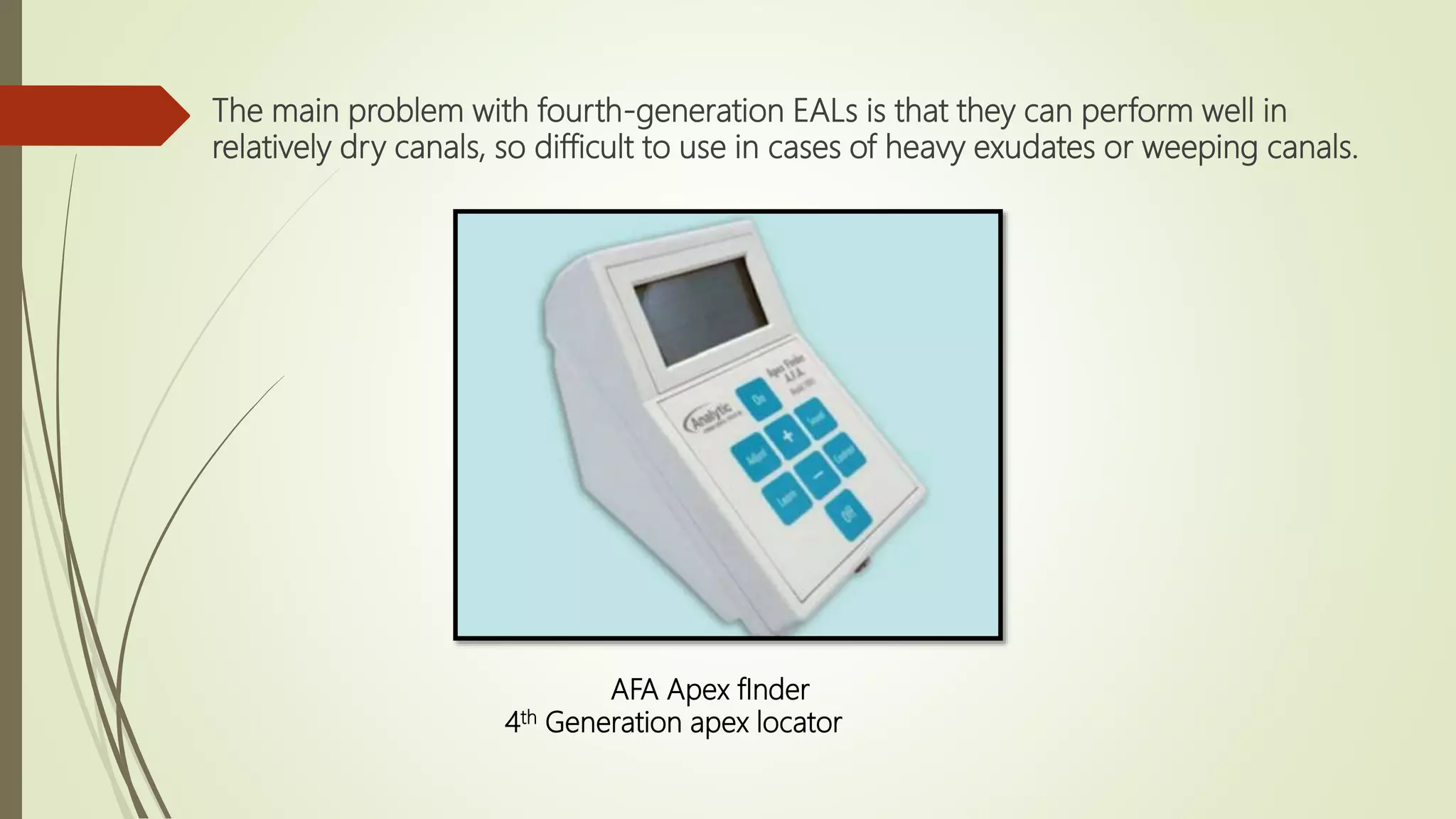
The main problem with fourth-generation EALs is that they can perform well in
relatively dry canals, so difficult to use in cases of heavy exudates or weeping canals.
AFA Apex fInder
4th Generation apex locator
5. Fifth-generation EALs (dual-frequency ratio
type)
To overcome the disadvantages of previous generations of apex locators, fifth-
generation EALs have been developed which are based on comparison of data
taken from the electrical characteristic of the canal and additional mathematical
processing.
These show accurate reading in presence of dry, wet, saline, EDTA, blood, or sodium
hypochlorite.
Examples of fifth generation apex locators are
Rayapex
Propex II
Propex Pixi
I –ROOT
JOYPEX 5
5TH Generation apex locator
6. Sixth-generation EALs (adaptive apex
locators)
This apex locator is intended to overcome the disadvantages of fourth- and
fifth-generation EALs.
It eliminates the need of drying the canals.
Examples of 6th generation apex locator are
-Adaptive apex locator
-Raypex 6
RAYPEX 6
6TH Generation apex locator
ADVANTAGES OF APEX LOCATORS
• Provide objective information with high degree of accuracy
• Accurate in reading (90–98% accuracy)
• Some apex locators are also available in combination with pulp tester and can be used
to test pulp vitality
DISADVANTAGES OF APEX LOCATORS
• Can provide inaccurate readings in the following cases:
– Presence of pulp tissue in canal
– Too wet or too dry canal
– Blockage of canal
– Incomplete circuit
– Low battery
• Chances of overestimation
• Incorrect readings in teeth with periapical radiolucencies and necrotic pulp associated
with root resorption, etc. because of lack of viable periodontal ligament
CONCLUSION
 The electronic apex locators are now considered the most ideal
method to measure the working length of a root canal.They can
be used alone without the need of radiographs. However , It is
recommended combined use of an apex locator along with the
radiographic technique for accurate clinical measurement of
Root Canal working length
Refrences
-Text book of Grossman's Endodontic practice (14th Edition)
-Text book of Endodontics (by Amit garg and Nisha Garg (4th Edition)
-Goldman M,Pearson AH ,Darzenta N .Endodontic success

ELECTRONIC APEX LOCATOR (EAL)

  • 1.
    APEX LOCATOR DEEPAK NEUPANE DEPARTMENTOF CONSERVATIVE DENTISTRY AND ENDODONTICS UCDS,BHAIRAHAWA
  • 2.
    Electronic Apex Locators These are the electronic devices that have been developed for determining the working length of a root canal without resorting to radiography.  Currently, Electronic Apex Locator (EAL) is the most optimal and accurate method to establish the root canal working length  Electronic apex locator (EAL) is used to locate the apical constriction or cementodentinal junction, apical foramen, but not the radiographic apex. Hence, the term apex locator is a misnomer one.
  • 3.
    DEVELOPMENT  CLUSTER (1918): Proposed the concept of measuring the canal length electronically.  SUZUKI (1942) : Principle and design of EAP.  SUNADA (1962) : Introduction of first commercial EAL  INOVE (1969) : Significant contribution in evolution of EAL.  PRATTEN AND McDONALD (1996) : Compared the efficacy of three parallel radiographs and Endex apex locators in Cadaver.
  • 4.
    Components of EALs LIPCLIP FILE CLIP ELECTRONIC DEVICE CORD WHICH CONNECTS ABOVE THREE PARTS
  • 6.
    Classification According to Generationsof EALs (Evolution of EALs) First-generation apex locator (resistance based apex locator) Second-generation apex locator (impedance-based apex locator)/low- frequency apex locator Third-generation apex locator(high-frequency apex locator) Fourth-generation apex locator(multiple frequency ratio based apex locator) Fifth-generation EALs (dual-frequency ratio type) Sixth-generation EALs (adaptive apex locators)
  • 7.
    McDonald's Classification (On thebasis of type of current flow) TYPES OF APEX LOCATOR vvvO Based on Direct Current Based on alternating current Frequency Type Original OHM meter Used by Suzuki and Sunada Resistance Type -Root canal meter -Endodontic meter Impedence type -sonoexplorer Subtraction type -Endex -Neosonaultima EZ Ratio Type 2 Frequencies 5 Frequencies
  • 8.
    USES OF APEXLOCATORS ‰ Provide objective information with high degree of accuracy ‰ Useful in conditions where apical portion of canal system is obstructed by • Impacted teeth • Zygomatic arch • Tori • Excessive bone density • Overlapping roots • Shallow palatal vault ‰ Useful in patients who cannot tolerate X-ray film placement because of gag reflex ‰ Useful in pregnant patients, to reduce the radiation exposure
  • 9.
    ‰ Useful in childrenwho may not tolerate taking radiographs, disabled patients and patients who are heavily sedated ‰ Valuable tool for • Detecting site of root perforations • Diagnosis of external and internal resorption which have penetrated root surface • Detection of horizontal and vertical root fracture • Determination of perforations caused during postpreparation • Testing pulp vitality
  • 10.
    ContraIndications Older apex locatorswere contraindicated in the patients who have cardiac pacemaker functions. Electrical stimulation to such patients could interfere with pacemaker function. But this problem has been overcome in newer generation of apex locators.
  • 11.
    MECHANISM OF ACTIONOF APEX LOCATOR  Root canals are surrounded by dentine and cementum that are insulators to electric current. At the apical foramen there is a small hole in which conductive materials within the canal are electrically connected to the periodontal ligament that is a conductor of electric current. The resistive material of the canal (dentine, tissue, fluid) with a particular resistivity forms a resistor, the value of which depends on the length, cross-sectional area and the resistivity of the materials .  If an endodontic file penetrates inside the canal, and approaches the canal terminus, the resistance between the end of the instrument and the apical portion of the canal decreases, because the effective length of the resistive material inside the canal decreases .
  • 12.
     Apex locatorsuse the human body to complete an electrical circuit.One side of the circuitry is connected to an endo instrument & the other end to the patients body- (patients lip or by an electrode held in the patients hand).The impedance between the lip and the periodontal ligament (PDL) is a known value,6.5 KOhm so as the file tip is advanced toward the PDL, the EAL detects the changing impedance values and indicates the approach to the apex on its screen.
  • 13.
    1. First-generation apexlocator (resistance apex locator) • It is also known as resistance apex locator which measures opposition to flow of direct current, that is, resistance • It is based on the principle that resistance offered by periodontal ligament, and oral mucous membrane is the same, that is, 6.5 kΩ • Examples of 1st generation apex locators are root canal meter, endometric meter (Onuki Medical Co., Japan), Dentometer, Endo Radar.
  • 14.
    ADVANTAGES • Easily operated •Digital read out • Audible indication • Detect perforation • Can be used with K-file • May incorporate pulp tester DISADVANTAGES • Requires a dry field • Patient sensitivity • Requires calibration • Requires good contact with lip clip • Cannot estimate beyond 2 mm •File should fit snugly in the canal • File should not contact metal restorations
  • 15.
    2. Second-generation apexlocator (impedance-based apex locator)/low-frequency apex locator • Inoue introduced the concept of impedance-based apex locator which measure opposition to flow of alternating current or impedance • This apex locator indicates the apex when two impedance values approach each other. Examples of second-generation apex locators are: – Sonoexplorer – Apex finder – Exact-A-Pex – Endoanalyzer (combination of apex locator and pulp tester)
  • 16.
    ADVANTAGES • Does notrequire lip clip • No patient sensitivity • Analog meter • Detects perforations DISADVANTAGES • No digital read out • Difficult to operate • Canal should be free of electroconductive irrigants and tissue fluids • Requires coated probes
  • 17.
    3. Third-generation apexlocator/high- frequency apex locator • It is based on the fact that different sites in canal give difference in impedance between high (8 kHz) and low (400 Hz) frequencies Various thirdgeneration apex locators are: – Endex (Original third-generation apex locator) – Neosomo ultimo EZ apex locator – Mark V plus – Root ZX – Root ZX II – Root ZX mini
  • 18.
    ADVANTAGES • Easy tooperate • Uses K-type file • Audible indication • Can operate in presence of fluids • Analog read out DISADVANTAGES • Requires lip clip • Chances of short circuit • Needs fully charged battery • Must calibrate each canal • Sensitive to canal fluid level
  • 19.
    ROOT ZX II 3rdGeneration apex locator
  • 20.
    4. Fourth-generation apexlocator • Fourth-generation EAL measures resistance and capacitance separately rather than the resultant impedance value • There can be different combination of values of capacitance and resistance that provides the same impedance and the same foraminal reading • However, by using fourth-generation apex locator, this can be broken down into primary components and measures separately for better accuracy and thus less chances of occurrence of errors Examples of fourth-generation apex locators are - AFA apex finder - i-Pex - Rayapex 4
  • 21.
    The main problemwith fourth-generation EALs is that they can perform well in relatively dry canals, so difficult to use in cases of heavy exudates or weeping canals. AFA Apex fInder 4th Generation apex locator
  • 22.
    5. Fifth-generation EALs(dual-frequency ratio type) To overcome the disadvantages of previous generations of apex locators, fifth- generation EALs have been developed which are based on comparison of data taken from the electrical characteristic of the canal and additional mathematical processing. These show accurate reading in presence of dry, wet, saline, EDTA, blood, or sodium hypochlorite. Examples of fifth generation apex locators are Rayapex Propex II Propex Pixi I –ROOT
  • 23.
  • 24.
    6. Sixth-generation EALs(adaptive apex locators) This apex locator is intended to overcome the disadvantages of fourth- and fifth-generation EALs. It eliminates the need of drying the canals. Examples of 6th generation apex locator are -Adaptive apex locator -Raypex 6
  • 25.
  • 26.
    ADVANTAGES OF APEXLOCATORS • Provide objective information with high degree of accuracy • Accurate in reading (90–98% accuracy) • Some apex locators are also available in combination with pulp tester and can be used to test pulp vitality DISADVANTAGES OF APEX LOCATORS • Can provide inaccurate readings in the following cases: – Presence of pulp tissue in canal – Too wet or too dry canal – Blockage of canal – Incomplete circuit – Low battery • Chances of overestimation • Incorrect readings in teeth with periapical radiolucencies and necrotic pulp associated with root resorption, etc. because of lack of viable periodontal ligament
  • 27.
    CONCLUSION  The electronicapex locators are now considered the most ideal method to measure the working length of a root canal.They can be used alone without the need of radiographs. However , It is recommended combined use of an apex locator along with the radiographic technique for accurate clinical measurement of Root Canal working length
  • 28.
    Refrences -Text book ofGrossman's Endodontic practice (14th Edition) -Text book of Endodontics (by Amit garg and Nisha Garg (4th Edition) -Goldman M,Pearson AH ,Darzenta N .Endodontic success