Endodontic Materials:Endodontic Materials:
Root canal irrigantsRoot canal irrigants
and medicamentsand medicaments
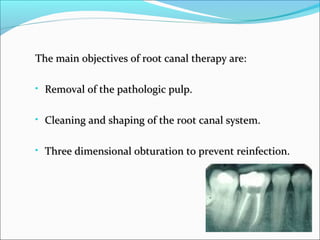
The main objectives of root canal therapy are:The main objectives of root canal therapy are:
• Removal of the pathologic pulp.Removal of the pathologic pulp.
• Cleaning and shaping of the root canal system.Cleaning and shaping of the root canal system.
• Three dimensional obturation to prevent reinfection.Three dimensional obturation to prevent reinfection.
There is no definitive evidence in the literature to
show that mechanical instrumentation alone will
predictably result in bacteria-free root canal
systems.
Irrigation is an essential part of root canal
debridement because it allows for cleaning beyond
what might be achieved by root canal
instrumentation alone.
Disinfection of the root canal system is one of the
primary aims of root canal treatment. This can be
achieved through the use of various antimicrobial
agents in the form of irrigants (only used for
relatively short periods of time) and
medicaments (days or several weeks).
IrrigantsIrrigants
Ideal properties:Ideal properties:
LubricantLubricant
AntimicrobialAntimicrobial
Dissolve organic debrisDissolve organic debris
FlushingFlushing
BiocompatibleBiocompatible
CheapCheap
Functions of irrigantsFunctions of irrigants
 Irrigants are used to clean the root canal and areIrrigants are used to clean the root canal and are
used in association with the shaping instruments.used in association with the shaping instruments.
 Functions of irrigants include:Functions of irrigants include:
1.1. Lubrication of instruments used to shape the canal.Lubrication of instruments used to shape the canal.
2.2. Flushing out of gross debris.Flushing out of gross debris.
3.3. Dissolution of organic and inorganic tissue.Dissolution of organic and inorganic tissue.
4.4. Antimicrobial effect.Antimicrobial effect.
Phenol based agents, Aldehydes and HalidyesPhenol based agents, Aldehydes and Halidyes
Phenol, parachlorophenol(PCP), camphorated monoPhenol, parachlorophenol(PCP), camphorated mono
PCP, cresol, creosote, formacresol and chlorine.PCP, cresol, creosote, formacresol and chlorine.
Antibacterial agents.Antibacterial agents.
Highly toxic agents.Highly toxic agents.
Possible mutagenic and carcinogenic effect.Possible mutagenic and carcinogenic effect.
Classification of irrigantsClassification of irrigants
Chemically inactive irrigantsChemically inactive irrigants
WaterWater
SalineSaline
Local anaesthetic solutionLocal anaesthetic solution
Chemically active irrigantsChemically active irrigants
Sodium hypochlorite (NaOCl).Sodium hypochlorite (NaOCl).
Oxidizing agents as Hydrogen peroxide (HOxidizing agents as Hydrogen peroxide (H22OO22))
Chelating agents as EDTA.Chelating agents as EDTA.
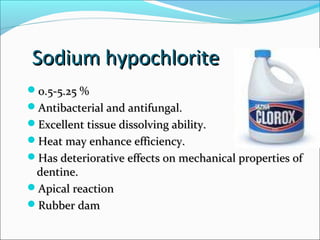
Sodium hypochloriteSodium hypochlorite
0.5-5.25 %0.5-5.25 %
Antibacterial and antifungal.Antibacterial and antifungal.
Excellent tissue dissolving ability.Excellent tissue dissolving ability.
Heat may enhance efficiency.Heat may enhance efficiency.
Has deteriorative effects on mechanical properties ofHas deteriorative effects on mechanical properties of
dentine.dentine.
Apical reactionApical reaction
Rubber damRubber dam
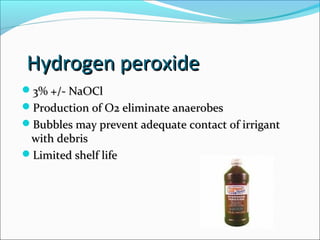
Hydrogen peroxideHydrogen peroxide
3% +/- NaOCl3% +/- NaOCl
Production of O2 eliminate anaerobesProduction of O2 eliminate anaerobes
Bubbles may prevent adequate contact of irrigantBubbles may prevent adequate contact of irrigant
with debriswith debris
Limited shelf lifeLimited shelf life
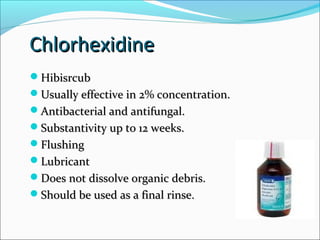
ChlorhexidineChlorhexidine
HibisrcubHibisrcub
Usually effective in 2% concentration.Usually effective in 2% concentration.
Antibacterial and antifungal.Antibacterial and antifungal.
Substantivity up to 12 weeks.Substantivity up to 12 weeks.
FlushingFlushing
LubricantLubricant
Does not dissolve organic debris.Does not dissolve organic debris.
Should be used as a final rinse.Should be used as a final rinse.
Chelating agentChelating agent
Ethylene Diamine Tetracetic Acid “EDTA” (File-eze,Ethylene Diamine Tetracetic Acid “EDTA” (File-eze,
RC Prep)RC Prep)
Remove smear layer allowingRemove smear layer allowing
cleaning of tubulescleaning of tubules
Soften dentineSoften dentine
Not antibacterialNot antibacterial
File-eze is water soluble unlike RC Prep whichFile-eze is water soluble unlike RC Prep which
contains carbowax and is difficult to removecontains carbowax and is difficult to remove
• Introduced by Torabinejad et al. in 2003 .
• Mixture of 3% doxycycline, 4.25% citric acid
and a detergent (0.5% Polysorbate 80).
•MTAD is able to remove the smear layer
and is effective against E. faecalis.
•Shows substantivity up to 4 weeks.
BioPure (MTAD)BioPure (MTAD)
IrrigantsIrrigants
Sterile waterSterile water
Local anaestheticLocal anaesthetic
Saline (0.9%)Saline (0.9%)
They only provide lubrication and gross debris removalThey only provide lubrication and gross debris removal
functions.functions.
Best Irrigation protocol is the alternating use
of NaOCl with EDTA or BioPure. CHX can be
used as a final rinse.
Irrigants have to be used in large volumes
and to be confined to root canal space. Never
to be delivered with excessive force.
Irrigation Delivery and Agitation techniques:
A-Manual Techniques:
1.Syringe irrigation with needles: passively or with
agitation. Irrigant delivered distally or laterally.
2.Brushes: for irrigant agitation and debridement
of root canal wall.
3.Manual-dynamic irrigation: well-fitted gutta
percha cone.
B-Machine-assisted Techniques:
1.Rotary brushes.
2.Continuous irrigation during rotary instrumentation.
3.Sonic irrigation.
4.Ultrasonic irrigation.
Intracanal medicamentsIntracanal medicaments
If root canal treatment can’t be finished in a single visit,If root canal treatment can’t be finished in a single visit,
root canals are dressed with medicaments.root canals are dressed with medicaments.
A medicament is an antimicrobial agent that is placedA medicament is an antimicrobial agent that is placed
inside the root canal between treatment appointments ininside the root canal between treatment appointments in
an attempt to destroy remaining microorganisms andan attempt to destroy remaining microorganisms and
prevent reinfection.prevent reinfection.
Functions of intracanal medicaments:Functions of intracanal medicaments:
Primary function: antimicrobial activityPrimary function: antimicrobial activity
 AntisepsisAntisepsis
 DisinfectionDisinfection
Secondary functionsSecondary functions
 Hard-tissue formationHard-tissue formation
 Pain controlPain control
 Exudation controlExudation control
 Resorption controlResorption control
Intracanal medicamentIntracanal medicament
Ideal propertiesIdeal properties
 AntibacterialAntibacterial
 Penetrates dentinal tubulesPenetrates dentinal tubules
 Control exudation or bleedingControl exudation or bleeding
 Biocompatibile.Biocompatibile.
 Eliminates painEliminates pain
 Induce calcific barrierInduce calcific barrier
 No effect on temporaryNo effect on temporary
 Radio-opaqueRadio-opaque
 Does not stain toothDoes not stain tooth
The clinical effectiveness of these agents
must be evaluated in the light of the
complexity of root canal anatomy and
polymicrobial nature of root canal
infections.
The antimicrobial efficacy of intracanal
medicaments on bacterial biofilms still need to be
confirmed.
Root canal preparation, with careful disinfection and
use of intracanal substances that provide good
antimicrobial efficacy, tissue dissolution capacity,
and acceptable biocompatibility, will definitely
improve the prognosis of the treatment of apical
periodontitis.
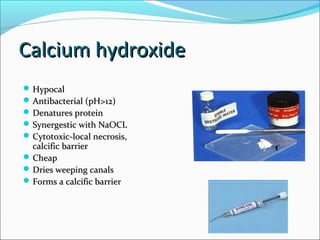
Calcium hydroxideCalcium hydroxide
 HypocalHypocal
 Antibacterial (pH>12)Antibacterial (pH>12)
 Denatures proteinDenatures protein
 Synergestic with NaOCLSynergestic with NaOCL
 Cytotoxic-local necrosis,Cytotoxic-local necrosis,
calcific barriercalcific barrier
 CheapCheap
 Dries weeping canalsDries weeping canals
 Forms a calcific barrierForms a calcific barrier
AntibioticsAntibiotics
Tetracyclines have been used to remove the
smear layer from instrumented root canal walls,
for irrigation of retrograde cavities during
periapical surgical procedures , and as an
intracanal medicament.
Combination of drugs required to be effective
Resistant strains becoming more difficult to treat
Allergies.
SteroidsSteroids
Triamicinolone, prednisolone
Pain relief but no evidence of more effective than
Ca(OH)2
?use in root resorption by inhibiting odontoclasts
?depresses the host inflammatory response
Not antibacterial but can be mixed with Ca(OH)2
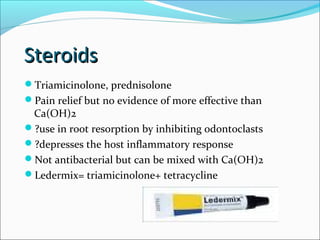
Ledermix= triamicinolone+ tetracycline
CHXCHX
Owing to the greater activity against Gram-positive than
Gram-negative organisms, application of CHX as
intracanal medicament is preferred in retreatment case
compared with initial endodontic infections.

Endodontic materials ♥

  • 1.
    Endodontic Materials:Endodontic Materials: Rootcanal irrigantsRoot canal irrigants and medicamentsand medicaments
  • 2.
    The main objectivesof root canal therapy are:The main objectives of root canal therapy are: • Removal of the pathologic pulp.Removal of the pathologic pulp. • Cleaning and shaping of the root canal system.Cleaning and shaping of the root canal system. • Three dimensional obturation to prevent reinfection.Three dimensional obturation to prevent reinfection.
  • 5.
    There is nodefinitive evidence in the literature to show that mechanical instrumentation alone will predictably result in bacteria-free root canal systems. Irrigation is an essential part of root canal debridement because it allows for cleaning beyond what might be achieved by root canal instrumentation alone.
  • 6.
    Disinfection of theroot canal system is one of the primary aims of root canal treatment. This can be achieved through the use of various antimicrobial agents in the form of irrigants (only used for relatively short periods of time) and medicaments (days or several weeks).
  • 7.
    IrrigantsIrrigants Ideal properties:Ideal properties: LubricantLubricant AntimicrobialAntimicrobial Dissolveorganic debrisDissolve organic debris FlushingFlushing BiocompatibleBiocompatible CheapCheap
  • 8.
    Functions of irrigantsFunctionsof irrigants  Irrigants are used to clean the root canal and areIrrigants are used to clean the root canal and are used in association with the shaping instruments.used in association with the shaping instruments.  Functions of irrigants include:Functions of irrigants include: 1.1. Lubrication of instruments used to shape the canal.Lubrication of instruments used to shape the canal. 2.2. Flushing out of gross debris.Flushing out of gross debris. 3.3. Dissolution of organic and inorganic tissue.Dissolution of organic and inorganic tissue. 4.4. Antimicrobial effect.Antimicrobial effect.
  • 9.
    Phenol based agents,Aldehydes and HalidyesPhenol based agents, Aldehydes and Halidyes Phenol, parachlorophenol(PCP), camphorated monoPhenol, parachlorophenol(PCP), camphorated mono PCP, cresol, creosote, formacresol and chlorine.PCP, cresol, creosote, formacresol and chlorine. Antibacterial agents.Antibacterial agents. Highly toxic agents.Highly toxic agents. Possible mutagenic and carcinogenic effect.Possible mutagenic and carcinogenic effect.
  • 10.
    Classification of irrigantsClassificationof irrigants Chemically inactive irrigantsChemically inactive irrigants WaterWater SalineSaline Local anaesthetic solutionLocal anaesthetic solution Chemically active irrigantsChemically active irrigants Sodium hypochlorite (NaOCl).Sodium hypochlorite (NaOCl). Oxidizing agents as Hydrogen peroxide (HOxidizing agents as Hydrogen peroxide (H22OO22)) Chelating agents as EDTA.Chelating agents as EDTA.
  • 11.
    Sodium hypochloriteSodium hypochlorite 0.5-5.25%0.5-5.25 % Antibacterial and antifungal.Antibacterial and antifungal. Excellent tissue dissolving ability.Excellent tissue dissolving ability. Heat may enhance efficiency.Heat may enhance efficiency. Has deteriorative effects on mechanical properties ofHas deteriorative effects on mechanical properties of dentine.dentine. Apical reactionApical reaction Rubber damRubber dam
  • 12.
    Hydrogen peroxideHydrogen peroxide 3%+/- NaOCl3% +/- NaOCl Production of O2 eliminate anaerobesProduction of O2 eliminate anaerobes Bubbles may prevent adequate contact of irrigantBubbles may prevent adequate contact of irrigant with debriswith debris Limited shelf lifeLimited shelf life
  • 13.
    ChlorhexidineChlorhexidine HibisrcubHibisrcub Usually effective in2% concentration.Usually effective in 2% concentration. Antibacterial and antifungal.Antibacterial and antifungal. Substantivity up to 12 weeks.Substantivity up to 12 weeks. FlushingFlushing LubricantLubricant Does not dissolve organic debris.Does not dissolve organic debris. Should be used as a final rinse.Should be used as a final rinse.
  • 14.
    Chelating agentChelating agent EthyleneDiamine Tetracetic Acid “EDTA” (File-eze,Ethylene Diamine Tetracetic Acid “EDTA” (File-eze, RC Prep)RC Prep) Remove smear layer allowingRemove smear layer allowing cleaning of tubulescleaning of tubules Soften dentineSoften dentine Not antibacterialNot antibacterial File-eze is water soluble unlike RC Prep whichFile-eze is water soluble unlike RC Prep which contains carbowax and is difficult to removecontains carbowax and is difficult to remove
  • 15.
    • Introduced byTorabinejad et al. in 2003 . • Mixture of 3% doxycycline, 4.25% citric acid and a detergent (0.5% Polysorbate 80). •MTAD is able to remove the smear layer and is effective against E. faecalis. •Shows substantivity up to 4 weeks. BioPure (MTAD)BioPure (MTAD)
  • 16.
    IrrigantsIrrigants Sterile waterSterile water LocalanaestheticLocal anaesthetic Saline (0.9%)Saline (0.9%) They only provide lubrication and gross debris removalThey only provide lubrication and gross debris removal functions.functions.
  • 17.
    Best Irrigation protocolis the alternating use of NaOCl with EDTA or BioPure. CHX can be used as a final rinse. Irrigants have to be used in large volumes and to be confined to root canal space. Never to be delivered with excessive force.
  • 18.
    Irrigation Delivery andAgitation techniques: A-Manual Techniques: 1.Syringe irrigation with needles: passively or with agitation. Irrigant delivered distally or laterally. 2.Brushes: for irrigant agitation and debridement of root canal wall. 3.Manual-dynamic irrigation: well-fitted gutta percha cone.
  • 19.
    B-Machine-assisted Techniques: 1.Rotary brushes. 2.Continuousirrigation during rotary instrumentation. 3.Sonic irrigation. 4.Ultrasonic irrigation.
  • 20.
    Intracanal medicamentsIntracanal medicaments Ifroot canal treatment can’t be finished in a single visit,If root canal treatment can’t be finished in a single visit, root canals are dressed with medicaments.root canals are dressed with medicaments. A medicament is an antimicrobial agent that is placedA medicament is an antimicrobial agent that is placed inside the root canal between treatment appointments ininside the root canal between treatment appointments in an attempt to destroy remaining microorganisms andan attempt to destroy remaining microorganisms and prevent reinfection.prevent reinfection.
  • 21.
    Functions of intracanalmedicaments:Functions of intracanal medicaments: Primary function: antimicrobial activityPrimary function: antimicrobial activity  AntisepsisAntisepsis  DisinfectionDisinfection Secondary functionsSecondary functions  Hard-tissue formationHard-tissue formation  Pain controlPain control  Exudation controlExudation control  Resorption controlResorption control
  • 22.
    Intracanal medicamentIntracanal medicament IdealpropertiesIdeal properties  AntibacterialAntibacterial  Penetrates dentinal tubulesPenetrates dentinal tubules  Control exudation or bleedingControl exudation or bleeding  Biocompatibile.Biocompatibile.  Eliminates painEliminates pain  Induce calcific barrierInduce calcific barrier  No effect on temporaryNo effect on temporary  Radio-opaqueRadio-opaque  Does not stain toothDoes not stain tooth
  • 23.
    The clinical effectivenessof these agents must be evaluated in the light of the complexity of root canal anatomy and polymicrobial nature of root canal infections.
  • 24.
    The antimicrobial efficacyof intracanal medicaments on bacterial biofilms still need to be confirmed. Root canal preparation, with careful disinfection and use of intracanal substances that provide good antimicrobial efficacy, tissue dissolution capacity, and acceptable biocompatibility, will definitely improve the prognosis of the treatment of apical periodontitis.
  • 25.
    Calcium hydroxideCalcium hydroxide HypocalHypocal  Antibacterial (pH>12)Antibacterial (pH>12)  Denatures proteinDenatures protein  Synergestic with NaOCLSynergestic with NaOCL  Cytotoxic-local necrosis,Cytotoxic-local necrosis, calcific barriercalcific barrier  CheapCheap  Dries weeping canalsDries weeping canals  Forms a calcific barrierForms a calcific barrier
  • 26.
    AntibioticsAntibiotics Tetracyclines have beenused to remove the smear layer from instrumented root canal walls, for irrigation of retrograde cavities during periapical surgical procedures , and as an intracanal medicament. Combination of drugs required to be effective Resistant strains becoming more difficult to treat Allergies.
  • 27.
    SteroidsSteroids Triamicinolone, prednisolone Pain reliefbut no evidence of more effective than Ca(OH)2 ?use in root resorption by inhibiting odontoclasts ?depresses the host inflammatory response Not antibacterial but can be mixed with Ca(OH)2 Ledermix= triamicinolone+ tetracycline
  • 28.
    CHXCHX Owing to thegreater activity against Gram-positive than Gram-negative organisms, application of CHX as intracanal medicament is preferred in retreatment case compared with initial endodontic infections.