HAEMOPHILIAC DENTAL PATIENT
 The advent of new materials, attention to meticulous
operative technique, use of local haemostatic agents, and
an increasing interest in the prevention of dental problems
along with the development of minimally invasive techniques
heralds a new era in dental care for patients with congenital
bleeding disorders.
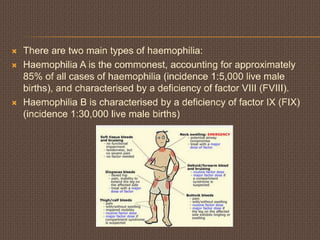
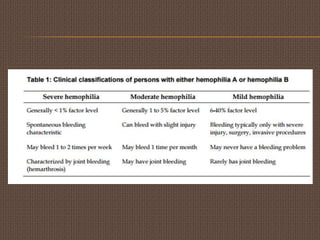
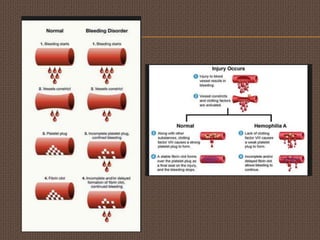
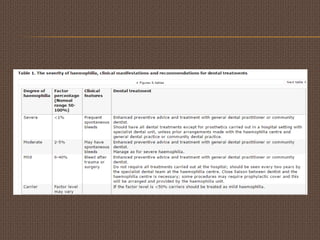
 There are two main types of haemophilia:
 Haemophilia A is the commonest, accounting for approximately
85% of all cases of haemophilia (incidence 1:5,000 live male
births), and characterised by a deficiency of factor VIII (FVIII).
 Haemophilia B is characterised by a deficiency of factor IX (FIX)
(incidence 1:30,000 live male births)
Von Willebrand Disease
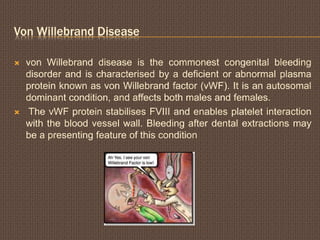
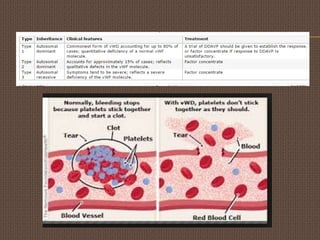
 von Willebrand disease is the commonest congenital bleeding
disorder and is characterised by a deficient or abnormal plasma
protein known as von Willebrand factor (vWF). It is an autosomal
dominant condition, and affects both males and females.
 The vWF protein stabilises FVIII and enables platelet interaction
with the blood vessel wall. Bleeding after dental extractions may
be a presenting feature of this condition
 Factor XI deficiency differs from haemophilia A and B by the lack
of bleeding into joints and muscles.
 The inheritance is autosomal and may occur in either sex. There
is typically an unpredictable mild bleeding tendency that may be
provoked by surgery in areas with high fibrinolytic activity such as
tonsillectomy and dental procedures.
 The bleeding risk is difficult to assess from the level of severity of
factor deficiency making this congenital bleeding disorder a
challenge to treat
MANAGEMENT STRATEGIES
 Four therapeutic management options depending on the type of
haemophilia and vWD, namely:
 Coagulation factor replacement therapy
 Release of endogenous factor stores using desmopressin
(DDAVP)
 Improving clot stability by antifibrinolytic drugs, for example,
tranexamic acid
 Local haemostatic measures.
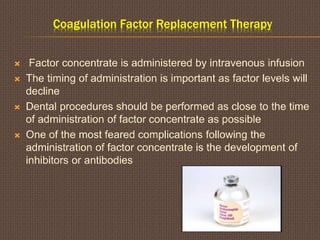
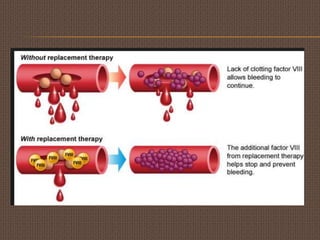
Coagulation Factor Replacement Therapy
 Factor concentrate is administered by intravenous infusion
 The timing of administration is important as factor levels will
decline
 Dental procedures should be performed as close to the time
of administration of factor concentrate as possible
 One of the most feared complications following the
administration of factor concentrate is the development of
inhibitors or antibodies
Desmopressin (Desamino-8-d-arginine Vasopressin [DDAVP])
 The synthetic antidiuretic hormone, desmopressin, stimulates
release of endogenous FVIII and vWF from stores in patients with
mild haemophilia and Vwd
 DDAVP can be administered one hour pre-procedure
subcutaneously (0.3 μg/kg using the 15 μg/ml concentration)
 .Alternatively, DDAVP (0.3 μg/kg in 50 ml of normal saline) can be
administered intravenously (4 μg/ml concentration) one hour pre-
procedure as a slow intravenous infusion over 20–30 minutes.
 Fluid intake should be restricted for around 24 hours after DDAVP
is given.
Antifibrinolytic Agents
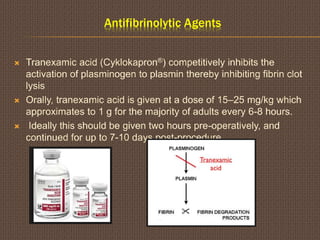
 Tranexamic acid (Cyklokapron®) competitively inhibits the
activation of plasminogen to plasmin thereby inhibiting fibrin clot
lysis
 Orally, tranexamic acid is given at a dose of 15–25 mg/kg which
approximates to 1 g for the majority of adults every 6-8 hours.
 Ideally this should be given two hours pre-operatively, and
continued for up to 7-10 days post-procedure
Local Haemostatic Measures
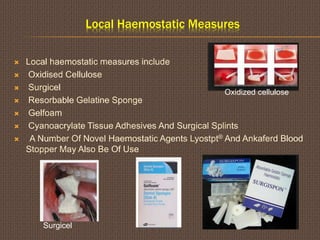
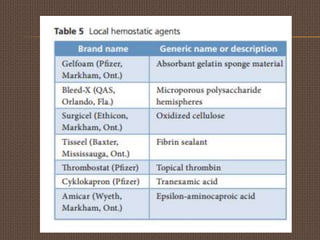
 Local haemostatic measures include
 Oxidised Cellulose
 Surgicel
 Resorbable Gelatine Sponge
 Gelfoam
 Cyanoacrylate Tissue Adhesives And Surgical Splints
 A Number Of Novel Haemostatic Agents Lyostpt® And Ankaferd Blood
Stopper May Also Be Of Use
Oxidized cellulose
Surgicel
 For patients taking warfarin, their international normalized ratio
(INR) should be measured before a surgical procedure.
 The normal therapeutic range is 2.0–3.0
 .According to current recommendations, most oral surgical
procedures can be performed without altering the warfarin dose if
the INR is less than 3.0.
 If INR values are greater than 3.0, physician referral is
suggested.
 It is important to consider the risk of reducing the level of
anticoagulation in patients on warfarin due to the risk of a
thromboembolic event.
DENTAL TREATMENTS
 General measures to reduce accidental trauma and minimise
damage to oral mucosa should be employed at all times including
careful use of saliva ejectors, careful removal of impressions and
care in the placement of radiographic films
 Local anaesthetic infiltration using a slow injection technique and
modern fine gauge single-use needles can usually be used
without the need for factor replacement
 Augmentation of factor levels with or without tranexamic acid is
required in all age groups when inferior alveolar and posterior
superior alveolar dental nerve-blocks are given
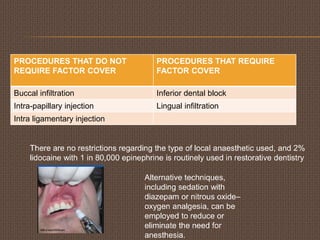
PROCEDURES THAT DO NOT
REQUIRE FACTOR COVER
PROCEDURES THAT REQUIRE
FACTOR COVER
Buccal infiltration Inferior dental block
Intra-papillary injection Lingual infiltration
Intra ligamentary injection
There are no restrictions regarding the type of local anaesthetic used, and 2%
lidocaine with 1 in 80,000 epinephrine is routinely used in restorative dentistry
Alternative techniques,
including sedation with
diazepam or nitrous oxide–
oxygen analgesia, can be
employed to reduce or
eliminate the need for
anesthesia.
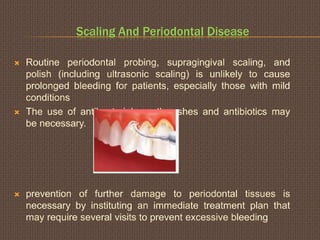
Scaling And Periodontal Disease
 Routine periodontal probing, supragingival scaling, and
polish (including ultrasonic scaling) is unlikely to cause
prolonged bleeding for patients, especially those with mild
conditions
 The use of antibacterial mouthwashes and antibiotics may
be necessary.
 prevention of further damage to periodontal tissues is
necessary by instituting an immediate treatment plan that
may require several visits to prevent excessive bleeding
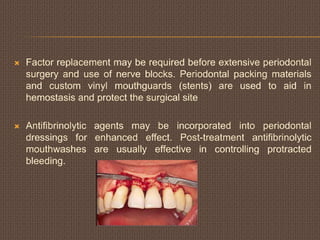
 Factor replacement may be required before extensive periodontal
surgery and use of nerve blocks. Periodontal packing materials
and custom vinyl mouthguards (stents) are used to aid in
hemostasis and protect the surgical site
 Antifibrinolytic agents may be incorporated into periodontal
dressings for enhanced effect. Post-treatment antifibrinolytic
mouthwashes are usually effective in controlling protracted
bleeding.
Orthodontic Treatment
 The appliance should be designed so that the gingival and buccal
mucosa cannot be damaged by sharp edges or wires.
 Fixed and removable orthodontic appliances may be used as long
as enhanced preventive advice including oral hygiene instruction
and demonstrations are carried out
Prosthodontic (construction of dentures) treatment
 The provision of any removable prosthesis and the use of full or
partial dentures should not pose any additional problems in this
group of patients
 Trauma should be minimized by careful post-insertion
adjustments
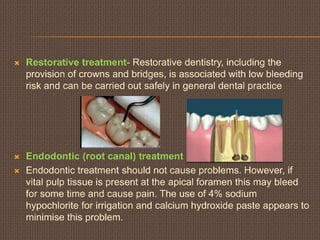
 Restorative treatment- Restorative dentistry, including the
provision of crowns and bridges, is associated with low bleeding
risk and can be carried out safely in general dental practice
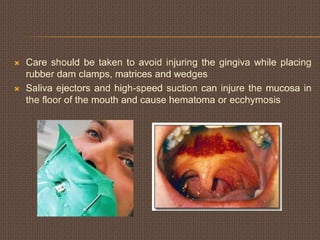
 Endodontic (root canal) treatment
 Endodontic treatment should not cause problems. However, if
vital pulp tissue is present at the apical foramen this may bleed
for some time and cause pain. The use of 4% sodium
hypochlorite for irrigation and calcium hydroxide paste appears to
minimise this problem.
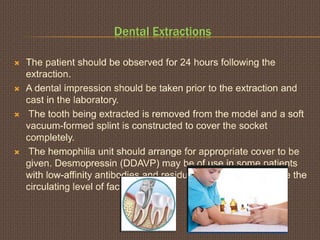
 Care should be taken to avoid injuring the gingiva while placing
rubber dam clamps, matrices and wedges
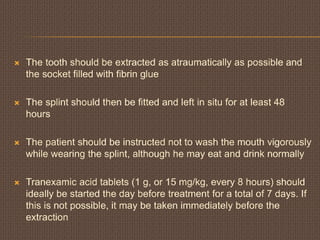
 Saliva ejectors and high-speed suction can injure the mucosa in
the floor of the mouth and cause hematoma or ecchymosis
Dental Extractions
 The patient should be observed for 24 hours following the
extraction.
 A dental impression should be taken prior to the extraction and
cast in the laboratory.
 The tooth being extracted is removed from the model and a soft
vacuum-formed splint is constructed to cover the socket
completely.
 The hemophilia unit should arrange for appropriate cover to be
given. Desmopressin (DDAVP) may be of use in some patients
with low-affinity antibodies and residual factor VIII to increase the
circulating level of factor
 The tooth should be extracted as atraumatically as possible and
the socket filled with fibrin glue
 The splint should then be fitted and left in situ for at least 48
hours
 The patient should be instructed not to wash the mouth vigorously
while wearing the splint, although he may eat and drink normally
 Tranexamic acid tablets (1 g, or 15 mg/kg, every 8 hours) should
ideally be started the day before treatment for a total of 7 days. If
this is not possible, it may be taken immediately before the
extraction
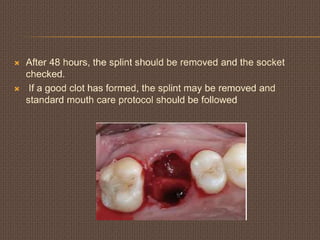
 After 48 hours, the splint should be removed and the socket
checked.
 If a good clot has formed, the splint may be removed and
standard mouth care protocol should be followed
Choice Of Medications
 Aspirin, and aspirin-containing medications, should be avoided in
patients with bleeding disorders as the haemorrhagic tendency
may worsen as a result of the inhibitory effect on platelet function
 Paracetamol and codeine-based preparations are safe
alternatives.
 There are no contra-indications to any antibiotics for patients with
congenital bleeding disorders
 Penicillins, erythromycin, metronidazole, tetracyclines and
miconazole also have potentiating effects on warfarin.

Haemophilia

  • 1.
  • 2.
     The adventof new materials, attention to meticulous operative technique, use of local haemostatic agents, and an increasing interest in the prevention of dental problems along with the development of minimally invasive techniques heralds a new era in dental care for patients with congenital bleeding disorders.
  • 3.
     There aretwo main types of haemophilia:  Haemophilia A is the commonest, accounting for approximately 85% of all cases of haemophilia (incidence 1:5,000 live male births), and characterised by a deficiency of factor VIII (FVIII).  Haemophilia B is characterised by a deficiency of factor IX (FIX) (incidence 1:30,000 live male births)
  • 7.
    Von Willebrand Disease von Willebrand disease is the commonest congenital bleeding disorder and is characterised by a deficient or abnormal plasma protein known as von Willebrand factor (vWF). It is an autosomal dominant condition, and affects both males and females.  The vWF protein stabilises FVIII and enables platelet interaction with the blood vessel wall. Bleeding after dental extractions may be a presenting feature of this condition
  • 10.
     Factor XIdeficiency differs from haemophilia A and B by the lack of bleeding into joints and muscles.  The inheritance is autosomal and may occur in either sex. There is typically an unpredictable mild bleeding tendency that may be provoked by surgery in areas with high fibrinolytic activity such as tonsillectomy and dental procedures.  The bleeding risk is difficult to assess from the level of severity of factor deficiency making this congenital bleeding disorder a challenge to treat
  • 11.
    MANAGEMENT STRATEGIES  Fourtherapeutic management options depending on the type of haemophilia and vWD, namely:  Coagulation factor replacement therapy  Release of endogenous factor stores using desmopressin (DDAVP)  Improving clot stability by antifibrinolytic drugs, for example, tranexamic acid  Local haemostatic measures.
  • 12.
    Coagulation Factor ReplacementTherapy  Factor concentrate is administered by intravenous infusion  The timing of administration is important as factor levels will decline  Dental procedures should be performed as close to the time of administration of factor concentrate as possible  One of the most feared complications following the administration of factor concentrate is the development of inhibitors or antibodies
  • 14.
    Desmopressin (Desamino-8-d-arginine Vasopressin[DDAVP])  The synthetic antidiuretic hormone, desmopressin, stimulates release of endogenous FVIII and vWF from stores in patients with mild haemophilia and Vwd  DDAVP can be administered one hour pre-procedure subcutaneously (0.3 μg/kg using the 15 μg/ml concentration)  .Alternatively, DDAVP (0.3 μg/kg in 50 ml of normal saline) can be administered intravenously (4 μg/ml concentration) one hour pre- procedure as a slow intravenous infusion over 20–30 minutes.  Fluid intake should be restricted for around 24 hours after DDAVP is given.
  • 15.
    Antifibrinolytic Agents  Tranexamicacid (Cyklokapron®) competitively inhibits the activation of plasminogen to plasmin thereby inhibiting fibrin clot lysis  Orally, tranexamic acid is given at a dose of 15–25 mg/kg which approximates to 1 g for the majority of adults every 6-8 hours.  Ideally this should be given two hours pre-operatively, and continued for up to 7-10 days post-procedure
  • 16.
    Local Haemostatic Measures Local haemostatic measures include  Oxidised Cellulose  Surgicel  Resorbable Gelatine Sponge  Gelfoam  Cyanoacrylate Tissue Adhesives And Surgical Splints  A Number Of Novel Haemostatic Agents Lyostpt® And Ankaferd Blood Stopper May Also Be Of Use Oxidized cellulose Surgicel
  • 18.
     For patientstaking warfarin, their international normalized ratio (INR) should be measured before a surgical procedure.  The normal therapeutic range is 2.0–3.0  .According to current recommendations, most oral surgical procedures can be performed without altering the warfarin dose if the INR is less than 3.0.  If INR values are greater than 3.0, physician referral is suggested.  It is important to consider the risk of reducing the level of anticoagulation in patients on warfarin due to the risk of a thromboembolic event.
  • 19.
    DENTAL TREATMENTS  Generalmeasures to reduce accidental trauma and minimise damage to oral mucosa should be employed at all times including careful use of saliva ejectors, careful removal of impressions and care in the placement of radiographic films  Local anaesthetic infiltration using a slow injection technique and modern fine gauge single-use needles can usually be used without the need for factor replacement  Augmentation of factor levels with or without tranexamic acid is required in all age groups when inferior alveolar and posterior superior alveolar dental nerve-blocks are given
  • 20.
    PROCEDURES THAT DONOT REQUIRE FACTOR COVER PROCEDURES THAT REQUIRE FACTOR COVER Buccal infiltration Inferior dental block Intra-papillary injection Lingual infiltration Intra ligamentary injection There are no restrictions regarding the type of local anaesthetic used, and 2% lidocaine with 1 in 80,000 epinephrine is routinely used in restorative dentistry Alternative techniques, including sedation with diazepam or nitrous oxide– oxygen analgesia, can be employed to reduce or eliminate the need for anesthesia.
  • 21.
    Scaling And PeriodontalDisease  Routine periodontal probing, supragingival scaling, and polish (including ultrasonic scaling) is unlikely to cause prolonged bleeding for patients, especially those with mild conditions  The use of antibacterial mouthwashes and antibiotics may be necessary.  prevention of further damage to periodontal tissues is necessary by instituting an immediate treatment plan that may require several visits to prevent excessive bleeding
  • 22.
     Factor replacementmay be required before extensive periodontal surgery and use of nerve blocks. Periodontal packing materials and custom vinyl mouthguards (stents) are used to aid in hemostasis and protect the surgical site  Antifibrinolytic agents may be incorporated into periodontal dressings for enhanced effect. Post-treatment antifibrinolytic mouthwashes are usually effective in controlling protracted bleeding.
  • 23.
    Orthodontic Treatment  Theappliance should be designed so that the gingival and buccal mucosa cannot be damaged by sharp edges or wires.  Fixed and removable orthodontic appliances may be used as long as enhanced preventive advice including oral hygiene instruction and demonstrations are carried out Prosthodontic (construction of dentures) treatment  The provision of any removable prosthesis and the use of full or partial dentures should not pose any additional problems in this group of patients  Trauma should be minimized by careful post-insertion adjustments
  • 24.
     Restorative treatment-Restorative dentistry, including the provision of crowns and bridges, is associated with low bleeding risk and can be carried out safely in general dental practice  Endodontic (root canal) treatment  Endodontic treatment should not cause problems. However, if vital pulp tissue is present at the apical foramen this may bleed for some time and cause pain. The use of 4% sodium hypochlorite for irrigation and calcium hydroxide paste appears to minimise this problem.
  • 25.
     Care shouldbe taken to avoid injuring the gingiva while placing rubber dam clamps, matrices and wedges  Saliva ejectors and high-speed suction can injure the mucosa in the floor of the mouth and cause hematoma or ecchymosis
  • 26.
    Dental Extractions  Thepatient should be observed for 24 hours following the extraction.  A dental impression should be taken prior to the extraction and cast in the laboratory.  The tooth being extracted is removed from the model and a soft vacuum-formed splint is constructed to cover the socket completely.  The hemophilia unit should arrange for appropriate cover to be given. Desmopressin (DDAVP) may be of use in some patients with low-affinity antibodies and residual factor VIII to increase the circulating level of factor
  • 27.
     The toothshould be extracted as atraumatically as possible and the socket filled with fibrin glue  The splint should then be fitted and left in situ for at least 48 hours  The patient should be instructed not to wash the mouth vigorously while wearing the splint, although he may eat and drink normally  Tranexamic acid tablets (1 g, or 15 mg/kg, every 8 hours) should ideally be started the day before treatment for a total of 7 days. If this is not possible, it may be taken immediately before the extraction
  • 28.
     After 48hours, the splint should be removed and the socket checked.  If a good clot has formed, the splint may be removed and standard mouth care protocol should be followed
  • 29.
    Choice Of Medications Aspirin, and aspirin-containing medications, should be avoided in patients with bleeding disorders as the haemorrhagic tendency may worsen as a result of the inhibitory effect on platelet function  Paracetamol and codeine-based preparations are safe alternatives.  There are no contra-indications to any antibiotics for patients with congenital bleeding disorders  Penicillins, erythromycin, metronidazole, tetracyclines and miconazole also have potentiating effects on warfarin.