endodontic failures
  and retreatment
Introdution
• In different studies success rate ranges from 54
  percent to 95 percent.

• The definition of success is ambiguous
  - stringent : radiographic and clinical normalcy
  - lenient : only clinical normalcy
Endodontic treatment
          outcome
• Healed:
  both clinical and radiographic presentations are
  normal
• Healing:
  it’s a dynamic process, reduced radiolucency
  combined with normal clinical presentation
• Disease:
  No change or increase in radiolucency, clinical
  signs may or may not be present or vice versa
Evaluation of success

• Success or failures following endodontic therapy
  could be evaluated from combination of clinical,
  histopathological and radio graphical criteria.
Clinical evaluation for
            success
• No tenderness to percussion or palpation
• Normal tooth mobility
• No evidence of subjective discomfort
• Tooth having normal form, function and
  aesthetics
• No sign of infection or swelling
• No sinus tract or integrated periodontal disease
• Minimal to no scarring or discoloration
Radiographic evaluation
        for success
• Normal or slightly thickened periodontal ligament
  space
• Reduction or elimination of previous rarefaction
• No evidence of resorption
• Normal lamina dura
• A dense three dimensional obturation of canal
  space
Histological evaluation for
          success
•   Absence of inflammation
•   Regeneration of periodontal ligament fibers
•   Presence of osseous repair
•   Repair of cementum
•   Absence of resorption
•   Repair of previously resorbed areas
Causes of the endodontic
         failures

 Bacteria somewhere in the root canal system
 Divided into local and systemic
Factors affecting success or
failure of endodontic therapy
         in every case
•   Diagnosis and the treatment planning
•   Radiographic interpretation
•   Anatomy of the tooth and root canal system
•   Debridement of the root canal space
Factors affecting success or
failure of endodontic therapy
         in every case
•   Quality and extent of apical seal
•   Quality of post endodontic restoration
•   Systemic health of the patient
•   Skill of the operator
Factors      affecting success or
      failure      of a particular case
      Factors      affecting success or
      failure      of a particular case
•   Pupal and Periodontal status
•   Size of periapical radioleucency
•   Canal anatomy
•   Crown and root fracture
Factors     affecting success or
      failure     of a particular case
      Factors     affecting success or
      failure     of a particular case
•   Iatrogenic errors
•   Extent and quality of the obturation
•   Quality of the post endodontic restoration
•   Time of post treatment evaluation
Local Factors causing
         endodontic failures
•   Infection
•   Incomplete debridement of the root canal system
•   Excessive hemorrhage
•   Chemical irritants
•   Iatrogenic errors
Infection
• infected and necrotic pulp tissue→main irritant to
  the periapical tissues
• The host parasite relationship 、 virulence of
  microorganisms , ability of infected tissues to
  heal→influence the repair of the periapical tissues
• Endo success →debridement
Incomplete debridement of
     the root canal system
• Main objective of root canal therapy→complete
  elimination
  of the microorganisms and their
  byproducts

• Poor debridement → residual
  microorganisms 、 byproducts and
  tissue debris → recolonize
Excessive hemorrhage
• Extirpation of pulp and instrumentation beyond
  periapical tissues
• Local accumulation of the blood→mild
  inflammation
• Extravasated blood cells and fluid : foreign body
  nidus for bacterial growth
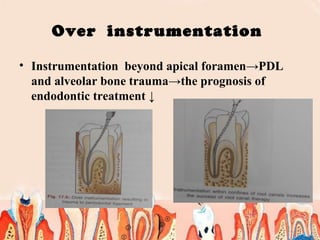
Over instrumentation

• Instrumentation beyond apical foramen→PDL
  and alveolar bone trauma→the prognosis of
  endodontic treatment ↓
Chemical irritants

• Intracanal medicaments and irrigating solution
  →extruded in the periapical tissues→the
  prognosis of endodontic treatment ↓
• One should take care while Using medicaments to
  avoid their periapical
  extrusion
Iatrogenic errors
• Separated instruments—
• Caused by improper or overuse of
•    instruments and forcing them in curved
          canals
• Prognosis : no much affected in vital pulps
        poor in necrotic tissue.
Iatrogenic errors
• Canal blockage and ledge formation—
• Accumulation of dentin chips or tissue debris
   prevent the instruments to reach its
     full working length
• Ledge formation—straight instruments in
                   curved canals
• These lead to bacteria & debris remained
                        endo failure
Iatrogenic errors
• Perforations—
• Lack of knowledge of anatomy of the tooth,
     attention, misdirection of the instruments
• Prognosis : location, time, perforation seal and
  size
• Poor prognosis  remaining
                   infected tissue
Iatrogenic errors
• Incompletely filled teeth—
• Teeth filled more than 2mm short of apex
• Several studies shown :
• poor prognosis—underfillings with necrotic
  pulps
• Overfilling of root canals—
• Overfilling extending ≧ 2mm beyond
•     radiographic apex
• Continuous irritation of the periapical
•     tissues endo failure
Iatrogenic errors
•   Anatomic factors—
•   Such as : overly curved canals, calcifications,
•   numerous lateral and accessory canals,
•       bifurcations, C or S shaped canals
•   Problems in cleaning and shaping &
•     incomplete filling of root canals
•                  endodontic failure
Iatrogenic errors
•   Root fractures—
•   Partial or complete fractures of roots
•   Prognosis of teeth :
•     vertical root is poor than horizontal fractures
•   Traumatic occlusion –
•   Cause endo failures because of its effect on
•      periodontium
Systemic factors causing
     endodontic failures

• Nutritional          • Autoimmune disorders
  deficiencies         • Opportunistic
• Diabetes mellitus      infections
• Renal failure        • Aging
• Blood dyscrasias     • Long term steroid
• Hormonal imbalance     therapy
Endodontic retreatment

 Before going/performing
 Case selection
 Prognosis ,Contraindications and problems
 Steps
Before going to endodontic
           retreatment

•   when should Treatment be considered
•   Patient’s needs
•   Strategic importance of the tooth
•   Periodontal evaluation of the tooth
•   Chair time & cost
Before performing to
      endodontic retreatment
•   May to prevent the potential disease
•   Remove/remade extensive coronal restoration
•   Technical problems
•   May not achieve better results
•   Filling materials have to be removed
•   Prognosis could be poorer
•   Patient might be more apprehensive
Case selection
• Careful history
• Anatomy of root canal , canal curvature,
  calcifications,unusual configurations
• Quality of obturation
• Iatrogenic complications
• Cooperation of the patient
Factors affecting prognosis
     of endodontic treatment
•   Periapical radiolucency
•   Quality of the obturation
•   Apical extension of the obturation material
•   Bacterial status
•   Observation period
•   Postendodontic coronal restoration
•   Iatrogenic complication
Contraindications of
       endodontic retreatment
•   Unfavorable root anatomy
•   Untreatable root resorptions or perforations
•   Root or bifurcation caries
•   Insufficient crown/root ratio
Problems of endodontic
            retreatment

•   Unpredictable result
•   Frustration
•   Cost factor
•   Time consuming
Steps of Retreatment
1.   Coronal disassembly
2.   Establish access to root canal system
3.   Remove canal obstructions
4.   Establish patency
5.   Thorough cleaning, shaping and obturation of
     the canal
1. Coronal Disassembly
• Removal of existing   • Access made through
  coronal restoration     coronal restoration
Disadvantages of
Advantages of gaining         retaining a
access through                restoration:
original restoration:
                             a. Reduce visibility and
a. Facilitate rubber dam
                                accessibility
   placement
                             b. Increased risks of
b. Maintaining form,
                                irreparable errors
   function and aesthetics
                             c. Increased risks of
c. Reducing the
                                microbial infection if
  cost of replacement           crown margins are
                                poorly adapted
Advice:
Remove the existing restoration
Especially: poor marginal
 adaptation, secondary caries
Place temporary crown
 to maintain form, function
 and aesthetics.
2. Establish Access to Root
   Canal System

Teeth restored with post and
core:
1.Post and core need to be
removed for gaining access to
root canal system
2.Post and core can be perforated
to gain access
Posts can be removed by:

1. Weakening retention of
   posts by use of ultrasonic
   vibration.
2. Forceful pulling of posts but it increases the risk
   of root fracture
3. Removing posts with the help of special pliers
   using post removal systems
Post Removal System(PRS)

•   5 various designed trephines
•   Corresponding taps(microtubular tap)
•   Torque bar
•   Transmetal bur
•   Rubber bumpers
•   Extracting plier
1-Transmental bur
Effeciently dooming of the post head
2-Add lubricant

• EX: RC Prep
• Be placed on the post head to further facilitate the
  machining process
3-Trephine bur
Use the largest bur to machine down
  the coronal 2-3 mm of the post.
4-Rubber bumper
inserted on the tab & pushed on the occlusal
surface.
Act as a cushion, distribute the loads and
protect thetooth during the removal
 procedure.
5-Microtubular tap
• Inserted against the post head.
• Screwed it into post with counter clockwise
  direction and strongly engage the post.
Post removal plier
• Mount the post removal plier on tubular tap
• Ultrasonic instrument using/torque bar inserting
                                       Ultrasonic instrument

    Screw knob                            Tubular tap


                                         Rubber bumper
      plier
Post removal plier

1 -Nonsurgical Removal of Posts Broken Instruments - YouTube_x264.mp4
Removing Canal
  Obstructions and
Establishing Patency
Silver Point Removal
 A- Microsurgical forceps
Silver point removal

      B-Ultrasonic
Siver point removal

C- Using Hedstroem files(H-files)
Silver Point Removal

E- Post removal system kit.
D- Instrument removal system(IRS).
Gutta-Percha Removal
• The relative difficulty in removing gutta-percha is
  influenced by some factors of canal system:
    Length
    Diameter
    Curvature
    Internal configuration
• Progressive Manner :
   gutta-percha is best removed from canal in
  progressive manner to prevent its extrusion
  periapically
Gutta-Percha Removal
• Coronal portion of gutta-percha should always be
  explored by Gates-Gliddens to:
    Quickly : Remove gutta-percha quickly
    Solvent : Provide space for solvents
    Convenience : Improve convenience form
• Gutta-percha can be removed by using:
    Solvents
    Hand instruments
    Rotary instruments
    Microdebrider
1. Solvents
•   GP is soluble in:
     Chloroform : most effective but carcinogenic with
      high concentratin , excessive filling in pulp
      chamber is avoided
     Methyl chloroform
     Benzene
     Xylene
     Eucalyptol oil
     Halothane

•   GP dissolution should be supplemented by using
    hand instruments
2. Hand Instruments

 Used mainly in apical portion of the canal.
• Hedstroem files
• Hot endodontic instrument like Reamer or files

    Poorly condenced GP can be pulled easily
3. Rotary Instruments
•They are Safe to be used in straight canals
   Recently:
•ProTaper universal systems
    Consisting of file :D1 D2 D3
    500-700 rpm
Protaper universal system

• D1 :
    Remove filling from the coronal third
• D2 :
    Remove filling from the middle third
• D3 :
    Remove filling from appical third
Microdebriders

    A small files with 90 degrees bends

    Removing remaining gutta-percha on the sides
    of canal walls
Pastes and Cement

    Soft setting pastes
       
           Penetrated by endodontic instruments

    Hard setting cements
       
           Softened by solvents: xylene, eucalyptol......
           Then removed by files .
       
           Ultrasonic devices
Separated Instruments and
         Foreign Objects

    Coronal third – attempt retrieval

    Middle third – attempt retrieval or bypass

    Apical third – surgical treat
Separated Instruments and
           Foreign Objects

    Attempt retrieval
       
          Mechanism → Stieglitz pliers, Massermann
          extractor
       
          Vibration → Ultrasonics
       
          Accessibility → Modified Gates Glidden
          bur

    Bypass
       
          Reamers or files with copious irrigation

    Surgical treat
       
          Apicoectomy
Ultrasonic


4-endo(instrument removal) - YouTube_x264.mp4
Instrument removal system (IRS)
    Can be used to remove the
          broken files


  microtube   screw wedge
The beveled end of the microtube        The introduction of the screw wedge which is
oriented toward the outer wall of the   rotated CCW to engage and displace the head
canal to “scoop up” the head of the     of the file out the side window.
broken file.
Completion of the
               Retreatment

    Thorough cleaning, shaping and obturation

    The outcome of retreatment
       
            Short-term: no pain and swelling
       
            Long-term: depended regaining canal patency &
            obturation of the root canal system

    Retreatment is mostly associated with procedural
    complication.

    Effective communication is required b/t dentist & patient.

Endodontic failures

  • 1.
    endodontic failures and retreatment
  • 2.
    Introdution • In differentstudies success rate ranges from 54 percent to 95 percent. • The definition of success is ambiguous - stringent : radiographic and clinical normalcy - lenient : only clinical normalcy
  • 3.
    Endodontic treatment outcome • Healed: both clinical and radiographic presentations are normal • Healing: it’s a dynamic process, reduced radiolucency combined with normal clinical presentation • Disease: No change or increase in radiolucency, clinical signs may or may not be present or vice versa
  • 4.
    Evaluation of success •Success or failures following endodontic therapy could be evaluated from combination of clinical, histopathological and radio graphical criteria.
  • 5.
    Clinical evaluation for success • No tenderness to percussion or palpation • Normal tooth mobility • No evidence of subjective discomfort • Tooth having normal form, function and aesthetics • No sign of infection or swelling • No sinus tract or integrated periodontal disease • Minimal to no scarring or discoloration
  • 6.
    Radiographic evaluation for success • Normal or slightly thickened periodontal ligament space • Reduction or elimination of previous rarefaction • No evidence of resorption • Normal lamina dura • A dense three dimensional obturation of canal space
  • 7.
    Histological evaluation for success • Absence of inflammation • Regeneration of periodontal ligament fibers • Presence of osseous repair • Repair of cementum • Absence of resorption • Repair of previously resorbed areas
  • 8.
    Causes of theendodontic failures  Bacteria somewhere in the root canal system  Divided into local and systemic
  • 9.
    Factors affecting successor failure of endodontic therapy in every case • Diagnosis and the treatment planning • Radiographic interpretation • Anatomy of the tooth and root canal system • Debridement of the root canal space
  • 10.
    Factors affecting successor failure of endodontic therapy in every case • Quality and extent of apical seal • Quality of post endodontic restoration • Systemic health of the patient • Skill of the operator
  • 11.
    Factors affecting success or failure of a particular case Factors affecting success or failure of a particular case • Pupal and Periodontal status • Size of periapical radioleucency • Canal anatomy • Crown and root fracture
  • 12.
    Factors affecting success or failure of a particular case Factors affecting success or failure of a particular case • Iatrogenic errors • Extent and quality of the obturation • Quality of the post endodontic restoration • Time of post treatment evaluation
  • 13.
    Local Factors causing endodontic failures • Infection • Incomplete debridement of the root canal system • Excessive hemorrhage • Chemical irritants • Iatrogenic errors
  • 14.
    Infection • infected andnecrotic pulp tissue→main irritant to the periapical tissues • The host parasite relationship 、 virulence of microorganisms , ability of infected tissues to heal→influence the repair of the periapical tissues • Endo success →debridement
  • 15.
    Incomplete debridement of the root canal system • Main objective of root canal therapy→complete elimination of the microorganisms and their byproducts • Poor debridement → residual microorganisms 、 byproducts and tissue debris → recolonize
  • 16.
    Excessive hemorrhage • Extirpationof pulp and instrumentation beyond periapical tissues • Local accumulation of the blood→mild inflammation • Extravasated blood cells and fluid : foreign body nidus for bacterial growth
  • 17.
    Over instrumentation • Instrumentationbeyond apical foramen→PDL and alveolar bone trauma→the prognosis of endodontic treatment ↓
  • 18.
    Chemical irritants • Intracanalmedicaments and irrigating solution →extruded in the periapical tissues→the prognosis of endodontic treatment ↓ • One should take care while Using medicaments to avoid their periapical extrusion
  • 19.
    Iatrogenic errors • Separatedinstruments— • Caused by improper or overuse of • instruments and forcing them in curved canals • Prognosis : no much affected in vital pulps poor in necrotic tissue.
  • 20.
    Iatrogenic errors • Canalblockage and ledge formation— • Accumulation of dentin chips or tissue debris prevent the instruments to reach its full working length • Ledge formation—straight instruments in curved canals • These lead to bacteria & debris remained endo failure
  • 21.
    Iatrogenic errors • Perforations— •Lack of knowledge of anatomy of the tooth, attention, misdirection of the instruments • Prognosis : location, time, perforation seal and size • Poor prognosis  remaining infected tissue
  • 22.
    Iatrogenic errors • Incompletelyfilled teeth— • Teeth filled more than 2mm short of apex • Several studies shown : • poor prognosis—underfillings with necrotic pulps • Overfilling of root canals— • Overfilling extending ≧ 2mm beyond • radiographic apex • Continuous irritation of the periapical • tissues endo failure
  • 23.
    Iatrogenic errors • Anatomic factors— • Such as : overly curved canals, calcifications, • numerous lateral and accessory canals, • bifurcations, C or S shaped canals • Problems in cleaning and shaping & • incomplete filling of root canals •  endodontic failure
  • 24.
    Iatrogenic errors • Root fractures— • Partial or complete fractures of roots • Prognosis of teeth : • vertical root is poor than horizontal fractures • Traumatic occlusion – • Cause endo failures because of its effect on • periodontium
  • 25.
    Systemic factors causing endodontic failures • Nutritional • Autoimmune disorders deficiencies • Opportunistic • Diabetes mellitus infections • Renal failure • Aging • Blood dyscrasias • Long term steroid • Hormonal imbalance therapy
  • 26.
    Endodontic retreatment  Beforegoing/performing  Case selection  Prognosis ,Contraindications and problems  Steps
  • 27.
    Before going toendodontic retreatment • when should Treatment be considered • Patient’s needs • Strategic importance of the tooth • Periodontal evaluation of the tooth • Chair time & cost
  • 28.
    Before performing to endodontic retreatment • May to prevent the potential disease • Remove/remade extensive coronal restoration • Technical problems • May not achieve better results • Filling materials have to be removed • Prognosis could be poorer • Patient might be more apprehensive
  • 29.
    Case selection • Carefulhistory • Anatomy of root canal , canal curvature, calcifications,unusual configurations • Quality of obturation • Iatrogenic complications • Cooperation of the patient
  • 30.
    Factors affecting prognosis of endodontic treatment • Periapical radiolucency • Quality of the obturation • Apical extension of the obturation material • Bacterial status • Observation period • Postendodontic coronal restoration • Iatrogenic complication
  • 31.
    Contraindications of endodontic retreatment • Unfavorable root anatomy • Untreatable root resorptions or perforations • Root or bifurcation caries • Insufficient crown/root ratio
  • 32.
    Problems of endodontic retreatment • Unpredictable result • Frustration • Cost factor • Time consuming
  • 33.
    Steps of Retreatment 1. Coronal disassembly 2. Establish access to root canal system 3. Remove canal obstructions 4. Establish patency 5. Thorough cleaning, shaping and obturation of the canal
  • 34.
    1. Coronal Disassembly •Removal of existing • Access made through coronal restoration coronal restoration
  • 35.
    Disadvantages of Advantages ofgaining retaining a access through restoration: original restoration: a. Reduce visibility and a. Facilitate rubber dam accessibility placement b. Increased risks of b. Maintaining form, irreparable errors function and aesthetics c. Increased risks of c. Reducing the microbial infection if cost of replacement crown margins are poorly adapted
  • 36.
    Advice: Remove the existingrestoration Especially: poor marginal adaptation, secondary caries Place temporary crown to maintain form, function and aesthetics.
  • 37.
    2. Establish Accessto Root Canal System Teeth restored with post and core: 1.Post and core need to be removed for gaining access to root canal system 2.Post and core can be perforated to gain access
  • 38.
    Posts can beremoved by: 1. Weakening retention of posts by use of ultrasonic vibration. 2. Forceful pulling of posts but it increases the risk of root fracture 3. Removing posts with the help of special pliers using post removal systems
  • 39.
  • 40.
    Post Removal System(PRS) • 5 various designed trephines • Corresponding taps(microtubular tap) • Torque bar • Transmetal bur • Rubber bumpers • Extracting plier
  • 41.
  • 42.
    2-Add lubricant • EX:RC Prep • Be placed on the post head to further facilitate the machining process
  • 43.
    3-Trephine bur Use thelargest bur to machine down the coronal 2-3 mm of the post.
  • 44.
    4-Rubber bumper inserted onthe tab & pushed on the occlusal surface. Act as a cushion, distribute the loads and protect thetooth during the removal procedure.
  • 45.
    5-Microtubular tap • Insertedagainst the post head. • Screwed it into post with counter clockwise direction and strongly engage the post.
  • 46.
    Post removal plier •Mount the post removal plier on tubular tap • Ultrasonic instrument using/torque bar inserting Ultrasonic instrument Screw knob Tubular tap Rubber bumper plier
  • 47.
    Post removal plier 1-Nonsurgical Removal of Posts Broken Instruments - YouTube_x264.mp4
  • 48.
    Removing Canal Obstructions and Establishing Patency
  • 49.
    Silver Point Removal A- Microsurgical forceps
  • 50.
  • 52.
    Siver point removal C-Using Hedstroem files(H-files)
  • 53.
    Silver Point Removal E-Post removal system kit. D- Instrument removal system(IRS).
  • 54.
    Gutta-Percha Removal • Therelative difficulty in removing gutta-percha is influenced by some factors of canal system:  Length  Diameter  Curvature  Internal configuration • Progressive Manner : gutta-percha is best removed from canal in progressive manner to prevent its extrusion periapically
  • 55.
    Gutta-Percha Removal • Coronalportion of gutta-percha should always be explored by Gates-Gliddens to:  Quickly : Remove gutta-percha quickly  Solvent : Provide space for solvents  Convenience : Improve convenience form • Gutta-percha can be removed by using:  Solvents  Hand instruments  Rotary instruments  Microdebrider
  • 56.
    1. Solvents • GP is soluble in:  Chloroform : most effective but carcinogenic with high concentratin , excessive filling in pulp chamber is avoided  Methyl chloroform  Benzene  Xylene  Eucalyptol oil  Halothane • GP dissolution should be supplemented by using hand instruments
  • 57.
    2. Hand Instruments Used mainly in apical portion of the canal. • Hedstroem files • Hot endodontic instrument like Reamer or files Poorly condenced GP can be pulled easily
  • 58.
    3. Rotary Instruments •Theyare Safe to be used in straight canals Recently: •ProTaper universal systems  Consisting of file :D1 D2 D3  500-700 rpm
  • 59.
    Protaper universal system •D1 : Remove filling from the coronal third • D2 : Remove filling from the middle third • D3 : Remove filling from appical third
  • 60.
    Microdebriders  A small files with 90 degrees bends  Removing remaining gutta-percha on the sides of canal walls
  • 61.
    Pastes and Cement  Soft setting pastes  Penetrated by endodontic instruments  Hard setting cements  Softened by solvents: xylene, eucalyptol...... Then removed by files .  Ultrasonic devices
  • 62.
    Separated Instruments and Foreign Objects  Coronal third – attempt retrieval  Middle third – attempt retrieval or bypass  Apical third – surgical treat
  • 63.
    Separated Instruments and Foreign Objects  Attempt retrieval  Mechanism → Stieglitz pliers, Massermann extractor  Vibration → Ultrasonics  Accessibility → Modified Gates Glidden bur  Bypass  Reamers or files with copious irrigation  Surgical treat  Apicoectomy
  • 64.
  • 65.
    Instrument removal system(IRS) Can be used to remove the broken files microtube screw wedge
  • 66.
    The beveled endof the microtube The introduction of the screw wedge which is oriented toward the outer wall of the rotated CCW to engage and displace the head canal to “scoop up” the head of the of the file out the side window. broken file.
  • 68.
    Completion of the Retreatment  Thorough cleaning, shaping and obturation  The outcome of retreatment  Short-term: no pain and swelling  Long-term: depended regaining canal patency & obturation of the root canal system  Retreatment is mostly associated with procedural complication.  Effective communication is required b/t dentist & patient.