OBTURATION OF THE CLEANED &
SHAPED ROOT CANAL SYSTEM
Dr POOJA JAYAN
CONTENTS SECTION I
• Importance of Effectively
Sealing the Root Canal System
• Historical Perspectives
• Timing of Obturation
• Length of Obturation
• Preparation for Obturation
• The Ideal Root Canal Filling
• Types of Sealers
• Sealer Placement
• Core Materials
SECTION II
Methods of Obturation
• Cold lateral compaction
• Warm vertical Compaction
• Continuous wave Compaction
• Thermoplastic Injection
Techniques
• Warm Lateral Compaction
• Carrier-Based Gutta-Percha
• Thermomechanical
Compaction
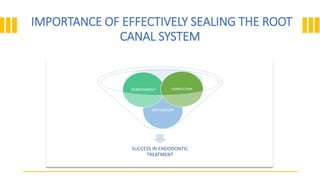
IMPORTANCE OF EFFECTIVELY SEALING THE ROOT
CANAL SYSTEM
SUCCESS IN ENDODONTIC
TREATMENT
OBTURATION
DEBRIDEMENT DISINFECTION
DEFINITION
OBTURATION
The method used to fill and seal a cleaned and
shaped root canal using a root canal sealer and
core filling material.
American Association Of Endodontists (AAE) Glossary of Endodontic terms
5
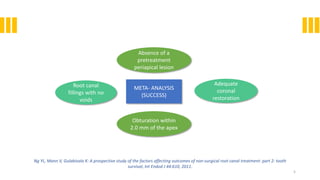
META- ANALYSIS
(SUCCESS)
Absence of a
pretreatment
periapical lesion
Root canal
fillings with no
voids
Obturation within
2.0 mm of the apex
Adequate
coronal
restoration
Ng YL, Mann V, Gulabivala K: A prospective study of the factors affecting outcomes of non-surgical root canal treatment: part 2: tooth
survival, Int Endod J 44:610, 2011.
BIOLOGICAL
CONSIDERATIONS
ON ROOT CANAL
OBTURATION
• NEED FOR OBTURATION
• IMPORTANCE OF CORONAL SEAL vs IMPORTANCE
OF ROOT CANAL FILLING
Stagnation theory (or) Hollow tube theory by Rickert and Dixon (1931)
• Empty space within a living organism tends to fill with tissue fluids in a short period of time
• This theory was based on the observation of an inflammatory reaction around the ends of
hollow steel and platinum anesthetic needle fragments implanted in experimental animals.
• This reaction did not occur if the implant was made of a solid, non-porous material.
Coolidge 1939
• Just as within unfilled or underfilled root canals, fluids that accumulate within empty spaces
are rapidly colonized by microorganisms reaching these spaces by means of “anachoresis”
and causing inflammatory reaction.
• For years, this theory has influenced the concept that the root canals must be filled to the
apex.
• If not, empty spaces would quickly be colonized by bacteria, through anachoresis, and
would prevent or delay healing of the periapical tissues.
• Later studies have shown evidence refuting the “hollow tube” theory.
• It has been demonstrated, in experimental animals, that empty spaces made inside plastic
teeth, implanted in fresh sockets, did not produce any inflammation around the open ends.
• In many cases these spaces were subsequently filled with fibrous tissue or bone.
Davis SM, Joseph WS, Bucher JF. Periapical and intracanal healing following incomplete root canal fillings in dogs. Oral Surg Oral Med Oral Pathol. 1971;31:662–675
• In order for anachoresis to occur, the presence of blood vessels is necessary.
• Microorganisms can easily invade a space where tissue is present, inflamed, or partially
necrotic, traveling via the blood circulation.
• However, this is not the case where active blood circulation doesn’t exist – Necrotic cases
• Toronto group evaluated success and failure of root canal treatment at 4 to 6 years after
completion of treatment
• Primary root canal treatment 
• Flared preparation and vertical compaction of warm gutta-percha(90% success rate) >
step-back preparation and lateral compaction (80%)
• Adequate length had a higher success rate (87%) when compared with inadequate
length (77%)
Farzaneh M, Abitbol S, Lawrence HP, et al: Treatment outcome in endodontics—the Toronto Study. Phase II: initial treatment, J Endod 30:302, 2004
• Washington Study - early radiographic study of success and failure, Ingle and colleagues
• Indicated that 58% of treatment failures were due to incomplete obturation.
• Teeth that are poorly obturated are often poorly prepared. Procedural errors such as loss of
length, canal transportation, perforations, loss of coronal seal, and vertical root fracture may
have occurred.
Ingle JI, Beveridge E, Glick D, et al: The Washington Study. In: Ingle I, Taintor JF, editors. Endodontics, Philadelphia, 1994, Lea & Febiger, pp 1–53.
• It is prudent that clean and shaped root canals must be completely obturated to prevent re-
infection.
• Complete sterilization and removal of all pulpal debris from an infected root canal is very difficult,
if not impossible
• What is achieved, in most cases, is the disinfection of the root canal system.
• Residual microorganisms may remain inside the root canal system, mainly within dentinal
tubules.
• Presence of necrotic pulp remnants, together with the accumulating exudate, can contribute to
their viability.
• If the root canal system is completely obturated in all three dimensions, any remaining
microorganism may be “entrapped” without nutritional sources and with reduced possibility of
proliferation
• Sjogren et al. studied the influence of the presence of infection at the time of root canal filling,
on the outcome of endodontic treatment, in teeth with apical periodontitis.
• They theorized that success obtained, despite positive bacterial cultures, was due to the bacteria
“entombed” in the canal.
• Moawad has demonstrated that bacteria entrapped within a completely filled root canal
become nonviable within five days after root canal filling.
• Obturation with gutta-percha and sealer after chemomechanical cleaning and disinfection with
sodium hypochlorite also deprives the remaining microorganisms from their nutrient supply,
thereby reducing their ability to cause or maintain disease.
• It has been demonstrated that most microorganisms in the dentinal tubules died within 24 hours
after removal of the nutrient medium.
Sjögren V, Figdor D, Persson S, Sundquist G. Influence of infection at the time of root filling on the outcome of endodontic treatment of teeth with apical periodontitis. Int Endod J. 1997;30:297–306.
• Coronal leakage has also been proposed to contribute to treatment failure based on in vitro
leakage studies.
• The clinical implication is that retreatment has to be performed in those teeth that are not
restored permanently after 3 months of root canal treatment.
• This controversial issue has been recently challenged, as this data stimulated intense
research and discussions for almost two decades
Ricucci D, Bergenholtz G: Bacterial status in root-filled teeth exposed to the oral environment by loss of restoration and fracture or caries—a histobacteriological study of treated cases, Int Endod J 36:787, 2003
A recent systematic review and meta-analysis of the results derived from nine similar studies
indicate that poor quality root canal treatment and poor quality coronal restorations have
similar odds in adversely affecting the healing of apical periodontitis
Gillen BM, Looney SW, Gu LS, et al: Impact of the quality of coronal restoration versus the quality of root canal fillings on success of root canal treatment: a
systematic review and meta-analysis, J Endod 37:895, 2011.
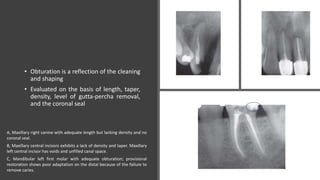
• Obturation is a reflection of the cleaning
and shaping
• Evaluated on the basis of length, taper,
density, level of gutta-percha removal,
and the coronal seal
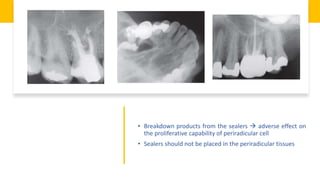
A, Maxillary right canine with adequate length but lacking density and no
coronal seal.
B, Maxillary central incisors exhibits a lack of density and taper. Maxillary
left central incisor has voids and unfilled canal space.
C, Mandibular left first molar with adequate obturation; provisional
restoration shows poor adaptation on the distal because of the failure to
remove caries.
HISTORICAL PERSPECTIVES
• “Hermetic seal” -- a major goal of root canal treatment
• Before 1800 - gold.
• Various metals, oxychloride of zinc, paraffin, and
amalgam
• 1847, Hill  first gutta-percha root canal filling material
known as “Hill’s stopping.”
• In 1887 the S.S. White Company began to manufacture
gutta-percha points
Koch CRE, Thorpe BLT: A history of dentistry, vols. 2 and 3, Fort Wayne, IN, 1909, National Art Publishing Company
OBJECTIVES OF
OBTURATION
Substitution of an inert
filling in the space
previously occupied by the
pulp tissue
To eliminate leakage from
the oral cavity or the
periradicular tissues into
the root canal system
To seal within the system
any irritants that cannot be
fully removed during canal
cleaning and shaping
procedures
To adequately seal
iatrogenic causes such
perforations, ledges and
zipped apices
To attain a radiographic
appearance of a three
dimensional filling which
extends as close as possible
to the CDJ
TIMING OF
OBTURATION
Patient’s signs and symptoms
Status of the pulp and periradicular tissue
The degree of difficulty
Patient management.
VITAL PULP
TISSUE
One-step treatment
procedures
Relative absence of
bacterial contamination
Leakage during the
period between patient
visits can beavoided
Pain occurs as the result
of irreversible pulpitis
obturation can occur at
the initial visit- removal
of vital tissue resolves
pain
Figini L, Lodi G, Gorni F, et al: Single versus multiple visits for endodontic treatment of permanent teeth: a Cochrane systematic review, J Endod 34:1041, 2008.
NECROTIC PULP TISSUE
• Pulp necrosis with or without asymptomatic periradicular pathosis - treated
in one visit
• Acute symptoms caused by pulp necrosis and acute periradicular abscess -
delayed until patient is asymptomatic
• No significant difference in the healing rates of apical periodontitis between
single-visit and multiple-visit root canal treatment
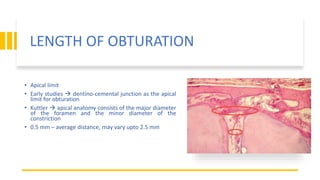
LENGTH OF OBTURATION
• Apical limit
• Early studies  dentino-cemental junction as the apical
limit for obturation
• Kuttler  apical anatomy consists of the major diameter
of the foramen and the minor diameter of the
constriction
• 0.5 mm – average distance, may vary upto 2.5 mm
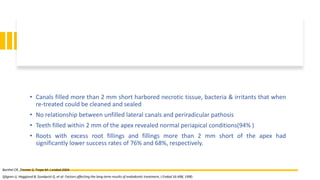
• Canals filled more than 2 mm short harbored necrotic tissue, bacteria & irritants that when
re-treated could be cleaned and sealed
• No relationship between unfilled lateral canals and periradicular pathosis
• Teeth filled within 2 mm of the apex revealed normal periapical conditions(94% )
• Roots with excess root fillings and fillings more than 2 mm short of the apex had
significantly lower success rates of 76% and 68%, respectively.
Sjögren U, Hagglund B, Sundqvist G, et al: Factors affecting the long-term results of endodontic treatment, J Endod 16:498, 1990.
Barthel CR, Zimmer S, Trope M: J endod 2004
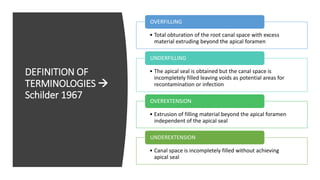
DEFINITION OF
TERMINOLOGIES 
Schilder 1967
• Total obturation of the root canal space with excess
material extruding beyond the apical foramen
OVERFILLING
• The apical seal is obtained but the canal space is
incompletely filled leaving voids as potential areas for
recontamination or infection
UNDERFILLING
• Extrusion of filling material beyond the apical foramen
independent of the apical seal
OVEREXTENSION
• Canal space is incompletely filled without achieving
apical seal
UNDEREXTENSION
Anatomical Apex - represents the geometric vertex of the root
Radiographic Apex -that represents the anatomic apex as seen on the radiograph.
The terminal point of the root canal - not always at the radiographic apex and therefore cannot be used as a reference point to the actual
working length.
Radiographic Terminus of the canal refers to the point at which the endodontic instrument, within the root canal, radiographically
encounters the external profile of the root.
Endodontic Or Physiologic Apex indicates the cemento-dentinal junction, which usually corresponds to the narrowest area of the canal
lumen.
Apical Foramen refers to the opening of the root canal on the external surface of the root
TO CONCLUDE
• Many reliable electronic apex locators are available today, and they indicate the end of the canal (which is the foramen)
• Therefore we can assert that all of our endodontic treatments are performed at the “electronic apex”
• 50% of the times coincides with the radiographic apex because the root canal is straight.
• The other 50% of the times the root canal is not straight but is curved and when it makes a curvature, about 40% of the times the
curvature is to the mesial or to the distal (so that the “radiographic terminus of the canal” can still be seen on the radiograph)
• Only about 10 % of the times the curvature is to the buccal or to the lingual. These are the cases where we must rely on the
electronic apex locators only and these are the cases that appear to be “radiographically short”.
Castellucci A, Falchetta M, Sinigaglia F. La determinazione radiografica della sede del forame apicale. G It Endo. 1993;3:114–122.
PREPARATION
FOR
OBTURATION
• SMEAR LAYER
• Act as a physical barrier, decreasing bacterial
penetration into tubules
• Interfere with adhesion and penetration of sealers
into dentinal tubules
• Interfere with the action of irrigants used as
disinfectants.
• Root canal filling materials adapt better to the canal
walls after smear layer removal
• 1-minute exposure to 10 mL of EDTA  remove the
smear layer
Leonard JE, Gutmann JL, Guo IY , Int Endod J 29:76, 1996
SEALERS
• Exhibits tackiness when mixed to provide good adhesion between it and the canal wall when set
• Establishes a hermetic seal
• Radiopaque
• Very fine powder, so that it can mix easily with liquid
• No shrinkage on setting
• No staining
• Bacteriostatic or at least does not encourage bacterial growth
• Exhibits a slow set
• Insoluble in tissue fluids
• Tissue tolerant; that is, non irritating to periradicular tissue
• Soluble in a common solvent if it is necessary to remove the root canal filling
• Breakdown products from the sealers  adverse effect on
the proliferative capability of periradicular cell
• Sealers should not be placed in the periradicular tissues
ZINC OXIDE AND EUGENOL
• Resorb if extruded into the periradicular tissues
• Antimicrobial activity.
• Slow setting time
• Shrinkage on setting
• Solubility
• Stain tooth structure
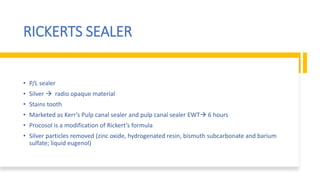
RICKERTS SEALER
• P/L sealer
• Silver  radio opaque material
• Stains tooth
• Marketed as Kerr’s Pulp canal sealer and pulp canal sealer EWT 6 hours
• Procosol is a modification of Rickert’s formula
• Silver particles removed (zinc oxide, hydrogenated resin, bismuth subcarbonate and barium
sulfate; liquid eugenol)
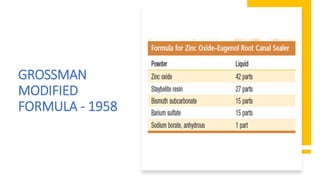
GROSSMAN
MODIFIED
FORMULA - 1958
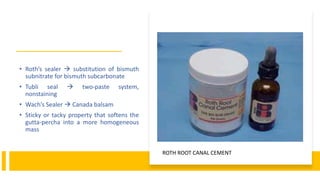
• Roth’s sealer  substitution of bismuth
subnitrate for bismuth subcarbonate
• Tubli seal  two-paste system,
nonstaining
• Wach’s Sealer  Canada balsam
• Sticky or tacky property that softens the
gutta-percha into a more homogeneous
mass
ROTH ROOT CANAL CEMENT
NON EUGENOL SEALERS
• Developed from a periodontal dressing
• Nogenol
• Root canal sealer without the irritating effects of eugenol
• Base Zinc Oxide, Barium Sulfate & Bismuth Oxychloride.
CALCIUM HYDROXIDE SEALERS
• Calciobiotic root canal sealer (CRCS) : Zinc Oxide–eugenol sealer + Calcium hydroxide as one
ingredient
• Sealapex : catalyst-base system
• The base contains zinc oxide, calcium hydroxide, butyl benzene, sulfonamide, and zinc
stearate. The catalyst contains barium sulfate and titanium dioxide as radiopacifiers in
addition to resin, isobutyl salicylate, and aerosol R972.
• Apexit and Apexit Plus : salicylates incorporated
• Activator (disalicylate, bismuth hydroxide/bismuth carbonate, and fillers) and a base (calcium
hydroxide, hydrated colophonium [i.e., pine resin], and fillers).
• Cytotoxicity : Sealapex > CRCS > Apexit
Desai S, Chandler N: Calcium hydroxide-based root canal sealers: a review, J Endod 35:475, 2009.
Mohammadi Z, Dummer PM: Properties and applications of calcium hydroxide in endodontics, Int Endod J 44:697, 2011.
GLASS IONOMER SEALERS
• Dentin-bonding properties
• Ketac-Endo
• Difficult to properly condition the dentinal walls in the apical and middle thirds
• Disadvantage 
Removal if retreatment is required
Minimal antimicrobial activity
Loest C, Trope M, Friedman S, J Endod 19:201, 1993
Heling I ; J Endod 22:257, 1996..
RESIN SEALERS
• Provide adhesion, and do not contain eugenol
• Two major categories
Epoxy resin–based
Methacrylate resin–based sealers
EPOXY RESIN SEALERS
• AH-26
• slow-setting epoxy resin
• release formaldehyde
• AH Plus
• Formaldehyde is not released
• Working time ̴ 4 hours.
• Sealing abilities of AH-26 and AH Plus appear comparable
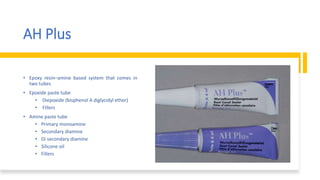
AH Plus
• Epoxy resin–amine based system that comes in
two tubes
• Epoxide paste tube
• Diepoxide (bisphenol A diglycidyl ether)
• Fillers
• Amine paste tube
• Primary monoamine
• Secondary diamine
• Di secondary diamine
• Silicone oil
• Fillers
METHACRYLATE RESIN SEALERS
FOUR GENERATIONS
• First generation of hydrophilic methacrylate resin–based material  Hydron
• En masse root filling  mid 1970s
• Major component of Hydron was poly [2-hydroxyethyl methacrylate] (poly[HEMA])
• Injected into a root canal and polymerized
• Without the adjunctive use of a root-filling material
METHACRYLATE RESIN SEALERS
 Second generation of bondable sealer is nonetching and hydrophilic in nature
 Does not require use of a dentin adhesive
• Flow into accessory canals and dentinal tubules to facilitate resin tag formation for
retention and seal after smear layer removal
• EndoREZ : Dual-cured radiopaque hydrophilic methacrylate sealer that contains non-
acidic diurethane dimethacrylate
• Seal best when applied to slightly moist intraradicular dentin
METHACRYLATE RESIN SEALERS
• Recommended with either a conventional gutta-percha cone or with specific EndoREZ points
• A retrospective clinical and radiographic study  10-year treatment outcome of one-visit root
canal treatment using gutta-percha and the EndoREZ sealer  success of 92.1% after 10 years
Zmener O, Pameijer CH: Clinical and radiographic evaluation of a resin-based root canal sealer: 10-year recall data, Int J Dent 2012:763248, 2012.
METHACRYLATE RESIN SEALERS
Third generation self-etching sealers
• contain a self-etching primer
• a dual-cured resin composite root canal sealer
• acidic primer penetrates through the smear layer and demineralizes the superficial
dentin.
• air-dried and then a dual-cured moderately filled flowable resin composite sealer is
applied and polymerized.
METHACRYLATE RESIN SEALERS
• Popularized following the introduction of Resilon
• A dimethacrylate-containing polycaprolactone-based thermoplastic root-filling material
• RealSeal
• Self-etching primers are supplied as a single-bottle system
• 2-acrylamido-2-methyl-propanesulfonic acid (AMPS) as the functional acidic monomer
METHACRYLATE RESIN SEALERS
• Fourth-generation methacrylate resin–based sealers e.g., MetaSEAL
• functionally analogous to self-adhesive resin luting cements
• eliminated the separate etching/bonding step
• all-in-one self-etching, self-adhesive sealer  reduces errors that may occur during each
bonding step
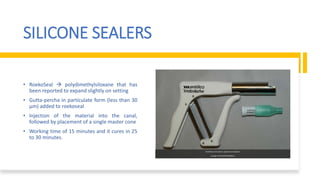
SILICONE SEALERS
• RoekoSeal  polydimethylsiloxane that has
been reported to expand slightly on setting
• Gutta-percha in particulate form (less than 30
μm) added to roekoseal
• Injection of the material into the canal,
followed by placement of a single master cone
• Working time of 15 minutes and it cures in 25
to 30 minutes.
GuttaFlow trituration capsule and injection
syringe (Coltène/Whaledent).
• Fills canal irregularities with consistency
• Biocompatible
• Setting time is inconsistent
• Delayed by final irrigation with sodium hypochlorite.
• Sealing ability appears comparable to other techniques in some studies and inferior in others
Bouillaguet S, Wataha JC, Tay FR, et al, J Endod 32:989, 2006
Brackett MG, Martin R, Sword J, et al:, J Endod 32:1188, 2006.
CALCIUM SILICATE SEALERS
• Based on mineral trioxide aggregate (MTA)
• set by reaction with water and form a highly alkaline (pH of about 12) mixture consisting of a
rigid matrix of calcium silicate hydrates and calcium hydroxide
• Setting time 165 minutes for the initial set and less than 6 hours for the final set
• Four tricalcium silicate sealers
• MTA Fillapex
• iRoot SP
• Endo CPM Sealer
• MTA Plus
SEALER
PLACEMENT
• Master cone, lentulo spirals, files and
reamers, and ultrasonics.
• Variation in sealer coating was in the apical
area
• Better adhesion to the dentinal walls 
leaving the canals slightly moist
Requirements
for an Ideal
Root Canal
Filling
Material
1. It should be easily introduced into the root canal.
2. It should seal the canal laterally as well as apically.
3. It should not shrink after being inserted.
4. It should be impervious to moisture.
5. It should be bacteriostatic or at least not encourage
bacterial growth.
6. It should be radiopaque.
7. It should not stain tooth structure.
8. It should not irritate periradicular tissues.
9. It should be sterile, or easily and quickly sterilized,
immediately before insertion.
10. It should be removed easily from the root canal, if necessary
ROOT CANAL
FILLING
MATERIALS
ACCORDING TO INGLE
• Solid-core filling materials
• Semisolid-core filling materials
• Paste filling materials
SOLID-CORE FILLING MATERIALS
• HISTORICAL ROOT CANAL FILLING MATERIALS (SILVER POINTS)
• Introduced by Jasper in 1933
• Same diameter and taper as files and reamers
• Indicated in mature teeth with small or well-calcified round tapered canals
• Not indicated for filling anterior teeth, single canal premolars, or large single canals in molars.
• Easy to insert, and length control was easier.
• Do not seal well laterally or apically
• Spaces or voids
• leakage allows corrosion & formation of silver salts
SOLID-CORE FILLING MATERIALS
• Cytotoxic
• Gutierrez et al. reported that canal irrigants could corrode silver points
• Kehoe reported a case of localized argyria  ‘‘tattooing’’of the alveolar mucosa
• Brady and del Rio reported that sulfur and chlorides were detected by microanalysis of failed
corroded points
SEMISOLID-CORE FILLING MATERIALS
GUTTA-PERCHA
• Gutta-percha has been known to dentistry for over 100 years
• It is derived from a rubber base obtained from certain tropical plants (from Malaysia, Borneo,
Indonesia, South Africa, and Brazil) belonging to the genera Sapotaceae.
• trans-isomer of polyisoprene
• Two distinctly different crystalline forms (alpha and beta) that can be converted into each other
• Alpha form comes directly from the tree
• Commercial gutta-percha beta crystalline form
• Difference in the crystalline lattice
• Heated material changes to the α phase and becomes pliable and tacky
• Increase in tackiness create a more homogeneous filling
• Can be made to flow when pressure is applied.
• Disadvantage α phase – material shrinks on setting.
Goodman A, Schilder H, Aldrich W. The thermomechanical properties of gutta percha. II. The history and molecular chemistry of gutta-percha. Oral Surg 1974;37:954
GUTTA-PERCHA CONES COMPOSITION FRIEDMAN
• 20% gutta-percha
• 66% zinc oxide
• 11% radiopacifiers
• 3% plasticizers
Friedman CE, Sandrik JL, Heuer MA, et al: Composition and physical properties of gutta-percha endodontic filling materials,
J Endod 3:304, 1977.
• α form of gutta-percha melts when heated above 65°C.
• cooled extremely slowly, the α form will recrystallize
• α-phase gutta-percha is heated and cooled - it undergoes less shrinkage
• making it more dimensionally stable for thermoplasticized techniques
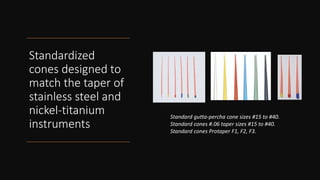
Standardized
cones designed to
match the taper of
stainless steel and
nickel-titanium
instruments
Standard gutta-percha cone sizes #15 to #40.
Standard cones #.06 taper sizes #15 to #40.
Standard cones Protaper F1, F2, F3.
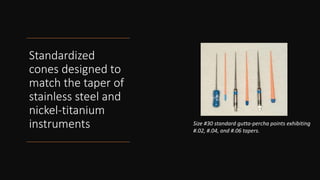
Standardized
cones designed to
match the taper of
stainless steel and
nickel-titanium
instruments Size #30 standard gutta-percha points exhibiting
#.02, #.04, and #.06 tapers.
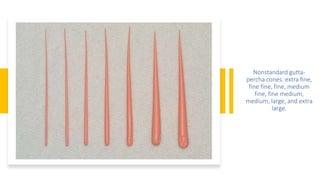
Nonstandard gutta-
percha cones: extra fine,
fine fine, fine, medium
fine, fine medium,
medium, large, and extra
large.
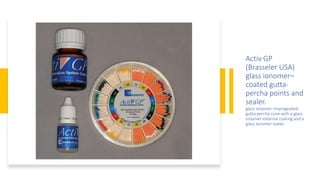
Activ GP
(Brasseler USA)
glass ionomer–
coated gutta-
percha points and
sealer.
glass ionomer–impregnated
gutta-percha cone with a glass
ionomer external coating and a
glass ionomer sealer
METHODS OF
OBTURATION
LATERAL COMPACTION
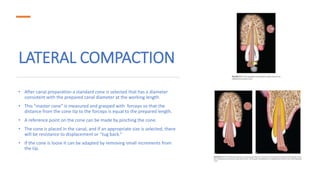
• After canal preparation a standard cone is selected that has a diameter
consistent with the prepared canal diameter at the working length.
• This “master cone” is measured and grasped with forceps so that the
distance from the cone tip to the forceps is equal to the prepared length.
• A reference point on the cone can be made by pinching the cone.
• The cone is placed in the canal, and if an appropriate size is selected, there
will be resistance to displacement or “tug back.”
• If the cone is loose it can be adapted by removing small increments from
the tip.
LATERAL COMPACTION
• If the master cone fails to go to the prepared length a smaller cone can be selected.
• Devices are available to cut cones accurately at a predetermined length (Tip Snip; SybronEndo).
• When the cone extends beyond the prepared length a larger cone must be adapted or the existing cone shortened until
there is resistance to displacement at the corrected working length.
• The master cone placement is confirmed with a radiograph.
• The canal is irrigated and dried with paper points.
• Sealer is applied to the canal walls, and a spreader is prefitted so as to allow it to be inserted to within 1.0 to 2.0 mm from
working length.
• Appropriate accessory points are also selected to closely match the size of the spreader.
• The spreader should fit to within 1 to 2 mm of the prepared length, and when introduced into the canal with the master
cone in place, it should be within 2 mm of the working length.
LATERAL COMPACTION
• After placement the spreader is removed by rotating it back and forth as it is withdrawn.
• An accessory cone is placed in the space vacated by the instrument.
• The process is repeated until the spreader no longer goes beyond the coronal one third of the canal.
• The excess gutta-percha is removed with heat and the coronal mass is compacted with an appropriate plugger.
DISADVANTAGES
• It does not produce a homogeneous mass.
• The accessory and master cones are laminated and remain separate.
• It is hoped that the space between each of the cones is filled with sealer.
WARM VERTICAL COMPACTION
• Schilder introduced warm vertical compaction as a method of filling the radicular space in
three dimensions.
• Preparation requirements for the technique include preparing a canal with a continuously
tapering funnel and keeping the apical foramen as small as possible.
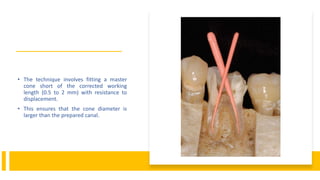
• The technique involves fitting a master
cone short of the corrected working
length (0.5 to 2 mm) with resistance to
displacement.
• This ensures that the cone diameter is
larger than the prepared canal.
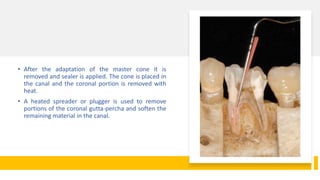
• After the adaptation of the master cone it is
removed and sealer is applied. The cone is placed in
the canal and the coronal portion is removed with
heat.
• A heated spreader or plugger is used to remove
portions of the coronal gutta-percha and soften the
remaining material in the canal.
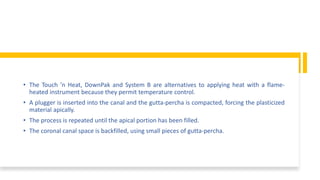
• The Touch ’n Heat, DownPak and System B are alternatives to applying heat with a flame-
heated instrument because they permit temperature control.
• A plugger is inserted into the canal and the gutta-percha is compacted, forcing the plasticized
material apically.
• The process is repeated until the apical portion has been filled.
• The coronal canal space is backfilled, using small pieces of gutta-percha.
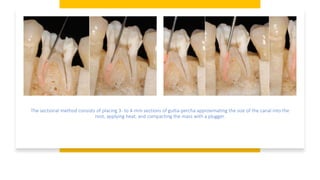
The sectional method consists of placing 3- to 4-mm sections of gutta-percha approximating the size of the canal into the
root, applying heat, and compacting the mass with a plugger.
• Advantages of warm vertical compaction include filling of canal irregularities and accessory
canals.
• Disadvantages include a slight risk of vertical root fracture because of compaction forces, less
length control than with lateral compaction, and the potential for extrusion of material into
the periradicular tissues.
• Warm vertical compaction is difficult in curved canals, where the rigid pluggers are unable to
penetrate to the necessary depth.
• To allow the rigid carriers to penetrate within 4 to 5 mm of the apex, the canals must be
enlarged and tapered more, in comparison with the lateral compaction technique
CONTINUOUS WAVE COMPACTION
TECHNIQUE
• A variation of warm vertical compaction
• The continuous wave compaction technique employs an electric heat carrier, the
temperature setting never exceeded the critical 10°C rise with any temperature setting or
tip
• After selecting an appropriate master cone, a plugger is prefitted to fit within 5 to 7 mm of
the canal length.
• Placing the plugger deeper into the canal may enhance the flow of gutta-percha.
• The point of plugger binding should be noted because once the instrument reaches this
point the hydraulic forces on the gutta-percha will decrease and forces on the root will
increase.
• The System B unit is set to 200° C in the touch mode. The plugger is inserted into the canal
orifice and activated to remove excess coronal material.
• Compaction is initiated by placing the cold plugger against the gutta-percha in the canal
orifice.
• Firm pressure is applied and heat is activated with the device.
• The plugger is moved rapidly (1 to 2 s) to within 3 mm of the binding point.
• The heat is inactivated while firm pressure is maintained on the plugger for 5 to 10 seconds.
• After the gutta-percha mass has cooled a 1-second application of heat separates the plugger
from the gutta-percha, and it is removed.
• The pluggers are designed to heat from the tip to their shank, which decreases the potential
for dislodging the compacted mass and prevents a second application of heat to the
material.
• Confirmation that the apical mass is still present in the canal can be established with hand
pluggers.
• Two hand instruments are manufactured with tip diameters of 0.4 and 0.9 mm and 0.7 and
1.4 mm.
• Heat source is placed only to within 5 to 7 mm from the tip of the gutta-percha
• The apical portion of the gutta-percha remains essentially a single cone technique as the
heat transfer does not take place in the apical 2 to 5 mm of the gutta-percha.
• In ovoid canals, where the canal configuration may prevent the generation of hydraulic
forces, an accessory cone can be placed alongside the master cone before compaction.
WARM LATERAL COMPACTION
• Lateral compaction of gutta-percha provides for length control, which is an advantage over
thermoplastic techniques.
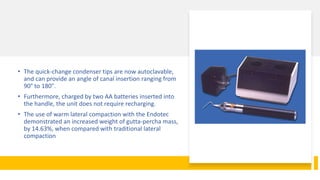
• The Endotec II device provides the clinician with the ability to employ length control while
incorporating a warm gutta-percha technique.
• Endotec II produced a fusion of the guttapercha into a solid homogeneous mass.
• The quick-change condenser tips are now autoclavable,
and can provide an angle of canal insertion ranging from
90° to 180°.
• Furthermore, charged by two AA batteries inserted into
the handle, the unit does not require recharging.
• The use of warm lateral compaction with the Endotec
demonstrated an increased weight of gutta-percha mass,
by 14.63%, when compared with traditional lateral
compaction
• The warm lateral compaction technique involves adapting a master cone in the same manner
as with traditional lateral compaction.
• An appropriate-size Endotec II tip is selected.
• The device is activated and the tip is inserted beside the master cone to within 2 to 4 mm of
the apex, using light pressure.
• The tip is rotated for 5 to 8 seconds and removed.
• An unheated spreader can be placed in the channel created to ensure adaptation and then an
accessory cone is placed.
• The process is continued until the canal is filled.
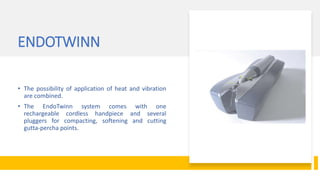
ENDOTWINN
• The possibility of application of heat and vibration
are combined.
• The EndoTwinn system comes with one
rechargeable cordless handpiece and several
pluggers for compacting, softening and cutting
gutta-percha points.
• The tips can be used with and without vibrations.
• The combination of heat and vibrations seems to give the best results.
• The difference in results between the EndoTwinn heat and EndoTwinn heat and vibration has
to be explained by the vibration function.
• Low vibration in combination with the heat is enough to give the gutta-percha more flow
properties which results in a higher value of percentage of gutta-percha.
THERMOPLASTIC INJECTION TECHNIQUES
• Heating of gutta-percha outside the tooth and injecting the material into the canal is an
additional variation of the thermoplastic technique.
• The Obtura II, Calamus, Elements, HotShot, and Ultrafil 3D are available devices.
• The Obtura II system heats the gutta percha to 160° C, whereas the Ultrafil 3D system
employs a low-temperature gutta-percha that is heated to 90° C.
OBTURA III
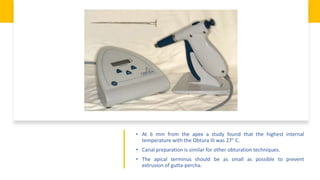
• The Obtura III system consists of a hand-held “gun” that contains a chamber surrounded by
a heating element into which pellets of gutta-percha are loaded.
• Silver needles (varying gauges of 20, 23, and 25) are attached to deliver the
thermoplasticized material to the canal.
• The control unit allows the operator to adjust the temperature and thus the viscosity of the
gutta-percha.
• At 6 mm from the apex a study found that the highest internal
temperature with the Obtura III was 27° C.
• Canal preparation is similar for other obturation techniques.
• The apical terminus should be as small as possible to prevent
extrusion of gutta-percha.
• The technique requires the use of sealer, and once the canal is dried, the canal walls are
coated with sealer, using the last file used to length or a paper point.
• Gutta-percha is preheated in the gun, and the needle is positioned in the canal so that it
reaches within 3 to 5 mm of the apical preparation.
• Gutta-percha is then gradually, passively injected by squeezing the trigger of the “gun.”
• The needle backs out of the canal as the apical portion is filled.
• Pluggers dipped in alcohol are used to compact the guttapercha.
• A segmental technique may also be used, in which 3- to 4-mm segments of gutta-percha are
sequentially injected and compacted.
• In either case, compaction should continue until the gutta-percha cools and solidifies to
compensate for the contraction that takes place on cooling.
• The difficulties with this system include lack of length control.
• Both overextension and underextension are common results.
• To overcome this drawback, a hybrid technique may be used, in which the clinician begins
filling the canal by the lateral compaction technique.
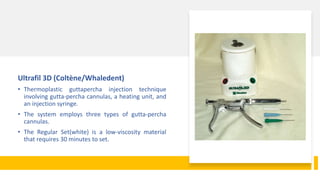
Ultrafil 3D (Coltène/Whaledent)
• Thermoplastic guttapercha injection technique
involving gutta-percha cannulas, a heating unit, and
an injection syringe.
• The system employs three types of gutta-percha
cannulas.
• The Regular Set(white) is a low-viscosity material
that requires 30 minutes to set.
• The Firm Set(blue cannula) is also a low-viscosity material but differs in that it sets in 4
minutes.
• The manufacturer recommends compaction after the initial set with both materials.
• Endoset (green)has a higher viscosity and does not flow as well.
• It is recommended for techniques employing compaction and sets in 2 minutes.
• The heater is preset at 90° C and does not require adjustment.
• After removing the cannula from the heater the needle should be placed on the hot part of
the heater for several seconds.
• The gutta-percha remains able to flow for 45 to 60 seconds depending on the viscosity.
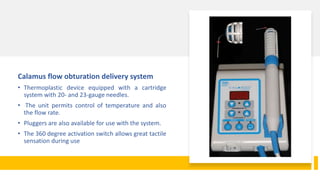
Calamus flow obturation delivery system
• Thermoplastic device equipped with a cartridge
system with 20- and 23-gauge needles.
• The unit permits control of temperature and also
the flow rate.
• Pluggers are also available for use with the system.
• The 360 degree activation switch allows great tactile
sensation during use
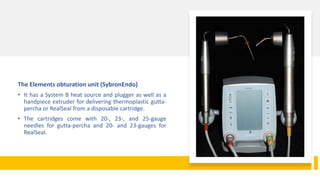
The Elements obturation unit (SybronEndo)
• It has a System B heat source and plugger as well as a
handpiece extruder for delivering thermoplastic gutta-
percha or RealSeal from a disposable cartridge.
• The cartridges come with 20-, 23-, and 25-gauge
needles for gutta-percha and 20- and 23-gauges for
RealSeal.
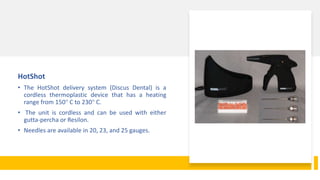
HotShot
• The HotShot delivery system (Discus Dental) is a
cordless thermoplastic device that has a heating
range from 150° C to 230° C.
• The unit is cordless and can be used with either
gutta-percha or Resilon.
• Needles are available in 20, 23, and 25 gauges.
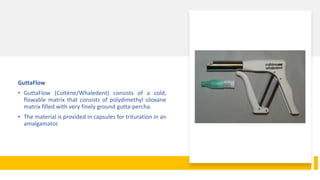
GuttaFlow
• GuttaFlow (Coltène/Whaledent) consists of a cold,
flowable matrix that consists of polydimethyl siloxane
matrix filled with very finely ground gutta-percha.
• The material is provided in capsules for trituration in an
amalgamator.
• The technique involves injection of the material into the canal
and placing a single master cone to length.
• The material provides a working time of 15 minutes and it cures in 25-30 minutes.
• Evidence suggests that the material fills canal irregularities with consistency and is
biocompatible, but the setting time is inconsistent and may be delayed by final irrigation
with sodium hypochlorite.
CARRIER-BASED GUTTA-PERCHA
• Thermafil
• Profile GT Obturators
• GT Series X Obturators
• ProTaper Universal Obturators
Cohen
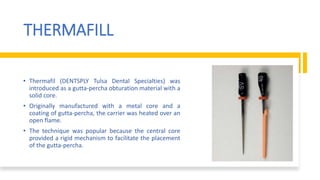
THERMAFILL
• Thermafil (DENTSPLY Tulsa Dental Specialties) was
introduced as a gutta-percha obturation material with a
solid core.
• Originally manufactured with a metal core and a
coating of gutta-percha, the carrier was heated over an
open flame.
• The technique was popular because the central core
provided a rigid mechanism to facilitate the placement
of the gutta-percha.
• Advantages included ease of placement and the pliable properties of the gutta-percha.
• Disadvantages were that the metallic core made placement of a post challenging and
retreatment procedures were difficult.
• The gutta-percha was often stripped from the carrier, leaving the carrier as the obturating
material in the apical area of the canal.
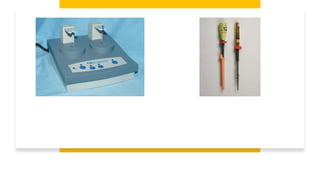
• Changes in the carrier systems include the development of a plastic core coated with α-phase
gutta-percha and a heating device that controls the temperature.
• Obturators are designed to correspond to the ISO standard file sizes, variable tapered nickel–
titanium rotary files, and the ProFile GT and GT Series X nickel–titanium rotary files
• After drying the canal a light coat of sealer is applied and a carrier is marked, set to the
predetermined length.
• This is accomplished by using the millimeter calibration markings on the carrier shaft.
• Markings are made at 18, 19, 20, 22, 24, 27, and 29 mm.
• Gutta-percha on the shaft that may be obscuring the calibration rings can be removed with a
surgical blade or knife.
• The carrier is disinfected with 5.25% NaOCl for 1 minute and rinsed in 70% alcohol.
• The carrier is then placed in the heating device.
• When the carrier is heated to the appropriate temperature the clinician has approximately 10
seconds to retrieve it and insert it into the canal.
• This is accomplished without rotation or twisting.
• The position of the carrier is verified radiographically.
• The gutta-percha is allowed 2 to 4 minutes to cool before resecting the coronal portion of the
carrier, which can be several millimetres above the canal orifice.
• This is accomplished by applying stabilizing pressure to the carrier and cutting the device with
an inverted cone, round bur, or a specially designed Prepi bur.
• Heated instruments are not recommended for this process because this may result in
displacement.
• Vertical compaction of the coronal gutta-percha can be accomplished.
• When necessary, gutta-percha can be added, heat softened, and compacted.
• An advantage to this technique is the potential for movement of gutta-percha into lateral and
accessory canals
• Extrusion of material beyond the apical extent of the preparation is a disadvantage
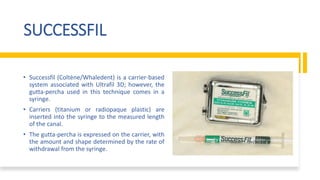
SUCCESSFIL
• Successfil (Coltène/Whaledent) is a carrier-based
system associated with Ultrafil 3D; however, the
gutta-percha used in this technique comes in a
syringe.
• Carriers (titanium or radiopaque plastic) are
inserted into the syringe to the measured length
of the canal.
• The gutta-percha is expressed on the carrier, with
the amount and shape determined by the rate of
withdrawal from the syringe.
• Sealer is lightly coated on the canal walls, and the carrier with gutta-percha is placed in the
canal to the prepared length.
• The gutta-percha can be compacted around the carrier with various pluggers depending on
the canal morphology.
• This is followed by severing of the carrier slightly above the orifice with a bur.
SIMPLIFILL
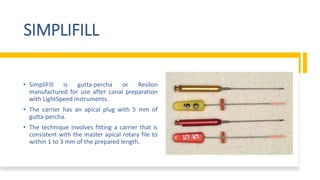
• SimpliFill is gutta-percha or Resilon
manufactured for use after canal preparation
with LightSpeed instruments.
• The carrier has an apical plug with 5 mm of
gutta-percha.
• The technique involves fitting a carrier that is
consistent with the master apical rotary file to
within 1 to 3 mm of the prepared length.
• The apical gutta-percha plug can be modified by clipping the end in 1-mm increments to
obtain an appropriate fit if the plug is too small.
• Once the cone is fitted it is withdrawn and sealer is applied to the canal walls.
• AH Plus is recommended.
• The SimpliFill carrier is slowly advanced to the prepared length.
• This may require firm pressure.
• With the plug at the corrected working length the handle is quickly rotated a minimum of four
complete terms in a counter clockwise direction to separate the shaft from the apical gutta-
percha.
• The coronal space can then be filled with gutta-percha, using lateral compaction or the warm
thermoplastic technique.
THERMOMECHANICAL COMPACTION
• McSpadden introduced an instrument, the McSpadden Compactor, with flutes similar to a
Hedström file but in reverse.
• When activated in a slow-speed handpiece the instrument would generate friction, soften
the gutta-percha, and move it apically.
• Rotary compactors similar in design have been developed and advocated.
• To increase flexibility the instrument is available in nickel–titanium.
• Advantages include simplicity of the armamentarium, the ability to fill canal irregularities
and time.
• Disadvantages include possible extrusion of material, instrument fracture, gouging of the
canal walls, the inability to use the technique in curved canals, and heat generation.
CORONAL PROTECTION OF THE
OBTURATION
RATIONALE FOR A CORONAL SEAL
• The importance of a coronal restoration placed over a canal obturation to prevent
microleakage is emphasized by the findings of Torabinejad
• They found that without a coronal protection seal of the canal obturation, it took only 19
days for Staphylococcus organisms placed in a coronal access cavity to reach the apex in half
of their test cases and 42 days for the same percentage of Proteus samples.
• Alves et al. found that bacterial endotoxins could reach the apex of obturated canals in as
little as 20 days if not protected by a coronal seal.
TEMPORARY FILLING MATERIALS
• Cavit (ESPE, Seefeld, Germany), has been found to prevent leakage, when used as a temporary
filling material to close access preparations, either as an interim filling material or after final
obturation before a permanent restoration is placed.
• Cavit is premixed and is easily introduced into the access cavity, as well as being easy to
remove from the access cavity at the subsequent appointment.
CONCLUSION
• The obturation method selected, whether a traditional method or a more contemporary
one, must be consistent with the principles of clinical practice, i.e., to provide the best
treatment for patients.
• A seal of the root canal system is desirable, but contemporary materials and methods
available for obturation do not always achieve this physical and biological goal.
• The advent of new devices and techniques are revolutionizing the practice of endodontics
and making obturation procedures more predictable.
REFERENCE
• Endodontics 5th edition: John I. Ingle, James H. S. Simon, Richard E.Walton, David H. Pashley, Leif K. Bakland, Geoffrey S.
Heithersay, and Harold R. Stanley
• Cohen S, Burns RC, eds. Pathways of the pulp. 7th edn. St. Louis: Mosby 1998
• Castellucci A. Endodontics.Vol II. Florence: Il Tridente, 2004:139-153
• Grossman li, Oliet s. Diagnosis and treatment of endodontic emergencies. Chicago: quintessence publishing co., 1981:25-26
• Ingle JI, Beveridge E, Glick D, Weichman J: The Washington Study. In: Ingle I, Taintor JF, editors. Endodontics, Philadelphia, 1994,
Lea & Febiger, pp 1–53.
• WEST, J.D.: The relationship between the three-dimensional endodontic seal and endodontic failures. Thesis, Boston University,
1975.
• Fabricius L, Dahlen G, Sundqvist G, Happonen RP, Moller AJ: Influence of residual bacteria on periapical tissue healing after
chemomechanical treatment and root filling of experimentally infected monkey teeth. Eur J Oral Sci 114:278, 2006.
REFERENCE
• Ray HA, Trope M: Periapical status of endodontically treated teeth in relation to the technical quality of the root filling and the
coronal restoration. Int Endod J 28:12,1995.
• Ricucci D, Grondahl K, Bergenholtz G: Periapical status of root-filled teeth exposed to the oral environment by loss of restoration or
caries. Oral Surg Oral Med Oral Pathol Oral Radiol Endod 90:354, 2000.
• Farzaneh M, Abitbol S, Lawrence HP, Friedman S: Treatment outcome in endodontics—the Toronto Study. Phase II: initial
treatment. J Endod 30:302, 2004
• Strindberg LZ. The dependence of the results of pulp therapy on certain factors. Acta Odont Scand 1956: 14suppl. 21.
• Alan h. Gluskin. Mishaps and serious complications in endodontic obturation: Endodontic Topics 2005, 12, 52–70
• Schilder H. Filling root canals in three dimensions. Dent Clin North Am 1967: 11: 723–744
• Schilder H. Filling Root Canals in Three Dimensions: JOE — Volume 32, Number 4, April 2006
• Alan H. Gluskin. Anatomy of an overfill: a reflection on the process: Endodontic Topics 2009, 16, 64–81
REFERENCE
• Dag Ørstavik. Materials used for root canal obturation: technical, biological and clinical testing: Endodontic Topics 2005, 12, 25–38
• Ricardo Caicedo. Modern Perspectives in Root Canal Obturation: ADA.
• Ørstavik D, Kerekes K, Eriksen HM. The periapical index: a scoring system for radiographic assessment of apical periodontitis.
Endod Dent Traumatol 1986: 2: 20–34.
• Friedman S. Treatment outcome and prognosis of endodontic therapy. In: Ørstavik D, Pitt Ford TR., eds. Essential Endodontology.
Prevention and Treatment of Apical Periodontitis. Oxford: Blackwell, 1998.

Obturation

  • 1.
    OBTURATION OF THECLEANED & SHAPED ROOT CANAL SYSTEM Dr POOJA JAYAN
  • 2.
    CONTENTS SECTION I •Importance of Effectively Sealing the Root Canal System • Historical Perspectives • Timing of Obturation • Length of Obturation • Preparation for Obturation • The Ideal Root Canal Filling • Types of Sealers • Sealer Placement • Core Materials SECTION II Methods of Obturation • Cold lateral compaction • Warm vertical Compaction • Continuous wave Compaction • Thermoplastic Injection Techniques • Warm Lateral Compaction • Carrier-Based Gutta-Percha • Thermomechanical Compaction
  • 3.
    IMPORTANCE OF EFFECTIVELYSEALING THE ROOT CANAL SYSTEM SUCCESS IN ENDODONTIC TREATMENT OBTURATION DEBRIDEMENT DISINFECTION
  • 4.
    DEFINITION OBTURATION The method usedto fill and seal a cleaned and shaped root canal using a root canal sealer and core filling material. American Association Of Endodontists (AAE) Glossary of Endodontic terms
  • 5.
    5 META- ANALYSIS (SUCCESS) Absence ofa pretreatment periapical lesion Root canal fillings with no voids Obturation within 2.0 mm of the apex Adequate coronal restoration Ng YL, Mann V, Gulabivala K: A prospective study of the factors affecting outcomes of non-surgical root canal treatment: part 2: tooth survival, Int Endod J 44:610, 2011.
  • 6.
    BIOLOGICAL CONSIDERATIONS ON ROOT CANAL OBTURATION •NEED FOR OBTURATION • IMPORTANCE OF CORONAL SEAL vs IMPORTANCE OF ROOT CANAL FILLING
  • 7.
    Stagnation theory (or)Hollow tube theory by Rickert and Dixon (1931) • Empty space within a living organism tends to fill with tissue fluids in a short period of time • This theory was based on the observation of an inflammatory reaction around the ends of hollow steel and platinum anesthetic needle fragments implanted in experimental animals. • This reaction did not occur if the implant was made of a solid, non-porous material.
  • 8.
    Coolidge 1939 • Justas within unfilled or underfilled root canals, fluids that accumulate within empty spaces are rapidly colonized by microorganisms reaching these spaces by means of “anachoresis” and causing inflammatory reaction.
  • 9.
    • For years,this theory has influenced the concept that the root canals must be filled to the apex. • If not, empty spaces would quickly be colonized by bacteria, through anachoresis, and would prevent or delay healing of the periapical tissues. • Later studies have shown evidence refuting the “hollow tube” theory. • It has been demonstrated, in experimental animals, that empty spaces made inside plastic teeth, implanted in fresh sockets, did not produce any inflammation around the open ends. • In many cases these spaces were subsequently filled with fibrous tissue or bone. Davis SM, Joseph WS, Bucher JF. Periapical and intracanal healing following incomplete root canal fillings in dogs. Oral Surg Oral Med Oral Pathol. 1971;31:662–675
  • 10.
    • In orderfor anachoresis to occur, the presence of blood vessels is necessary. • Microorganisms can easily invade a space where tissue is present, inflamed, or partially necrotic, traveling via the blood circulation. • However, this is not the case where active blood circulation doesn’t exist – Necrotic cases
  • 11.
    • Toronto groupevaluated success and failure of root canal treatment at 4 to 6 years after completion of treatment • Primary root canal treatment  • Flared preparation and vertical compaction of warm gutta-percha(90% success rate) > step-back preparation and lateral compaction (80%) • Adequate length had a higher success rate (87%) when compared with inadequate length (77%) Farzaneh M, Abitbol S, Lawrence HP, et al: Treatment outcome in endodontics—the Toronto Study. Phase II: initial treatment, J Endod 30:302, 2004
  • 12.
    • Washington Study- early radiographic study of success and failure, Ingle and colleagues • Indicated that 58% of treatment failures were due to incomplete obturation. • Teeth that are poorly obturated are often poorly prepared. Procedural errors such as loss of length, canal transportation, perforations, loss of coronal seal, and vertical root fracture may have occurred. Ingle JI, Beveridge E, Glick D, et al: The Washington Study. In: Ingle I, Taintor JF, editors. Endodontics, Philadelphia, 1994, Lea & Febiger, pp 1–53.
  • 13.
    • It isprudent that clean and shaped root canals must be completely obturated to prevent re- infection. • Complete sterilization and removal of all pulpal debris from an infected root canal is very difficult, if not impossible • What is achieved, in most cases, is the disinfection of the root canal system. • Residual microorganisms may remain inside the root canal system, mainly within dentinal tubules. • Presence of necrotic pulp remnants, together with the accumulating exudate, can contribute to their viability. • If the root canal system is completely obturated in all three dimensions, any remaining microorganism may be “entrapped” without nutritional sources and with reduced possibility of proliferation
  • 14.
    • Sjogren etal. studied the influence of the presence of infection at the time of root canal filling, on the outcome of endodontic treatment, in teeth with apical periodontitis. • They theorized that success obtained, despite positive bacterial cultures, was due to the bacteria “entombed” in the canal. • Moawad has demonstrated that bacteria entrapped within a completely filled root canal become nonviable within five days after root canal filling. • Obturation with gutta-percha and sealer after chemomechanical cleaning and disinfection with sodium hypochlorite also deprives the remaining microorganisms from their nutrient supply, thereby reducing their ability to cause or maintain disease. • It has been demonstrated that most microorganisms in the dentinal tubules died within 24 hours after removal of the nutrient medium. Sjögren V, Figdor D, Persson S, Sundquist G. Influence of infection at the time of root filling on the outcome of endodontic treatment of teeth with apical periodontitis. Int Endod J. 1997;30:297–306.
  • 15.
    • Coronal leakagehas also been proposed to contribute to treatment failure based on in vitro leakage studies. • The clinical implication is that retreatment has to be performed in those teeth that are not restored permanently after 3 months of root canal treatment. • This controversial issue has been recently challenged, as this data stimulated intense research and discussions for almost two decades Ricucci D, Bergenholtz G: Bacterial status in root-filled teeth exposed to the oral environment by loss of restoration and fracture or caries—a histobacteriological study of treated cases, Int Endod J 36:787, 2003
  • 16.
    A recent systematicreview and meta-analysis of the results derived from nine similar studies indicate that poor quality root canal treatment and poor quality coronal restorations have similar odds in adversely affecting the healing of apical periodontitis Gillen BM, Looney SW, Gu LS, et al: Impact of the quality of coronal restoration versus the quality of root canal fillings on success of root canal treatment: a systematic review and meta-analysis, J Endod 37:895, 2011.
  • 17.
    • Obturation isa reflection of the cleaning and shaping • Evaluated on the basis of length, taper, density, level of gutta-percha removal, and the coronal seal A, Maxillary right canine with adequate length but lacking density and no coronal seal. B, Maxillary central incisors exhibits a lack of density and taper. Maxillary left central incisor has voids and unfilled canal space. C, Mandibular left first molar with adequate obturation; provisional restoration shows poor adaptation on the distal because of the failure to remove caries.
  • 18.
    HISTORICAL PERSPECTIVES • “Hermeticseal” -- a major goal of root canal treatment • Before 1800 - gold. • Various metals, oxychloride of zinc, paraffin, and amalgam • 1847, Hill  first gutta-percha root canal filling material known as “Hill’s stopping.” • In 1887 the S.S. White Company began to manufacture gutta-percha points Koch CRE, Thorpe BLT: A history of dentistry, vols. 2 and 3, Fort Wayne, IN, 1909, National Art Publishing Company
  • 19.
    OBJECTIVES OF OBTURATION Substitution ofan inert filling in the space previously occupied by the pulp tissue To eliminate leakage from the oral cavity or the periradicular tissues into the root canal system To seal within the system any irritants that cannot be fully removed during canal cleaning and shaping procedures To adequately seal iatrogenic causes such perforations, ledges and zipped apices To attain a radiographic appearance of a three dimensional filling which extends as close as possible to the CDJ
  • 20.
    TIMING OF OBTURATION Patient’s signsand symptoms Status of the pulp and periradicular tissue The degree of difficulty Patient management.
  • 21.
    VITAL PULP TISSUE One-step treatment procedures Relativeabsence of bacterial contamination Leakage during the period between patient visits can beavoided Pain occurs as the result of irreversible pulpitis obturation can occur at the initial visit- removal of vital tissue resolves pain Figini L, Lodi G, Gorni F, et al: Single versus multiple visits for endodontic treatment of permanent teeth: a Cochrane systematic review, J Endod 34:1041, 2008.
  • 22.
    NECROTIC PULP TISSUE •Pulp necrosis with or without asymptomatic periradicular pathosis - treated in one visit • Acute symptoms caused by pulp necrosis and acute periradicular abscess - delayed until patient is asymptomatic • No significant difference in the healing rates of apical periodontitis between single-visit and multiple-visit root canal treatment
  • 23.
    LENGTH OF OBTURATION •Apical limit • Early studies  dentino-cemental junction as the apical limit for obturation • Kuttler  apical anatomy consists of the major diameter of the foramen and the minor diameter of the constriction • 0.5 mm – average distance, may vary upto 2.5 mm
  • 24.
    • Canals filledmore than 2 mm short harbored necrotic tissue, bacteria & irritants that when re-treated could be cleaned and sealed • No relationship between unfilled lateral canals and periradicular pathosis • Teeth filled within 2 mm of the apex revealed normal periapical conditions(94% ) • Roots with excess root fillings and fillings more than 2 mm short of the apex had significantly lower success rates of 76% and 68%, respectively. Sjögren U, Hagglund B, Sundqvist G, et al: Factors affecting the long-term results of endodontic treatment, J Endod 16:498, 1990. Barthel CR, Zimmer S, Trope M: J endod 2004
  • 25.
    DEFINITION OF TERMINOLOGIES  Schilder1967 • Total obturation of the root canal space with excess material extruding beyond the apical foramen OVERFILLING • The apical seal is obtained but the canal space is incompletely filled leaving voids as potential areas for recontamination or infection UNDERFILLING • Extrusion of filling material beyond the apical foramen independent of the apical seal OVEREXTENSION • Canal space is incompletely filled without achieving apical seal UNDEREXTENSION
  • 26.
    Anatomical Apex -represents the geometric vertex of the root Radiographic Apex -that represents the anatomic apex as seen on the radiograph. The terminal point of the root canal - not always at the radiographic apex and therefore cannot be used as a reference point to the actual working length. Radiographic Terminus of the canal refers to the point at which the endodontic instrument, within the root canal, radiographically encounters the external profile of the root. Endodontic Or Physiologic Apex indicates the cemento-dentinal junction, which usually corresponds to the narrowest area of the canal lumen. Apical Foramen refers to the opening of the root canal on the external surface of the root
  • 27.
    TO CONCLUDE • Manyreliable electronic apex locators are available today, and they indicate the end of the canal (which is the foramen) • Therefore we can assert that all of our endodontic treatments are performed at the “electronic apex” • 50% of the times coincides with the radiographic apex because the root canal is straight. • The other 50% of the times the root canal is not straight but is curved and when it makes a curvature, about 40% of the times the curvature is to the mesial or to the distal (so that the “radiographic terminus of the canal” can still be seen on the radiograph) • Only about 10 % of the times the curvature is to the buccal or to the lingual. These are the cases where we must rely on the electronic apex locators only and these are the cases that appear to be “radiographically short”. Castellucci A, Falchetta M, Sinigaglia F. La determinazione radiografica della sede del forame apicale. G It Endo. 1993;3:114–122.
  • 28.
    PREPARATION FOR OBTURATION • SMEAR LAYER •Act as a physical barrier, decreasing bacterial penetration into tubules • Interfere with adhesion and penetration of sealers into dentinal tubules • Interfere with the action of irrigants used as disinfectants. • Root canal filling materials adapt better to the canal walls after smear layer removal • 1-minute exposure to 10 mL of EDTA  remove the smear layer Leonard JE, Gutmann JL, Guo IY , Int Endod J 29:76, 1996
  • 29.
    SEALERS • Exhibits tackinesswhen mixed to provide good adhesion between it and the canal wall when set • Establishes a hermetic seal • Radiopaque • Very fine powder, so that it can mix easily with liquid • No shrinkage on setting • No staining • Bacteriostatic or at least does not encourage bacterial growth • Exhibits a slow set • Insoluble in tissue fluids • Tissue tolerant; that is, non irritating to periradicular tissue • Soluble in a common solvent if it is necessary to remove the root canal filling
  • 30.
    • Breakdown productsfrom the sealers  adverse effect on the proliferative capability of periradicular cell • Sealers should not be placed in the periradicular tissues
  • 31.
    ZINC OXIDE ANDEUGENOL • Resorb if extruded into the periradicular tissues • Antimicrobial activity. • Slow setting time • Shrinkage on setting • Solubility • Stain tooth structure
  • 32.
    RICKERTS SEALER • P/Lsealer • Silver  radio opaque material • Stains tooth • Marketed as Kerr’s Pulp canal sealer and pulp canal sealer EWT 6 hours • Procosol is a modification of Rickert’s formula • Silver particles removed (zinc oxide, hydrogenated resin, bismuth subcarbonate and barium sulfate; liquid eugenol)
  • 33.
  • 34.
    • Roth’s sealer substitution of bismuth subnitrate for bismuth subcarbonate • Tubli seal  two-paste system, nonstaining • Wach’s Sealer  Canada balsam • Sticky or tacky property that softens the gutta-percha into a more homogeneous mass ROTH ROOT CANAL CEMENT
  • 35.
    NON EUGENOL SEALERS •Developed from a periodontal dressing • Nogenol • Root canal sealer without the irritating effects of eugenol • Base Zinc Oxide, Barium Sulfate & Bismuth Oxychloride.
  • 36.
    CALCIUM HYDROXIDE SEALERS •Calciobiotic root canal sealer (CRCS) : Zinc Oxide–eugenol sealer + Calcium hydroxide as one ingredient • Sealapex : catalyst-base system • The base contains zinc oxide, calcium hydroxide, butyl benzene, sulfonamide, and zinc stearate. The catalyst contains barium sulfate and titanium dioxide as radiopacifiers in addition to resin, isobutyl salicylate, and aerosol R972. • Apexit and Apexit Plus : salicylates incorporated • Activator (disalicylate, bismuth hydroxide/bismuth carbonate, and fillers) and a base (calcium hydroxide, hydrated colophonium [i.e., pine resin], and fillers). • Cytotoxicity : Sealapex > CRCS > Apexit Desai S, Chandler N: Calcium hydroxide-based root canal sealers: a review, J Endod 35:475, 2009. Mohammadi Z, Dummer PM: Properties and applications of calcium hydroxide in endodontics, Int Endod J 44:697, 2011.
  • 37.
    GLASS IONOMER SEALERS •Dentin-bonding properties • Ketac-Endo • Difficult to properly condition the dentinal walls in the apical and middle thirds • Disadvantage  Removal if retreatment is required Minimal antimicrobial activity Loest C, Trope M, Friedman S, J Endod 19:201, 1993 Heling I ; J Endod 22:257, 1996..
  • 38.
    RESIN SEALERS • Provideadhesion, and do not contain eugenol • Two major categories Epoxy resin–based Methacrylate resin–based sealers
  • 39.
    EPOXY RESIN SEALERS •AH-26 • slow-setting epoxy resin • release formaldehyde • AH Plus • Formaldehyde is not released • Working time ̴ 4 hours. • Sealing abilities of AH-26 and AH Plus appear comparable
  • 40.
    AH Plus • Epoxyresin–amine based system that comes in two tubes • Epoxide paste tube • Diepoxide (bisphenol A diglycidyl ether) • Fillers • Amine paste tube • Primary monoamine • Secondary diamine • Di secondary diamine • Silicone oil • Fillers
  • 41.
    METHACRYLATE RESIN SEALERS FOURGENERATIONS • First generation of hydrophilic methacrylate resin–based material  Hydron • En masse root filling  mid 1970s • Major component of Hydron was poly [2-hydroxyethyl methacrylate] (poly[HEMA]) • Injected into a root canal and polymerized • Without the adjunctive use of a root-filling material
  • 42.
    METHACRYLATE RESIN SEALERS Second generation of bondable sealer is nonetching and hydrophilic in nature  Does not require use of a dentin adhesive • Flow into accessory canals and dentinal tubules to facilitate resin tag formation for retention and seal after smear layer removal • EndoREZ : Dual-cured radiopaque hydrophilic methacrylate sealer that contains non- acidic diurethane dimethacrylate • Seal best when applied to slightly moist intraradicular dentin
  • 43.
    METHACRYLATE RESIN SEALERS •Recommended with either a conventional gutta-percha cone or with specific EndoREZ points • A retrospective clinical and radiographic study  10-year treatment outcome of one-visit root canal treatment using gutta-percha and the EndoREZ sealer  success of 92.1% after 10 years Zmener O, Pameijer CH: Clinical and radiographic evaluation of a resin-based root canal sealer: 10-year recall data, Int J Dent 2012:763248, 2012.
  • 44.
    METHACRYLATE RESIN SEALERS Thirdgeneration self-etching sealers • contain a self-etching primer • a dual-cured resin composite root canal sealer • acidic primer penetrates through the smear layer and demineralizes the superficial dentin. • air-dried and then a dual-cured moderately filled flowable resin composite sealer is applied and polymerized.
  • 45.
    METHACRYLATE RESIN SEALERS •Popularized following the introduction of Resilon • A dimethacrylate-containing polycaprolactone-based thermoplastic root-filling material • RealSeal • Self-etching primers are supplied as a single-bottle system • 2-acrylamido-2-methyl-propanesulfonic acid (AMPS) as the functional acidic monomer
  • 46.
    METHACRYLATE RESIN SEALERS •Fourth-generation methacrylate resin–based sealers e.g., MetaSEAL • functionally analogous to self-adhesive resin luting cements • eliminated the separate etching/bonding step • all-in-one self-etching, self-adhesive sealer  reduces errors that may occur during each bonding step
  • 47.
    SILICONE SEALERS • RoekoSeal polydimethylsiloxane that has been reported to expand slightly on setting • Gutta-percha in particulate form (less than 30 μm) added to roekoseal • Injection of the material into the canal, followed by placement of a single master cone • Working time of 15 minutes and it cures in 25 to 30 minutes. GuttaFlow trituration capsule and injection syringe (Coltène/Whaledent).
  • 48.
    • Fills canalirregularities with consistency • Biocompatible • Setting time is inconsistent • Delayed by final irrigation with sodium hypochlorite. • Sealing ability appears comparable to other techniques in some studies and inferior in others Bouillaguet S, Wataha JC, Tay FR, et al, J Endod 32:989, 2006 Brackett MG, Martin R, Sword J, et al:, J Endod 32:1188, 2006.
  • 49.
    CALCIUM SILICATE SEALERS •Based on mineral trioxide aggregate (MTA) • set by reaction with water and form a highly alkaline (pH of about 12) mixture consisting of a rigid matrix of calcium silicate hydrates and calcium hydroxide • Setting time 165 minutes for the initial set and less than 6 hours for the final set
  • 50.
    • Four tricalciumsilicate sealers • MTA Fillapex • iRoot SP • Endo CPM Sealer • MTA Plus
  • 51.
    SEALER PLACEMENT • Master cone,lentulo spirals, files and reamers, and ultrasonics. • Variation in sealer coating was in the apical area • Better adhesion to the dentinal walls  leaving the canals slightly moist
  • 52.
    Requirements for an Ideal RootCanal Filling Material 1. It should be easily introduced into the root canal. 2. It should seal the canal laterally as well as apically. 3. It should not shrink after being inserted. 4. It should be impervious to moisture. 5. It should be bacteriostatic or at least not encourage bacterial growth. 6. It should be radiopaque. 7. It should not stain tooth structure. 8. It should not irritate periradicular tissues. 9. It should be sterile, or easily and quickly sterilized, immediately before insertion. 10. It should be removed easily from the root canal, if necessary
  • 53.
    ROOT CANAL FILLING MATERIALS ACCORDING TOINGLE • Solid-core filling materials • Semisolid-core filling materials • Paste filling materials
  • 54.
    SOLID-CORE FILLING MATERIALS •HISTORICAL ROOT CANAL FILLING MATERIALS (SILVER POINTS) • Introduced by Jasper in 1933 • Same diameter and taper as files and reamers • Indicated in mature teeth with small or well-calcified round tapered canals • Not indicated for filling anterior teeth, single canal premolars, or large single canals in molars. • Easy to insert, and length control was easier. • Do not seal well laterally or apically • Spaces or voids • leakage allows corrosion & formation of silver salts
  • 55.
    SOLID-CORE FILLING MATERIALS •Cytotoxic • Gutierrez et al. reported that canal irrigants could corrode silver points • Kehoe reported a case of localized argyria  ‘‘tattooing’’of the alveolar mucosa • Brady and del Rio reported that sulfur and chlorides were detected by microanalysis of failed corroded points
  • 56.
    SEMISOLID-CORE FILLING MATERIALS GUTTA-PERCHA •Gutta-percha has been known to dentistry for over 100 years • It is derived from a rubber base obtained from certain tropical plants (from Malaysia, Borneo, Indonesia, South Africa, and Brazil) belonging to the genera Sapotaceae. • trans-isomer of polyisoprene
  • 57.
    • Two distinctlydifferent crystalline forms (alpha and beta) that can be converted into each other • Alpha form comes directly from the tree • Commercial gutta-percha beta crystalline form • Difference in the crystalline lattice • Heated material changes to the α phase and becomes pliable and tacky • Increase in tackiness create a more homogeneous filling • Can be made to flow when pressure is applied. • Disadvantage α phase – material shrinks on setting. Goodman A, Schilder H, Aldrich W. The thermomechanical properties of gutta percha. II. The history and molecular chemistry of gutta-percha. Oral Surg 1974;37:954
  • 58.
    GUTTA-PERCHA CONES COMPOSITIONFRIEDMAN • 20% gutta-percha • 66% zinc oxide • 11% radiopacifiers • 3% plasticizers Friedman CE, Sandrik JL, Heuer MA, et al: Composition and physical properties of gutta-percha endodontic filling materials, J Endod 3:304, 1977.
  • 59.
    • α formof gutta-percha melts when heated above 65°C. • cooled extremely slowly, the α form will recrystallize • α-phase gutta-percha is heated and cooled - it undergoes less shrinkage • making it more dimensionally stable for thermoplasticized techniques
  • 60.
    Standardized cones designed to matchthe taper of stainless steel and nickel-titanium instruments Standard gutta-percha cone sizes #15 to #40. Standard cones #.06 taper sizes #15 to #40. Standard cones Protaper F1, F2, F3.
  • 61.
    Standardized cones designed to matchthe taper of stainless steel and nickel-titanium instruments Size #30 standard gutta-percha points exhibiting #.02, #.04, and #.06 tapers.
  • 62.
    Nonstandard gutta- percha cones:extra fine, fine fine, fine, medium fine, fine medium, medium, large, and extra large.
  • 63.
    Activ GP (Brasseler USA) glassionomer– coated gutta- percha points and sealer. glass ionomer–impregnated gutta-percha cone with a glass ionomer external coating and a glass ionomer sealer
  • 64.
  • 65.
    LATERAL COMPACTION • Aftercanal preparation a standard cone is selected that has a diameter consistent with the prepared canal diameter at the working length. • This “master cone” is measured and grasped with forceps so that the distance from the cone tip to the forceps is equal to the prepared length. • A reference point on the cone can be made by pinching the cone. • The cone is placed in the canal, and if an appropriate size is selected, there will be resistance to displacement or “tug back.” • If the cone is loose it can be adapted by removing small increments from the tip.
  • 66.
    LATERAL COMPACTION • Ifthe master cone fails to go to the prepared length a smaller cone can be selected. • Devices are available to cut cones accurately at a predetermined length (Tip Snip; SybronEndo). • When the cone extends beyond the prepared length a larger cone must be adapted or the existing cone shortened until there is resistance to displacement at the corrected working length. • The master cone placement is confirmed with a radiograph. • The canal is irrigated and dried with paper points. • Sealer is applied to the canal walls, and a spreader is prefitted so as to allow it to be inserted to within 1.0 to 2.0 mm from working length. • Appropriate accessory points are also selected to closely match the size of the spreader. • The spreader should fit to within 1 to 2 mm of the prepared length, and when introduced into the canal with the master cone in place, it should be within 2 mm of the working length.
  • 67.
    LATERAL COMPACTION • Afterplacement the spreader is removed by rotating it back and forth as it is withdrawn. • An accessory cone is placed in the space vacated by the instrument. • The process is repeated until the spreader no longer goes beyond the coronal one third of the canal. • The excess gutta-percha is removed with heat and the coronal mass is compacted with an appropriate plugger.
  • 68.
    DISADVANTAGES • It doesnot produce a homogeneous mass. • The accessory and master cones are laminated and remain separate. • It is hoped that the space between each of the cones is filled with sealer.
  • 69.
    WARM VERTICAL COMPACTION •Schilder introduced warm vertical compaction as a method of filling the radicular space in three dimensions. • Preparation requirements for the technique include preparing a canal with a continuously tapering funnel and keeping the apical foramen as small as possible.
  • 70.
    • The techniqueinvolves fitting a master cone short of the corrected working length (0.5 to 2 mm) with resistance to displacement. • This ensures that the cone diameter is larger than the prepared canal.
  • 71.
    • After theadaptation of the master cone it is removed and sealer is applied. The cone is placed in the canal and the coronal portion is removed with heat. • A heated spreader or plugger is used to remove portions of the coronal gutta-percha and soften the remaining material in the canal.
  • 72.
    • The Touch’n Heat, DownPak and System B are alternatives to applying heat with a flame- heated instrument because they permit temperature control. • A plugger is inserted into the canal and the gutta-percha is compacted, forcing the plasticized material apically. • The process is repeated until the apical portion has been filled. • The coronal canal space is backfilled, using small pieces of gutta-percha.
  • 73.
    The sectional methodconsists of placing 3- to 4-mm sections of gutta-percha approximating the size of the canal into the root, applying heat, and compacting the mass with a plugger.
  • 74.
    • Advantages ofwarm vertical compaction include filling of canal irregularities and accessory canals. • Disadvantages include a slight risk of vertical root fracture because of compaction forces, less length control than with lateral compaction, and the potential for extrusion of material into the periradicular tissues. • Warm vertical compaction is difficult in curved canals, where the rigid pluggers are unable to penetrate to the necessary depth. • To allow the rigid carriers to penetrate within 4 to 5 mm of the apex, the canals must be enlarged and tapered more, in comparison with the lateral compaction technique
  • 75.
    CONTINUOUS WAVE COMPACTION TECHNIQUE •A variation of warm vertical compaction • The continuous wave compaction technique employs an electric heat carrier, the temperature setting never exceeded the critical 10°C rise with any temperature setting or tip
  • 76.
    • After selectingan appropriate master cone, a plugger is prefitted to fit within 5 to 7 mm of the canal length. • Placing the plugger deeper into the canal may enhance the flow of gutta-percha. • The point of plugger binding should be noted because once the instrument reaches this point the hydraulic forces on the gutta-percha will decrease and forces on the root will increase.
  • 77.
    • The SystemB unit is set to 200° C in the touch mode. The plugger is inserted into the canal orifice and activated to remove excess coronal material. • Compaction is initiated by placing the cold plugger against the gutta-percha in the canal orifice. • Firm pressure is applied and heat is activated with the device. • The plugger is moved rapidly (1 to 2 s) to within 3 mm of the binding point.
  • 78.
    • The heatis inactivated while firm pressure is maintained on the plugger for 5 to 10 seconds. • After the gutta-percha mass has cooled a 1-second application of heat separates the plugger from the gutta-percha, and it is removed. • The pluggers are designed to heat from the tip to their shank, which decreases the potential for dislodging the compacted mass and prevents a second application of heat to the material. • Confirmation that the apical mass is still present in the canal can be established with hand pluggers. • Two hand instruments are manufactured with tip diameters of 0.4 and 0.9 mm and 0.7 and 1.4 mm.
  • 79.
    • Heat sourceis placed only to within 5 to 7 mm from the tip of the gutta-percha • The apical portion of the gutta-percha remains essentially a single cone technique as the heat transfer does not take place in the apical 2 to 5 mm of the gutta-percha. • In ovoid canals, where the canal configuration may prevent the generation of hydraulic forces, an accessory cone can be placed alongside the master cone before compaction.
  • 80.
    WARM LATERAL COMPACTION •Lateral compaction of gutta-percha provides for length control, which is an advantage over thermoplastic techniques. • The Endotec II device provides the clinician with the ability to employ length control while incorporating a warm gutta-percha technique. • Endotec II produced a fusion of the guttapercha into a solid homogeneous mass.
  • 81.
    • The quick-changecondenser tips are now autoclavable, and can provide an angle of canal insertion ranging from 90° to 180°. • Furthermore, charged by two AA batteries inserted into the handle, the unit does not require recharging. • The use of warm lateral compaction with the Endotec demonstrated an increased weight of gutta-percha mass, by 14.63%, when compared with traditional lateral compaction
  • 82.
    • The warmlateral compaction technique involves adapting a master cone in the same manner as with traditional lateral compaction. • An appropriate-size Endotec II tip is selected. • The device is activated and the tip is inserted beside the master cone to within 2 to 4 mm of the apex, using light pressure. • The tip is rotated for 5 to 8 seconds and removed. • An unheated spreader can be placed in the channel created to ensure adaptation and then an accessory cone is placed. • The process is continued until the canal is filled.
  • 83.
    ENDOTWINN • The possibilityof application of heat and vibration are combined. • The EndoTwinn system comes with one rechargeable cordless handpiece and several pluggers for compacting, softening and cutting gutta-percha points.
  • 84.
    • The tipscan be used with and without vibrations. • The combination of heat and vibrations seems to give the best results. • The difference in results between the EndoTwinn heat and EndoTwinn heat and vibration has to be explained by the vibration function. • Low vibration in combination with the heat is enough to give the gutta-percha more flow properties which results in a higher value of percentage of gutta-percha.
  • 85.
    THERMOPLASTIC INJECTION TECHNIQUES •Heating of gutta-percha outside the tooth and injecting the material into the canal is an additional variation of the thermoplastic technique. • The Obtura II, Calamus, Elements, HotShot, and Ultrafil 3D are available devices. • The Obtura II system heats the gutta percha to 160° C, whereas the Ultrafil 3D system employs a low-temperature gutta-percha that is heated to 90° C.
  • 86.
    OBTURA III • TheObtura III system consists of a hand-held “gun” that contains a chamber surrounded by a heating element into which pellets of gutta-percha are loaded. • Silver needles (varying gauges of 20, 23, and 25) are attached to deliver the thermoplasticized material to the canal. • The control unit allows the operator to adjust the temperature and thus the viscosity of the gutta-percha.
  • 87.
    • At 6mm from the apex a study found that the highest internal temperature with the Obtura III was 27° C. • Canal preparation is similar for other obturation techniques. • The apical terminus should be as small as possible to prevent extrusion of gutta-percha.
  • 88.
    • The techniquerequires the use of sealer, and once the canal is dried, the canal walls are coated with sealer, using the last file used to length or a paper point. • Gutta-percha is preheated in the gun, and the needle is positioned in the canal so that it reaches within 3 to 5 mm of the apical preparation. • Gutta-percha is then gradually, passively injected by squeezing the trigger of the “gun.” • The needle backs out of the canal as the apical portion is filled. • Pluggers dipped in alcohol are used to compact the guttapercha.
  • 89.
    • A segmentaltechnique may also be used, in which 3- to 4-mm segments of gutta-percha are sequentially injected and compacted. • In either case, compaction should continue until the gutta-percha cools and solidifies to compensate for the contraction that takes place on cooling. • The difficulties with this system include lack of length control. • Both overextension and underextension are common results. • To overcome this drawback, a hybrid technique may be used, in which the clinician begins filling the canal by the lateral compaction technique.
  • 90.
    Ultrafil 3D (Coltène/Whaledent) •Thermoplastic guttapercha injection technique involving gutta-percha cannulas, a heating unit, and an injection syringe. • The system employs three types of gutta-percha cannulas. • The Regular Set(white) is a low-viscosity material that requires 30 minutes to set.
  • 91.
    • The FirmSet(blue cannula) is also a low-viscosity material but differs in that it sets in 4 minutes. • The manufacturer recommends compaction after the initial set with both materials. • Endoset (green)has a higher viscosity and does not flow as well. • It is recommended for techniques employing compaction and sets in 2 minutes. • The heater is preset at 90° C and does not require adjustment. • After removing the cannula from the heater the needle should be placed on the hot part of the heater for several seconds. • The gutta-percha remains able to flow for 45 to 60 seconds depending on the viscosity.
  • 92.
    Calamus flow obturationdelivery system • Thermoplastic device equipped with a cartridge system with 20- and 23-gauge needles. • The unit permits control of temperature and also the flow rate. • Pluggers are also available for use with the system. • The 360 degree activation switch allows great tactile sensation during use
  • 93.
    The Elements obturationunit (SybronEndo) • It has a System B heat source and plugger as well as a handpiece extruder for delivering thermoplastic gutta- percha or RealSeal from a disposable cartridge. • The cartridges come with 20-, 23-, and 25-gauge needles for gutta-percha and 20- and 23-gauges for RealSeal.
  • 94.
    HotShot • The HotShotdelivery system (Discus Dental) is a cordless thermoplastic device that has a heating range from 150° C to 230° C. • The unit is cordless and can be used with either gutta-percha or Resilon. • Needles are available in 20, 23, and 25 gauges.
  • 95.
    GuttaFlow • GuttaFlow (Coltène/Whaledent)consists of a cold, flowable matrix that consists of polydimethyl siloxane matrix filled with very finely ground gutta-percha. • The material is provided in capsules for trituration in an amalgamator.
  • 96.
    • The techniqueinvolves injection of the material into the canal and placing a single master cone to length. • The material provides a working time of 15 minutes and it cures in 25-30 minutes. • Evidence suggests that the material fills canal irregularities with consistency and is biocompatible, but the setting time is inconsistent and may be delayed by final irrigation with sodium hypochlorite.
  • 97.
    CARRIER-BASED GUTTA-PERCHA • Thermafil •Profile GT Obturators • GT Series X Obturators • ProTaper Universal Obturators Cohen
  • 98.
    THERMAFILL • Thermafil (DENTSPLYTulsa Dental Specialties) was introduced as a gutta-percha obturation material with a solid core. • Originally manufactured with a metal core and a coating of gutta-percha, the carrier was heated over an open flame. • The technique was popular because the central core provided a rigid mechanism to facilitate the placement of the gutta-percha.
  • 99.
    • Advantages includedease of placement and the pliable properties of the gutta-percha. • Disadvantages were that the metallic core made placement of a post challenging and retreatment procedures were difficult. • The gutta-percha was often stripped from the carrier, leaving the carrier as the obturating material in the apical area of the canal.
  • 100.
    • Changes inthe carrier systems include the development of a plastic core coated with α-phase gutta-percha and a heating device that controls the temperature. • Obturators are designed to correspond to the ISO standard file sizes, variable tapered nickel– titanium rotary files, and the ProFile GT and GT Series X nickel–titanium rotary files
  • 102.
    • After dryingthe canal a light coat of sealer is applied and a carrier is marked, set to the predetermined length. • This is accomplished by using the millimeter calibration markings on the carrier shaft. • Markings are made at 18, 19, 20, 22, 24, 27, and 29 mm. • Gutta-percha on the shaft that may be obscuring the calibration rings can be removed with a surgical blade or knife. • The carrier is disinfected with 5.25% NaOCl for 1 minute and rinsed in 70% alcohol.
  • 103.
    • The carrieris then placed in the heating device. • When the carrier is heated to the appropriate temperature the clinician has approximately 10 seconds to retrieve it and insert it into the canal. • This is accomplished without rotation or twisting.
  • 104.
    • The positionof the carrier is verified radiographically. • The gutta-percha is allowed 2 to 4 minutes to cool before resecting the coronal portion of the carrier, which can be several millimetres above the canal orifice. • This is accomplished by applying stabilizing pressure to the carrier and cutting the device with an inverted cone, round bur, or a specially designed Prepi bur. • Heated instruments are not recommended for this process because this may result in displacement.
  • 105.
    • Vertical compactionof the coronal gutta-percha can be accomplished. • When necessary, gutta-percha can be added, heat softened, and compacted. • An advantage to this technique is the potential for movement of gutta-percha into lateral and accessory canals • Extrusion of material beyond the apical extent of the preparation is a disadvantage
  • 106.
    SUCCESSFIL • Successfil (Coltène/Whaledent)is a carrier-based system associated with Ultrafil 3D; however, the gutta-percha used in this technique comes in a syringe. • Carriers (titanium or radiopaque plastic) are inserted into the syringe to the measured length of the canal. • The gutta-percha is expressed on the carrier, with the amount and shape determined by the rate of withdrawal from the syringe.
  • 107.
    • Sealer islightly coated on the canal walls, and the carrier with gutta-percha is placed in the canal to the prepared length. • The gutta-percha can be compacted around the carrier with various pluggers depending on the canal morphology. • This is followed by severing of the carrier slightly above the orifice with a bur.
  • 108.
    SIMPLIFILL • SimpliFill isgutta-percha or Resilon manufactured for use after canal preparation with LightSpeed instruments. • The carrier has an apical plug with 5 mm of gutta-percha. • The technique involves fitting a carrier that is consistent with the master apical rotary file to within 1 to 3 mm of the prepared length.
  • 109.
    • The apicalgutta-percha plug can be modified by clipping the end in 1-mm increments to obtain an appropriate fit if the plug is too small. • Once the cone is fitted it is withdrawn and sealer is applied to the canal walls. • AH Plus is recommended.
  • 110.
    • The SimpliFillcarrier is slowly advanced to the prepared length. • This may require firm pressure. • With the plug at the corrected working length the handle is quickly rotated a minimum of four complete terms in a counter clockwise direction to separate the shaft from the apical gutta- percha. • The coronal space can then be filled with gutta-percha, using lateral compaction or the warm thermoplastic technique.
  • 111.
    THERMOMECHANICAL COMPACTION • McSpaddenintroduced an instrument, the McSpadden Compactor, with flutes similar to a Hedström file but in reverse. • When activated in a slow-speed handpiece the instrument would generate friction, soften the gutta-percha, and move it apically. • Rotary compactors similar in design have been developed and advocated. • To increase flexibility the instrument is available in nickel–titanium.
  • 112.
    • Advantages includesimplicity of the armamentarium, the ability to fill canal irregularities and time. • Disadvantages include possible extrusion of material, instrument fracture, gouging of the canal walls, the inability to use the technique in curved canals, and heat generation.
  • 113.
    CORONAL PROTECTION OFTHE OBTURATION RATIONALE FOR A CORONAL SEAL • The importance of a coronal restoration placed over a canal obturation to prevent microleakage is emphasized by the findings of Torabinejad • They found that without a coronal protection seal of the canal obturation, it took only 19 days for Staphylococcus organisms placed in a coronal access cavity to reach the apex in half of their test cases and 42 days for the same percentage of Proteus samples. • Alves et al. found that bacterial endotoxins could reach the apex of obturated canals in as little as 20 days if not protected by a coronal seal.
  • 114.
    TEMPORARY FILLING MATERIALS •Cavit (ESPE, Seefeld, Germany), has been found to prevent leakage, when used as a temporary filling material to close access preparations, either as an interim filling material or after final obturation before a permanent restoration is placed. • Cavit is premixed and is easily introduced into the access cavity, as well as being easy to remove from the access cavity at the subsequent appointment.
  • 115.
    CONCLUSION • The obturationmethod selected, whether a traditional method or a more contemporary one, must be consistent with the principles of clinical practice, i.e., to provide the best treatment for patients. • A seal of the root canal system is desirable, but contemporary materials and methods available for obturation do not always achieve this physical and biological goal. • The advent of new devices and techniques are revolutionizing the practice of endodontics and making obturation procedures more predictable.
  • 116.
    REFERENCE • Endodontics 5thedition: John I. Ingle, James H. S. Simon, Richard E.Walton, David H. Pashley, Leif K. Bakland, Geoffrey S. Heithersay, and Harold R. Stanley • Cohen S, Burns RC, eds. Pathways of the pulp. 7th edn. St. Louis: Mosby 1998 • Castellucci A. Endodontics.Vol II. Florence: Il Tridente, 2004:139-153 • Grossman li, Oliet s. Diagnosis and treatment of endodontic emergencies. Chicago: quintessence publishing co., 1981:25-26 • Ingle JI, Beveridge E, Glick D, Weichman J: The Washington Study. In: Ingle I, Taintor JF, editors. Endodontics, Philadelphia, 1994, Lea & Febiger, pp 1–53. • WEST, J.D.: The relationship between the three-dimensional endodontic seal and endodontic failures. Thesis, Boston University, 1975. • Fabricius L, Dahlen G, Sundqvist G, Happonen RP, Moller AJ: Influence of residual bacteria on periapical tissue healing after chemomechanical treatment and root filling of experimentally infected monkey teeth. Eur J Oral Sci 114:278, 2006.
  • 117.
    REFERENCE • Ray HA,Trope M: Periapical status of endodontically treated teeth in relation to the technical quality of the root filling and the coronal restoration. Int Endod J 28:12,1995. • Ricucci D, Grondahl K, Bergenholtz G: Periapical status of root-filled teeth exposed to the oral environment by loss of restoration or caries. Oral Surg Oral Med Oral Pathol Oral Radiol Endod 90:354, 2000. • Farzaneh M, Abitbol S, Lawrence HP, Friedman S: Treatment outcome in endodontics—the Toronto Study. Phase II: initial treatment. J Endod 30:302, 2004 • Strindberg LZ. The dependence of the results of pulp therapy on certain factors. Acta Odont Scand 1956: 14suppl. 21. • Alan h. Gluskin. Mishaps and serious complications in endodontic obturation: Endodontic Topics 2005, 12, 52–70 • Schilder H. Filling root canals in three dimensions. Dent Clin North Am 1967: 11: 723–744 • Schilder H. Filling Root Canals in Three Dimensions: JOE — Volume 32, Number 4, April 2006 • Alan H. Gluskin. Anatomy of an overfill: a reflection on the process: Endodontic Topics 2009, 16, 64–81
  • 118.
    REFERENCE • Dag Ørstavik.Materials used for root canal obturation: technical, biological and clinical testing: Endodontic Topics 2005, 12, 25–38 • Ricardo Caicedo. Modern Perspectives in Root Canal Obturation: ADA. • Ørstavik D, Kerekes K, Eriksen HM. The periapical index: a scoring system for radiographic assessment of apical periodontitis. Endod Dent Traumatol 1986: 2: 20–34. • Friedman S. Treatment outcome and prognosis of endodontic therapy. In: Ørstavik D, Pitt Ford TR., eds. Essential Endodontology. Prevention and Treatment of Apical Periodontitis. Oxford: Blackwell, 1998.