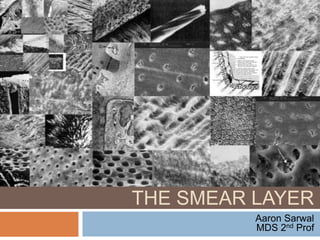
THE SMEAR LAYER
Aaron Sarwal
MDS 2nd Prof
CONTENTS
 Introduction
 Definition
 History
 Components Of Smear Layer
 Bonding & Smear Layer
 Functional Implications
 Methods Of Removal
 Conclusion
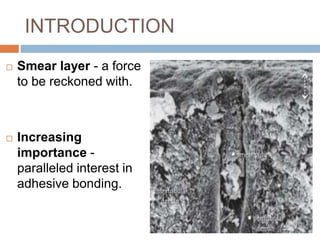
INTRODUCTION
 Smear layer - a force
to be reckoned with.
 Increasing
importance -
paralleled interest in
adhesive bonding.
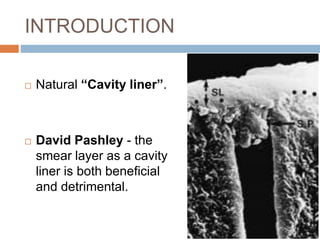
INTRODUCTION
 Natural “Cavity liner”.
 David Pashley - the
smear layer as a cavity
liner is both beneficial
and detrimental.
DEFINITION
 According to Operative Dentistry Journal
(1984) the term smear layer applies to:
“any debris produced iatrogenically by the
cutting, not only of dentin, but also of enamel,
cementum and even the dentin of the root
canal”.
DEFINITION
 Cohen defined smear layer as:
“an amorphous, relatively smooth layer of
microcrystalline debris whose featureless
surface cannot be seen with the naked eye”.
DEFINITION
 The American Association of Endodontists
defined smear layer as a:
“surface film of debris retained on dentin or other
tooth surfaces like enamel, cementum after
Instrumentation with either rotary instruments
or endodontic files”.
HOW IS SMEAR LAYER
FORMED?
 According to DCNA (1990)
“when tooth structure is cut, instead of being
uniformly sheared, the mineralised matrix
shatters. Existing on the strategic interface of
restorative materials and the dentin matrix
most of the debris is scattered over the enamel
and dentin surface to form what is known as
smear layer”.
HISTORY
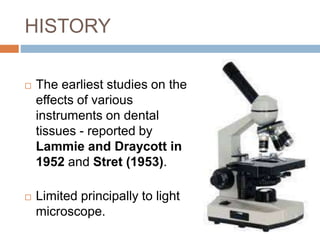
 The earliest studies on the
effects of various
instruments on dental
tissues - reported by
Lammie and Draycott in
1952 and Stret (1953).
 Limited principally to light
microscope.
HISTORY
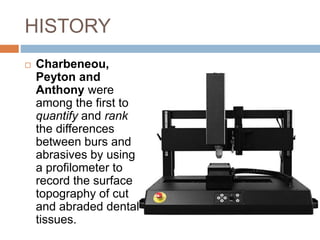
 Charbeneou,
Peyton and
Anthony were
among the first to
quantify and rank
the differences
between burs and
abrasives by using
a profilometer to
record the surface
topography of cut
and abraded dental
tissues.
HISTORY
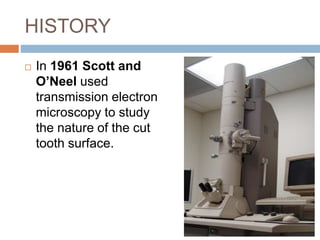
 In 1961 Scott and
O’Neel used
transmission electron
microscopy to study
the nature of the cut
tooth surface.
HISTORY
 Advent of SEM - grinding debris was first
referred to as the smear layer by Boyde,
Switsur and Stewart in 1963.
HISTORY
 Eick and others in 1970 attempted to quantify
and identify cutting debris on tooth surfaces.
They confirmed that:
 Surfaces abraded with diamonds were rougher
than those cut with tungsten carbide burs.
 Surfaces cut dry were rougher and more
smeared than those in which water was used as
coolant.
 The smear layer is composed of an organic film
less than 0.5 microns thick. Included with in it
were particles of opacity ranging from 0.5 – 15
microns.
 Such layers were present on all surfaces though
HISTORY
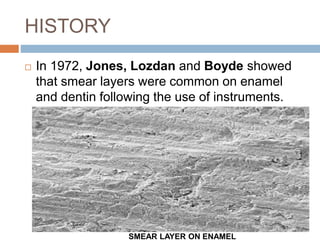
 In 1972, Jones, Lozdan and Boyde showed
that smear layers were common on enamel
and dentin following the use of instruments.
SMEAR LAYER ON ENAMEL
HISTORY
 Erich and co-workers in 1976 discussed the
role of friction and abrasion in the drilling of
teeth.
 They accounted for the formation of smear
layers, especially in dentin by a brittle and
ductile transition and alternating rupture and
transfer of apatite and collagen matrix into the
surface.
HISTORY
 In 1982, Goldman and others studied smear
layers after the use of endodontic
instrumentation.
SMEAR DILEMMA
TO
REMOVE
NOT TO
REMOVE
IN SUPPORT OF RETAINING SMEAR
LAYER
 Blocks the dentinal tubules, preventing the
exchange of bacteria and other irritants by
altering permeability (Michelich et al. 1980,
Pashley et al. 1981, Safavi et al. 1990, Drake
et al. 1994, Galvan et al. 1994).
 Barrier to prevent bacterial migration into the
dentinal tubules (Drake et al. 1994, Galvan et
al. 1994, Love et al. 1996, Perez et al. 1996).
 Vojinovic et.al. showed that bacteria could not
penetrate into dentin in the presence of smear
IN SUPPORT OF REMOVING SMEAR
LAYER
 Smear layer - unpredictable thickness and
volume, because a great portion of it
consists of water (Cergneux et al. 1987).
 It contains bacteria, their by products and
necrotic tissue (McComb & Smith 1975,
Goldberg & Abramo- vich 1977, Wayman et al.
1979,
Cunningham & Martin 1982, Yamada et al.
1983).
 Bacteria may survive and multiply (Brannstrom
& Nyborg 1973) and can proliferate into the
dentinal tubules (Olgart et al. 1974, Akpata &
Blechman
1982, Williams & Goldman 1985, Meryon et al.
1986, Meryon & Brook 1990), which may serve
as a reservoir of microbial irritants (Pashley
1984).
 It may act as a substrate for bacteria, allowing
their deeper penetration in the dentinal
IN SUPPORT OF REMOVING SMEAR
LAYER
 It may limit the optimum penetration of
disinfecting agents (McComb & Smith 1975,
Outhwaite et al. 1976, Goldberg & Abramovich
1977, Wayman et al. 1979, Yamada et al.
1983).
 It can act as a barrier between filling
materials and the canal wall and therefore
compromise the formation of a satisfactory
seal (Lester & Boyde 1977, White et al. 1984,
Cergneux et al. 1987, Czonstkowsky et al.
IN SUPPORT OF REMOVING SMEAR
LAYER
COMPONENTS OF SMEAR
LAYER
 The exact proportionate composition of the
smear layer has not been determined but SEM
examinations have disclosed that its
composition is both organic and inorganic.
COMPONENTS OF SMEAR
LAYER
 The inorganic material in the smear layer is
made up of tooth structures and some non-
specific inorganic contaminants.
 The organic components may consist of
heated coagulated proteins, necrotic or
viable pulp tissues and odontoblastic
processes plus saliva, blood cells and
microorganisms.
SMEAR PHENOMENON
 Eirich (1976) stated that smearing occurs
when “hydroxy apatite within the tissue is
either plucked out or broken or swept along
and resets in the smeared out matrix”.
 Temperature rises upto 600oC in dentin when
it is cut without a coolant.
 This value is significantly lower than the
melting point of apatite (1500-1800oC)
SMEAR PHENOMENON
 Smearing is a physico-chemical
phenomenon rather than a thermal
transformation of apatite involving mechanical
shearing and thermal dehydration of the
protein.
 Plastic flow of hydroxy apatite is believed to
occur at lower temperature than its melting
point and may also be a contributing factor to
smearing.
MORPHOLOGY OF SMEAR
LAYER
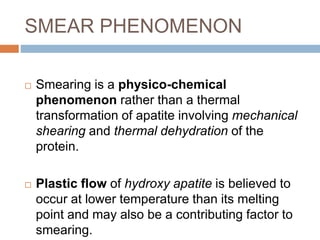
 Smear layer - two
separate layers – a
superficial layer and a
layer loosely attached to
the underlying dentin.
 Dentin debris enters the
orifices of the dentinal
tubules and acts as plugs
to occlude the ends of the
tubules.
 The smear layer is not
always firmly attached and
neither is it continuous
over the substrate.
 Smear layers found on
deep dentin contain more
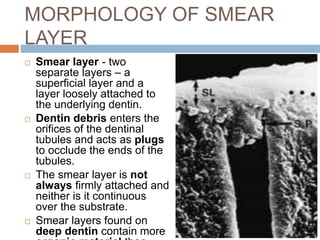
Disc of human dentin cut with a fine-grit diamond blade on a metallurgical saw.
Note the uniformity and amorphous nature of the smear layer. Water was the
coolant.
SCANNING ELECTRON MICROGRAPH
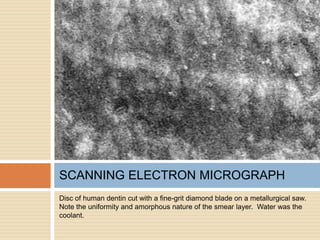
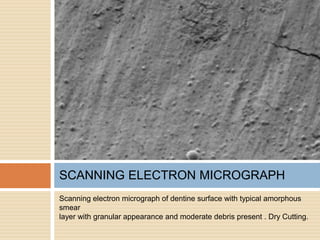
Scanning electron micrograph of dentine surface with typical amorphous
smear
layer with granular appearance and moderate debris present . Dry Cutting.
SCANNING ELECTRON MICROGRAPH
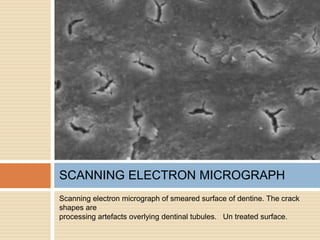
Scanning electron micrograph of smeared surface of dentine. The crack
shapes are
processing artefacts overlying dentinal tubules. Un treated surface.
SCANNING ELECTRON MICROGRAPH
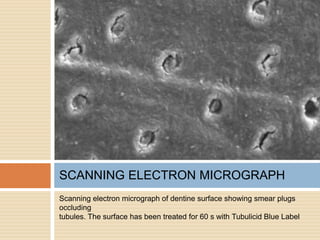
Scanning electron micrograph of dentine surface showing smear plugs
occluding
tubules. The surface has been treated for 60 s with Tubulicid Blue Label
SCANNING ELECTRON MICROGRAPH
 Clinically produced smear layers have an average
depth of from 1-5 microns (Goldman et.al. 1981,
Mader et.al. 1984).
 The depth entering the dentinal tubule may vary from
a very few microns to 40 microns.
 Cengiz et.al. (1990) proposed that the penetration of
smear layer into dentinal tubules could be caused by
Capillary action as a result of adhesive forces between the
dentinal tubules and the smear material.
MORPHOLOGY OF SMEAR
LAYER
 Several factors may cause the depth of the
smear layer to vary from tooth to tooth:
 Dry or wet cutting of the dentin.
 The type of instrument used and
 The amount and chemical make of the irrigation
solution.
MORPHOLOGY OF SMEAR
LAYER
 Filing a canal without irrigation or cutting
without a water spray will produce a thicker
layer of dentin debris
 The use of coarse diamond burs produces a
thicker smear layer than the use of carbide
burs.
MORPHOLOGY OF SMEAR
LAYER
TOPOGRAPHICAL DETAIL OF CUT
DENTIN
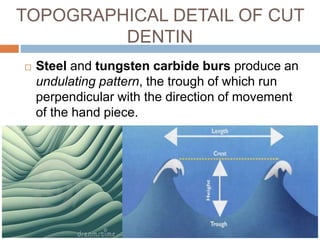
 Steel and tungsten carbide burs produce an
undulating pattern, the trough of which run
perpendicular with the direction of movement
of the hand piece.
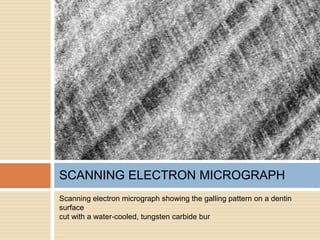
 Fine grooves can be seen running
perpendicular to the undulations and parallel
with the direction of rotation of the bur.
 Such a phenomenon is referred to as
“galling”.
TOPOGRAPHICAL DETAIL OF CUT
DENTIN
Scanning electron micrograph showing the galling pattern on a dentin
surface
cut with a water-cooled, tungsten carbide bur
SCANNING ELECTRON MICROGRAPH
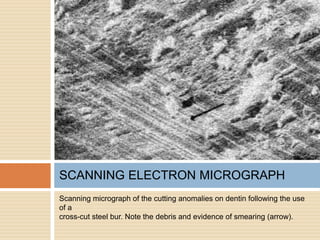
Scanning micrograph of the cutting anomalies on dentin following the use
of a
cross-cut steel bur. Note the debris and evidence of smearing (arrow).
SCANNING ELECTRON MICROGRAPH
 The galling phenomenon appears more
masked with tungsten carbide burs run at high
speed.
 An examination of both steel and tungsten
carbide burs shows a rapid deterioration of the
cutting edges through what appears to be a
brittle fracture.
 Brittleness significantly diminishes the cutting
efficiencies of the bur - increases frictional
heat - causes smearing.
TOPOGRAPHICAL DETAIL OF CUT
DENTIN
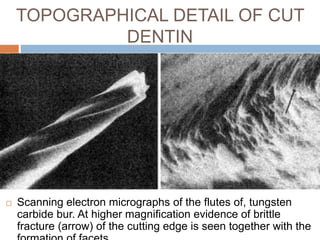
 Scanning electron micrographs of the flutes of, tungsten
carbide bur. At higher magnification evidence of brittle
fracture (arrow) of the cutting edge is seen together with the
TOPOGRAPHICAL DETAIL OF CUT
DENTIN
 Steel and tungsten carbide burs - obliterate
normal
structural detail of the tissue.
 Debris, irregular in shape and non-uniform in
size and distribution, remains on the surface
even after thorough lavage with H2O2
TOPOGRAPHICAL DETAIL OF CUT
DENTIN
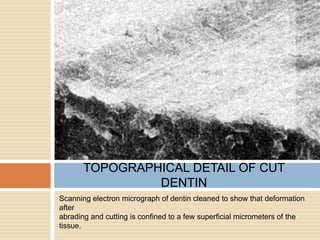
Scanning electron micrograph of dentin cleaned to show that deformation
after
abrading and cutting is confined to a few superficial micrometers of the
tissue.
TOPOGRAPHICAL DETAIL OF CUT
DENTIN
 The mechanism of dental tissue removal for
burs and diamond is different significantly.
 As burs rotate, the flute undermines the tissue,
the amount being determined by such factors
as the angle of attack of the flute.
TOPOGRAPHICAL DETAIL OF CUT
DENTIN
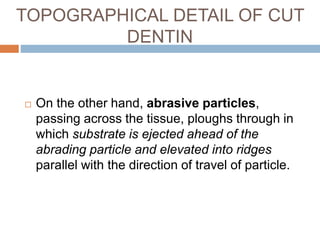
 On the other hand, abrasive particles,
passing across the tissue, ploughs through in
which substrate is ejected ahead of the
abrading particle and elevated into ridges
parallel with the direction of travel of particle.
TOPOGRAPHICAL DETAIL OF CUT
DENTIN
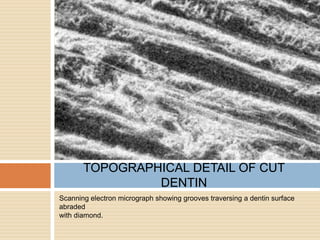
Scanning electron micrograph showing grooves traversing a dentin surface
abraded
with diamond.
TOPOGRAPHICAL DETAIL OF CUT
DENTIN
TOPOGRAPHICAL DETAIL OF CUT
DENTIN
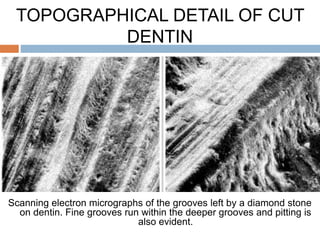
Scanning electron micrographs of the grooves left by a diamond stone
on dentin. Fine grooves run within the deeper grooves and pitting is
also evident.
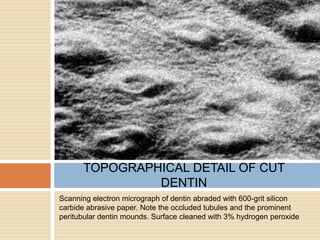
Scanning electron micrograph of dentin abraded with 600-grit silicon
carbide abrasive paper. Note the occluded tubules and the prominent
peritubular dentin mounds. Surface cleaned with 3% hydrogen peroxide
TOPOGRAPHICAL DETAIL OF CUT
DENTIN
 Several factors govern the size of the
grooves, including particle size, pressure and
hardness of the abrasive related to the
substrate.
TOPOGRAPHICAL DETAIL OF CUT
DENTIN
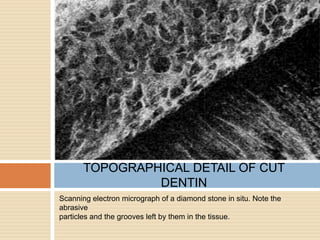
Scanning electron micrograph of a diamond stone in situ. Note the
abrasive
particles and the grooves left by them in the tissue.
TOPOGRAPHICAL DETAIL OF CUT
DENTIN
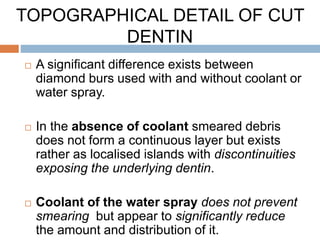
 A significant difference exists between
diamond burs used with and without coolant or
water spray.
 In the absence of coolant smeared debris
does not form a continuous layer but exists
rather as localised islands with discontinuities
exposing the underlying dentin.
 Coolant of the water spray does not prevent
smearing but appear to significantly reduce
the amount and distribution of it.
TOPOGRAPHICAL DETAIL OF CUT
DENTIN
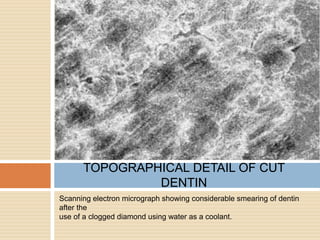
Scanning electron micrograph showing considerable smearing of dentin
after the
use of a clogged diamond using water as a coolant.
TOPOGRAPHICAL DETAIL OF CUT
DENTIN
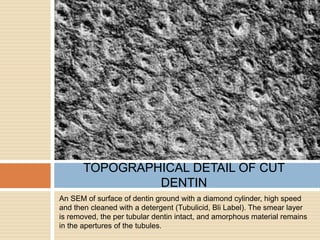
An SEM of surface of dentin ground with a diamond cylinder, high speed
and then cleaned with a detergent (Tubulicid, Bli Label). The smear layer
is removed, the per tubular dentin intact, and amorphous material remains
in the apertures of the tubules.
TOPOGRAPHICAL DETAIL OF CUT
DENTIN
BONDING THE SMEAR LAYER
 Diamonds, through the introduction of grooved
anomalies - greater surface area than burs.
 Increased surface area - offers large number
of retentive sites.
 These sites in enamel are primarily
micromechanical and the retention
mechanism for the tissue lies in the multitude of
superficial micropores enhanced following acid
conditioning of the tissue.
 Acids - remove the smear layer. For enamel -
H3PO4 phoshoric acid in gel solution ranging
from 30-50%.
 Branstrom, Nordel Wall and Gwinnett –
conditioning facilitates the penetration of
resin into the dentinal tubules - increases bond
strength.
BONDING THE SMEAR LAYER
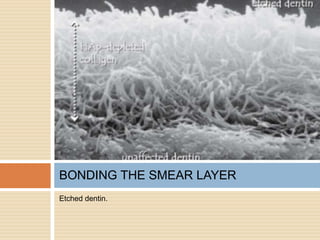
Etched dentin.
BONDING THE SMEAR LAYER
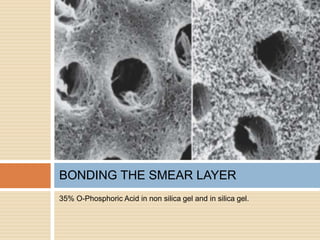
35% O-Phosphoric Acid in non silica gel and in silica gel.
BONDING THE SMEAR LAYER
TOTAL ETCH VS SELF ETCH
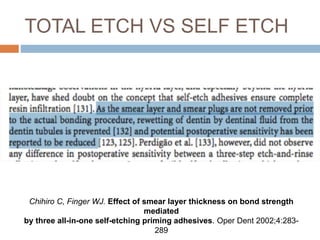
Chihiro C, Finger WJ. Effect of smear layer thickness on bond strength
mediated
by three all-in-one self-etching priming adhesives. Oper Dent 2002;4:283-
289
RESTORATIVE DENTISTRY
FUNCTIONAL
IMPLICATIONS
Smear
Layer
of
Denti
n
INFLUENCE OF CONDITIONING OF
SMEAR LAYER ON SENSITIVITY OF
DENTIN
 Etching the dentin of roots, whether done
therapeutically or by the action of
microorganisms of plaque can remove the thin
layer of covering cementum or smear layer or
both.
 Conditioning with acids will remove the smear
layer plugs exposing patent dentinal tubules to
the oral cavity.
 This can lead to sensitivity of the dentin to the
 Several studies indicate that most of the
resistance to the flow of fluid across dentin is due
to the presence of smear layer.
 Etching dentin greatly increases the ease
with which fluid can move across dentin.
 This is accompanied clinically by increased
sensitivity of dentin to osmotic, thermal and
tactile stimuli.
INFLUENCE OF CONDITIONING OF
SMEAR LAYER ON SENSITIVITY OF
DENTIN
INFLUENCE ON PERMEABILITY OF
DENTIN
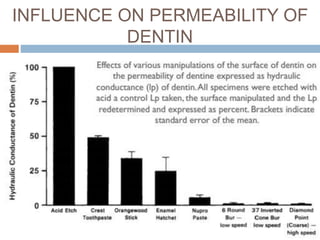
 Substances diffuse across dentin at a rate that
is proportional to their concentration gradient
and the surface available for diffusion.
 The removal of smear layer increases the
dentin permeability by 5-6 times in vitro by
diffusion but increases it by 25-36 times by
filtration.
INFLUENCE ON PERMEABILITY OF
DENTIN
BACTERIA UNDER SMEAR LAYER
UNDER RESTORATIONS
 Water cleaned cavities with the smear layer
remaining underneath the composite
restoration showed the presence of numerous
bacteria, whereas in the antiseptically cleaned
cavities, bacteria were absent.
 Micro organisms get sufficient nourishment
from the smear layer and dentinal fluid.
BACTERIA UNDER SMEAR LAYER
UNDER RESTORATIONS
 These considerations favour the opinion that
most of the smear layer should be removed
and any smear layer remaining for instance at
the tubule should be antiseptically treated
before the application of lining or a luting
cement.
 There is no evidence that common permanent
restorative materials are sufficiently
antibacterial to kill bacteria entrapped within
the smear layer, especially when a fluid filled
contraction gap, 5-20 microns wide separates
 Bases of ZnOE and Ca(OH)2 may have good
antiseptic effects but unfortunately under
permanent restorations, these bases cannot be
placed on all cavity walls.
 Pure Ca(OH)2 is an excellent antibacterial
temporary dressing and should be applied under
temperature fillings.
 Ca(OH)2 may reinforce the remaining smear
plugs in the outer apertures of dentinal tubules.
BACTERIA UNDER SMEAR
LAYER UNDER RESTORATIONS
THE PROTECTIVE EFFECT OF
SMEAR PLUGS IN APERTURES
 Etching the cavity prior to the placement of the
composite resin resulted in a massive invasion of
bacteria in dentinal tubules. This was seen in all
teeth after 3-4 weeks.
 The corresponding cavities, cleaned by water
and with smear layer had a bacterial layer on the
cavity walls but practically no invasion into the
dentinal tubules.
 Obviously smear plugs in the apertures of the
tubules had prevented bacterial invasion.
THE CONSEQUENCE OF REMOVING
THE PLUGS
 From opened tubules, bacteria may easily reach the pulp
and
multiply therefore removal of smear plugs should be
avoided.
 Another important consequence of etching and removal
of
smear plugs and peritubular dentin at the surface is that
the
area of wet tubules may increase from about 10-25% of
the
total.
 Subsequently it is difficult to get the dentin dry because
THE CONSEQUENCE OF
REMOVING THE PLUGS
 Inflammation was present under all infected
cavities, being somewhat more pronounced on
the etched cavities, but the difference was not
great.
 Thus smear plugs did not prevent bacterial toxins
from diffusing into the pulp.
ENDODONTICS
FUNCTIONAL
IMPLICATIONS
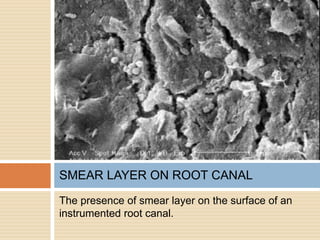
The presence of smear layer on the surface of an
instrumented root canal.
SMEAR LAYER ON ROOT CANAL
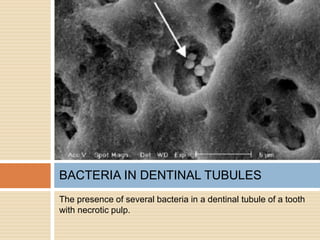
The presence of several bacteria in a dentinal tubule of a tooth
with necrotic pulp.
BACTERIA IN DENTINAL TUBULES
ROLE OF SMEAR LAYER IN APICAL
LEAKAGE
 The smear layer’s presence plays a significant
part in an apical leakage.
 Its absence makes the dentin more conducive to a
better and closer adaptation of the gutta percha to
the canal wall. With the smear layer intact, apical
leakage will be significantly increased, without the
smear layer, the leakage will still occur but at a
decreased rate.
 Plasticized GP can enter the dentinal tubules
when the smear layer is absent. This can
establish a mechanical block b/w the GP and the
EFFECT OF SMEAR LAYER ON
SEALERS
 The type of sealer used has different implications
once the smear layer is removed.
 A powder liquid combination, the most of which is
grossmans sealer contains small particles in the
powder that could enter the orifices of the dentinal
tubules and help create a reaction interface
between sealer and canal wall.
 Ca(OH)2 based sealers have the advantage of
promoting the apposition of cements at the canal
apex and sealing it off against microleakage.
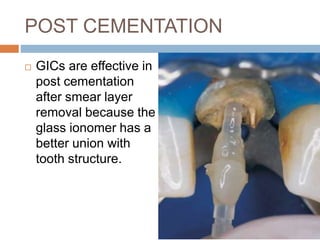
POST CEMENTATION
 GICs are effective in
post cementation
after smear layer
removal because the
glass ionomer has a
better union with
tooth structure.
METHODS OF REMOVAL
FUNCTIONAL
IMPLICATIONS
METHODS OF REMOVAL
 Braunsternis - described the use of H2O, H2O2
benzalkonium chloride, EDTA and other agents
to remove the smear layer.
 Commercially available products like tubulicid
blue label, tubulicid red label - remove most of
smear layer without removing smear debris that
has fallen into the orifices of the tubules to form
plugs on the cut surface of the dentin.
METHODS OF REMOVAL
 Smear layer removed by etching with acid -
does not injure the pulp, especially if dilute
acids are used for short periods of time.
 Etching dentin with 6% citric acid for 60
seconds removes all of the smear layer as
does 15 seconds of etching with 37%
phosphoric acid.
ADVANTAGES OF REMOVAL BY
ETCHING
 The smear layer is entirely removed.
 The tubules are open and available for retention.
 The surface collagen is exposed for possible covalent
linkage with new experimental primers for cavities.
 Further with the smear layer gone, one does not have to
worry about it slowly dissolving under a leaking
restoration or being removed by acid produced by
bacteria, leaving a void b/w the cavity wall and the
restoration might permit bacterial colonization.
DISADVANTAGES OF
REMOVING THE SMEAR LAYER
 In its absence, there is no physical barrier to
bacterial penetration of dentinal tubules
SODIUM HYPOCHLORITE
 The capacity of NaOCl to remove the smear
layer from the instrumented root canal wall has
been found to be insufficient.
 Even the combination of NaOCl and H2O2
proved to be ineffective.
 NaOCl cannot destroy bacteria within the
tubules closed by a smear layer covering.
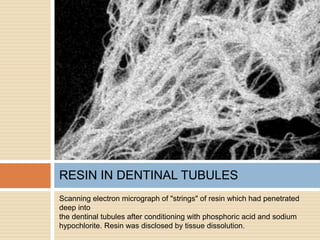
Scanning electron micrograph of "strings" of resin which had penetrated
deep into
the dentinal tubules after conditioning with phosphoric acid and sodium
hypochlorite. Resin was disclosed by tissue dissolution.
RESIN IN DENTINAL TUBULES
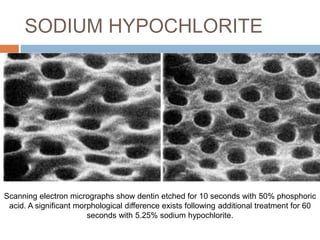
SODIUM HYPOCHLORITE
Scanning electron micrographs show dentin etched for 10 seconds with 50% phosphoric
acid. A significant morphological difference exists following additional treatment for 60
seconds with 5.25% sodium hypochlorite.
SODIUM HYPOCHLORITE
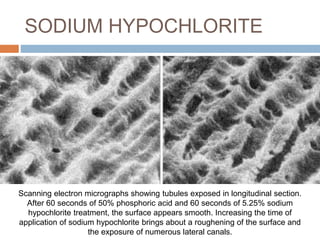
Scanning electron micrographs showing tubules exposed in longitudinal section.
After 60 seconds of 50% phosphoric acid and 60 seconds of 5.25% sodium
hypochlorite treatment, the surface appears smooth. Increasing the time of
application of sodium hypochlorite brings about a roughening of the surface and
the exposure of numerous lateral canals.
CHELATING AGENTS
 The most common chelating solutions are based on
ethylenediamine tetra acetic acid (EDTA 17% 10
minutes) which reacts with Ca++ in dentin and forms
soluble calcium chelates.
 While Fehr and Nygard Ostby (1963) found that
EDTA decalcified dentin to a depth of 20-30
microns in 5 minutes.
 Fraser (1974) stated that chelating effect was
almost negligible in the apical third of the root
canals.
CHELATING AGENTS
 Different preparations of EDTA have been used as a
root canal irrigants.
 Root canal preparations i.e. a mixture of EDTA and
urea peroxide left a residue of this mixture after
instrumentation. This may have disadvantages in the
hermetic sealing of root canals.
 The combination of EDTA + cetrimide (a
quarternary ammonium bromide) left no smear layer
except in the apical part of the canal.
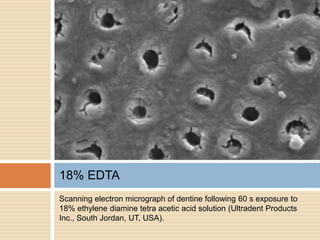
Scanning electron micrograph of dentine following 60 s exposure to
18% ethylene diamine tetra acetic acid solution (Ultradent Products
Inc., South Jordan, UT, USA).
18% EDTA
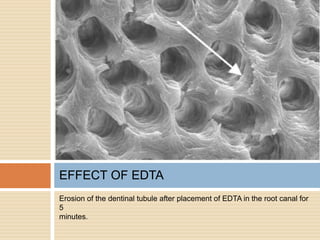
Erosion of the dentinal tubule after placement of EDTA in the root canal for
5
minutes.
EFFECT OF EDTA
GLYOXIDE
 Glyoxide - 10% urea peroxide (carbamide
peroxide) in a vehicle of anhydrous glycerol.
 In 1961 Steward proposed glyoxide to be an
effective adjunct to instrumentation for
cleaning of the root canal
GLYOXIDE
 Glyoxide - greater solvent action than 3%
H2O2.
 It enhances root canal lubrication without
softening dentin.
 Other root canal chelating agent - solvizol
which is based on aminogerinaldium diacetate
and EDTAC i.e. EDTA + Ceterlon.
ORGANIC ACIDS
 Citric acid removed smear layer better than many
acids such as polyacrylic acid, lactic acid and
phosphoric acid and phosphoric acid except EDTA.
 Yamada et.al. in 1983 observed that the 25% citric
acid – NaOcl combination was not effective as 17%
EDTA-NaOcl combination.
 Citric acid left precipitated crystals in the root canal -
disadvantageous in the root canal obturation.
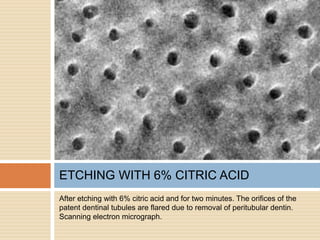
After etching with 6% citric acid and for two minutes. The orifices of the
patent dentinal tubules are flared due to removal of peritubular dentin.
Scanning electron micrograph.
ETCHING WITH 6% CITRIC ACID
 With 50% lactic acid, the canal walls were
generally clean but the openings of the
dentinal tubules did not appear completely
patent.
 25% tannic acid introduced by Bitter in 1989
was better than NaOcl – H2O2 combination.
 20% polyacrylic acid was less effective than
REDTA according to a study conducted by Mc
Cough and Smith.
ORGANIC ACIDS
SODIUM HYPOCHLORITE
&EDTA
 Goldman et.al. in 1982 - most effective
working solution - 5.25% NaOCl and the most
effective final flush -10 ml of 17% EDTA
followed by 10 ml of 5.25% NaOCl.
 NaOCl removes organic material including
the collagenous matrix of dentin and EDTA
removes the mineralized dentin, thereby
exposing more collagen.
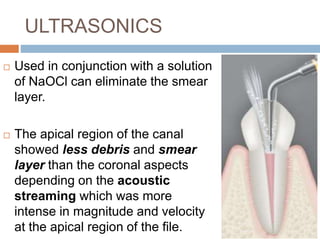
ULTRASONICS
 Used in conjunction with a solution
of NaOCl can eliminate the smear
layer.
 The apical region of the canal
showed less debris and smear
layer than the coronal aspects
depending on the acoustic
streaming which was more
intense in magnitude and velocity
at the apical region of the file.
LASERS
 Takeda et al - lasers - vaporize tissues in the
main canal, remove the smear layer, and
eliminate the residual tissue in the apical
portion of the root canals.
 Effectiveness of lasers depends on - power
level, the duration of exposure, the absorption
of light in the tissue, the geometry of the root
canal, and
the tip-to-target distance.
Smear Layer of Dentin - Operative Dentistry, Supplement 3,1984.
Pathways of the Pulp - Cohen, 6th edition.
Ingle’s Endodontics - 6th edition.
Gunnar’s Textbook of Endodontics - 2nd edition.
Grossman’s Endodontic Practice - 12th edition.
REFERENCES
9
6
The Smear Layer

The Smear Layer

  • 1.
    THE SMEAR LAYER AaronSarwal MDS 2nd Prof
  • 2.
    CONTENTS  Introduction  Definition History  Components Of Smear Layer  Bonding & Smear Layer  Functional Implications  Methods Of Removal  Conclusion
  • 3.
    INTRODUCTION  Smear layer- a force to be reckoned with.  Increasing importance - paralleled interest in adhesive bonding.
  • 4.
    INTRODUCTION  Natural “Cavityliner”.  David Pashley - the smear layer as a cavity liner is both beneficial and detrimental.
  • 5.
    DEFINITION  According toOperative Dentistry Journal (1984) the term smear layer applies to: “any debris produced iatrogenically by the cutting, not only of dentin, but also of enamel, cementum and even the dentin of the root canal”.
  • 6.
    DEFINITION  Cohen definedsmear layer as: “an amorphous, relatively smooth layer of microcrystalline debris whose featureless surface cannot be seen with the naked eye”.
  • 7.
    DEFINITION  The AmericanAssociation of Endodontists defined smear layer as a: “surface film of debris retained on dentin or other tooth surfaces like enamel, cementum after Instrumentation with either rotary instruments or endodontic files”.
  • 8.
    HOW IS SMEARLAYER FORMED?  According to DCNA (1990) “when tooth structure is cut, instead of being uniformly sheared, the mineralised matrix shatters. Existing on the strategic interface of restorative materials and the dentin matrix most of the debris is scattered over the enamel and dentin surface to form what is known as smear layer”.
  • 9.
    HISTORY  The earlieststudies on the effects of various instruments on dental tissues - reported by Lammie and Draycott in 1952 and Stret (1953).  Limited principally to light microscope.
  • 10.
    HISTORY  Charbeneou, Peyton and Anthonywere among the first to quantify and rank the differences between burs and abrasives by using a profilometer to record the surface topography of cut and abraded dental tissues.
  • 11.
    HISTORY  In 1961Scott and O’Neel used transmission electron microscopy to study the nature of the cut tooth surface.
  • 12.
    HISTORY  Advent ofSEM - grinding debris was first referred to as the smear layer by Boyde, Switsur and Stewart in 1963.
  • 13.
    HISTORY  Eick andothers in 1970 attempted to quantify and identify cutting debris on tooth surfaces. They confirmed that:  Surfaces abraded with diamonds were rougher than those cut with tungsten carbide burs.  Surfaces cut dry were rougher and more smeared than those in which water was used as coolant.  The smear layer is composed of an organic film less than 0.5 microns thick. Included with in it were particles of opacity ranging from 0.5 – 15 microns.  Such layers were present on all surfaces though
  • 14.
    HISTORY  In 1972,Jones, Lozdan and Boyde showed that smear layers were common on enamel and dentin following the use of instruments. SMEAR LAYER ON ENAMEL
  • 15.
    HISTORY  Erich andco-workers in 1976 discussed the role of friction and abrasion in the drilling of teeth.  They accounted for the formation of smear layers, especially in dentin by a brittle and ductile transition and alternating rupture and transfer of apatite and collagen matrix into the surface.
  • 16.
    HISTORY  In 1982,Goldman and others studied smear layers after the use of endodontic instrumentation.
  • 17.
  • 18.
    IN SUPPORT OFRETAINING SMEAR LAYER  Blocks the dentinal tubules, preventing the exchange of bacteria and other irritants by altering permeability (Michelich et al. 1980, Pashley et al. 1981, Safavi et al. 1990, Drake et al. 1994, Galvan et al. 1994).  Barrier to prevent bacterial migration into the dentinal tubules (Drake et al. 1994, Galvan et al. 1994, Love et al. 1996, Perez et al. 1996).  Vojinovic et.al. showed that bacteria could not penetrate into dentin in the presence of smear
  • 19.
    IN SUPPORT OFREMOVING SMEAR LAYER  Smear layer - unpredictable thickness and volume, because a great portion of it consists of water (Cergneux et al. 1987).  It contains bacteria, their by products and necrotic tissue (McComb & Smith 1975, Goldberg & Abramo- vich 1977, Wayman et al. 1979, Cunningham & Martin 1982, Yamada et al. 1983).
  • 20.
     Bacteria maysurvive and multiply (Brannstrom & Nyborg 1973) and can proliferate into the dentinal tubules (Olgart et al. 1974, Akpata & Blechman 1982, Williams & Goldman 1985, Meryon et al. 1986, Meryon & Brook 1990), which may serve as a reservoir of microbial irritants (Pashley 1984).  It may act as a substrate for bacteria, allowing their deeper penetration in the dentinal IN SUPPORT OF REMOVING SMEAR LAYER
  • 21.
     It maylimit the optimum penetration of disinfecting agents (McComb & Smith 1975, Outhwaite et al. 1976, Goldberg & Abramovich 1977, Wayman et al. 1979, Yamada et al. 1983).  It can act as a barrier between filling materials and the canal wall and therefore compromise the formation of a satisfactory seal (Lester & Boyde 1977, White et al. 1984, Cergneux et al. 1987, Czonstkowsky et al. IN SUPPORT OF REMOVING SMEAR LAYER
  • 22.
    COMPONENTS OF SMEAR LAYER The exact proportionate composition of the smear layer has not been determined but SEM examinations have disclosed that its composition is both organic and inorganic.
  • 23.
    COMPONENTS OF SMEAR LAYER The inorganic material in the smear layer is made up of tooth structures and some non- specific inorganic contaminants.  The organic components may consist of heated coagulated proteins, necrotic or viable pulp tissues and odontoblastic processes plus saliva, blood cells and microorganisms.
  • 24.
    SMEAR PHENOMENON  Eirich(1976) stated that smearing occurs when “hydroxy apatite within the tissue is either plucked out or broken or swept along and resets in the smeared out matrix”.  Temperature rises upto 600oC in dentin when it is cut without a coolant.  This value is significantly lower than the melting point of apatite (1500-1800oC)
  • 25.
    SMEAR PHENOMENON  Smearingis a physico-chemical phenomenon rather than a thermal transformation of apatite involving mechanical shearing and thermal dehydration of the protein.  Plastic flow of hydroxy apatite is believed to occur at lower temperature than its melting point and may also be a contributing factor to smearing.
  • 26.
    MORPHOLOGY OF SMEAR LAYER Smear layer - two separate layers – a superficial layer and a layer loosely attached to the underlying dentin.  Dentin debris enters the orifices of the dentinal tubules and acts as plugs to occlude the ends of the tubules.  The smear layer is not always firmly attached and neither is it continuous over the substrate.  Smear layers found on deep dentin contain more
  • 27.
    Disc of humandentin cut with a fine-grit diamond blade on a metallurgical saw. Note the uniformity and amorphous nature of the smear layer. Water was the coolant. SCANNING ELECTRON MICROGRAPH
  • 28.
    Scanning electron micrographof dentine surface with typical amorphous smear layer with granular appearance and moderate debris present . Dry Cutting. SCANNING ELECTRON MICROGRAPH
  • 29.
    Scanning electron micrographof smeared surface of dentine. The crack shapes are processing artefacts overlying dentinal tubules. Un treated surface. SCANNING ELECTRON MICROGRAPH
  • 30.
    Scanning electron micrographof dentine surface showing smear plugs occluding tubules. The surface has been treated for 60 s with Tubulicid Blue Label SCANNING ELECTRON MICROGRAPH
  • 31.
     Clinically producedsmear layers have an average depth of from 1-5 microns (Goldman et.al. 1981, Mader et.al. 1984).  The depth entering the dentinal tubule may vary from a very few microns to 40 microns.  Cengiz et.al. (1990) proposed that the penetration of smear layer into dentinal tubules could be caused by Capillary action as a result of adhesive forces between the dentinal tubules and the smear material. MORPHOLOGY OF SMEAR LAYER
  • 32.
     Several factorsmay cause the depth of the smear layer to vary from tooth to tooth:  Dry or wet cutting of the dentin.  The type of instrument used and  The amount and chemical make of the irrigation solution. MORPHOLOGY OF SMEAR LAYER
  • 33.
     Filing acanal without irrigation or cutting without a water spray will produce a thicker layer of dentin debris  The use of coarse diamond burs produces a thicker smear layer than the use of carbide burs. MORPHOLOGY OF SMEAR LAYER
  • 34.
    TOPOGRAPHICAL DETAIL OFCUT DENTIN  Steel and tungsten carbide burs produce an undulating pattern, the trough of which run perpendicular with the direction of movement of the hand piece.
  • 35.
     Fine groovescan be seen running perpendicular to the undulations and parallel with the direction of rotation of the bur.  Such a phenomenon is referred to as “galling”. TOPOGRAPHICAL DETAIL OF CUT DENTIN
  • 36.
    Scanning electron micrographshowing the galling pattern on a dentin surface cut with a water-cooled, tungsten carbide bur SCANNING ELECTRON MICROGRAPH
  • 37.
    Scanning micrograph ofthe cutting anomalies on dentin following the use of a cross-cut steel bur. Note the debris and evidence of smearing (arrow). SCANNING ELECTRON MICROGRAPH
  • 38.
     The gallingphenomenon appears more masked with tungsten carbide burs run at high speed.  An examination of both steel and tungsten carbide burs shows a rapid deterioration of the cutting edges through what appears to be a brittle fracture.  Brittleness significantly diminishes the cutting efficiencies of the bur - increases frictional heat - causes smearing. TOPOGRAPHICAL DETAIL OF CUT DENTIN
  • 39.
     Scanning electronmicrographs of the flutes of, tungsten carbide bur. At higher magnification evidence of brittle fracture (arrow) of the cutting edge is seen together with the TOPOGRAPHICAL DETAIL OF CUT DENTIN
  • 40.
     Steel andtungsten carbide burs - obliterate normal structural detail of the tissue.  Debris, irregular in shape and non-uniform in size and distribution, remains on the surface even after thorough lavage with H2O2 TOPOGRAPHICAL DETAIL OF CUT DENTIN
  • 41.
    Scanning electron micrographof dentin cleaned to show that deformation after abrading and cutting is confined to a few superficial micrometers of the tissue. TOPOGRAPHICAL DETAIL OF CUT DENTIN
  • 42.
     The mechanismof dental tissue removal for burs and diamond is different significantly.  As burs rotate, the flute undermines the tissue, the amount being determined by such factors as the angle of attack of the flute. TOPOGRAPHICAL DETAIL OF CUT DENTIN
  • 43.
     On theother hand, abrasive particles, passing across the tissue, ploughs through in which substrate is ejected ahead of the abrading particle and elevated into ridges parallel with the direction of travel of particle. TOPOGRAPHICAL DETAIL OF CUT DENTIN
  • 44.
    Scanning electron micrographshowing grooves traversing a dentin surface abraded with diamond. TOPOGRAPHICAL DETAIL OF CUT DENTIN
  • 45.
    TOPOGRAPHICAL DETAIL OFCUT DENTIN Scanning electron micrographs of the grooves left by a diamond stone on dentin. Fine grooves run within the deeper grooves and pitting is also evident.
  • 46.
    Scanning electron micrographof dentin abraded with 600-grit silicon carbide abrasive paper. Note the occluded tubules and the prominent peritubular dentin mounds. Surface cleaned with 3% hydrogen peroxide TOPOGRAPHICAL DETAIL OF CUT DENTIN
  • 47.
     Several factorsgovern the size of the grooves, including particle size, pressure and hardness of the abrasive related to the substrate. TOPOGRAPHICAL DETAIL OF CUT DENTIN
  • 48.
    Scanning electron micrographof a diamond stone in situ. Note the abrasive particles and the grooves left by them in the tissue. TOPOGRAPHICAL DETAIL OF CUT DENTIN
  • 49.
     A significantdifference exists between diamond burs used with and without coolant or water spray.  In the absence of coolant smeared debris does not form a continuous layer but exists rather as localised islands with discontinuities exposing the underlying dentin.  Coolant of the water spray does not prevent smearing but appear to significantly reduce the amount and distribution of it. TOPOGRAPHICAL DETAIL OF CUT DENTIN
  • 50.
    Scanning electron micrographshowing considerable smearing of dentin after the use of a clogged diamond using water as a coolant. TOPOGRAPHICAL DETAIL OF CUT DENTIN
  • 51.
    An SEM ofsurface of dentin ground with a diamond cylinder, high speed and then cleaned with a detergent (Tubulicid, Bli Label). The smear layer is removed, the per tubular dentin intact, and amorphous material remains in the apertures of the tubules. TOPOGRAPHICAL DETAIL OF CUT DENTIN
  • 52.
    BONDING THE SMEARLAYER  Diamonds, through the introduction of grooved anomalies - greater surface area than burs.  Increased surface area - offers large number of retentive sites.  These sites in enamel are primarily micromechanical and the retention mechanism for the tissue lies in the multitude of superficial micropores enhanced following acid conditioning of the tissue.
  • 53.
     Acids -remove the smear layer. For enamel - H3PO4 phoshoric acid in gel solution ranging from 30-50%.  Branstrom, Nordel Wall and Gwinnett – conditioning facilitates the penetration of resin into the dentinal tubules - increases bond strength. BONDING THE SMEAR LAYER
  • 54.
  • 55.
    35% O-Phosphoric Acidin non silica gel and in silica gel. BONDING THE SMEAR LAYER
  • 56.
    TOTAL ETCH VSSELF ETCH Chihiro C, Finger WJ. Effect of smear layer thickness on bond strength mediated by three all-in-one self-etching priming adhesives. Oper Dent 2002;4:283- 289
  • 57.
  • 58.
  • 59.
    INFLUENCE OF CONDITIONINGOF SMEAR LAYER ON SENSITIVITY OF DENTIN  Etching the dentin of roots, whether done therapeutically or by the action of microorganisms of plaque can remove the thin layer of covering cementum or smear layer or both.  Conditioning with acids will remove the smear layer plugs exposing patent dentinal tubules to the oral cavity.  This can lead to sensitivity of the dentin to the
  • 60.
     Several studiesindicate that most of the resistance to the flow of fluid across dentin is due to the presence of smear layer.  Etching dentin greatly increases the ease with which fluid can move across dentin.  This is accompanied clinically by increased sensitivity of dentin to osmotic, thermal and tactile stimuli. INFLUENCE OF CONDITIONING OF SMEAR LAYER ON SENSITIVITY OF DENTIN
  • 61.
    INFLUENCE ON PERMEABILITYOF DENTIN  Substances diffuse across dentin at a rate that is proportional to their concentration gradient and the surface available for diffusion.  The removal of smear layer increases the dentin permeability by 5-6 times in vitro by diffusion but increases it by 25-36 times by filtration.
  • 62.
  • 63.
    BACTERIA UNDER SMEARLAYER UNDER RESTORATIONS  Water cleaned cavities with the smear layer remaining underneath the composite restoration showed the presence of numerous bacteria, whereas in the antiseptically cleaned cavities, bacteria were absent.  Micro organisms get sufficient nourishment from the smear layer and dentinal fluid.
  • 64.
    BACTERIA UNDER SMEARLAYER UNDER RESTORATIONS  These considerations favour the opinion that most of the smear layer should be removed and any smear layer remaining for instance at the tubule should be antiseptically treated before the application of lining or a luting cement.  There is no evidence that common permanent restorative materials are sufficiently antibacterial to kill bacteria entrapped within the smear layer, especially when a fluid filled contraction gap, 5-20 microns wide separates
  • 65.
     Bases ofZnOE and Ca(OH)2 may have good antiseptic effects but unfortunately under permanent restorations, these bases cannot be placed on all cavity walls.  Pure Ca(OH)2 is an excellent antibacterial temporary dressing and should be applied under temperature fillings.  Ca(OH)2 may reinforce the remaining smear plugs in the outer apertures of dentinal tubules. BACTERIA UNDER SMEAR LAYER UNDER RESTORATIONS
  • 66.
    THE PROTECTIVE EFFECTOF SMEAR PLUGS IN APERTURES  Etching the cavity prior to the placement of the composite resin resulted in a massive invasion of bacteria in dentinal tubules. This was seen in all teeth after 3-4 weeks.  The corresponding cavities, cleaned by water and with smear layer had a bacterial layer on the cavity walls but practically no invasion into the dentinal tubules.  Obviously smear plugs in the apertures of the tubules had prevented bacterial invasion.
  • 67.
    THE CONSEQUENCE OFREMOVING THE PLUGS  From opened tubules, bacteria may easily reach the pulp and multiply therefore removal of smear plugs should be avoided.  Another important consequence of etching and removal of smear plugs and peritubular dentin at the surface is that the area of wet tubules may increase from about 10-25% of the total.  Subsequently it is difficult to get the dentin dry because
  • 68.
    THE CONSEQUENCE OF REMOVINGTHE PLUGS  Inflammation was present under all infected cavities, being somewhat more pronounced on the etched cavities, but the difference was not great.  Thus smear plugs did not prevent bacterial toxins from diffusing into the pulp.
  • 69.
  • 70.
    The presence ofsmear layer on the surface of an instrumented root canal. SMEAR LAYER ON ROOT CANAL
  • 71.
    The presence ofseveral bacteria in a dentinal tubule of a tooth with necrotic pulp. BACTERIA IN DENTINAL TUBULES
  • 72.
    ROLE OF SMEARLAYER IN APICAL LEAKAGE  The smear layer’s presence plays a significant part in an apical leakage.  Its absence makes the dentin more conducive to a better and closer adaptation of the gutta percha to the canal wall. With the smear layer intact, apical leakage will be significantly increased, without the smear layer, the leakage will still occur but at a decreased rate.  Plasticized GP can enter the dentinal tubules when the smear layer is absent. This can establish a mechanical block b/w the GP and the
  • 73.
    EFFECT OF SMEARLAYER ON SEALERS  The type of sealer used has different implications once the smear layer is removed.  A powder liquid combination, the most of which is grossmans sealer contains small particles in the powder that could enter the orifices of the dentinal tubules and help create a reaction interface between sealer and canal wall.  Ca(OH)2 based sealers have the advantage of promoting the apposition of cements at the canal apex and sealing it off against microleakage.
  • 74.
    POST CEMENTATION  GICsare effective in post cementation after smear layer removal because the glass ionomer has a better union with tooth structure.
  • 75.
  • 76.
    METHODS OF REMOVAL Braunsternis - described the use of H2O, H2O2 benzalkonium chloride, EDTA and other agents to remove the smear layer.  Commercially available products like tubulicid blue label, tubulicid red label - remove most of smear layer without removing smear debris that has fallen into the orifices of the tubules to form plugs on the cut surface of the dentin.
  • 77.
    METHODS OF REMOVAL Smear layer removed by etching with acid - does not injure the pulp, especially if dilute acids are used for short periods of time.  Etching dentin with 6% citric acid for 60 seconds removes all of the smear layer as does 15 seconds of etching with 37% phosphoric acid.
  • 78.
    ADVANTAGES OF REMOVALBY ETCHING  The smear layer is entirely removed.  The tubules are open and available for retention.  The surface collagen is exposed for possible covalent linkage with new experimental primers for cavities.  Further with the smear layer gone, one does not have to worry about it slowly dissolving under a leaking restoration or being removed by acid produced by bacteria, leaving a void b/w the cavity wall and the restoration might permit bacterial colonization.
  • 79.
    DISADVANTAGES OF REMOVING THESMEAR LAYER  In its absence, there is no physical barrier to bacterial penetration of dentinal tubules
  • 80.
    SODIUM HYPOCHLORITE  Thecapacity of NaOCl to remove the smear layer from the instrumented root canal wall has been found to be insufficient.  Even the combination of NaOCl and H2O2 proved to be ineffective.  NaOCl cannot destroy bacteria within the tubules closed by a smear layer covering.
  • 81.
    Scanning electron micrographof "strings" of resin which had penetrated deep into the dentinal tubules after conditioning with phosphoric acid and sodium hypochlorite. Resin was disclosed by tissue dissolution. RESIN IN DENTINAL TUBULES
  • 82.
    SODIUM HYPOCHLORITE Scanning electronmicrographs show dentin etched for 10 seconds with 50% phosphoric acid. A significant morphological difference exists following additional treatment for 60 seconds with 5.25% sodium hypochlorite.
  • 83.
    SODIUM HYPOCHLORITE Scanning electronmicrographs showing tubules exposed in longitudinal section. After 60 seconds of 50% phosphoric acid and 60 seconds of 5.25% sodium hypochlorite treatment, the surface appears smooth. Increasing the time of application of sodium hypochlorite brings about a roughening of the surface and the exposure of numerous lateral canals.
  • 84.
    CHELATING AGENTS  Themost common chelating solutions are based on ethylenediamine tetra acetic acid (EDTA 17% 10 minutes) which reacts with Ca++ in dentin and forms soluble calcium chelates.  While Fehr and Nygard Ostby (1963) found that EDTA decalcified dentin to a depth of 20-30 microns in 5 minutes.  Fraser (1974) stated that chelating effect was almost negligible in the apical third of the root canals.
  • 85.
    CHELATING AGENTS  Differentpreparations of EDTA have been used as a root canal irrigants.  Root canal preparations i.e. a mixture of EDTA and urea peroxide left a residue of this mixture after instrumentation. This may have disadvantages in the hermetic sealing of root canals.  The combination of EDTA + cetrimide (a quarternary ammonium bromide) left no smear layer except in the apical part of the canal.
  • 86.
    Scanning electron micrographof dentine following 60 s exposure to 18% ethylene diamine tetra acetic acid solution (Ultradent Products Inc., South Jordan, UT, USA). 18% EDTA
  • 87.
    Erosion of thedentinal tubule after placement of EDTA in the root canal for 5 minutes. EFFECT OF EDTA
  • 88.
    GLYOXIDE  Glyoxide -10% urea peroxide (carbamide peroxide) in a vehicle of anhydrous glycerol.  In 1961 Steward proposed glyoxide to be an effective adjunct to instrumentation for cleaning of the root canal
  • 89.
    GLYOXIDE  Glyoxide -greater solvent action than 3% H2O2.  It enhances root canal lubrication without softening dentin.  Other root canal chelating agent - solvizol which is based on aminogerinaldium diacetate and EDTAC i.e. EDTA + Ceterlon.
  • 90.
    ORGANIC ACIDS  Citricacid removed smear layer better than many acids such as polyacrylic acid, lactic acid and phosphoric acid and phosphoric acid except EDTA.  Yamada et.al. in 1983 observed that the 25% citric acid – NaOcl combination was not effective as 17% EDTA-NaOcl combination.  Citric acid left precipitated crystals in the root canal - disadvantageous in the root canal obturation.
  • 91.
    After etching with6% citric acid and for two minutes. The orifices of the patent dentinal tubules are flared due to removal of peritubular dentin. Scanning electron micrograph. ETCHING WITH 6% CITRIC ACID
  • 92.
     With 50%lactic acid, the canal walls were generally clean but the openings of the dentinal tubules did not appear completely patent.  25% tannic acid introduced by Bitter in 1989 was better than NaOcl – H2O2 combination.  20% polyacrylic acid was less effective than REDTA according to a study conducted by Mc Cough and Smith. ORGANIC ACIDS
  • 93.
    SODIUM HYPOCHLORITE &EDTA  Goldmanet.al. in 1982 - most effective working solution - 5.25% NaOCl and the most effective final flush -10 ml of 17% EDTA followed by 10 ml of 5.25% NaOCl.  NaOCl removes organic material including the collagenous matrix of dentin and EDTA removes the mineralized dentin, thereby exposing more collagen.
  • 94.
    ULTRASONICS  Used inconjunction with a solution of NaOCl can eliminate the smear layer.  The apical region of the canal showed less debris and smear layer than the coronal aspects depending on the acoustic streaming which was more intense in magnitude and velocity at the apical region of the file.
  • 95.
    LASERS  Takeda etal - lasers - vaporize tissues in the main canal, remove the smear layer, and eliminate the residual tissue in the apical portion of the root canals.  Effectiveness of lasers depends on - power level, the duration of exposure, the absorption of light in the tissue, the geometry of the root canal, and the tip-to-target distance.
  • 96.
    Smear Layer ofDentin - Operative Dentistry, Supplement 3,1984. Pathways of the Pulp - Cohen, 6th edition. Ingle’s Endodontics - 6th edition. Gunnar’s Textbook of Endodontics - 2nd edition. Grossman’s Endodontic Practice - 12th edition. REFERENCES 9 6