Removal of Obturation
Materials
Mohamed Ali Alazrag
BDS.Msc
Tripoli Medical center .Libya
Obturation Materials
 Guttapercha
 Solid core obturators.
 Paste
 Resilon
 Silver points.
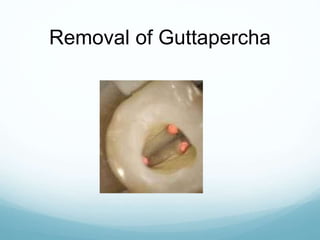
Removal of Guttapercha
it is depend on the quality of obturation :
 Single cone GP
 Condensed GP
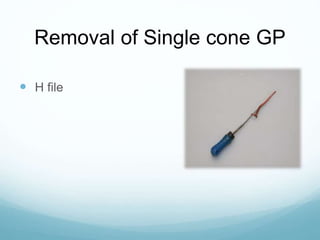
Removal of Single cone GP
 H file
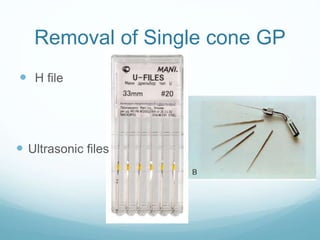
Removal of Single cone GP
 H file
 Ultrasonic files
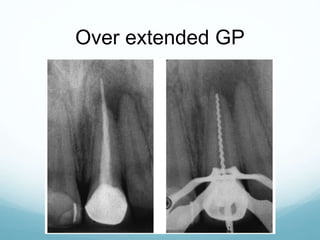
Over extended GP
Removal of Condensed GP
• Removal of gutta percha manually
• Removal of gutta percha using rotary system
• Removal of gutta percha using LASER
Removal of gutta percha manually:
1. Probing of the orifice
Removal of gutta percha manually:
1. Probing of the orifice
2. Heating endodontic carrier (to remove the
coronal part) avoid over heat.
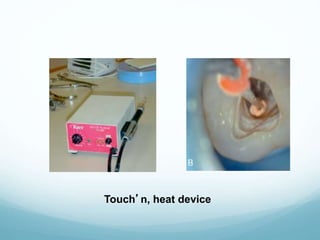
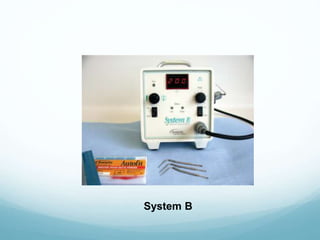
Touch’n, heat device
System B
Removal of gutta percha manually:
1. Probing of the orifice
2. Heating endodontic carrier (to remove the coronal
part) avoid over heat.
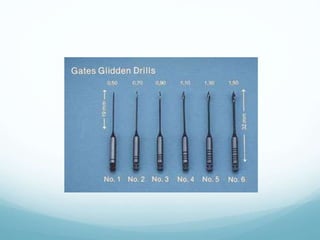
3. Using small Gates gliding drills. (to remove any
remaining coronal material)
Removal of gutta percha manually:
1. Probing of the orifice
2. Heating endodontic carrier (to remove the coronal
part) avoid over heat.
3. Using small Gates gliding drills. (to remove any
remaining coronal material)
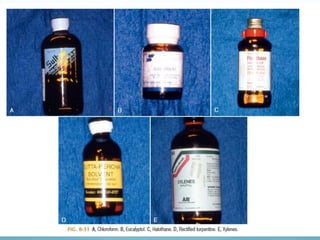
4. Using gutta percha solvents (to remove the
remaining material in the apica part of the
canal).
• Exposure of dental personnel to
chloroform in root-filling procedures.
Allard U, Andersson , Endod Dent
Traumatol 8:155, 1992.
• Chloroform in the endodontic operatory.
McDonald MN, Vire DE, J Endod 18:301,
1992.
• Risk assessment of the toxicity of
solvents of gutta-percha used in
endodontic retreatment.
Chutich MJ et al , J Endod 24:213, 1998.
Removal of gutta percha manually:
1. Probing of the orifice
2. Heating endodontic carrier (to remove the
coronal part) avoid over heat.
3. Using small Gates gliding drills. (to remove any
remaining coronal material)
4. Using gutta percha solvents (to remove the
remaining material in the apica part of the canal).
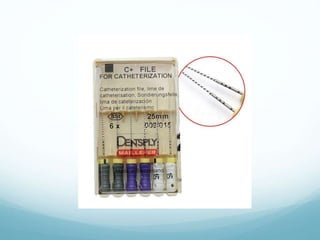
5. Small hand files (#15 C+ file to penetrate the
remaing root filling and enhance it is dissolution
by solvent).
Removal of gutta percha manually:
1. Probing of the orifice
2. Heating endodontic carrier (to remove the coronal
part) avoid over heat.
3. Using small Gates gliding drills. (to remove any
remaining coronal material)
4. Using gutta percha solvents (to remove the
remaining material in the apica part of the canal).
5. Small hand files (#15 C+ file to penetrate the
remaing root filling and enhance it is dissolution by
solvent).
6. Radiographic assessment.
• An in vivo comparison of two frequency-
based electronic apex locators.
Welk AR, Baumgartner JC, Marshall JG,
J Endod 29:497, 2003.
• Accuracy of two root canal length
measurement devices integrated into
rotary endodontic motors when removing
gutta-percha from root-filled teeth.
Uzun O, Topuz O, Tinaz C, et al, Int
Endod J 41:725, 2008.
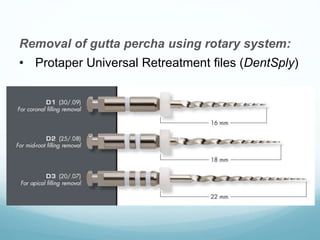
Removal of gutta percha using rotary system:
• Protaper Universal Retreatment files (DentSply)
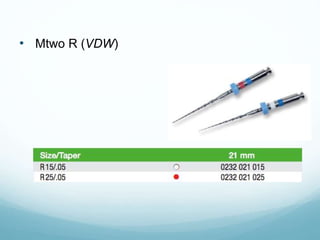
• Mtwo R (VDW)
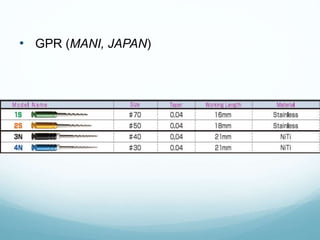
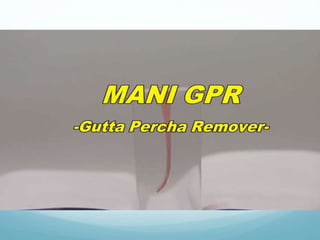
• GPR (MANI, JAPAN)
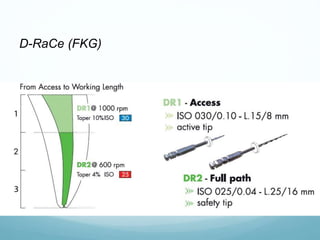
D-RaCe (FKG)
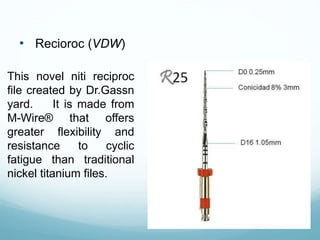
• Recioroc (VDW)
This novel niti reciproc
file created by Dr.Gassn
yard. It is made from
M-Wire® that offers
greater flexibility and
resistance to cyclic
fatigue than traditional
nickel titanium files.
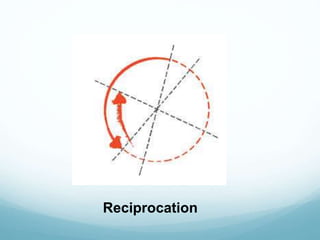
Reciprocation
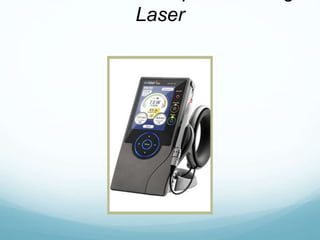
Laser
 Removal of gutta-percha from root canals using
an Nd:YAG laser. ( In vitro study )
Viducic D, Jukic S, Karlovic Z, et al; Int Endod J,
2003.
N.B: Further investigation required to proving safety and
efficacy of laser during gutta-percha removal .
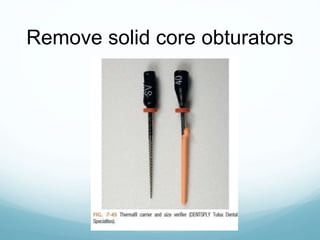
Remove solid core obturators
With the increased use of carrier-based systems such
as Thermafill we should understand how to retreat
carriers, and we must be aware of the different types
of carriers
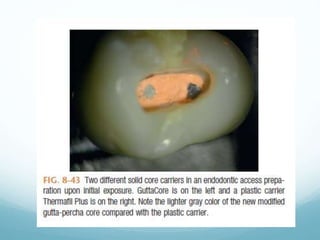
Three Types of solid carriers are found on these
system:
• The first generation: Metal (Stainless steel or
titanium) core and a coating of guttapercha
• The second generation: Plastic core coated with
alpha form of guttapercha e.g. Thermafill
(Dentsplay)
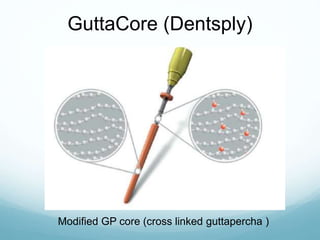
• The last generation: Modified GP core (cross
linked guttapercha ) rather than plastic core e.g.
GuttaCore (Dentsply).
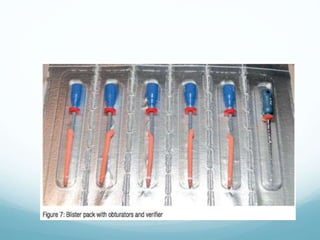
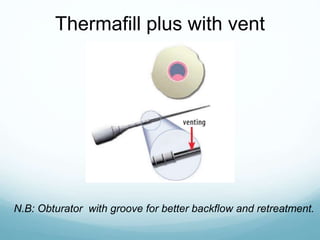
Thermafill plus with vent
N.B: Obturator with groove for better backflow and retreatment.
GuttaCore (Dentsply)
Modified GP core (cross linked guttapercha )
Techniques for removal of metal core
obturators:
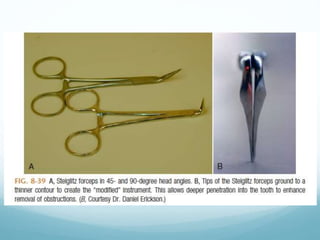
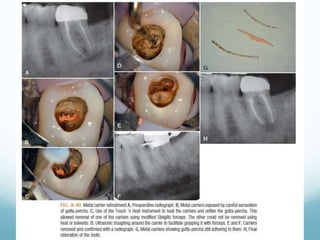
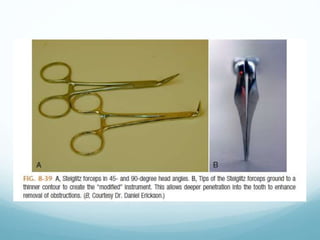
1st Heat application to the carrier to soft GP
surrounding it to facilitate its removal with with plier
or Steiglitz forceps.
 Endodontic retreatment of Thermafil versus
laterally condensed gutta-percha.
Wilcox LR, Juhlin JJ. J Endod. 1994
2nd : Use of solvent and removal of surrounding
GP with small hand instrument ,followed by
ultrasonic toughing around the carrier and
remove it like separated instrument.
 Problem solving in endodontics. Prevention,
identification, and management.
Editors: Gutmann JL, Dumsha TC, Lovdahl PE,
Hovland EJ, ed 3, St. Louis, 1997, Mosby.
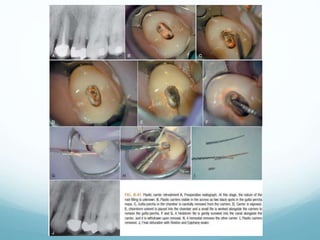
Techniques for removal of plastic core
obturators:
1st technique: Use of solvent and Hand files to
remove the GP surrounding the carrier then a
large Hedstrom file used to remove the carrier.
 Removal of Thermafil root canal filling material.
Bertrand MF, Pellegrino JC, Rocca JP ; J Endod
1997
2nd technique: The manufacture recommended
the Use of rotary System e.g. Profile 0.04 taper
 Efficiency of the 0.04 taper ProFile during the
re-treatment of gutta-percha-filled root canals.
Baratto Filho F, Ferreira EL, Fariniuk LF, Int
Endod J, 2002.
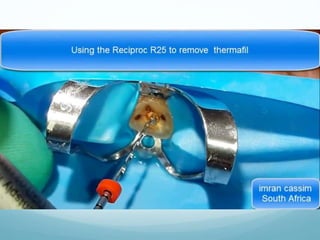
 Efficacy of Reciproc® and Profile® Instruments
in the Removal of Gutta-Percha from Straight
and Curved Root Canals ex Vivo. Journal of
Oral & Maxillofacial Research.
Marfisi K et al. (Sep)
2015
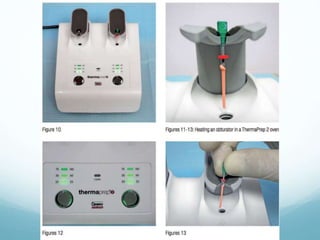
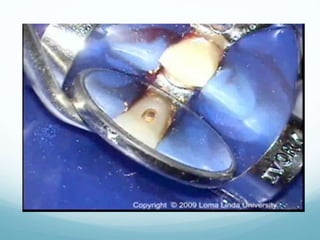
3rd technique: Using of System B heat source
 Thermafil retreatment using a new “System B”
technique or a solvent.
Wolcott JF, Himel VT, Hicks ML, J Endod ,1999.
Removal of Modified GP core carrier.
(GuttaCore,DentSply)
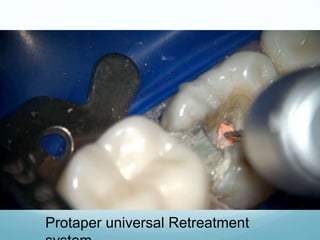
Rotary System e.g. Protaper universal
Retreatment system
 Time required to remove GuttaCore, Thermafil Plus,
and Thermoplasticized gutta-percha from moderately
curved root canals with ProTaper files.
Beasley RT et al ; J Endod 2013
Protaper universal Retreatment
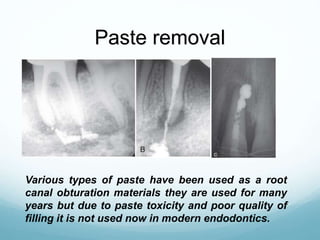
Paste removal
Various types of paste have been used as a root
canal obturation materials they are used for many
years but due to paste toxicity and poor quality of
filling it is not used now in modern endodontics.
Removal of Non sitting or Soft paste
• Solvent
• Hand or rotary instrument (copious Naocl
irrigation ).
• Ultrasonically activated and irrigated files.
 Problem solving in endodontics. Prevention,
identification, and management.
Editors: Gutmann JL, Lovdahl PE, ed 5, ELSEVIER,
2011 Mosby.
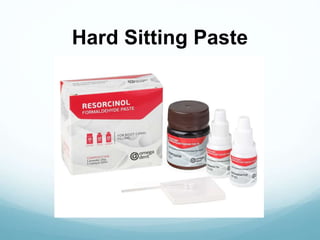
Hard Sitting Paste
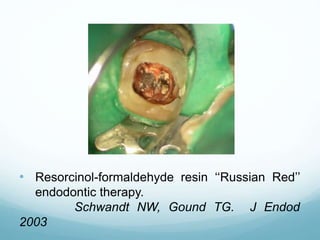
• Resorcinol-formaldehyde resin ‘‘Russian Red’’
endodontic therapy.
Schwandt NW, Gound TG. J Endod
2003
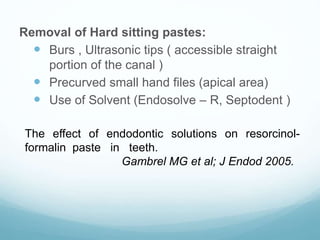
Removal of Hard sitting pastes:
 Burs , Ultrasonic tips ( accessible straight
portion of the canal )
 Precurved small hand files (apical area)
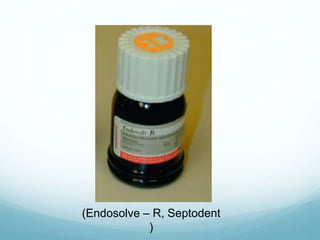
 Use of Solvent (Endosolve – R, Septodent )
The effect of endodontic solutions on resorcinol-
formalin paste in teeth.
Gambrel MG et al; J Endod 2005.
(Endosolve – R, Septodent
)
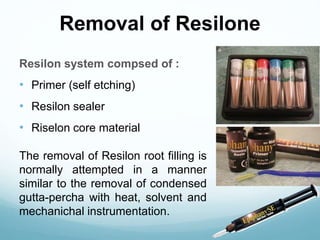
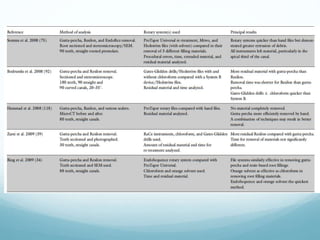
Removal of Resilone
Resilon system compsed of :
• Primer (self etching)
• Resilon sealer
• Riselon core material
The removal of Resilon root filling is
normally attempted in a manner
similar to the removal of condensed
gutta-percha with heat, solvent and
mechanichal instrumentation.
 The complete removal of Resilon may be
challenging since the resin sealer can
penetrate into the dentinal tubules. This is why
Guttapercha still the 1st choice for filling of root
canals.
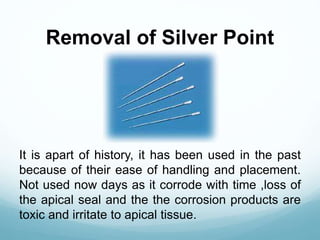
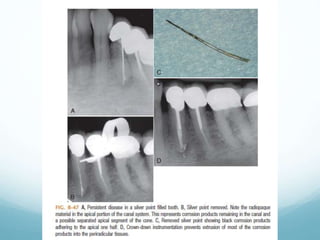
Removal of Silver Point
It is apart of history, it has been used in the past
because of their ease of handling and placement.
Not used now days as it corrode with time ,loss of
the apical seal and the the corrosion products are
toxic and irritate to apical tissue.
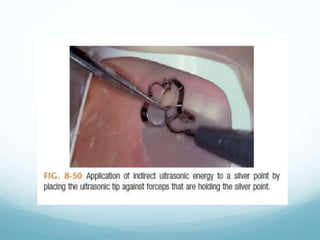
1st technique :
 is to establish a proper access.
 Carefully remove core material around the sliver
cone by use of ultrasonic
 Solvent to dissolve the sealer around the cone
 Grasp the exposed end of the silver point with
plier.
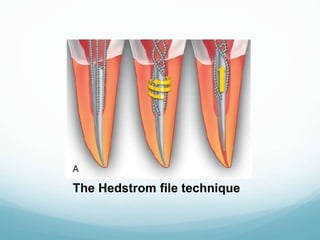
2nd technique : The Hedstrom file technique:
 The sealer around the silver cone is dissolved
by use of solvent.
 Small file are negotiated as far apically as
possibly in two to three areas around the silver
point.
 The spaces surrounding the silver point are
carefully instrumented to size 15, and then small
Hedstrom files are gently screwed in as far as
possible apically.
 The files then twisted together and pulled out
through the access.
The Hedstrom file technique
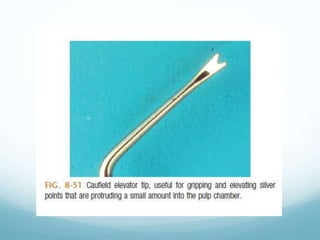
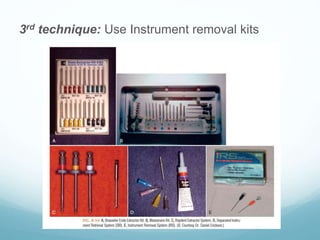
3rd technique: Use Instrument removal kits
Thank You
References
 Cohen’s Pathway of the pulp 11th edition
 Endodontic Principles and Practice 4th Edition
 Problem solving in endodontics. Prevention,
identification, and management. Editors: Gutmann
JL, Lovdahl PE, ed 5, ELSEVIER, 2011,Mosby.
 Removal of root filling materials." Duncan, Henry
Fergus, and BUN SAN CHONG. ,Endodontic topics
19 (2011): 33-57.

Removal of obturation materials

  • 1.
    Removal of Obturation Materials MohamedAli Alazrag BDS.Msc Tripoli Medical center .Libya
  • 2.
    Obturation Materials  Guttapercha Solid core obturators.  Paste  Resilon  Silver points.
  • 3.
  • 4.
    it is dependon the quality of obturation :  Single cone GP  Condensed GP
  • 5.
    Removal of Singlecone GP  H file
  • 6.
    Removal of Singlecone GP  H file  Ultrasonic files
  • 7.
  • 8.
    Removal of CondensedGP • Removal of gutta percha manually • Removal of gutta percha using rotary system • Removal of gutta percha using LASER
  • 9.
    Removal of guttapercha manually: 1. Probing of the orifice
  • 10.
    Removal of guttapercha manually: 1. Probing of the orifice 2. Heating endodontic carrier (to remove the coronal part) avoid over heat.
  • 11.
  • 12.
  • 13.
    Removal of guttapercha manually: 1. Probing of the orifice 2. Heating endodontic carrier (to remove the coronal part) avoid over heat. 3. Using small Gates gliding drills. (to remove any remaining coronal material)
  • 15.
    Removal of guttapercha manually: 1. Probing of the orifice 2. Heating endodontic carrier (to remove the coronal part) avoid over heat. 3. Using small Gates gliding drills. (to remove any remaining coronal material) 4. Using gutta percha solvents (to remove the remaining material in the apica part of the canal).
  • 17.
    • Exposure ofdental personnel to chloroform in root-filling procedures. Allard U, Andersson , Endod Dent Traumatol 8:155, 1992. • Chloroform in the endodontic operatory. McDonald MN, Vire DE, J Endod 18:301, 1992. • Risk assessment of the toxicity of solvents of gutta-percha used in endodontic retreatment. Chutich MJ et al , J Endod 24:213, 1998.
  • 18.
    Removal of guttapercha manually: 1. Probing of the orifice 2. Heating endodontic carrier (to remove the coronal part) avoid over heat. 3. Using small Gates gliding drills. (to remove any remaining coronal material) 4. Using gutta percha solvents (to remove the remaining material in the apica part of the canal). 5. Small hand files (#15 C+ file to penetrate the remaing root filling and enhance it is dissolution by solvent).
  • 20.
    Removal of guttapercha manually: 1. Probing of the orifice 2. Heating endodontic carrier (to remove the coronal part) avoid over heat. 3. Using small Gates gliding drills. (to remove any remaining coronal material) 4. Using gutta percha solvents (to remove the remaining material in the apica part of the canal). 5. Small hand files (#15 C+ file to penetrate the remaing root filling and enhance it is dissolution by solvent). 6. Radiographic assessment.
  • 21.
    • An invivo comparison of two frequency- based electronic apex locators. Welk AR, Baumgartner JC, Marshall JG, J Endod 29:497, 2003. • Accuracy of two root canal length measurement devices integrated into rotary endodontic motors when removing gutta-percha from root-filled teeth. Uzun O, Topuz O, Tinaz C, et al, Int Endod J 41:725, 2008.
  • 23.
    Removal of guttapercha using rotary system: • Protaper Universal Retreatment files (DentSply)
  • 24.
  • 25.
  • 27.
  • 28.
    • Recioroc (VDW) Thisnovel niti reciproc file created by Dr.Gassn yard. It is made from M-Wire® that offers greater flexibility and resistance to cyclic fatigue than traditional nickel titanium files.
  • 29.
  • 31.
  • 32.
     Removal ofgutta-percha from root canals using an Nd:YAG laser. ( In vitro study ) Viducic D, Jukic S, Karlovic Z, et al; Int Endod J, 2003. N.B: Further investigation required to proving safety and efficacy of laser during gutta-percha removal .
  • 33.
  • 34.
    With the increaseduse of carrier-based systems such as Thermafill we should understand how to retreat carriers, and we must be aware of the different types of carriers Three Types of solid carriers are found on these system: • The first generation: Metal (Stainless steel or titanium) core and a coating of guttapercha • The second generation: Plastic core coated with alpha form of guttapercha e.g. Thermafill (Dentsplay) • The last generation: Modified GP core (cross linked guttapercha ) rather than plastic core e.g. GuttaCore (Dentsply).
  • 36.
    Thermafill plus withvent N.B: Obturator with groove for better backflow and retreatment.
  • 37.
    GuttaCore (Dentsply) Modified GPcore (cross linked guttapercha )
  • 40.
    Techniques for removalof metal core obturators: 1st Heat application to the carrier to soft GP surrounding it to facilitate its removal with with plier or Steiglitz forceps.  Endodontic retreatment of Thermafil versus laterally condensed gutta-percha. Wilcox LR, Juhlin JJ. J Endod. 1994
  • 42.
    2nd : Useof solvent and removal of surrounding GP with small hand instrument ,followed by ultrasonic toughing around the carrier and remove it like separated instrument.  Problem solving in endodontics. Prevention, identification, and management. Editors: Gutmann JL, Dumsha TC, Lovdahl PE, Hovland EJ, ed 3, St. Louis, 1997, Mosby.
  • 44.
    Techniques for removalof plastic core obturators: 1st technique: Use of solvent and Hand files to remove the GP surrounding the carrier then a large Hedstrom file used to remove the carrier.  Removal of Thermafil root canal filling material. Bertrand MF, Pellegrino JC, Rocca JP ; J Endod 1997
  • 46.
    2nd technique: Themanufacture recommended the Use of rotary System e.g. Profile 0.04 taper  Efficiency of the 0.04 taper ProFile during the re-treatment of gutta-percha-filled root canals. Baratto Filho F, Ferreira EL, Fariniuk LF, Int Endod J, 2002.
  • 47.
     Efficacy ofReciproc® and Profile® Instruments in the Removal of Gutta-Percha from Straight and Curved Root Canals ex Vivo. Journal of Oral & Maxillofacial Research. Marfisi K et al. (Sep) 2015
  • 49.
    3rd technique: Usingof System B heat source  Thermafil retreatment using a new “System B” technique or a solvent. Wolcott JF, Himel VT, Hicks ML, J Endod ,1999.
  • 51.
    Removal of ModifiedGP core carrier. (GuttaCore,DentSply) Rotary System e.g. Protaper universal Retreatment system  Time required to remove GuttaCore, Thermafil Plus, and Thermoplasticized gutta-percha from moderately curved root canals with ProTaper files. Beasley RT et al ; J Endod 2013
  • 52.
  • 53.
    Paste removal Various typesof paste have been used as a root canal obturation materials they are used for many years but due to paste toxicity and poor quality of filling it is not used now in modern endodontics.
  • 54.
    Removal of Nonsitting or Soft paste • Solvent • Hand or rotary instrument (copious Naocl irrigation ). • Ultrasonically activated and irrigated files.  Problem solving in endodontics. Prevention, identification, and management. Editors: Gutmann JL, Lovdahl PE, ed 5, ELSEVIER, 2011 Mosby.
  • 55.
  • 56.
    • Resorcinol-formaldehyde resin‘‘Russian Red’’ endodontic therapy. Schwandt NW, Gound TG. J Endod 2003
  • 57.
    Removal of Hardsitting pastes:  Burs , Ultrasonic tips ( accessible straight portion of the canal )  Precurved small hand files (apical area)  Use of Solvent (Endosolve – R, Septodent ) The effect of endodontic solutions on resorcinol- formalin paste in teeth. Gambrel MG et al; J Endod 2005.
  • 58.
    (Endosolve – R,Septodent )
  • 59.
    Removal of Resilone Resilonsystem compsed of : • Primer (self etching) • Resilon sealer • Riselon core material The removal of Resilon root filling is normally attempted in a manner similar to the removal of condensed gutta-percha with heat, solvent and mechanichal instrumentation.
  • 62.
     The completeremoval of Resilon may be challenging since the resin sealer can penetrate into the dentinal tubules. This is why Guttapercha still the 1st choice for filling of root canals.
  • 63.
    Removal of SilverPoint It is apart of history, it has been used in the past because of their ease of handling and placement. Not used now days as it corrode with time ,loss of the apical seal and the the corrosion products are toxic and irritate to apical tissue.
  • 64.
    1st technique : is to establish a proper access.  Carefully remove core material around the sliver cone by use of ultrasonic  Solvent to dissolve the sealer around the cone  Grasp the exposed end of the silver point with plier.
  • 69.
    2nd technique :The Hedstrom file technique:  The sealer around the silver cone is dissolved by use of solvent.  Small file are negotiated as far apically as possibly in two to three areas around the silver point.  The spaces surrounding the silver point are carefully instrumented to size 15, and then small Hedstrom files are gently screwed in as far as possible apically.  The files then twisted together and pulled out through the access.
  • 70.
  • 72.
    3rd technique: UseInstrument removal kits
  • 73.
  • 74.
    References  Cohen’s Pathwayof the pulp 11th edition  Endodontic Principles and Practice 4th Edition  Problem solving in endodontics. Prevention, identification, and management. Editors: Gutmann JL, Lovdahl PE, ed 5, ELSEVIER, 2011,Mosby.  Removal of root filling materials." Duncan, Henry Fergus, and BUN SAN CHONG. ,Endodontic topics 19 (2011): 33-57.

Editor's Notes

  • #12 e.g. the heat should be applied in a short burst to allow the instrument to penetrate the gutta-percha mass, followed by cooling, which will cause the material to adhere to the heat carrier facilitating its removal
  • #22 It has been shown that apex locators may be less accurate in retreatment situations however: in this study the error was that readings indicated a working length that was too short. In a more recent study, an apex locator built into a rotary handpiece indicated working lengths that were too long in simulated retreatment situations.
  • #25 With active cutting tip used with 300rpm 1.2ncm
  • #29 This novel niti reciproc file created by Gassn yard it is cut in counter clock wise M-Wire® has both greater resistance to cyclic fatigue Recipro system Size 40 6% ( apex 3mm) Size 50 5% ( apex 3mm)
  • #33  He examine the use of Nd:YAG laser in removing guttapercha as root canal filling without solvent and with solvent eucalyptol,DMF dimethylformamide as solvents The time taken to remove the gutta-percha was within the range of other studies of mechanical gutta-percha removal. also addition of solvents did not improve the performance of the laser. As in most other studies, varying amounts of gutta-percha, was left in the canals after laser removal. The Root surface temperatures did increase, However, further investigation required to proving safety and efficacy, laser during gutta-percha removal .
  • #37 A solvent (chloroform) can be used to soften the gutta-percha in order to facilitate the penetration by the nickel titanium instrument along the carrier. The rotation speed of the NiTi instruments should be 600 to 800 revolutions/minute.
  • #38  The last generation: Modified GP core (cross linked guttapercha ) rather than plastic core e.g. GuttaCore (Dentsply). The cross-linking connects the polymer chains, which changes the material and gives the carrier different properties than the plastic carriers. The gutta-percha surrounding the carrier is alpha-phase gutta-percha, which is identical to that which encompasses the plastic carrier based systems.
  • #43 Often there is not enough of carrier remaining in the access to grasp with forceps
  • #45 Removal of plastic carriers is similar to removal of guttapercha root fillings,
  • #47 It has been suggested by the manufacturer of Thermafil that a 0.04 taper ProFile, which corresponds to the size of the carrier, should be used at 1500rpm to facilitate removal. It is inserted alongside the carrier until resistance is met. The theory is that the heat generated by friction will soften the gutta-percha and allow the instrument to advance into the root filling.
  • #49 R25 Reciproc file
  • #54  In the early 1950s, a Swiss dentist named Angelo Sargenti began filling roots with a paste that contained paraformaldehyde. Over the years, the formula's name and ingredients have changed many times, but paraformaldehyde has always been included. The names used have included "Sargenti Paste," "N2,”.
  • #55 Easy to remove
  • #67 pliers