 When we talk about endemism, we refer to a
species whose geographical range is limited.
Endemic animals and plants, whose
vulnerability is enormous due to smaller
populations, are key to their ecosystems and
become a thermometer when it comes to
measuring the state of health of a territory.
For that reason, their protection from
extinction threats is critical.
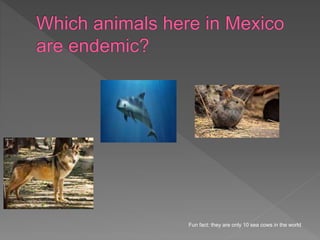
Fun fact: they are only 10 sea cows in the world
 Endemic species are important for a number of reasons. First, since endemic species have a
generally restricted distribution, threats to endemics carry more risk of extinction than for broadly
distributed species.
Second, according to the book Climate Change and Biodiverity, edited by Thomas E. Lovejoy
and Lee Hannah, when an endemic plant species becomes extinct, it takes with it between 10
and 30 endemic animal species.
Third, endemics, by definition, are highly adapted to their home range. As conditions within their
range change, whether
 from anthropogenic or natural causes,
 their adaptations can function as a
 source of competitive strength or weakness.
 In other words, some endemics of distinct
 regions may function as a sort of “collective
 insurance” for continued genetic diversity in
 the face of rapid changes, while others are at
 greatest risk of extinction as conditions change.
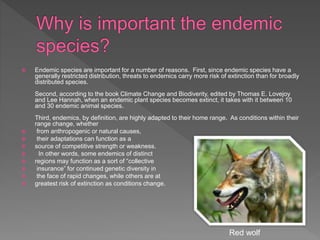
Red wolf
 Keeping endemic species around is importan
t. Many of them are endangered due to habit
at loss and other human actions. They’re imp
ortant to save not just because they’re uniqu
e to a
particular area, but because they are importa
nt to maintaining biodiversity, too.
emperor penguins
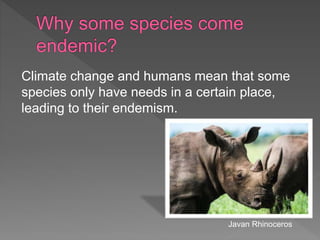
Climate change and humans mean that some
species only have needs in a certain place,
leading to their endemism.
Javan Rhinoceros
Endemic species.pptx

Endemic species.pptx

  • 2.
     When wetalk about endemism, we refer to a species whose geographical range is limited. Endemic animals and plants, whose vulnerability is enormous due to smaller populations, are key to their ecosystems and become a thermometer when it comes to measuring the state of health of a territory. For that reason, their protection from extinction threats is critical.
  • 3.
    Fun fact: theyare only 10 sea cows in the world
  • 4.
     Endemic speciesare important for a number of reasons. First, since endemic species have a generally restricted distribution, threats to endemics carry more risk of extinction than for broadly distributed species. Second, according to the book Climate Change and Biodiverity, edited by Thomas E. Lovejoy and Lee Hannah, when an endemic plant species becomes extinct, it takes with it between 10 and 30 endemic animal species. Third, endemics, by definition, are highly adapted to their home range. As conditions within their range change, whether  from anthropogenic or natural causes,  their adaptations can function as a  source of competitive strength or weakness.  In other words, some endemics of distinct  regions may function as a sort of “collective  insurance” for continued genetic diversity in  the face of rapid changes, while others are at  greatest risk of extinction as conditions change. Red wolf
  • 5.
     Keeping endemicspecies around is importan t. Many of them are endangered due to habit at loss and other human actions. They’re imp ortant to save not just because they’re uniqu e to a particular area, but because they are importa nt to maintaining biodiversity, too. emperor penguins
  • 7.
    Climate change andhumans mean that some species only have needs in a certain place, leading to their endemism. Javan Rhinoceros