Heat and Temperature
Allison Vilchis Arratia, Adriana Fernanda González Vargas,
Ana Gabriela rosas López, Danna guerrero cardenas,
Fernanda yasbet Magaña rosas, Keila Lizeth Villanueva Molina,
Leyre Ximena aldrete martinez.
What is it?
• Heat is a form of energy that flows from one object to another, it is the flow
of kinetic energy. It can be produced by:
• Bending metal
• Chemical reaction
• Collision
• Temperature is the measure of hotness or coldness in terms of any several
scales.
How does heat
travels?
• Heat can only travels from a hotter object to
a cooler object.
• It travels by three different ways:
o Conduction through solids
o Invection through liquids or gases
o Radiation through vaccum
How does it work?
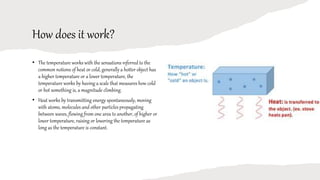
• The temperature works with the sensations referred to the
common notions of heat or cold, generally a hotter object has
a higher temperature or a lower temperature, the
temperature works by having a scale that measures how cold
or hot something is, a magnitude climbing.
• Heat works by transmitting energy spontaneously, moving
with atoms, molecules and other particles propagating
between waves, flowing from one area to another, of higher or
lower temperature, raising or lowering the temperature as
long as the temperature is constant.
Conductors and Insulators
When material allow heat to pass through them
rapidly, they are known as conductors.
Other materials like metals, liquids and gases that do
not allow heat to pass through easily are known as bad
conductors of heat or insulators.
Differences
between heat and
temperature • The fundamental difference is that heat deals with thermal energy, while temperature
deals more with molecular kinetic energy. Heat is the transfer of thermal energy, while
temperature is a property of the object.
• Heat can be likened to the total energy of molecular motion in a substance, while
temperature is a measure of the average molecular energy. The heat depends on the speed
of the particles, their number, their size and their type. The temperature does not depend
on the size, nor on the number or type
Measuring system
Where can we find it in
everyday life?
• Cooking: heat is needed for cooking food,because is one of
the basics necessities of life.
• Warming: we use heat for warming our houses, warming
water for cofee, tea and some drinks.
• Engines: some engines work on heat, for example rail
engines.
• Electrical appliance: All electrical appliances need heat, such
as microwave, the hair dryer and the boiler.
• Generate energy heat is used to generate energy , material
start to flow from the hot to the cold generating an electric
current.
Fuentes
• https://jamaicahospital.org/newsletter/history-of-
thermometers/
• https://www.visionlearning.com/en/library/Genera
l-Science/3/Temperature/48
(heating measure)

Proyecto Física.pptx

  • 1.
    Heat and Temperature AllisonVilchis Arratia, Adriana Fernanda González Vargas, Ana Gabriela rosas López, Danna guerrero cardenas, Fernanda yasbet Magaña rosas, Keila Lizeth Villanueva Molina, Leyre Ximena aldrete martinez.
  • 2.
    What is it? •Heat is a form of energy that flows from one object to another, it is the flow of kinetic energy. It can be produced by: • Bending metal • Chemical reaction • Collision • Temperature is the measure of hotness or coldness in terms of any several scales.
  • 3.
    How does heat travels? •Heat can only travels from a hotter object to a cooler object. • It travels by three different ways: o Conduction through solids o Invection through liquids or gases o Radiation through vaccum
  • 4.
    How does itwork? • The temperature works with the sensations referred to the common notions of heat or cold, generally a hotter object has a higher temperature or a lower temperature, the temperature works by having a scale that measures how cold or hot something is, a magnitude climbing. • Heat works by transmitting energy spontaneously, moving with atoms, molecules and other particles propagating between waves, flowing from one area to another, of higher or lower temperature, raising or lowering the temperature as long as the temperature is constant.
  • 5.
    Conductors and Insulators Whenmaterial allow heat to pass through them rapidly, they are known as conductors. Other materials like metals, liquids and gases that do not allow heat to pass through easily are known as bad conductors of heat or insulators.
  • 6.
    Differences between heat and temperature• The fundamental difference is that heat deals with thermal energy, while temperature deals more with molecular kinetic energy. Heat is the transfer of thermal energy, while temperature is a property of the object. • Heat can be likened to the total energy of molecular motion in a substance, while temperature is a measure of the average molecular energy. The heat depends on the speed of the particles, their number, their size and their type. The temperature does not depend on the size, nor on the number or type
  • 7.
  • 8.
    Where can wefind it in everyday life? • Cooking: heat is needed for cooking food,because is one of the basics necessities of life. • Warming: we use heat for warming our houses, warming water for cofee, tea and some drinks. • Engines: some engines work on heat, for example rail engines. • Electrical appliance: All electrical appliances need heat, such as microwave, the hair dryer and the boiler. • Generate energy heat is used to generate energy , material start to flow from the hot to the cold generating an electric current.
  • 9.