SPECIATION AND
EXTINCTION
SUBMITTED BY
HARIPRIYA U VARMA
1ST
MSC BIOTECHNOLOGY
NEHRU ARTS AND SCIENCE
COLLEGE COIMBATORE
CONTENTS
 INTRODUCTION
 DEFINITION AND TYPES OF SPECIATION
 STEPS OF SPECIATION
 HOW DOES SPECIATION OCCURS?
 FACTORS AFFECTING SPECIATION
INTRODUCTION
Group of organisms whose members has the potential to interbreed in
nature and produce viable, fertile offspring or smallest group of
organisms that share common ancestor are known as SPECIES.
Development of new species through a variety of factors are called
SPECIATION.
Species got extinct when all the members die are called EXTINCTION
SPECIATION
 Speciation is the process of formation of new species from existing
populations .
 It is also an evolutionary process of formation of new and distinct
species.
 Rate of speciation depends on generation time, environmental
conditions etc
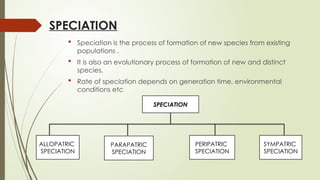
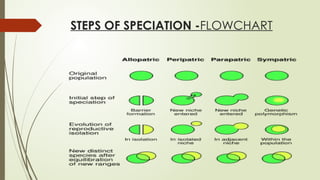
SPECIATION
ALLOPATRIC
SPECIATION
PARAPATRIC
SPECIATION
PERIPATRIC
SPECIATION
SYMPATRIC
SPECIATION
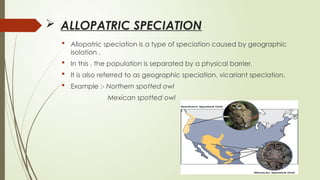
 ALLOPATRIC SPECIATION
 Allopatric speciation is a type of speciation caused by geographic
isolation .
 In this , the population is separated by a physical barrier.
 It is also referred to as geographic speciation, vicariant speciation.
 Example :- Northern spotted owl
Mexican spotted owl
Pic 1
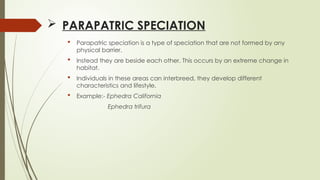
 PARAPATRIC SPECIATION
 Parapatric speciation is a type of speciation that are not formed by any
physical barrier.
 Instead they are beside each other. This occurs by an extreme change in
habitat.
 Individuals in these areas can interbreed, they develop different
characteristics and lifestyle.
 Example:- Ephedra California
Ephedra trifura
 PERIPATRIC SPECIATION
 Peripatric speciation is a type of speciation that new species are formed
from an isolated peripheral population.
 The population are prevented from exchanging genes and it is difficult to
distinguish between them.
 SYMPATRIC SPECIATION
 Sympatric speciation is a type of speciation that the evolution of new
species from the surviving ancestral species in which both the species
continue to live in same geographical region.
 Less common than allopatric speciation.
 This happens when gene flow is diminished by :-
• Polyploidy
• Habitat differentiation
• Sexual selection
STEPS OF SPECIATION -FLOWCHART
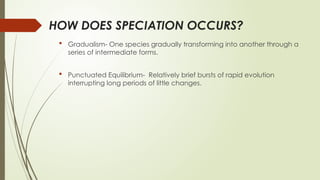
HOW DOES SPECIATION OCCURS?
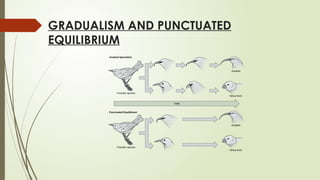
 Gradualism- One species gradually transforming into another through a
series of intermediate forms.
 Punctuated Equilibrium- Relatively brief bursts of rapid evolution
interrupting long periods of little changes.
GRADUALISM AND PUNCTUATED
EQUILIBRIUM
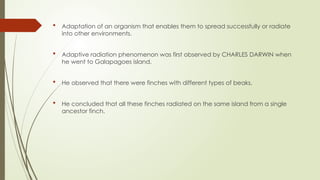
 Adaptation of an organism that enables them to spread successfully or radiate
into other environments.
 Adaptive radiation phenomenon was first observed by CHARLES DARWIN when
he went to Galapagoes island.
 He observed that there were finches with different types of beaks.
 He concluded that all these finches radiated on the same island from a single
ancestor finch.
FACTORS AFFECTING SPECIATION
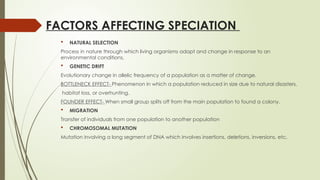
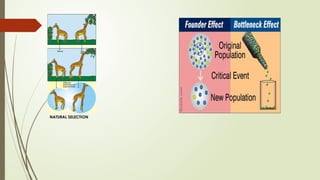
 NATURAL SELECTION
Process in nature through which living organisms adapt and change in response to an
environmental conditions.
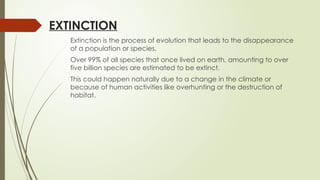
 GENETIC DRIFT
Evolutionary change in allelic frequency of a population as a matter of change.
BOTTLENECK EFFECT- Phenomenon in which a population reduced in size due to natural disasters,
habitat loss, or overhunting.
FOUNDER EFFECT- When small group splits off from the main population to found a colony.
 MIGRATION
Transfer of individuals from one population to another population
 CHROMOSOMAL MUTATION
Mutation involving a long segment of DNA which involves insertions, deletions, inversions, etc.
NATURAL SELECTION
EXTINCTION
Extinction is the process of evolution that leads to the disappearance
of a population or species.
Over 99% of all species that once lived on earth, amounting to over
five billion species are estimated to be extinct.
This could happen naturally due to a change in the climate or
because of human activities like overhunting or the destruction of
habitat.
REFERENCE
https://byjus.com/biology/speciation-evolution-factors/
https://www.slideshare.net/CandelaContent/13-speciation-chapter-13
https://www.britannica.com/science/speciation
THANK YOU

SPECIATION AND EXTINCTION - environmental biotechnology

  • 1.
    SPECIATION AND EXTINCTION SUBMITTED BY HARIPRIYAU VARMA 1ST MSC BIOTECHNOLOGY NEHRU ARTS AND SCIENCE COLLEGE COIMBATORE
  • 2.
    CONTENTS  INTRODUCTION  DEFINITIONAND TYPES OF SPECIATION  STEPS OF SPECIATION  HOW DOES SPECIATION OCCURS?  FACTORS AFFECTING SPECIATION
  • 3.
    INTRODUCTION Group of organismswhose members has the potential to interbreed in nature and produce viable, fertile offspring or smallest group of organisms that share common ancestor are known as SPECIES. Development of new species through a variety of factors are called SPECIATION. Species got extinct when all the members die are called EXTINCTION
  • 4.
    SPECIATION  Speciation isthe process of formation of new species from existing populations .  It is also an evolutionary process of formation of new and distinct species.  Rate of speciation depends on generation time, environmental conditions etc SPECIATION ALLOPATRIC SPECIATION PARAPATRIC SPECIATION PERIPATRIC SPECIATION SYMPATRIC SPECIATION
  • 5.
     ALLOPATRIC SPECIATION Allopatric speciation is a type of speciation caused by geographic isolation .  In this , the population is separated by a physical barrier.  It is also referred to as geographic speciation, vicariant speciation.  Example :- Northern spotted owl Mexican spotted owl Pic 1
  • 6.
     PARAPATRIC SPECIATION Parapatric speciation is a type of speciation that are not formed by any physical barrier.  Instead they are beside each other. This occurs by an extreme change in habitat.  Individuals in these areas can interbreed, they develop different characteristics and lifestyle.  Example:- Ephedra California Ephedra trifura
  • 7.
     PERIPATRIC SPECIATION Peripatric speciation is a type of speciation that new species are formed from an isolated peripheral population.  The population are prevented from exchanging genes and it is difficult to distinguish between them.
  • 8.
     SYMPATRIC SPECIATION Sympatric speciation is a type of speciation that the evolution of new species from the surviving ancestral species in which both the species continue to live in same geographical region.  Less common than allopatric speciation.  This happens when gene flow is diminished by :- • Polyploidy • Habitat differentiation • Sexual selection
  • 9.
  • 10.
    HOW DOES SPECIATIONOCCURS?  Gradualism- One species gradually transforming into another through a series of intermediate forms.  Punctuated Equilibrium- Relatively brief bursts of rapid evolution interrupting long periods of little changes.
  • 11.
  • 12.
     Adaptation ofan organism that enables them to spread successfully or radiate into other environments.  Adaptive radiation phenomenon was first observed by CHARLES DARWIN when he went to Galapagoes island.  He observed that there were finches with different types of beaks.  He concluded that all these finches radiated on the same island from a single ancestor finch.
  • 13.
    FACTORS AFFECTING SPECIATION NATURAL SELECTION Process in nature through which living organisms adapt and change in response to an environmental conditions.  GENETIC DRIFT Evolutionary change in allelic frequency of a population as a matter of change. BOTTLENECK EFFECT- Phenomenon in which a population reduced in size due to natural disasters, habitat loss, or overhunting. FOUNDER EFFECT- When small group splits off from the main population to found a colony.  MIGRATION Transfer of individuals from one population to another population  CHROMOSOMAL MUTATION Mutation involving a long segment of DNA which involves insertions, deletions, inversions, etc.
  • 14.
  • 15.
    EXTINCTION Extinction is theprocess of evolution that leads to the disappearance of a population or species. Over 99% of all species that once lived on earth, amounting to over five billion species are estimated to be extinct. This could happen naturally due to a change in the climate or because of human activities like overhunting or the destruction of habitat.
  • 16.
  • 17.