BIODIVERSITY
Lecture-4
Threats to Biodiversity
By
Dr. Suri Babu Golla
Assistant Professor
EM & H Department
SRKR Engineering College
Bhimavaram, Andhra Pradesh.
Mail: suribabu.g@srkrec.ac.in
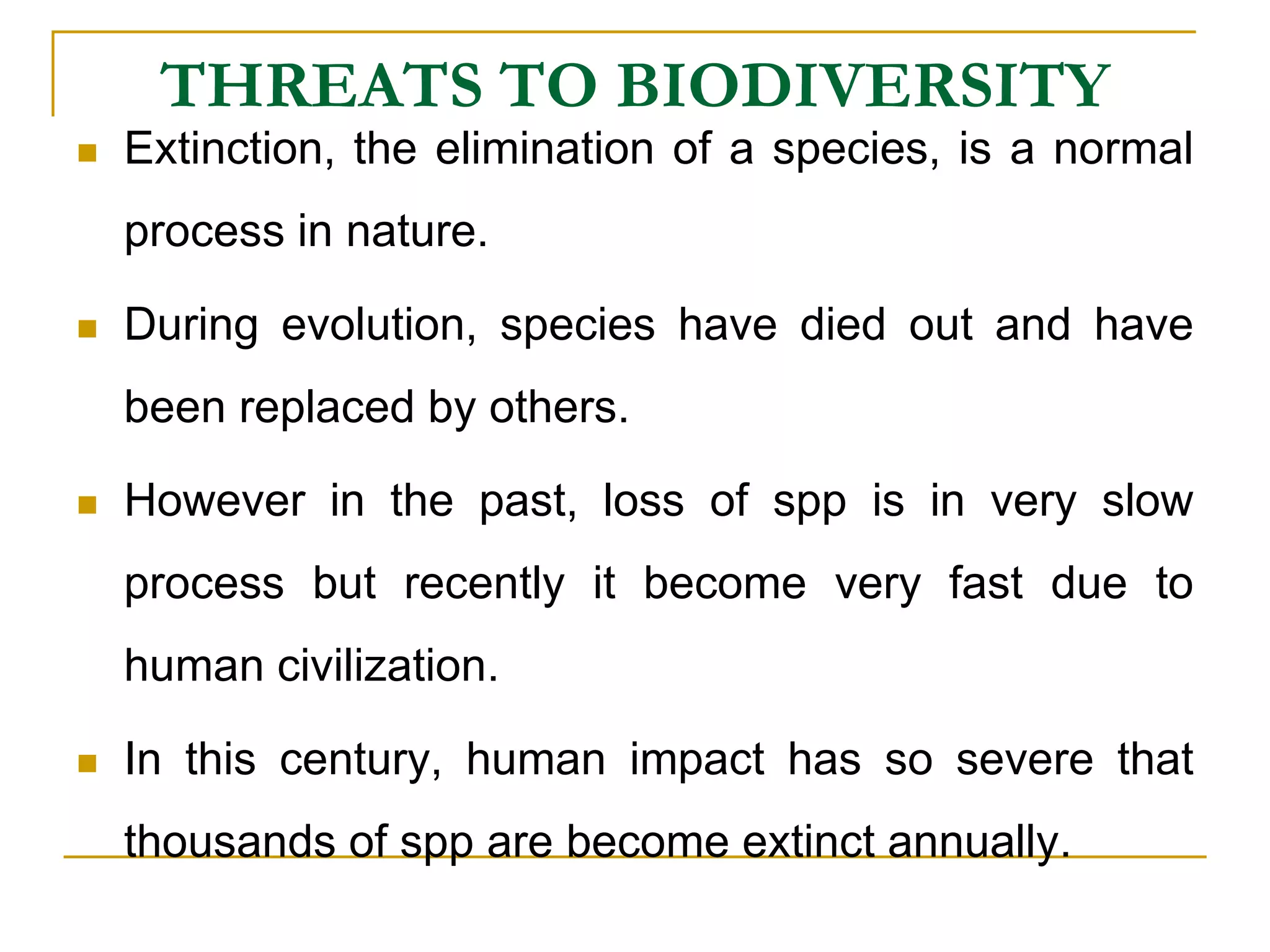
THREATS TO BIODIVERSITY
 Extinction, the elimination of a species, is a normal
process in nature.
 During evolution, species have died out and have
been replaced by others.
 However in the past, loss of spp is in very slow
process but recently it become very fast due to
human civilization.
 In this century, human impact has so severe that
thousands of spp are become extinct annually.
 One of the estimates says that extinction at
10,000 spp / year or 27 spp/day.
 Over the last 150 years the rate of extinction
has increased more. If present trend
continues, we would loose 1/3 to 2/3 of our
current biodiversity in this 21st century.
 Major causes related to threats to biodiversity
 Hotspots
 Habitat loss
 Poaching of wildlife
 Loss of species
 Loss of seeds
 Man-animal conflicts
 Hotspots are the areas which exhibit high
species richness as well as high species
endemism.
 Meyer introduced the term hotspot in 1988.
 Ecologically hotspots are determined by 4
factors
 No.of species
 Degree of endemism
 Degree of threat of habitat due to its degradation
 Degree of exploitation (utilization)
 Among 25 hotspots of the World, two are
found in India. (completed this topic in
lecture-3)
 Western Ghats
 Indo-Burma region (i.e Eastern Himalayas and
North-East India)
 Loss of Habitat: Destruction and loss of
natural habitat is the single largest cause of
biodiversity loss.. Billion hectares of forest
and grasslands are converted into
agriculture, urbanization and industrial lands.
 Estuaries and mangroves are under the most
serious threat today.
 Loss of species and seeds: Plants and
animals that are native to an ecosystem can
severely damaged by naturally. But exotics
(non-native spp) are often compete with
native spp and occupy much available
habitat.
 Poaching of wildlife: Illegal trade of wildlife
products by killing prohibited endangered
animals is called poaching, is also another
threat to wildlife.
 Wildlife items like furs, tusks, horns, herbal
products worth millions of dollars are
smuggled every year.
POACHING - TIGER
Trading of such wildlife products is highly profit making to the poachers.
These are smuggled to other countries through mafia.
POACHING - ELEPHANT
 Introduction of Exotic Species: Organisms
introduced into habitats where they are not
native are termed as exotics.
 They can be thought of as biological
pollutants and are considered to be among
the most damaging agents of habitat
alteration and degradation in the world
Man-Animal Conflicts
 A major problem associated with the conservation
of wild animals especially the herbivores like
elephants in India is that of crop depredation and
man-slaughter.
 Animals such as elephants, gaur, wild boar and
birds like peacock, cause extensive damage to the
crops.
 This phenomenon has registered significant
increase in recent years due to habitat
fragmentation and degradation of natural forests
and corridors.
 Instances of man animal conflicts keep on coming to
lime light from several states in our country.
 In Sambalpur, Orissa 195 humans were killed in the
last 5 years by elephants.
 In retaliation the villagers killed 98 elephants and
badly injured 30 elephants.
 Several instances of killing of elephants in the
border regions of Kote - Chamarajanagar belt in
Mysore have been reported recently.
MAN AND WILD LIFE CONFLICT
ENDANGERED SPECIES OF
INDIA
 The International Union of Conservation of Nature and Natural
Resources (IUCN) maintains what may be called a 'Red
Database' at the World Conservation Monitoring Centre (WCMC)
in which information on endangered and vulnerable species of
plants and animals is kept.
 From time to time, this database is translated into popular form
and published as 'Red Data Books'.
 The red data symbolizes the warning signal for those species
which are endangered and if not protected are likely to become
extinct in near future.
Red Data Books
 In India, nearly 450 plant species have been
identified in the categories of endangered,
threatened or rare.
 Existence of about 150 mammals and 150
species of birds is estimated to be threatened
while an unknown number of species of
insects are endangered.
 It may not be of direct relevance here to give
a complete list of endangered flora and fauna
of our country.
 However, a few species of endangered reptiles,
birds, mammals and plants are given below:
 (a)Reptiles: Gharial, green sea turtle, tortoise,
python
 (b)Birds: Great Indian bustard, Peacock, Pelican,
Great Indian Hornbill, Siberian White Crane
 (c)Carnivorous:Indian wolf, red fox, Sloth bear, red
panda, Mammals tiger, leopard, striped hyena,
Indian lion, golden cat, desert cat, dugong
 (d)Primates: Hoolock gibbon, lion-tailed macaque,
Nilgiri langur, Capped monkey, golden monkey
 (e) Plants: A large number of species of orchids,
Rhododendrons, medicinal plants like Rauwolfia
serpentina, the sandal wood tree Santalum, Cycas
beddomei etc.
Reptiles- Gharial
peacock Pelican Pelican
Indian
Tiger
leopard
Indian
Lion
Red
Fox
Great Indian Bustard
Siberian White Crane
Capped monkey golden monkey
Rhododendrons
Rauwolfia serpentina, Cycas beddomei
 (i) Endangered Species : A species is said to be
endangered when its number has been reduced to a
critical level or whose habitats, have been drastically
reduced and if such a species is not protected and
conserved, it is in immediate danger of extinction.
 (ii) Vulnerable Species : The species that are
under threat such that they may have to be
classified as endangered in the near future if causal
factors continue to operate.
 These include species whose populations have
been seriously depleted and whose ultimate security
is not assured, as well as those species whose
populations are still abundant but are under threat
throughout their range.
 (iii) Rare Species : These are species with small total population
size in the world. In their distribution, they are usually localized
within restricted habitats or geographical area or are thinly scattered
over an extensive range.
 It is necessary to mention here that a species that is rare is not
necessarily in danger of becoming extinct ; some species, like the
whooping crane, are naturally rare.
 However, rarity does raise concerns about the possibility of
extinction. Rare species, thus, are not at present endangered and ,
vulnerable but are at risks.
 (iv) Threatened Species : The term 'threatened' is used in the
context of conservation of the species which are in any one of the
above three categories.
 These are species that have declined significantly in total numbers
and may be on the verge of extinction in certain localities.
 ENDEMIC SPECIES OF INDIA:
 Endemics are species that are found in a single
locality/area and nowhere else in the world.
 They, thus, have a value in their uniqueness.
 The endemism of Indian biodiversity is quite high.
 About 33% of the country's flora are endemic to the
country and are concentrated mainly in the North-
East, Western Ghats, North-West Himalaya and the
Andaman and Nicobar Islands.
 Out of about 47,000 species of plants in our country
7000 are endemic.
Thank you
Dr. Suri Babu Golla
Asst. Professor,
S.R.K.R. Engg. College,
Bhimavaram.

Threats to biodiversity: Biodiversity

  • 1.
  • 2.
    Threats to Biodiversity By Dr.Suri Babu Golla Assistant Professor EM & H Department SRKR Engineering College Bhimavaram, Andhra Pradesh. Mail: suribabu.g@srkrec.ac.in
  • 4.
    THREATS TO BIODIVERSITY Extinction, the elimination of a species, is a normal process in nature.  During evolution, species have died out and have been replaced by others.  However in the past, loss of spp is in very slow process but recently it become very fast due to human civilization.  In this century, human impact has so severe that thousands of spp are become extinct annually.
  • 5.
     One ofthe estimates says that extinction at 10,000 spp / year or 27 spp/day.  Over the last 150 years the rate of extinction has increased more. If present trend continues, we would loose 1/3 to 2/3 of our current biodiversity in this 21st century.
  • 6.
     Major causesrelated to threats to biodiversity  Hotspots  Habitat loss  Poaching of wildlife  Loss of species  Loss of seeds  Man-animal conflicts
  • 7.
     Hotspots arethe areas which exhibit high species richness as well as high species endemism.  Meyer introduced the term hotspot in 1988.  Ecologically hotspots are determined by 4 factors  No.of species  Degree of endemism  Degree of threat of habitat due to its degradation  Degree of exploitation (utilization)
  • 8.
     Among 25hotspots of the World, two are found in India. (completed this topic in lecture-3)  Western Ghats  Indo-Burma region (i.e Eastern Himalayas and North-East India)
  • 9.
     Loss ofHabitat: Destruction and loss of natural habitat is the single largest cause of biodiversity loss.. Billion hectares of forest and grasslands are converted into agriculture, urbanization and industrial lands.  Estuaries and mangroves are under the most serious threat today.
  • 10.
     Loss ofspecies and seeds: Plants and animals that are native to an ecosystem can severely damaged by naturally. But exotics (non-native spp) are often compete with native spp and occupy much available habitat.
  • 11.
     Poaching ofwildlife: Illegal trade of wildlife products by killing prohibited endangered animals is called poaching, is also another threat to wildlife.  Wildlife items like furs, tusks, horns, herbal products worth millions of dollars are smuggled every year.
  • 12.
    POACHING - TIGER Tradingof such wildlife products is highly profit making to the poachers. These are smuggled to other countries through mafia.
  • 13.
  • 14.
     Introduction ofExotic Species: Organisms introduced into habitats where they are not native are termed as exotics.  They can be thought of as biological pollutants and are considered to be among the most damaging agents of habitat alteration and degradation in the world
  • 15.
    Man-Animal Conflicts  Amajor problem associated with the conservation of wild animals especially the herbivores like elephants in India is that of crop depredation and man-slaughter.  Animals such as elephants, gaur, wild boar and birds like peacock, cause extensive damage to the crops.  This phenomenon has registered significant increase in recent years due to habitat fragmentation and degradation of natural forests and corridors.
  • 16.
     Instances ofman animal conflicts keep on coming to lime light from several states in our country.  In Sambalpur, Orissa 195 humans were killed in the last 5 years by elephants.  In retaliation the villagers killed 98 elephants and badly injured 30 elephants.  Several instances of killing of elephants in the border regions of Kote - Chamarajanagar belt in Mysore have been reported recently.
  • 17.
    MAN AND WILDLIFE CONFLICT
  • 22.
    ENDANGERED SPECIES OF INDIA The International Union of Conservation of Nature and Natural Resources (IUCN) maintains what may be called a 'Red Database' at the World Conservation Monitoring Centre (WCMC) in which information on endangered and vulnerable species of plants and animals is kept.  From time to time, this database is translated into popular form and published as 'Red Data Books'.  The red data symbolizes the warning signal for those species which are endangered and if not protected are likely to become extinct in near future.
  • 23.
  • 24.
     In India,nearly 450 plant species have been identified in the categories of endangered, threatened or rare.  Existence of about 150 mammals and 150 species of birds is estimated to be threatened while an unknown number of species of insects are endangered.  It may not be of direct relevance here to give a complete list of endangered flora and fauna of our country.
  • 25.
     However, afew species of endangered reptiles, birds, mammals and plants are given below:  (a)Reptiles: Gharial, green sea turtle, tortoise, python  (b)Birds: Great Indian bustard, Peacock, Pelican, Great Indian Hornbill, Siberian White Crane  (c)Carnivorous:Indian wolf, red fox, Sloth bear, red panda, Mammals tiger, leopard, striped hyena, Indian lion, golden cat, desert cat, dugong  (d)Primates: Hoolock gibbon, lion-tailed macaque, Nilgiri langur, Capped monkey, golden monkey  (e) Plants: A large number of species of orchids, Rhododendrons, medicinal plants like Rauwolfia serpentina, the sandal wood tree Santalum, Cycas beddomei etc.
  • 26.
  • 27.
  • 28.
  • 29.
  • 30.
  • 31.
  • 32.
  • 33.
  • 34.
  • 35.
     (i) EndangeredSpecies : A species is said to be endangered when its number has been reduced to a critical level or whose habitats, have been drastically reduced and if such a species is not protected and conserved, it is in immediate danger of extinction.  (ii) Vulnerable Species : The species that are under threat such that they may have to be classified as endangered in the near future if causal factors continue to operate.  These include species whose populations have been seriously depleted and whose ultimate security is not assured, as well as those species whose populations are still abundant but are under threat throughout their range.
  • 36.
     (iii) RareSpecies : These are species with small total population size in the world. In their distribution, they are usually localized within restricted habitats or geographical area or are thinly scattered over an extensive range.  It is necessary to mention here that a species that is rare is not necessarily in danger of becoming extinct ; some species, like the whooping crane, are naturally rare.  However, rarity does raise concerns about the possibility of extinction. Rare species, thus, are not at present endangered and , vulnerable but are at risks.  (iv) Threatened Species : The term 'threatened' is used in the context of conservation of the species which are in any one of the above three categories.  These are species that have declined significantly in total numbers and may be on the verge of extinction in certain localities.
  • 37.
     ENDEMIC SPECIESOF INDIA:  Endemics are species that are found in a single locality/area and nowhere else in the world.  They, thus, have a value in their uniqueness.  The endemism of Indian biodiversity is quite high.  About 33% of the country's flora are endemic to the country and are concentrated mainly in the North- East, Western Ghats, North-West Himalaya and the Andaman and Nicobar Islands.  Out of about 47,000 species of plants in our country 7000 are endemic.
  • 38.
    Thank you Dr. SuriBabu Golla Asst. Professor, S.R.K.R. Engg. College, Bhimavaram.