Encryption Techniques
What is Encryption?
Encryption
In cryptography, encryption is the process of encoding information.
This process converts the original representation of the information,
known as plaintext, into an alternative form known as ciphertext.
Cryptography
Cryptography is a method of protecting information and
communications through the use of codes, so that only those for
whom the information is intended can read and process it.
Why encryption is need
â—‡It helps protect private information, sensitive data, and can
enhance the security of communication between client and
servers.
â—‡In essence, when your data is encrypted, even if an unauthorized
person or entity gains access to it, they will not be able to read it.
â—‡ Privacy. Encryption guarantees that no one can read messages
or access data except the legitimate recipient or data owner.
This measure prevents cybercriminals, hackers, internet service
providers, spammers, and even government institutions from
accessing and reading personal data.
â—‡ Security. Encryption helps protect information from data
breaches, whether the data is at rest or in transit.
â—‡ Authentication. Public key encryption proves that a website's
origin server owns the private key and thus was legitimately
assigned an SSL certificate.
â—‡ Symmetric Encryption (Secret Key)
In symmetric-key schemes, the encryption and decryption keys are the same.
Communicating parties must have the same key in order to achieve secure
communication.
â—‡ Asymmetric Encryption (Public Key)
In public-key encryption schemes, the encryption key is published for anyone to
use and for encrypting messages. Only the receiving party has access to the
decryption key that enables messages to be read.
Encryption types
DES Encryption
DES(Data Encryption Standard) is a block
Cipher, which means that it takes a fixed-
length string of plaintext bits and transforms it
through a series of complicated operations.
This fixed-length of plaintext is of 64-bits, and
the key which is the same for both encryption
and decryption is also of 64-bits.
The Feistel structure, it is a design model from
which various block Ciphers are derived. DES
is one such block Cipher. A cryptographic
system based on a Feistel model uses the
same algorithm for both encryption and
decryption. The Feistel model takes 64 bits of
plaintext and divides it into halves, L and R of
32 bits each. R₂ is calculated as L⊕ƒ(R, Key)
and Lâ‚‚ is the same as R.
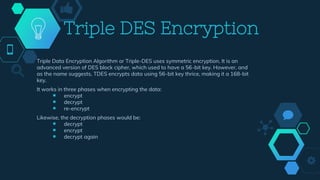
Triple DES Encryption
Triple Data Encryption Algorithm or Triple-DES uses symmetric encryption. It is an
advanced version of DES block cipher, which used to have a 56-bit key. However, and
as the name suggests, TDES encrypts data using 56-bit key thrice, making it a 168-bit
key.
It works in three phases when encrypting the data:
ďż­ encrypt
ďż­ decrypt
ďż­ re-encrypt
Likewise, the decryption phases would be:
ďż­ decrypt
ďż­ encrypt
ďż­ decrypt again
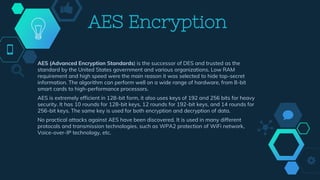
AES (Advanced Encryption Standards) is the successor of DES and trusted as the
standard by the United States government and various organizations. Low RAM
requirement and high speed were the main reason it was selected to hide top-secret
information. The algorithm can perform well on a wide range of hardware, from 8-bit
smart cards to high-performance processors.
AES is extremely efficient in 128-bit form, it also uses keys of 192 and 256 bits for heavy
security. It has 10 rounds for 128-bit keys, 12 rounds for 192-bit keys, and 14 rounds for
256-bit keys. The same key is used for both encryption and decryption of data.
No practical attacks against AES have been discovered. It is used in many different
protocols and transmission technologies, such as WPA2 protection of WiFi network,
Voice-over-IP technology, etc.
AES Encryption
AES Encryption
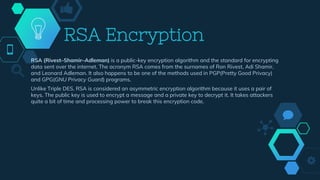
RSA (Rivest–Shamir–Adleman) is a public-key encryption algorithm and the standard for encrypting
data sent over the internet. The acronym RSA comes from the surnames of Ron Rivest, Adi Shamir,
and Leonard Adleman. It also happens to be one of the methods used in PGP(Pretty Good Privacy)
and GPG(GNU Privacy Guard) programs.
Unlike Triple DES, RSA is considered an asymmetric encryption algorithm because it uses a pair of
keys. The public key is used to encrypt a message and a private key to decrypt it. It takes attackers
quite a bit of time and processing power to break this encryption code.
RSA Encryption
RSA Encryption
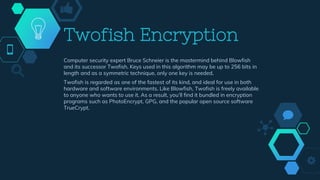
Computer security expert Bruce Schneier is the mastermind behind Blowfish
and its successor Twofish. Keys used in this algorithm may be up to 256 bits in
length and as a symmetric technique, only one key is needed.
Twofish is regarded as one of the fastest of its kind, and ideal for use in both
hardware and software environments. Like Blowfish, Twofish is freely available
to anyone who wants to use it. As a result, you’ll find it bundled in encryption
programs such as PhotoEncrypt, GPG, and the popular open source software
TrueCrypt.
Twofish Encryption
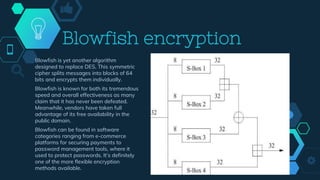
Blowfish is yet another algorithm
designed to replace DES. This symmetric
cipher splits messages into blocks of 64
bits and encrypts them individually.
Blowfish is known for both its tremendous
speed and overall effectiveness as many
claim that it has never been defeated.
Meanwhile, vendors have taken full
advantage of its free availability in the
public domain.
Blowfish can be found in software
categories ranging from e-commerce
platforms for securing payments to
password management tools, where it
used to protect passwords. It’s definitely
one of the more flexible encryption
methods available.
Blowfish encryption
IDEA Encryption
IDEA (International Data Encryption Algorithm) is an encryption algorithm
developed at ETH(public research university) in Zurich, Switzerland. It uses a
block cipher with a 128-bit key, and is generally considered to be very
secure. It is considered among the best publicly known algorithms.
In the several years that it has been in use, no practical attacks on it have
been published despite of a number of attempts to find some. IDEA is
patented in the United States and in most of the European countries. The
patent is held by Ascom-Tech. Non-commercial use of IDEA is free.
MD5 Encryption
Hashing is generating a value or values from a string of text using a
mathematical function.
Hashing is one way to enable security during the process of message
transmission when the message is intended for a particular recipient only. A
formula generates the hash, which helps to protect the security of the
transmission against tampering.
FPE Encryption
Format Preserving Encryption (FPE) is a fairly new encryption method. It
encrypts your data in a similar format. For instance, if you have encrypted
your password having 6 letters, 5 numbers and 4 special letters, then your
output will be a different combination of a similar format.
In other words, if you use this encryption technique, it will preserve the
format of your plain text that is after encryption the structure of your data
will remain the same. example: our 16-digit card number can encrypt to a
16-digit number
It is widely used in financial database systems, banking systems, retail, etc.
Encryption Key in
Magento
Magento uses an encryption key to protect passwords and other sensitive
data. An industry-standard Advanced Encryption Standard (AES-256)
algorithm is used to encrypt all data that requires decryption. This includes
credit card data and integration (payment and shipping module) passwords.
In addition, a strong Secure Hash Algorithm (SHA-256) is used to hash all
data that does not require decryption.
During the initial installation, you are prompted to either let Magento
generate an encryption key, or enter one of your own. The Encryption Key
tool allows you to change the key as needed. The encryption key should be
changed on a regular basis to improve security, as well as at any time the
original key might be compromised. Whenever the key is changed, all legacy
data is re-encoded using the new key.
Step 1: Make the File Writable
â—‡ To change the encryption key, make sure that the following file is
writable: [your store]/app/etc/env.php
Step 2: Change the Encryption Key
â—‡ On the Admin sidebar, go to System > Other Settings > Manage
Encryption Key.
â—‡ Do one of the following:
ďż­ To generate a new key, set Auto-generate Key to Yes.
ďż­ To use a different key, set Auto-generate Key to No. Then in the
New Key field, enter or paste the key that you want to use.
â—‡ Click Change Encryption Key.
â—‡ Keep a record of the new key in a secure location.
â—‡ It will be required to decrypt the data, if any problems occur with your
files.
The Future of
Encryption
Cyber attacks are constantly evolving, so security specialists must stay busy
in the lab concocting new schemes to keep them at bay.
Expert observers are hopeful that a new method called Honey Encryption
will deter hackers by serving up fake data for every incorrect guess of the
key code. This unique approach not only slows attackers down, but
potentially buries the correct key in a haystack of false hopes.

Encryption techniques

  • 1.
  • 2.
    What is Encryption? Encryption Incryptography, encryption is the process of encoding information. This process converts the original representation of the information, known as plaintext, into an alternative form known as ciphertext. Cryptography Cryptography is a method of protecting information and communications through the use of codes, so that only those for whom the information is intended can read and process it.
  • 3.
    Why encryption isneed â—‡It helps protect private information, sensitive data, and can enhance the security of communication between client and servers. â—‡In essence, when your data is encrypted, even if an unauthorized person or entity gains access to it, they will not be able to read it. â—‡ Privacy. Encryption guarantees that no one can read messages or access data except the legitimate recipient or data owner. This measure prevents cybercriminals, hackers, internet service providers, spammers, and even government institutions from accessing and reading personal data. â—‡ Security. Encryption helps protect information from data breaches, whether the data is at rest or in transit. â—‡ Authentication. Public key encryption proves that a website's origin server owns the private key and thus was legitimately assigned an SSL certificate.
  • 4.
    â—‡ Symmetric Encryption(Secret Key) In symmetric-key schemes, the encryption and decryption keys are the same. Communicating parties must have the same key in order to achieve secure communication. â—‡ Asymmetric Encryption (Public Key) In public-key encryption schemes, the encryption key is published for anyone to use and for encrypting messages. Only the receiving party has access to the decryption key that enables messages to be read. Encryption types
  • 5.
    DES Encryption DES(Data EncryptionStandard) is a block Cipher, which means that it takes a fixed- length string of plaintext bits and transforms it through a series of complicated operations. This fixed-length of plaintext is of 64-bits, and the key which is the same for both encryption and decryption is also of 64-bits. The Feistel structure, it is a design model from which various block Ciphers are derived. DES is one such block Cipher. A cryptographic system based on a Feistel model uses the same algorithm for both encryption and decryption. The Feistel model takes 64 bits of plaintext and divides it into halves, L and R of 32 bits each. R₂ is calculated as L⊕ƒ(R, Key) and L₂ is the same as R.
  • 6.
    Triple DES Encryption TripleData Encryption Algorithm or Triple-DES uses symmetric encryption. It is an advanced version of DES block cipher, which used to have a 56-bit key. However, and as the name suggests, TDES encrypts data using 56-bit key thrice, making it a 168-bit key. It works in three phases when encrypting the data: ďż­ encrypt ďż­ decrypt ďż­ re-encrypt Likewise, the decryption phases would be: ďż­ decrypt ďż­ encrypt ďż­ decrypt again
  • 8.
    AES (Advanced EncryptionStandards) is the successor of DES and trusted as the standard by the United States government and various organizations. Low RAM requirement and high speed were the main reason it was selected to hide top-secret information. The algorithm can perform well on a wide range of hardware, from 8-bit smart cards to high-performance processors. AES is extremely efficient in 128-bit form, it also uses keys of 192 and 256 bits for heavy security. It has 10 rounds for 128-bit keys, 12 rounds for 192-bit keys, and 14 rounds for 256-bit keys. The same key is used for both encryption and decryption of data. No practical attacks against AES have been discovered. It is used in many different protocols and transmission technologies, such as WPA2 protection of WiFi network, Voice-over-IP technology, etc. AES Encryption
  • 9.
  • 10.
    RSA (Rivest–Shamir–Adleman) isa public-key encryption algorithm and the standard for encrypting data sent over the internet. The acronym RSA comes from the surnames of Ron Rivest, Adi Shamir, and Leonard Adleman. It also happens to be one of the methods used in PGP(Pretty Good Privacy) and GPG(GNU Privacy Guard) programs. Unlike Triple DES, RSA is considered an asymmetric encryption algorithm because it uses a pair of keys. The public key is used to encrypt a message and a private key to decrypt it. It takes attackers quite a bit of time and processing power to break this encryption code. RSA Encryption
  • 11.
  • 12.
    Computer security expertBruce Schneier is the mastermind behind Blowfish and its successor Twofish. Keys used in this algorithm may be up to 256 bits in length and as a symmetric technique, only one key is needed. Twofish is regarded as one of the fastest of its kind, and ideal for use in both hardware and software environments. Like Blowfish, Twofish is freely available to anyone who wants to use it. As a result, you’ll find it bundled in encryption programs such as PhotoEncrypt, GPG, and the popular open source software TrueCrypt. Twofish Encryption
  • 13.
    Blowfish is yetanother algorithm designed to replace DES. This symmetric cipher splits messages into blocks of 64 bits and encrypts them individually. Blowfish is known for both its tremendous speed and overall effectiveness as many claim that it has never been defeated. Meanwhile, vendors have taken full advantage of its free availability in the public domain. Blowfish can be found in software categories ranging from e-commerce platforms for securing payments to password management tools, where it used to protect passwords. It’s definitely one of the more flexible encryption methods available. Blowfish encryption
  • 14.
    IDEA Encryption IDEA (InternationalData Encryption Algorithm) is an encryption algorithm developed at ETH(public research university) in Zurich, Switzerland. It uses a block cipher with a 128-bit key, and is generally considered to be very secure. It is considered among the best publicly known algorithms. In the several years that it has been in use, no practical attacks on it have been published despite of a number of attempts to find some. IDEA is patented in the United States and in most of the European countries. The patent is held by Ascom-Tech. Non-commercial use of IDEA is free.
  • 15.
    MD5 Encryption Hashing isgenerating a value or values from a string of text using a mathematical function. Hashing is one way to enable security during the process of message transmission when the message is intended for a particular recipient only. A formula generates the hash, which helps to protect the security of the transmission against tampering.
  • 16.
    FPE Encryption Format PreservingEncryption (FPE) is a fairly new encryption method. It encrypts your data in a similar format. For instance, if you have encrypted your password having 6 letters, 5 numbers and 4 special letters, then your output will be a different combination of a similar format. In other words, if you use this encryption technique, it will preserve the format of your plain text that is after encryption the structure of your data will remain the same. example: our 16-digit card number can encrypt to a 16-digit number It is widely used in financial database systems, banking systems, retail, etc.
  • 17.
    Encryption Key in Magento Magentouses an encryption key to protect passwords and other sensitive data. An industry-standard Advanced Encryption Standard (AES-256) algorithm is used to encrypt all data that requires decryption. This includes credit card data and integration (payment and shipping module) passwords. In addition, a strong Secure Hash Algorithm (SHA-256) is used to hash all data that does not require decryption. During the initial installation, you are prompted to either let Magento generate an encryption key, or enter one of your own. The Encryption Key tool allows you to change the key as needed. The encryption key should be changed on a regular basis to improve security, as well as at any time the original key might be compromised. Whenever the key is changed, all legacy data is re-encoded using the new key.
  • 18.
    Step 1: Makethe File Writable â—‡ To change the encryption key, make sure that the following file is writable: [your store]/app/etc/env.php Step 2: Change the Encryption Key â—‡ On the Admin sidebar, go to System > Other Settings > Manage Encryption Key. â—‡ Do one of the following: ďż­ To generate a new key, set Auto-generate Key to Yes. ďż­ To use a different key, set Auto-generate Key to No. Then in the New Key field, enter or paste the key that you want to use. â—‡ Click Change Encryption Key. â—‡ Keep a record of the new key in a secure location. â—‡ It will be required to decrypt the data, if any problems occur with your files.
  • 19.
    The Future of Encryption Cyberattacks are constantly evolving, so security specialists must stay busy in the lab concocting new schemes to keep them at bay. Expert observers are hopeful that a new method called Honey Encryption will deter hackers by serving up fake data for every incorrect guess of the key code. This unique approach not only slows attackers down, but potentially buries the correct key in a haystack of false hopes.