 WHAT IS ENCRYPTION :-
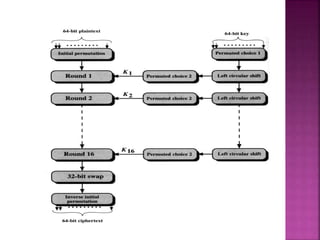
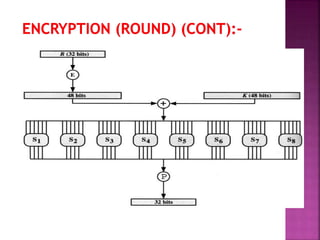
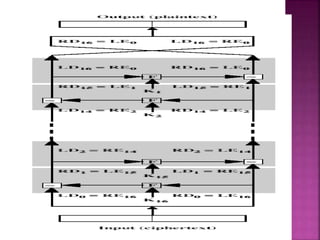
 Encryption (Round) (cont.) :-
 HISTORY OF DE :-
 TYPES OF DATA ENCRYPTION :-
 Decryption :-
 Security And Cryptanalysis :-
 KEY OF DATA ENCRYPTION:-
 Encryption is a technique for transforming
information on a computer in such a way that it
becomes unreadable.
 Encryption is the process of obscuring
information to make it unreadable without
special knowledge.
 A secure computing environment would not be
complete without consideration of encryption
technology.
 DEs was the result of research project set up by
International Business Machines (IBM).
 corporation in the late 1960’s which resulted in
a cipher know as LUCIFR in the early it was
decided to commercialise LUCIFER and a
number of significant. Changes were
introduced.
 Published in 1977, standardized in 1979.
 Key: 64 bit quantity=8-bit parity+56-bit key
 In 1971, IBM developed an algorithm, named
which operates on a block of using a key.
 In 1971, IBM developed an algorithm, named
which operates on a block of 64 using a key
 Walter Tuchman, an IBM researcher, refined
LUCIFER and reduced the key size to ,fit on a
chip.
 In 1977, the results of Tuchman’s project of
IBM was adopted as the by NSA (NIST).
 DES (and most of the other major symmetric
cipher) is based on cipher know as the festal
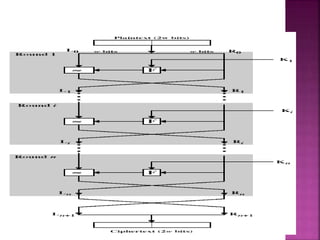
block cipher.
 This was block cipher developed by the IBM
cryptography research Horst feistily in the
early 70’s. it consists of a number rounds
where each round contains bit-suffering, non-
linear substitution (s-boxe) and exclusive or
operation.
 Most symmetric encryption schemes today are
based on this structure knows as a feistily
network.
 Once a plain-text message is received to be
encrypt.
 it is arranged into 64 bit blocks required for
input if the number.
 In this the message of bits in the message is
not evenly dividable by 64 then the last block.
 will be padded multiple permutation and
substitutions are incorporated throughout in
order to increase the difficulty of performing a
cryptanalyst is on the cipher.
 However it is generally accepted that the initial
and final permutation offer title or no
contribution to the security of DES and in fact
some software unit implementation then
although strictly speaking these are not DES as
 Hashing creates a unique, fixed-length
signature for a message or data set.
 Each “hash” is unique to a specific message, so
minor changes to that message would be easy
to track.
 Once data is encrypted using hashing, it cannot
be reversed or deciphered.
 Hashing, then, though not technically an
encryption method as such, is still useful for
proving data hasn’t been tampered with.
 Symmetric encryption is also known as
private-key cryptography, and is called so
because the key used to encrypt and decrypt.
 the message must remain secure, because
anyone with access to it can decrypt the data.
 Using this method, a sender encrypts the data
with one key, sends the data (the cipher text)
and then the receiver uses the key to decrypt
the data.
 Asymmetric encryption, or public-key
cryptography, is different than the previous method
because.
 it uses two keys for encryption or decryption (it has
the potential to sec such).
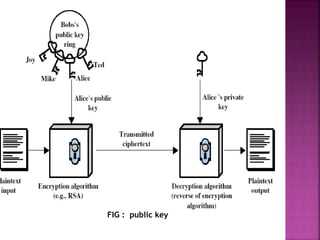
 With this method, a public key is freely available to
everyone and is used to encrypt messages, and a
different, private key is used by the recipient to
decrypt messages.
 Any of these methods would likely prove sufficient
for proper data security, and a quick Google search
will reveal the multitude of software available for
data encryption.
 .Data encryption is a necessity (both for legal reasons
and otherwise) when transmitting information like
PHI, so no matter what method you choose, make
sure you’re doing everything you can to protect data.
 Asymmetric encryption is most commonly used
to secure physically separate end points.
Examples include:
 Web browser and web server (HTTPS).
 VPN client and server.
 Secure FTP (SSL encrypted connection).
 The same algorithm as encryption. Asymmetric
encryption, or public-key cryptography,.
 Is different than the previous method because it
uses two keys for encryption or decryption (it
has the potential to be more secure as such).
 With this method, a public key is freely
available to everyone and is used to encrypt
messages, and a different, private key is used
by the recipient to decrypt messages.
 . Data encryption is a necessity (both for legal
reasons and otherwise) when transmitting
information like PHI, so no matter what
method you choose, make sure you’re doing
everything you can to protect data.
 Feistily cipher implements Shannon’s S-P
network concept.
based on invertible product cipher
 Process through multiple rounds which
 partitions input block into two halves
 perform a substitution on left data half
 based on round function of right half & sub key
 then have permutation swapping halves
 Feistel cipher implements Shannon’s S-P network
concept
 Achieve diffusion and confusion
 Although more information has been on the
Cryptanalysis of dfs than any other block
cipher while having a theoretical complicity
less than a brute force attack.
 The most practical attack to date is still abrate
foree approach .the length of the key
determines the number of possible.
 Differential cryptanalysis has been proposed
since 1990 to break block cipher such as DES
and while successful for breaking LUCIFER
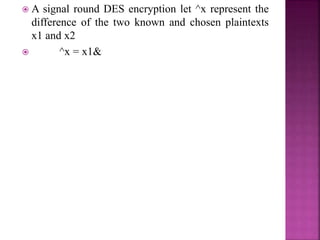
 A signal round DES encryption let ^x represent the
difference of the two known and chosen plaintexts
x1 and x2
 ^x = x1&
 A mentioned earlier there are two main types
of cryptography in use today secret key or
Private key cryptography and public key
cryptography key cryptography
 the oldest type wheres asymmetric
cryptography is only being used publicly since
the late 1970’s asymmetric.
 The was major milestone in the search for a
perfect encryption scheme.
 There are two types of Key Private Key &
public key.
 Private Key also called as the secret key.
 This cryptography goes back to least encryption
times and is of Concern
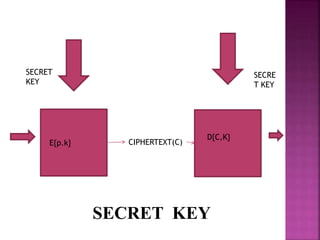
 here it involves the use of only one key which is
used for both encryption and decryption (hence the
use of the term symmetries).
 It is necessary for security purpose that the secret
key never be revaluated.
SECRE
T KEY
E{p.k}
D{C,K}
CIPHERTEXT(C)
SECRET
KEY
SECRET KEY
 Private/secret/single key cryptography uses
one key .
 Shared by both sender and receiver.
 If this key is disclosed communications are
compromised .
 Also is symmetric, parties are equal .
 Hence does not protect sender from receiver
forging a message & claiming is sent by sender
 It also referred as a symmetric encryption. It
two gets in that security key private key or yes
and public key.
 Sender user a security key to enciphers
message and sends to receiver when the
recipient get the message .
 he uses public key of sender to descript the
message it is most secure message than
sematic one because sender need not discover
this private key .
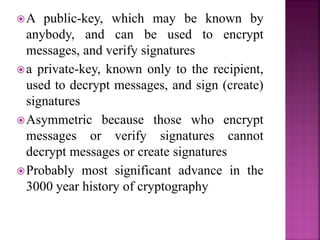
A public-key, which may be known by
anybody, and can be used to encrypt
messages, and verify signatures
a private-key, known only to the recipient,
used to decrypt messages, and sign (create)
signatures
Asymmetric because those who encrypt
messages or verify signatures cannot
decrypt messages or create signatures
Probably most significant advance in the
3000 year history of cryptography
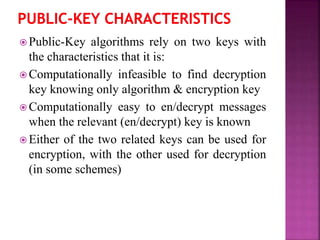
 Public-Key algorithms rely on two keys with
the characteristics that it is:
 Computationally infeasible to find decryption
key knowing only algorithm & encryption key
 Computationally easy to en/decrypt messages
when the relevant (en/decrypt) key is known
 Either of the two related keys can be used for
encryption, with the other used for decryption
(in some schemes)
FIG : public key
 William Stallings, Cryptography and
Network Security, 1999.
 https: www.google.com
THANKE YOU

Data encryption

  • 2.
     WHAT ISENCRYPTION :-  Encryption (Round) (cont.) :-  HISTORY OF DE :-  TYPES OF DATA ENCRYPTION :-  Decryption :-  Security And Cryptanalysis :-  KEY OF DATA ENCRYPTION:-
  • 3.
     Encryption isa technique for transforming information on a computer in such a way that it becomes unreadable.  Encryption is the process of obscuring information to make it unreadable without special knowledge.  A secure computing environment would not be complete without consideration of encryption technology.
  • 6.
     DEs wasthe result of research project set up by International Business Machines (IBM).  corporation in the late 1960’s which resulted in a cipher know as LUCIFR in the early it was decided to commercialise LUCIFER and a number of significant. Changes were introduced.  Published in 1977, standardized in 1979.  Key: 64 bit quantity=8-bit parity+56-bit key  In 1971, IBM developed an algorithm, named which operates on a block of using a key.
  • 7.
     In 1971,IBM developed an algorithm, named which operates on a block of 64 using a key  Walter Tuchman, an IBM researcher, refined LUCIFER and reduced the key size to ,fit on a chip.  In 1977, the results of Tuchman’s project of IBM was adopted as the by NSA (NIST).
  • 8.
     DES (andmost of the other major symmetric cipher) is based on cipher know as the festal block cipher.  This was block cipher developed by the IBM cryptography research Horst feistily in the early 70’s. it consists of a number rounds where each round contains bit-suffering, non- linear substitution (s-boxe) and exclusive or operation.  Most symmetric encryption schemes today are based on this structure knows as a feistily network.
  • 9.
     Once aplain-text message is received to be encrypt.  it is arranged into 64 bit blocks required for input if the number.  In this the message of bits in the message is not evenly dividable by 64 then the last block.  will be padded multiple permutation and substitutions are incorporated throughout in order to increase the difficulty of performing a cryptanalyst is on the cipher.  However it is generally accepted that the initial and final permutation offer title or no contribution to the security of DES and in fact some software unit implementation then although strictly speaking these are not DES as
  • 10.
     Hashing createsa unique, fixed-length signature for a message or data set.  Each “hash” is unique to a specific message, so minor changes to that message would be easy to track.  Once data is encrypted using hashing, it cannot be reversed or deciphered.  Hashing, then, though not technically an encryption method as such, is still useful for proving data hasn’t been tampered with.
  • 11.
     Symmetric encryptionis also known as private-key cryptography, and is called so because the key used to encrypt and decrypt.  the message must remain secure, because anyone with access to it can decrypt the data.  Using this method, a sender encrypts the data with one key, sends the data (the cipher text) and then the receiver uses the key to decrypt the data.
  • 12.
     Asymmetric encryption,or public-key cryptography, is different than the previous method because.  it uses two keys for encryption or decryption (it has the potential to sec such).  With this method, a public key is freely available to everyone and is used to encrypt messages, and a different, private key is used by the recipient to decrypt messages.  Any of these methods would likely prove sufficient for proper data security, and a quick Google search will reveal the multitude of software available for data encryption.
  • 13.
     .Data encryptionis a necessity (both for legal reasons and otherwise) when transmitting information like PHI, so no matter what method you choose, make sure you’re doing everything you can to protect data.  Asymmetric encryption is most commonly used to secure physically separate end points. Examples include:  Web browser and web server (HTTPS).  VPN client and server.  Secure FTP (SSL encrypted connection).
  • 14.
     The samealgorithm as encryption. Asymmetric encryption, or public-key cryptography,.  Is different than the previous method because it uses two keys for encryption or decryption (it has the potential to be more secure as such).  With this method, a public key is freely available to everyone and is used to encrypt messages, and a different, private key is used by the recipient to decrypt messages.  . Data encryption is a necessity (both for legal reasons and otherwise) when transmitting information like PHI, so no matter what method you choose, make sure you’re doing everything you can to protect data.
  • 16.
     Feistily cipherimplements Shannon’s S-P network concept. based on invertible product cipher  Process through multiple rounds which  partitions input block into two halves  perform a substitution on left data half  based on round function of right half & sub key  then have permutation swapping halves  Feistel cipher implements Shannon’s S-P network concept  Achieve diffusion and confusion
  • 18.
     Although moreinformation has been on the Cryptanalysis of dfs than any other block cipher while having a theoretical complicity less than a brute force attack.  The most practical attack to date is still abrate foree approach .the length of the key determines the number of possible.  Differential cryptanalysis has been proposed since 1990 to break block cipher such as DES and while successful for breaking LUCIFER
  • 19.
     A signalround DES encryption let ^x represent the difference of the two known and chosen plaintexts x1 and x2  ^x = x1&
  • 20.
     A mentionedearlier there are two main types of cryptography in use today secret key or Private key cryptography and public key cryptography key cryptography  the oldest type wheres asymmetric cryptography is only being used publicly since the late 1970’s asymmetric.  The was major milestone in the search for a perfect encryption scheme.  There are two types of Key Private Key & public key.
  • 21.
     Private Keyalso called as the secret key.  This cryptography goes back to least encryption times and is of Concern  here it involves the use of only one key which is used for both encryption and decryption (hence the use of the term symmetries).  It is necessary for security purpose that the secret key never be revaluated.
  • 22.
  • 23.
     Private/secret/single keycryptography uses one key .  Shared by both sender and receiver.  If this key is disclosed communications are compromised .  Also is symmetric, parties are equal .  Hence does not protect sender from receiver forging a message & claiming is sent by sender
  • 24.
     It alsoreferred as a symmetric encryption. It two gets in that security key private key or yes and public key.  Sender user a security key to enciphers message and sends to receiver when the recipient get the message .  he uses public key of sender to descript the message it is most secure message than sematic one because sender need not discover this private key .
  • 25.
    A public-key, whichmay be known by anybody, and can be used to encrypt messages, and verify signatures a private-key, known only to the recipient, used to decrypt messages, and sign (create) signatures Asymmetric because those who encrypt messages or verify signatures cannot decrypt messages or create signatures Probably most significant advance in the 3000 year history of cryptography
  • 26.
     Public-Key algorithmsrely on two keys with the characteristics that it is:  Computationally infeasible to find decryption key knowing only algorithm & encryption key  Computationally easy to en/decrypt messages when the relevant (en/decrypt) key is known  Either of the two related keys can be used for encryption, with the other used for decryption (in some schemes)
  • 27.
  • 28.
     William Stallings,Cryptography and Network Security, 1999.  https: www.google.com THANKE YOU