Emulsion stability
 Emulsions are neither homogeneous nor
thermodynamically stable, over time they will show
some tendency to separate on standing to produce the
minimum possible surface area of contact b/w phases.
 The ability of emulsion to resist change in its
physiochemical properties with time is called emulsion
stability.
 Mechanisms of emulsion breakdown:
 Two types of instabilities:
1. Physical instability.
2. Chemical instability.
Emulsion stability
Mechanisms of emulsion breakdown
 Physical instability has following types:
I. Creaming and sedimentation.
II. Coalescence and breaking.
III. Phase inversion.
IV. Ostwald repining.
Emulsion stability
Mechanisms of emulsion breakdown
1.Creaming and Sedimentation:
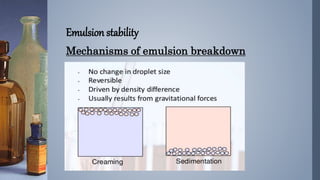
 The upward or downward movement of dispersed
droplets relative to continuous phase, termed as
creaming or sedimentation respectively.
 This process results due to gravitational and centrifugal
forces. When these forces exceeds thermal or Brownian
movement.
 In emulsions one process or the other takes place
depending on the disperse and continuous phase
density.
Emulsion stability
Mechanisms of emulsion breakdown
 When density of the dispersion medium is greater than
that of the dispersed phase Creaming is favored and
vice versa will favor sedimentation.
 It brought about the particles closer promoting the
problem of coalescence.
Emulsion stability
Mechanisms of emulsion breakdown
Emulsion stability
Mechanisms of emulsion breakdown
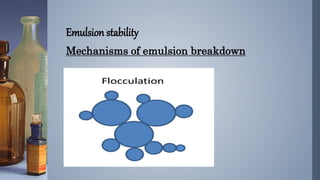
2.Flocculation:
 This process can be defined as the aggregation of two or
more droplets together with out changing their
individual identity.
 This process occurs when the attractive forces between
drops exceeds than the repulsive electrostatic forces.
 It can be effected by PH and ionic strength of the
aqueous medium.
 The term aggregation and flocculation are one and the
same.
Emulsion stability
Mechanisms of emulsion breakdown
Emulsion stability
Mechanisms of emulsion breakdown
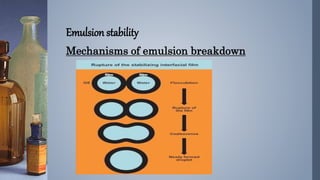
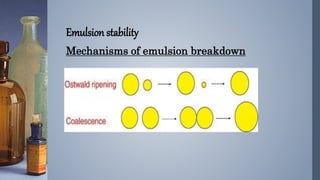
3.Coalescence and breaking:
 It involves breaking the interfacial film and is
irreversible.
 Extensive coalescence can lead to formation of separate
layers on top of product known as oiling off.
 It occurs due to the incompatibility of the added
substance with the emulsifying agent.
 It may occurs with change in temperature.
 Addition of excessive amount of dispersed phase may
lead to coalescence.
Emulsion stability
Mechanisms of emulsion breakdown
Emulsion stability
Mechanisms of emulsion breakdown
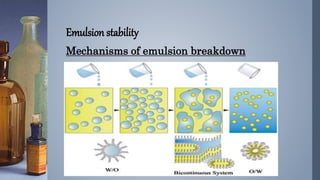
4.Phase inversion:
 Inversion in which O/W emulsion inverts to become a
W/O emulsion and vice versa.
 The reason for the phase inversion is using of wrong
type of emulsifying agents.
Causes
 Addition of an electrolyte may lead to phase inversion.
 May arise due to inappropriate emulsifier.
Emulsion stability
Mechanisms of emulsion breakdown
Emulsion stability
Mechanisms of emulsion breakdown
5.Ostwald ripening:
 Ostwald ripening is the growth of one emulsion droplet
at the expense of a smaller one as a result of the
difference in chemical potential of the material within
the droplets.
 This difference arises from the difference in the radius
of curvature of the drops.
Emulsion stability
Mechanisms of emulsion breakdown
Emulsion stability
Mechanisms of emulsion breakdown
Now questions is


How to make an emulsion stabilized?
How to overcome all these problems?
Emulsion stability
Mechanisms of emulsion breakdown
 We use emulsifying agents to overcome all these
problems.
 There are three theories that explains how emulsifying
agents works.
 These are :
1. Interfacial film theory.
2. Interfacial tension theory.
3. Oriented wedge theory.
Emulsion stability
Mechanisms of emulsion breakdown
Interfacial film theory:
 Also know as plastic theory.
 A rigid interfacial film is formed around the
dispersed liquid droplets. This is pliable and
elastic. It prevents coalescence and
sedimentation of droplets. The more pliable and
elastic the film is the more will be its stability.
Emulsion stability
Mechanisms of emulsion breakdown
Interfacial tension theory:
 The emulsifying agent reduces the tension
between dispersed phase and dispersion
medium.
 It reduces the repelling forces b/w liquids.
 Also known as surface tension theory.
Emulsion stability
Mechanisms of emulsion breakdown
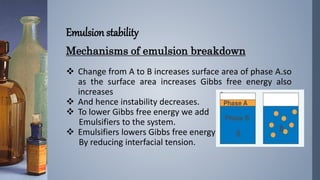
 Change from A to B increases surface area of phase A.so
as the surface area increases Gibbs free energy also
increases
 And hence instability decreases.
 To lower Gibbs free energy we add
Emulsifiers to the system.
 Emulsifiers lowers Gibbs free energy
By reducing interfacial tension.
Emulsion stability
Mechanisms of emulsion breakdown
Oriented wedge theory:
 It is based on the presumption that certain emulsifying
agents orient themselves about and within a liquid in a
manner reflective of their solubility in that particular
liquid.
 An emulsifying agent having greater hydrophilic
character than hydrophobic character will promote an
O/W emulsion and a W/O emulsion results through use
of more hydrophobic than hydrophilic emulsifiers.
Emulsion stability
Mechanisms of emulsion breakdown
 An emulsifying agent will orient itself in that
phase in which it is more soluble.
 According to Bancroft it is continuous phase.
All references taken from J.P. Remington the science and practice of pharmacy.

Emulsion stability by mgk

  • 2.
    Emulsion stability  Emulsionsare neither homogeneous nor thermodynamically stable, over time they will show some tendency to separate on standing to produce the minimum possible surface area of contact b/w phases.  The ability of emulsion to resist change in its physiochemical properties with time is called emulsion stability.  Mechanisms of emulsion breakdown:  Two types of instabilities: 1. Physical instability. 2. Chemical instability.
  • 3.
    Emulsion stability Mechanisms ofemulsion breakdown  Physical instability has following types: I. Creaming and sedimentation. II. Coalescence and breaking. III. Phase inversion. IV. Ostwald repining.
  • 4.
    Emulsion stability Mechanisms ofemulsion breakdown 1.Creaming and Sedimentation:  The upward or downward movement of dispersed droplets relative to continuous phase, termed as creaming or sedimentation respectively.  This process results due to gravitational and centrifugal forces. When these forces exceeds thermal or Brownian movement.  In emulsions one process or the other takes place depending on the disperse and continuous phase density.
  • 5.
    Emulsion stability Mechanisms ofemulsion breakdown  When density of the dispersion medium is greater than that of the dispersed phase Creaming is favored and vice versa will favor sedimentation.  It brought about the particles closer promoting the problem of coalescence.
  • 6.
  • 7.
    Emulsion stability Mechanisms ofemulsion breakdown 2.Flocculation:  This process can be defined as the aggregation of two or more droplets together with out changing their individual identity.  This process occurs when the attractive forces between drops exceeds than the repulsive electrostatic forces.  It can be effected by PH and ionic strength of the aqueous medium.  The term aggregation and flocculation are one and the same.
  • 8.
  • 9.
    Emulsion stability Mechanisms ofemulsion breakdown 3.Coalescence and breaking:  It involves breaking the interfacial film and is irreversible.  Extensive coalescence can lead to formation of separate layers on top of product known as oiling off.  It occurs due to the incompatibility of the added substance with the emulsifying agent.  It may occurs with change in temperature.  Addition of excessive amount of dispersed phase may lead to coalescence.
  • 10.
  • 11.
    Emulsion stability Mechanisms ofemulsion breakdown 4.Phase inversion:  Inversion in which O/W emulsion inverts to become a W/O emulsion and vice versa.  The reason for the phase inversion is using of wrong type of emulsifying agents. Causes  Addition of an electrolyte may lead to phase inversion.  May arise due to inappropriate emulsifier.
  • 12.
  • 13.
    Emulsion stability Mechanisms ofemulsion breakdown 5.Ostwald ripening:  Ostwald ripening is the growth of one emulsion droplet at the expense of a smaller one as a result of the difference in chemical potential of the material within the droplets.  This difference arises from the difference in the radius of curvature of the drops.
  • 14.
  • 15.
    Emulsion stability Mechanisms ofemulsion breakdown Now questions is

 How to make an emulsion stabilized? How to overcome all these problems?
  • 16.
    Emulsion stability Mechanisms ofemulsion breakdown  We use emulsifying agents to overcome all these problems.  There are three theories that explains how emulsifying agents works.  These are : 1. Interfacial film theory. 2. Interfacial tension theory. 3. Oriented wedge theory.
  • 17.
    Emulsion stability Mechanisms ofemulsion breakdown Interfacial film theory:  Also know as plastic theory.  A rigid interfacial film is formed around the dispersed liquid droplets. This is pliable and elastic. It prevents coalescence and sedimentation of droplets. The more pliable and elastic the film is the more will be its stability.
  • 18.
    Emulsion stability Mechanisms ofemulsion breakdown Interfacial tension theory:  The emulsifying agent reduces the tension between dispersed phase and dispersion medium.  It reduces the repelling forces b/w liquids.  Also known as surface tension theory.
  • 19.
    Emulsion stability Mechanisms ofemulsion breakdown  Change from A to B increases surface area of phase A.so as the surface area increases Gibbs free energy also increases  And hence instability decreases.  To lower Gibbs free energy we add Emulsifiers to the system.  Emulsifiers lowers Gibbs free energy By reducing interfacial tension.
  • 20.
    Emulsion stability Mechanisms ofemulsion breakdown Oriented wedge theory:  It is based on the presumption that certain emulsifying agents orient themselves about and within a liquid in a manner reflective of their solubility in that particular liquid.  An emulsifying agent having greater hydrophilic character than hydrophobic character will promote an O/W emulsion and a W/O emulsion results through use of more hydrophobic than hydrophilic emulsifiers.
  • 21.
    Emulsion stability Mechanisms ofemulsion breakdown  An emulsifying agent will orient itself in that phase in which it is more soluble.  According to Bancroft it is continuous phase.
  • 23.
    All references takenfrom J.P. Remington the science and practice of pharmacy.

Editor's Notes