1
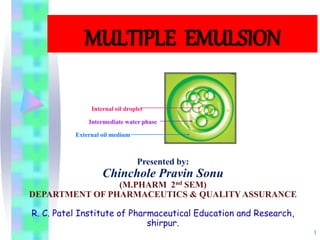
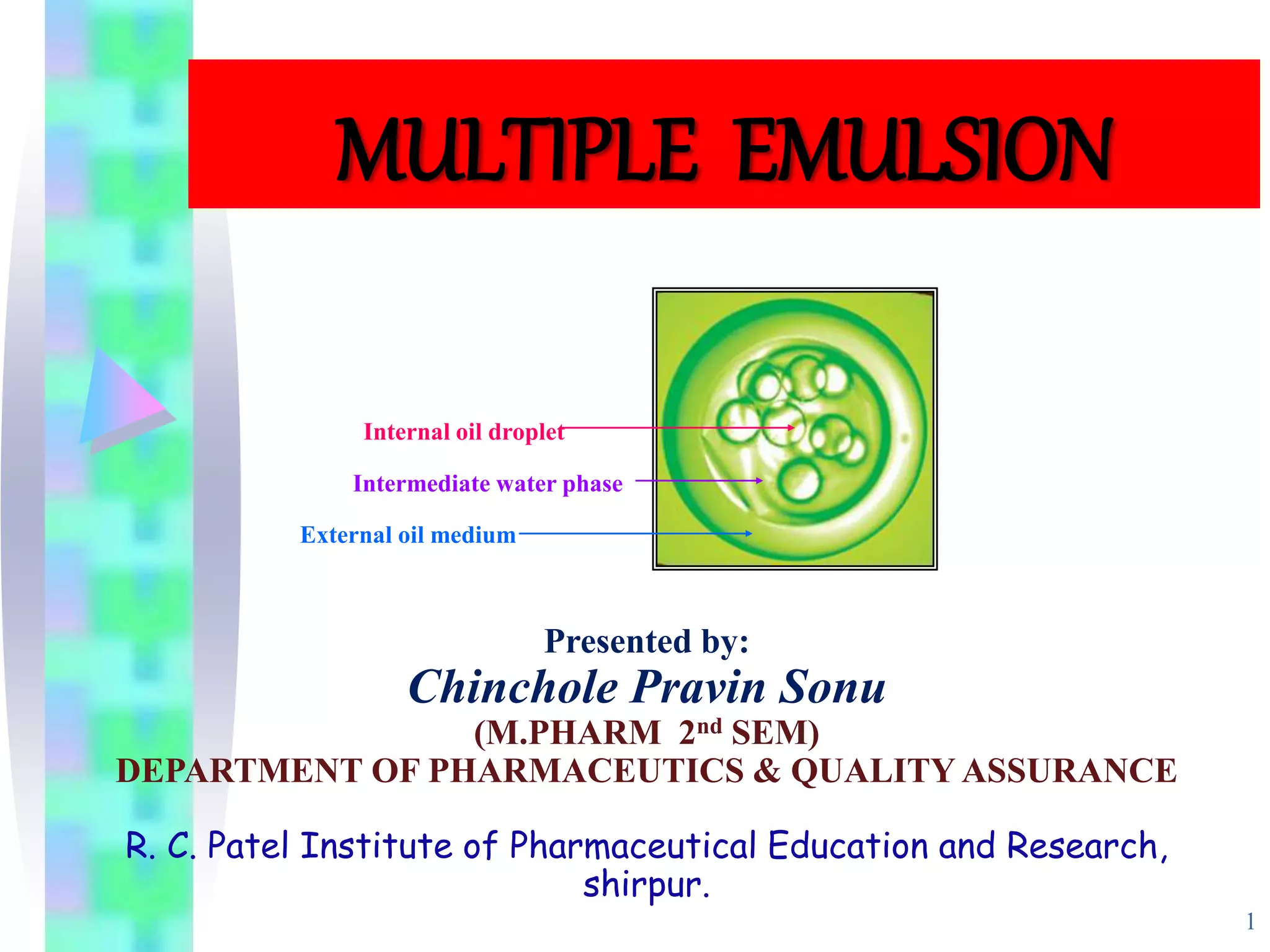
Internal oil droplet
External oil medium
Intermediate water phase
MULTIPLE EMULSION
Presented by:
Chinchole Pravin Sonu
(M.PHARM 2nd SEM)
DEPARTMENT OF PHARMACEUTICS & QUALITY ASSURANCE
R. C. Patel Institute of Pharmaceutical Education and Research,
shirpur.
Emulsion -
• Heterogeneous biphasic system in
which one immiscible liquid is dispersed
in another in the form of droplet and
stabilized by third component called
emulsifying agent.
2
Types of emulsions -
Mostly are of two types,
1. w/o system -
Dispersed phase - Water
Dispersion medium- Oil
2. o/w system –
Dispersed phase - Oil
Dispersion medium- Water
3
Multiple emulsions -
Novel development in emulsion technology.
Complex type of multiple system.
Also called,
 Emulsion of emulsion.
 Double or triple emulsion.
4
Internal oil droplet
External oil medium
Intermediate water phase
Types of multiple emulsions -
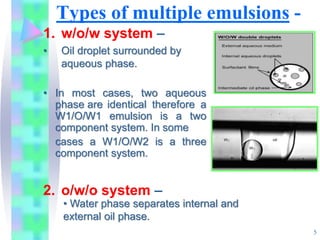
1. w/o/w system –
• Oil droplet surrounded by
aqueous phase.
• In most cases, two aqueous
phase are identical therefore a
W1/O/W1 emulsion is a two
component system. In some
cases a W1/O/W2 is a three
component system.
2. o/w/o system –
5
• Water phase separates internal and
external oil phase.
Advantages -
1. Protect active drug from degradation.
2. High encapsulation efficiency.
3. Prolonged or controlled drug release
can be achieved.
4. Easy to produce and scale up.
5. Economical.
6
Disadvantages -
1. Low thermodynamic stability.
2. It is bulkier system.
3. Disagreeable taste in some case.
7
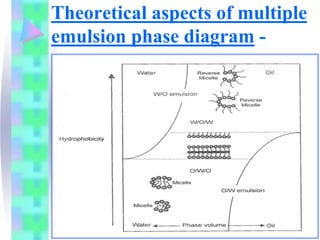
Theoretical aspects of multiple
emulsion phase diagram -
8
Formulation and manufacture
of multiple emulsion -
9
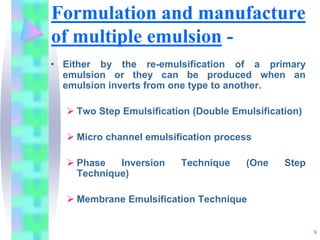
• Either by the re-emulsification of a primary
emulsion or they can be produced when an
emulsion inverts from one type to another.
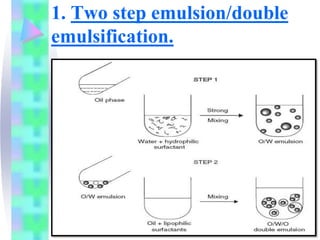
 Two Step Emulsification (Double Emulsification)
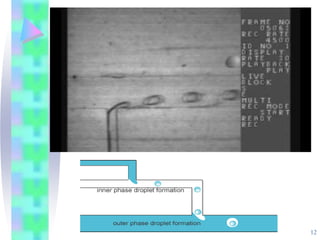
 Micro channel emulsification process
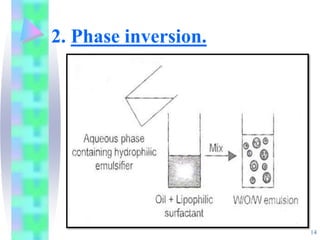
 Phase Inversion Technique (One Step
Technique)
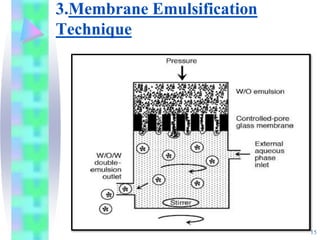
 Membrane Emulsification Technique
1. Two step emulsion/double
emulsification.
10
Micro Channel Emulsification
Process
• Two type of channel:
T – junction channel: -
Cross junction channel : -
11
12
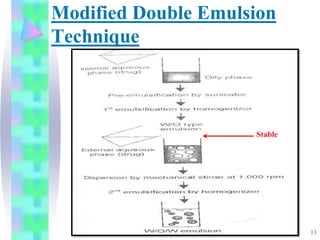
Modified Double Emulsion
Technique
13
Stable
2. Phase inversion.
14
15
3.Membrane Emulsification
Technique
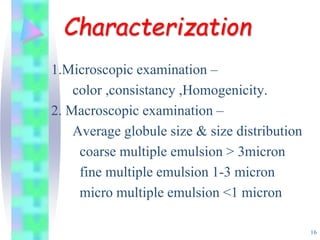
1.Microscopic examination –
color ,consistancy ,Homogenicity.
2. Macroscopic examination –
Average globule size & size distribution
coarse multiple emulsion > 3micron
fine multiple emulsion 1-3 micron
micro multiple emulsion <1 micron
16
Characterization
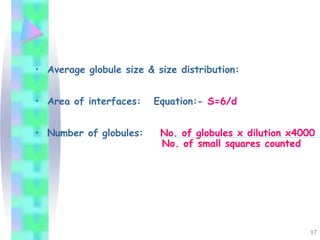
• Average globule size & size distribution:
• Area of interfaces: Equation:- S=6/d
• Number of globules: No. of globules x dilution x4000
No. of small squares counted
17
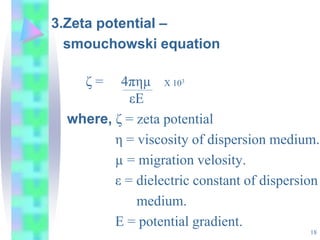
3.Zeta potential –
smouchowski equation
ζ = 4πηµ X 103
εE
where, ζ = zeta potential
η = viscosity of dispersion medium.
µ = migration velosity.
ε = dielectric constant of dispersion
medium.
E = potential gradient.
18
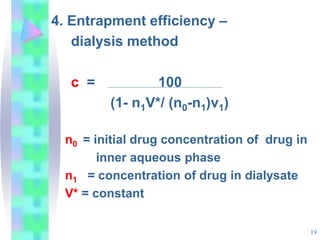
4. Entrapment efficiency –
dialysis method
c = 100
(1- n1V*/ (n0-n1)v1)
n0 = initial drug concentration of drug in
inner aqueous phase
n1 = concentration of drug in dialysate
V* = constant
19
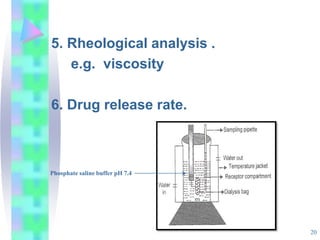
5. Rheological analysis .
e.g. viscosity
6. Drug release rate.
20
Phosphate saline buffer pH 7.4
Parameters affecting multiple
emulsion preparation -
1.Composition –
a) nature of oil –
controls permeability of liquid
membrane.
controls release rate of solute.
b) physiochemical properties –
density, viscosity, globule size
affect stability
21
2. shear/ agitation –
choice of mode of emulsification is
important.
high shear disrupts large percent
of multiple drops and leads
instability
requirements –
primary emulsification – 800 rpm
secondary emulsification – 200 rpm
22
3. Surfactant –
two types a) hydrophilic
b) lipophilic
concentration of secondary emulsifier
should 1/5 times less than primary.

non ionic surfactant mostly preferred
due to, better yield of multiple drops
non toxic
less interact with other
compounds.
eg.polysorbate 23
Stability
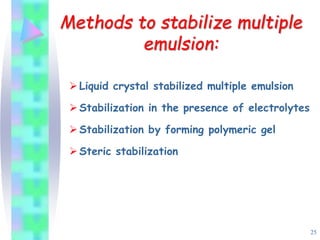
• Depending upon equilibrium between water, oil and surfactant.
• Unfortunately multiple emulsion are thermodynamically
unstable.
• Possible indication of instability include:
 Leakage of the contents from the inner aqueous phases
 Rupture of oil layer on the surface of the internal droplet i. e.
expulsion of internal droplet in external phase.
 Shrinkage and swelling of the internal drops due to osmotic
gradient across the oil membrane
 Phase separation
 Coalescence of the internal
droplets and multiple emulsion drops
24
Methods to stabilize multiple
emulsion:
Liquid crystal stabilized multiple emulsion
Stabilization in the presence of electrolytes
Stabilization by forming polymeric gel
Steric stabilization
25
Drug Release Mechanisms And
Models
• 1) Diffusion mechanism:
This is most obvious transport mechanism where
unionized hydrophobic drug diffuses through the oil
layer (Semi permeable liquid membrane) in the stable
multiple emulsions.
• 2) Micellar transport:
Inverse micelles play key role in this transport
mechanism. Inverse micelles consisting of nonpolar
part of surfactant lying outside and polar part inside
encapsulate hydrophilic drug in core and permeate
through the oil membrane because of the outer
lipophilic nature.
Inverse micelle can encapsulate both ionized and
unionized drug. 26
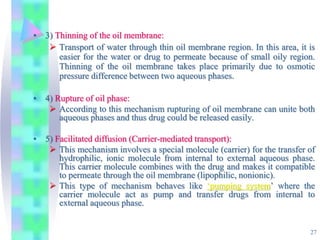
• 3) Thinning of the oil membrane:
 Transport of water through thin oil membrane region. In this area, it is
easier for the water or drug to permeate because of small oily region.
Thinning of the oil membrane takes place primarily due to osmotic
pressure difference between two aqueous phases.
• 4) Rupture of oil phase:
 According to this mechanism rupturing of oil membrane can unite both
aqueous phases and thus drug could be released easily.
• 5) Facilitated diffusion (Carrier-mediated transport):
 This mechanism involves a special molecule (carrier) for the transfer of
hydrophilic, ionic molecule from internal to external aqueous phase.
This carrier molecule combines with the drug and makes it compatible
to permeate through the oil membrane (lipophilic, nonionic).
 This type of mechanism behaves like ‘pumping system’ where the
carrier molecule act as pump and transfer drugs from internal to
external aqueous phase.
27
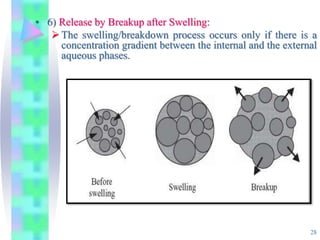
• 6) Release by Breakup after Swelling:
The swelling/breakdown process occurs only if there is a
concentration gradient between the internal and the external
aqueous phases.
28
In-Vivo release Study Of
Multiple Emulsion
• Blood, Lymph, Cerebrospinal fluid and Urine are all
basically aqueous media and sustained drug delivery to
these organs can be claimed if the rate of partitioning from
oil into an aqueous media is slow and controllable.
• W/O/W emulsion could breakdown rapidly in vivo due to
an osmotic effect.
• The use of isotonic system and/or the creation of thick
interfacial layer or gelled system that can withstand the
osmotic stress provides system that may have controlled
drug release characteristics in vivo.
29
Applications
• Controlled and Sustained Drug Delivery
• Drug Targeting
• Vaccine Adjuvant
• Cosmetics preparation
• Taste masking of the drug
• Haemoglobin Multiple emulsion as an oxygen
Delivery system.
30
Applications :-
1.Multiple emulsion in controlled release drug delivary.
curcumin extract nanoencapsulated in chitosan and
crosslinked with triployphosphate via multiple
emulsion shows 96.28% encapsulation efficacy with
controllled release.
2.Multiple emulsion in protein delivary
Insulin delivary –
EPA ,DHA, INSULIN multiple emulsion result shows
DHA facilitate intestinal insulin absorption without
inducing serious damage.
31
3.Others –
a) For delivery of blood substitutes.
b) For drug stability.
c) In microencapsulation.
d)Thermo reversible multiple emulsions.
e) Food processing.
32
Thank you
33

Multiple emulsion

  • 1.
    1 Internal oil droplet Externaloil medium Intermediate water phase MULTIPLE EMULSION Presented by: Chinchole Pravin Sonu (M.PHARM 2nd SEM) DEPARTMENT OF PHARMACEUTICS & QUALITY ASSURANCE R. C. Patel Institute of Pharmaceutical Education and Research, shirpur.
  • 2.
    Emulsion - • Heterogeneousbiphasic system in which one immiscible liquid is dispersed in another in the form of droplet and stabilized by third component called emulsifying agent. 2
  • 3.
    Types of emulsions- Mostly are of two types, 1. w/o system - Dispersed phase - Water Dispersion medium- Oil 2. o/w system – Dispersed phase - Oil Dispersion medium- Water 3
  • 4.
    Multiple emulsions - Noveldevelopment in emulsion technology. Complex type of multiple system. Also called,  Emulsion of emulsion.  Double or triple emulsion. 4 Internal oil droplet External oil medium Intermediate water phase
  • 5.
    Types of multipleemulsions - 1. w/o/w system – • Oil droplet surrounded by aqueous phase. • In most cases, two aqueous phase are identical therefore a W1/O/W1 emulsion is a two component system. In some cases a W1/O/W2 is a three component system. 2. o/w/o system – 5 • Water phase separates internal and external oil phase.
  • 6.
    Advantages - 1. Protectactive drug from degradation. 2. High encapsulation efficiency. 3. Prolonged or controlled drug release can be achieved. 4. Easy to produce and scale up. 5. Economical. 6
  • 7.
    Disadvantages - 1. Lowthermodynamic stability. 2. It is bulkier system. 3. Disagreeable taste in some case. 7
  • 8.
    Theoretical aspects ofmultiple emulsion phase diagram - 8
  • 9.
    Formulation and manufacture ofmultiple emulsion - 9 • Either by the re-emulsification of a primary emulsion or they can be produced when an emulsion inverts from one type to another.  Two Step Emulsification (Double Emulsification)  Micro channel emulsification process  Phase Inversion Technique (One Step Technique)  Membrane Emulsification Technique
  • 10.
    1. Two stepemulsion/double emulsification. 10
  • 11.
    Micro Channel Emulsification Process •Two type of channel: T – junction channel: - Cross junction channel : - 11
  • 12.
  • 13.
  • 14.
  • 15.
  • 16.
    1.Microscopic examination – color,consistancy ,Homogenicity. 2. Macroscopic examination – Average globule size & size distribution coarse multiple emulsion > 3micron fine multiple emulsion 1-3 micron micro multiple emulsion <1 micron 16 Characterization
  • 17.
    • Average globulesize & size distribution: • Area of interfaces: Equation:- S=6/d • Number of globules: No. of globules x dilution x4000 No. of small squares counted 17
  • 18.
    3.Zeta potential – smouchowskiequation ζ = 4πηµ X 103 εE where, ζ = zeta potential η = viscosity of dispersion medium. µ = migration velosity. ε = dielectric constant of dispersion medium. E = potential gradient. 18
  • 19.
    4. Entrapment efficiency– dialysis method c = 100 (1- n1V*/ (n0-n1)v1) n0 = initial drug concentration of drug in inner aqueous phase n1 = concentration of drug in dialysate V* = constant 19
  • 20.
    5. Rheological analysis. e.g. viscosity 6. Drug release rate. 20 Phosphate saline buffer pH 7.4
  • 21.
    Parameters affecting multiple emulsionpreparation - 1.Composition – a) nature of oil – controls permeability of liquid membrane. controls release rate of solute. b) physiochemical properties – density, viscosity, globule size affect stability 21
  • 22.
    2. shear/ agitation– choice of mode of emulsification is important. high shear disrupts large percent of multiple drops and leads instability requirements – primary emulsification – 800 rpm secondary emulsification – 200 rpm 22
  • 23.
    3. Surfactant – twotypes a) hydrophilic b) lipophilic concentration of secondary emulsifier should 1/5 times less than primary. non ionic surfactant mostly preferred due to, better yield of multiple drops non toxic less interact with other compounds. eg.polysorbate 23
  • 24.
    Stability • Depending uponequilibrium between water, oil and surfactant. • Unfortunately multiple emulsion are thermodynamically unstable. • Possible indication of instability include:  Leakage of the contents from the inner aqueous phases  Rupture of oil layer on the surface of the internal droplet i. e. expulsion of internal droplet in external phase.  Shrinkage and swelling of the internal drops due to osmotic gradient across the oil membrane  Phase separation  Coalescence of the internal droplets and multiple emulsion drops 24
  • 25.
    Methods to stabilizemultiple emulsion: Liquid crystal stabilized multiple emulsion Stabilization in the presence of electrolytes Stabilization by forming polymeric gel Steric stabilization 25
  • 26.
    Drug Release MechanismsAnd Models • 1) Diffusion mechanism: This is most obvious transport mechanism where unionized hydrophobic drug diffuses through the oil layer (Semi permeable liquid membrane) in the stable multiple emulsions. • 2) Micellar transport: Inverse micelles play key role in this transport mechanism. Inverse micelles consisting of nonpolar part of surfactant lying outside and polar part inside encapsulate hydrophilic drug in core and permeate through the oil membrane because of the outer lipophilic nature. Inverse micelle can encapsulate both ionized and unionized drug. 26
  • 27.
    • 3) Thinningof the oil membrane:  Transport of water through thin oil membrane region. In this area, it is easier for the water or drug to permeate because of small oily region. Thinning of the oil membrane takes place primarily due to osmotic pressure difference between two aqueous phases. • 4) Rupture of oil phase:  According to this mechanism rupturing of oil membrane can unite both aqueous phases and thus drug could be released easily. • 5) Facilitated diffusion (Carrier-mediated transport):  This mechanism involves a special molecule (carrier) for the transfer of hydrophilic, ionic molecule from internal to external aqueous phase. This carrier molecule combines with the drug and makes it compatible to permeate through the oil membrane (lipophilic, nonionic).  This type of mechanism behaves like ‘pumping system’ where the carrier molecule act as pump and transfer drugs from internal to external aqueous phase. 27
  • 28.
    • 6) Releaseby Breakup after Swelling: The swelling/breakdown process occurs only if there is a concentration gradient between the internal and the external aqueous phases. 28
  • 29.
    In-Vivo release StudyOf Multiple Emulsion • Blood, Lymph, Cerebrospinal fluid and Urine are all basically aqueous media and sustained drug delivery to these organs can be claimed if the rate of partitioning from oil into an aqueous media is slow and controllable. • W/O/W emulsion could breakdown rapidly in vivo due to an osmotic effect. • The use of isotonic system and/or the creation of thick interfacial layer or gelled system that can withstand the osmotic stress provides system that may have controlled drug release characteristics in vivo. 29
  • 30.
    Applications • Controlled andSustained Drug Delivery • Drug Targeting • Vaccine Adjuvant • Cosmetics preparation • Taste masking of the drug • Haemoglobin Multiple emulsion as an oxygen Delivery system. 30
  • 31.
    Applications :- 1.Multiple emulsionin controlled release drug delivary. curcumin extract nanoencapsulated in chitosan and crosslinked with triployphosphate via multiple emulsion shows 96.28% encapsulation efficacy with controllled release. 2.Multiple emulsion in protein delivary Insulin delivary – EPA ,DHA, INSULIN multiple emulsion result shows DHA facilitate intestinal insulin absorption without inducing serious damage. 31
  • 32.
    3.Others – a) Fordelivery of blood substitutes. b) For drug stability. c) In microencapsulation. d)Thermo reversible multiple emulsions. e) Food processing. 32
  • 33.