 Emulsifying agents
 m/a of emulsifying agents
 Physical instability – Markers
 Factors improving Physical Stability
 Phase inversion
 Evaluation of physical stability
 Preparation of Emulsions
Emulsions are biphasic systems in which both
phases are liquids.
Emulsifying agents stabilize emulsions by
preventing or reducing the coalescence of
dispersed globules.
A variety of emulsifying agents are used, each probably act by
different mechanisms. Irrespective of their chemical nature, they tend
to concentrate at the interface and form a tough film around the
globules.
CLASSIFICATION
Based on the types of films:-
•Surface active agents (soaps, span, tween).
•Hydrophilic colloids (acacia, gelatin).
•Finely divided solids (bentonite, veegum).
Based on nature of films:-
•Monomolecular adsorption & film formation.
•Multimolecular adsorption.
•Solid particle adsorption.
Mono molecular adsorption and film formation
Surfactants adsorb at oil
water interface and form a
mono molecular film. This
film rapidly envelops the
droplets as soon as they are
formed. Agents having
higher interfacial activity are
better suited for this
purpose. The mono
molecular film should be
compact and strong enough
so that if film is broken, it
should be elastic and flexible
enough, so that it can be
reformed rapidly on
moderate agitation.
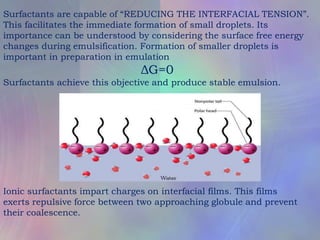
Surfactants are capable of “REDUCING THE INTERFACIAL TENSION”.
This facilitates the immediate formation of small droplets. Its
importance can be understood by considering the surface free energy
changes during emulsification. Formation of smaller droplets is
important in preparation in emulation
ΔG=0
Surfactants achieve this objective and produce stable emulsion.
Ionic surfactants impart charges on interfacial films. This films
exerts repulsive force between two approaching globule and prevent
their coalescence.
Combination of 2
surfactants give better
effect.
Here Tween 40 and
Span 80 and mixed
together for better
effect.
Multimolecular Adsorption
These emulsifying agents such as acacia and gelatin,
(isoelectric point) tend from Multimolecular film around the
globules and prevent coalescence. They also reduce
interfacial tension moderately, through it is secondary
importance. They are effective at high concentration and
promote the formation o/w emulsion owing to their
hydrophilicity. They also have affinity toward the oil phase
and facilitate interfacial adsorption. Normally, this stability
is improved by adding viscosity inducing agents such as
tragacanths methy1 cellulose CMC etc….
Solid particle adsorption
The finely divided solid particles adsorbs at oil-water interface and form
a rigid film of closely packed solids. This film acts as a mechanical barrier
and prevents the coalescence of globules. These tend to produce coarse
emulsion. Depending on the affinity of emulsifier to particular phase,
one can prepare both types of emulsions.
Examples are:
Bentonite (hydrated aluminum silicate, PH-9) ----- o/w & w/o
Veegum (magnesium aluminum silicate, >1%) ---- o/w
The stability of an emulsion depends on finer state of subdivision of
solid particles, irregular surface and charge on surface.
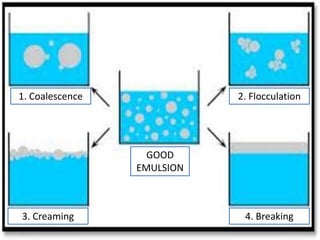
Flocculation
Creaming
Coalescence
Breaking
Phase inversion
1. Coalescence 2. Flocculation
3. Creaming 4. Breaking
GOOD
EMULSION
Flocculation
In this case neighboring globules come closer to each other and form
colonies in external phase. This aggregation of globules is not clearly
visible. The flocculation of globules depend on:
•Globule size distribution.
•Charge on globule surface.
•Viscosity of external medium.
Uniform sized globules prevent flocculation. This can be achieved by
proper size reduction process. If the viscosity of external medium is
increased, the globules become relatively immobile and flocculation can
be prevented. Flocs slowly move either upward or downward leading to
creaming. Flocculation is due to interaction of attractive and repulsive
force, where as creaming is due to density differences in two phases …
Creaming
Creaming can be prevented by:
1. Reducing the particle size by homogenization.
2. Increasing the viscosity of external phase by
adding the thickening agents.
3. Reducing the difference in densities between
dispersed phase and dispersion medium.
A few globules tend to fuse with each other and form bigger globules.
Coalescence is observed due to:-
-Insufficient amount of emulsifying agent
-Altered partitioning of emulsifying agent
-Incompatibilities between emulsifying agents
Breaking
This is indicated by complete separation of oil and aqueous
phase. It is an irreversible process i.e. simple mixing fails to re
suspend the globules into a uniform emulsion. In breaking,
protective sheath around the globules is completely destroyed.
Particle size:- Globule size is
REDUCED to exhibit Brownian motion
to maintain stability of emulsions. Particle size distribution:- Range must
be less varied to maintain good
stability.
Viscosity:- As it increases, the
flocculation is hindered and creaming
occurs, therefore optimum Viscosity is
necessary. Phase Volume Ratio:- It represents
the relative volume of water to oil in
an emulsion.
Charge of electric Double layer:- This
factor is only applied when there is
use of Ionic surfactant.
Physical properties of Interface:- The
film should be elastic enough to form
rapidly as soon as droplets are formed.
Densities of phases:- Densities can be
enhanced by addition of oil when oil
is an external phase. Temperature Fluctuations:- Elevation
in temperature can cause instability,
even degradation of drugs.
o/w  w/o OR w/o  o/w
It can be done by two ways:-
i. Changing chemical nature of emulsifier
ii. Altering the phase volume ratio.
PHYSICALSTABILITY
OF
EMULSIONS
It includes study of:
Degradation of Active
drug, Emulsifiers,
Preservatives, Anti-
oxidants, etc
It includes study of:
Shelf life, obtain its
form on moderate
shaking, etc
1.Extent of phase
Separation:
Commercially used method,
by studying the phase
separation.
It can be detected simply by
breaking of the emulsions.
Other factors are
coalescence and creaming…
2.Globule size distribution:
Microscopic evaluation of
Globule size gives idea of
stability of an emulsion.
If the globule size are
larger, it indicates the
aggregation of globules
and due to which the
emulsion is not stable.
It is studied by centrifugation method:
The Emulsion is kept in centrifuge and then plot of
Depth of Oil in centrifuge Vs Time (in seconds) is
plotted.
As the depth increases the stability is less..
• Selection of oil phase
• Selection of Aqueous phase
• Selection of Emulsifying agent
• Stability considerations of
emulsion
A) Small scale preparation
1. Wet Gum (English) method
2. Dry Gum (Continental) method
B) Large scale preparation
Method is similar to that of small
scale. Only the difference is the
agitation in small scale is done by
trituration and in large scale it is
done by various mixtures such as:
Agitator, Mechanical mixtures,
Propellers, Turbine mixers, colloid
mills, Ultrasonic devices.
Emulsion mechanichms

Emulsion mechanichms

  • 2.
     Emulsifying agents m/a of emulsifying agents  Physical instability – Markers  Factors improving Physical Stability  Phase inversion  Evaluation of physical stability  Preparation of Emulsions
  • 3.
    Emulsions are biphasicsystems in which both phases are liquids. Emulsifying agents stabilize emulsions by preventing or reducing the coalescence of dispersed globules.
  • 6.
    A variety ofemulsifying agents are used, each probably act by different mechanisms. Irrespective of their chemical nature, they tend to concentrate at the interface and form a tough film around the globules. CLASSIFICATION Based on the types of films:- •Surface active agents (soaps, span, tween). •Hydrophilic colloids (acacia, gelatin). •Finely divided solids (bentonite, veegum). Based on nature of films:- •Monomolecular adsorption & film formation. •Multimolecular adsorption. •Solid particle adsorption.
  • 7.
    Mono molecular adsorptionand film formation Surfactants adsorb at oil water interface and form a mono molecular film. This film rapidly envelops the droplets as soon as they are formed. Agents having higher interfacial activity are better suited for this purpose. The mono molecular film should be compact and strong enough so that if film is broken, it should be elastic and flexible enough, so that it can be reformed rapidly on moderate agitation.
  • 8.
    Surfactants are capableof “REDUCING THE INTERFACIAL TENSION”. This facilitates the immediate formation of small droplets. Its importance can be understood by considering the surface free energy changes during emulsification. Formation of smaller droplets is important in preparation in emulation ΔG=0 Surfactants achieve this objective and produce stable emulsion. Ionic surfactants impart charges on interfacial films. This films exerts repulsive force between two approaching globule and prevent their coalescence.
  • 9.
    Combination of 2 surfactantsgive better effect. Here Tween 40 and Span 80 and mixed together for better effect.
  • 10.
    Multimolecular Adsorption These emulsifyingagents such as acacia and gelatin, (isoelectric point) tend from Multimolecular film around the globules and prevent coalescence. They also reduce interfacial tension moderately, through it is secondary importance. They are effective at high concentration and promote the formation o/w emulsion owing to their hydrophilicity. They also have affinity toward the oil phase and facilitate interfacial adsorption. Normally, this stability is improved by adding viscosity inducing agents such as tragacanths methy1 cellulose CMC etc….
  • 11.
    Solid particle adsorption Thefinely divided solid particles adsorbs at oil-water interface and form a rigid film of closely packed solids. This film acts as a mechanical barrier and prevents the coalescence of globules. These tend to produce coarse emulsion. Depending on the affinity of emulsifier to particular phase, one can prepare both types of emulsions. Examples are: Bentonite (hydrated aluminum silicate, PH-9) ----- o/w & w/o Veegum (magnesium aluminum silicate, >1%) ---- o/w The stability of an emulsion depends on finer state of subdivision of solid particles, irregular surface and charge on surface.
  • 12.
  • 13.
    1. Coalescence 2.Flocculation 3. Creaming 4. Breaking GOOD EMULSION
  • 14.
    Flocculation In this caseneighboring globules come closer to each other and form colonies in external phase. This aggregation of globules is not clearly visible. The flocculation of globules depend on: •Globule size distribution. •Charge on globule surface. •Viscosity of external medium. Uniform sized globules prevent flocculation. This can be achieved by proper size reduction process. If the viscosity of external medium is increased, the globules become relatively immobile and flocculation can be prevented. Flocs slowly move either upward or downward leading to creaming. Flocculation is due to interaction of attractive and repulsive force, where as creaming is due to density differences in two phases …
  • 15.
  • 16.
    Creaming can beprevented by: 1. Reducing the particle size by homogenization. 2. Increasing the viscosity of external phase by adding the thickening agents. 3. Reducing the difference in densities between dispersed phase and dispersion medium.
  • 17.
    A few globulestend to fuse with each other and form bigger globules. Coalescence is observed due to:- -Insufficient amount of emulsifying agent -Altered partitioning of emulsifying agent -Incompatibilities between emulsifying agents
  • 18.
    Breaking This is indicatedby complete separation of oil and aqueous phase. It is an irreversible process i.e. simple mixing fails to re suspend the globules into a uniform emulsion. In breaking, protective sheath around the globules is completely destroyed.
  • 20.
    Particle size:- Globulesize is REDUCED to exhibit Brownian motion to maintain stability of emulsions. Particle size distribution:- Range must be less varied to maintain good stability. Viscosity:- As it increases, the flocculation is hindered and creaming occurs, therefore optimum Viscosity is necessary. Phase Volume Ratio:- It represents the relative volume of water to oil in an emulsion. Charge of electric Double layer:- This factor is only applied when there is use of Ionic surfactant. Physical properties of Interface:- The film should be elastic enough to form rapidly as soon as droplets are formed. Densities of phases:- Densities can be enhanced by addition of oil when oil is an external phase. Temperature Fluctuations:- Elevation in temperature can cause instability, even degradation of drugs.
  • 21.
    o/w  w/oOR w/o  o/w It can be done by two ways:- i. Changing chemical nature of emulsifier ii. Altering the phase volume ratio.
  • 22.
  • 23.
    It includes studyof: Degradation of Active drug, Emulsifiers, Preservatives, Anti- oxidants, etc It includes study of: Shelf life, obtain its form on moderate shaking, etc
  • 24.
    1.Extent of phase Separation: Commerciallyused method, by studying the phase separation. It can be detected simply by breaking of the emulsions. Other factors are coalescence and creaming… 2.Globule size distribution: Microscopic evaluation of Globule size gives idea of stability of an emulsion. If the globule size are larger, it indicates the aggregation of globules and due to which the emulsion is not stable.
  • 25.
    It is studiedby centrifugation method: The Emulsion is kept in centrifuge and then plot of Depth of Oil in centrifuge Vs Time (in seconds) is plotted. As the depth increases the stability is less..
  • 26.
    • Selection ofoil phase • Selection of Aqueous phase • Selection of Emulsifying agent • Stability considerations of emulsion A) Small scale preparation 1. Wet Gum (English) method 2. Dry Gum (Continental) method B) Large scale preparation
  • 29.
    Method is similarto that of small scale. Only the difference is the agitation in small scale is done by trituration and in large scale it is done by various mixtures such as: Agitator, Mechanical mixtures, Propellers, Turbine mixers, colloid mills, Ultrasonic devices.