EMULSION
• An emulsion may be defined as a biphasic system consisting
of two immiscible liquids one of which ( the dispersed
phase) is finely subdivided and uniformly dispersed as
droplets throughout the other ( the continuous phase).
• Since such a system is thermodynamically unstable, a
suitable emulsifying agent is required to stabilize the
system.
• The dispersed phase or continuous phase can range in
consistency from a mobile liquid to a semi-solid.
• Thus pharmaceutical emulsified systems range from lotions
and oral emulsions of relatively low viscosity to ointments
and creams which are semi-solid in nature.
• The particle size of the dispersed phase generally ranges
from 0.1 to 100 m.
Types of Emulsion
1. Oil-in-Water Emulsions:
• In pharmaceutical emulsions, one phase is usually water and
the other an oil, fat or waxy substance.
• Systems in which oil is the dispersed or discontinuous phase
and water is the continuous phase are termed as oil-in-water
(o/w) emulsions.
• Such emulsions are usually preferred for oral use since the
disagreeable taste and odour of the oil is generally masked
by emulsification.
• Additionally, the oil being in a finely dispersed state gets
easily assimilated in the body.
• Emulsions for intravenous administration should also be of
o/w type.
• Oil-in-water emulsions are also useful for preparations for
external use such as creams, lotions and liniments since they
provide a non-greasy feeling to the product and can easily
be washed off from the skin.
2. Water-in-Oil Emulsions
• Water-in-oil (w/o) emulsions are those in which oil forms
the continuous or external phase while water is the
dispersed or discontinuous phase.
• Such emulsion are mostly used externally as creams and
lotions.
• Such emulsions have an occlusive effect on the skin and are
useful for the preparation of moisturizing creams.
• They are also useful as cleansing creams since they
solubilize the oil-soluble dirt from the surface.
• Certain medicaments such as antiseptics are more effective
when use in the form of w/o emulsions.
• These emulsions are however not always acceptable
cosmetically because of their greasy feeling.
3. Multiple Emulsions:
• In addition to the two types of emulsions discussed above
there are certain complex, multiple emulsions in which the
oil-in-water or water-in-oil emulsions are dispersed in
another liquid medium.
• Thus, an oil-in-water-in-oil (o/w/o) emulsion consists of
very small droplets of oil dispersed in the water globules of
a water-in-oil emulsion and a water-in-oil-in-water (w/o/w)
emulsion consists of droplets of water dispersed in the oil
phase of an oil-in-water emulsion.
• More complex system such as water-in-oil-in-water-in-oil-
in-water emulsions, have also been developed.
• The preparation of multiple emulsions involves two stages.
For example, a w/o/w emulsion is prepared by first forming
a water-in-oil system and then dispersing this primary
emulsion in a second aqueous phase.
• Multiple emulsion have been proposed as potential
candidates for sustained release dosage forms since the drug
entrapped in the innermost phase has to pass through two
other phases before being released for absorption.
4. Micro emulsions:
• Normal emulsions generally contain globules ranging from
0.1 to 100 m in diameter.
• Micro emulsions are emulsions that contain globules having
diameters of less than 0.1 m.
• Droplets of such dimensions cannot refract light and, as a
result, are invisible to the naked eye.
• Micro emulsions therefore appear as transparent solutions
and are more acceptable physically in comparison to
conventional emulsions.
• Micro emulsions have been employed for preparation of
both external as well as internal formulations where they
have exhibited better bioavailability than conventional
emulsions.
Identification Of Emulsion Systems
• A number of tests have been proposed to determine the type
of emulsion. However, the result from one test should not be
taken to be conclusive and the identity of an emulsion type
should always be confirmed by at least two test procedures.
1. Dilution Test:
• The type of emulsion may be determined by diluting an
emulsion with oil or water.
• An oil-in-water emulsion can be easily diluted with an
aqueous solvent (e.g., milk, an o/w emulsion can be easily
diluted with water) whereas a water-in-oil emulsion can be
diluted with a oily liquid.
• Addition of the wrong liquid will cause cracking of the
emulsion.
2. Conductivity Test :
• This test is based on the principle that an emulsion with an
aqueous continuous phase will transmit an electrical
current whereas one with an oily continuous phase will
not.
• In this test, a pair of electrodes connected to a lamp and an
electrical source is generally dipped in to an emulsion.
• If the emulsion is o/w type, the lamp glows.
• Conductivity tests, however, may give false results with
non-ionic oil-in-water emulsions.
3. Dye Solubility Test:
• When a water-soluble dye such as amaranth is mixed with an
emulsion and examined under a microscope, the continuous
phase will appear coloured if the emulsion is o/w type while the
globules will appear coloured in case of w/o type.
• Similarly, the continuous phase of a w/o emulsion and the
globules of a o/w emulsion would appear coloured by an oil-
soluble dye such as Sudan III.
4. Cobalt Chloride Test:
• If a filter paper soaked in a cobalt chloride solution and allowed
to dry turns from blue to pink on exposure to an emulsion, it
indicates that the emulsion is of the o/w type.
• This test however may not work if the emulsion is unstable or
breaks in the presence of electrolytes.
5. Fluorescence Test:
• If a drop of an emulsion is exposed to ultraviolet radiation
and observed under a microscope a water-in-oil emulsion
should show continuous fluorescence while an oil-in-water
type would show only spotty fluorescence.
• This is because many oils have the property to exhibit
fluorescence on exposure to ultraviolet light.
6. Direction of Creaming Test:
• The direction of creaming in an emulsion can help in the
identification of the emulsion type if the densities of the
aqueous and oil phases are known.
• Water-in-oil emulsions would normally cream downwards
as oil is generally less dense than water. On the other hand,
o/w emulsions would normally cream upwards.
Pharmaceutical Applications of Emulsion
1. Emulsions can be used to administer orally unpleasant tasting
drugs such as liquid paraffin, cod liver oil and castor oil in a
palatable liquid formulation.
2. Oil soluble as well as water soluble materials can be formulated
into a single dosage form as an emulsion. For example, oil
soluble vitamins, A, D and E and water soluble ones such as
vitamins B and C can be formulated as a palatable fine
emulsion. Such a formulation also leads to better absorption of
vitamins.
3. Radio-opaque emulsions are used for diagnostic applications
such as X-ray examination.
4. O/w type emulsions have been used for intravenous
administration of oils and fats with high calorific value to
patients who are unable to ingest food by oral route.
5. Emulsions of both o/w and w/o types have extensively
been used to prepare pharmaceutical preparations for
external use and cosmetic preparations such as creams and
lotions.
6. Emulsification has also been used in aerosol products to
prepare foams.
7. Drugs which are susceptible to oxidation or hydrolysis can
sometimes be stabilized by formulating them in the form
of emulsion.
8. Bioavailability of certain poorly soluble drugs can also be
improved by dissolving them in oil and emulsifying.
Theories of Emulsification
• When one liquid is broken into small particles, the interfacial
area of the globules constitutes a surface that is enormous
compared with the surface area of the original liquid.
• There is an enormous increase in free energy associated with
the large increase in surface area of the oil and hence system
becomes thermodynamically unstable and separates into two
phases due to coalescence of oil droplets.
• In order to stabilize the emulsion, emulsifying agents are
added. These act by reducing the interfacial tension between
the two phases and forming a stable interfacial film between
the two.
• The stability of a prepared emulsion is primarily determined
by the strength and nature of the interfacial film formed.
• An ideal emulsifying agent for pharmaceutical use should
be stable, inert and free from toxic and irritant properties.
• It should preferably be odorless, tasteless, colorless and
should produce stable emulsions of the desired type at very
low concentrations.
• Emulsifying agents can be broadly classified into three
groups :
1. Surfactants which get adsorbed at the oil-water interface to
form monomolecular film and thereby reduce interfacial
tension.
2. Hydrophilic colloids which form a multimolecular film around
the dispersed droplets of oil in an oil in water emulsion.
3. Finely divided solids which get adsorbed at the interface
between the two immiscible liquid phases and form a film of
particles around the dispersed globules.
EMULSIFYING AGENTS
• Emulsifying agents stabilize emulsions by
preventing/reducing the coalescence of dispersed globules.
These possess certain degree of affinity to polar and
nonpolar liquids. They act as a bridge between the polar
and nonpolar phases and reduce the interfacial tension.
Consequently, the emulsion is stabilized.
• A few examples of emulsifying agents are:
Spans, Acacia, Soaps, Tweens, Gelatin
• Though emulsifying agents have affinity towards polar and
nonpolar liquids, they have a preferential solubility in one
of the liquids.
• Surfactant is more soluble in water so used in o/w
emulsion. For example tweens, acacia, bentonite are useful
emulsifying agents to form o/w emulsions.
• Oil soluble emulsifier, spans is employed in the
preparation of w/o type of emulsion.
• The relative solubility of an emulsifying agent in one of
the phases is expressed by HLB scale, i.e. hydrophilic-
lipophilic balance.
• Emulsifiers with a
high HLB value - soluble in water - produce o/w
emulsions. Examples are Tween 80 and sodium oleate.
low HLB value - oil soluble - produce w/o emulsions.
Examples are span 80 and glyceryl monostearate
• Combinations of emulsifying agents, i.e. oil soluble and
the water soluble, impart better stability than a single
agent.
For example, a blend of Tween 20 and Span 20 will be
suitable emulsifier for an o/w emulsion.
EMULSIFYING AGENTS- MECHANISM OF ACTION
• A variety of emulsifying agents are used, each act by
different mechanisms.
• Irrespective of their chemical nature, they tend to
concentrate at the interface and form a tough film around
the globules.

• Based on the type of the films they form, emulsifying
agents are classified as:
• Surface active agents: soaps, spans, tweens
• Hydrophilic colloids: acacia, gelatin
• Finely divided solids: bentonite, veegum
Monomolecular adsorption and film formation:
1. Surfactants adsorb at the oil-water interface and form a
monomolecular film. This film rapidly envelops the droplets
as soon as they are formed. Agents having higher interfacial
activity are better suited for this purpose.
• The monomolecular film should be compact and strong
enough so that it cannot be easily disturbed or broken. For
any reason, if the film is broken, it should be elastic and
flexible enough, so that it can be reformed rapidly on
moderate agitation.
• The physical, chemical and mechanical properties of the
interfacial films are of importance in stabilizing emulsions.
Attempts have been made to use a combination of surfactants
rather than a single one to impart these characteristics to the
interface.
• It is assumed that they support each other and strengthen
the monomolecular film. The surfactant blend consists of a
water soluble and an oil soluble surfactants.
• The hydrophilic surfactant approaches the interface from
aqueous phase side, while the oil-soluble surfactant
approaches from the oil phase-side. At the interface, the
two surfactants interact to form a complex and condense as
a monomolecular film.
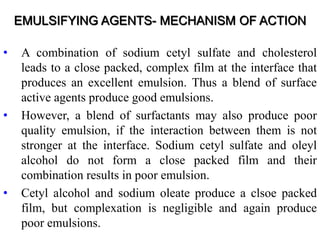
• The interaction within a mixture of emulsifying agents at
the interface and nature of film formed is depicted in
figure.
EMULSIFYING AGENTS- MECHANISM OF ACTION
OIL
Sodium Cetylsulfate
Cholesterol
OIL
Sodium Cetylsulfate
Oleyl alcohol
OIL
Cetyl alcohol
Sodium Oleate
Excellent Emulsion
Poor Emulsion – loose
packing
Poor Emulsion –
negligible complexation
EMULSIFYING AGENTS- MECHANISM OF ACTION
• A combination of sodium cetyl sulfate and cholesterol
leads to a close packed, complex film at the interface that
produces an excellent emulsion. Thus a blend of surface
active agents produce good emulsions.
• However, a blend of surfactants may also produce poor
quality emulsion, if the interaction between them is not
stronger at the interface. Sodium cetyl sulfate and oleyl
alcohol do not form a close packed film and their
combination results in poor emulsion.
• Cetyl alcohol and sodium oleate produce a clsoe packed
film, but complexation is negligible and again produce
poor emulsions.
2. Surfactants are capable of reducing the interfacial tension.
This facilitates the immediate formation of small droplets.
Furthermore, its importance can be understood by
considering the surface free energy changes during
emulsification.
• In equation, (Surface free energy) ΔG = γo/w. ΔA , ΔA is
increased due to formation of small globules. Usually, these
small globules tend to combine with each other and form
separate phases. But formation of smaller droplets is
important in the preparation of an emulsion. So, ΔA cannot
altered to get ΔG = 0.
• The only option is to reduce the interfacial tension, γo/w.
Surfactants achieve this objective and produce stable
emulsions. This factor is of secondary importance in
stabilization.
3. Ionic surfactants impart charges on interfacial films. These
films exert repulsive forces between two approaching
globules and prevent their coalescence.
• This mechanism is of importance. Nonionic surfactants
also produce good emulsions.
• In such cases, ions present in the aqueous phase often get
adsorbed onto the monomolecular film, thereby preventing
the coalescence of droplets.
Multimolecular adsorption:
• The emulsifying agents such as acacia and gelatin,
(isoelectric point)tend to form a multimolecular film
around the globules and prevents coalescence.
• They also reduce the interfacial tension moderately, though
it is of secondary importance. They are effective at high
concentration and promote the formation of o/w emulsion
owing to their hydrophilicity.
• They also have affinity towards the oil phase and this
facilitates interfacial adsorption. Normally, the stability is
improved by adding viscosity inducing agents such as
tragacanth, methyl cellulose, CMC etc.
Solid particle adsorption:
• The finely divided solid particles adsorb at the oil-water
interface and form a rigid film of closely packed solids.
This film acts as mechanical barrier and prevents the
coalescence of globules. These tend to produce coarse
emulsions.
• Powders that are wetted by water form O/W emulsions,
whereas those more easily wetted by oil form W/O
emulsions.
• The stability of an emulsion depends on the finer state of
solid particles, irregular surface and charge on the surface.
PHYSICAL INSTABILITY
• Emulsifying agents help to stabilize the emulsion. Inspite
of best efforts, emulsions tends to be unstable.
Flocculation:
• In this case, neighboring globules come closer to each
other and form colonies in the external phase.
• This aggregation of globules is not clearly visible. This is
probably the initial stage that leads to instability.
• The extent of flocculation of globules depends on
Globule size distribution
Charge on the globule surface
Viscosity of the external medium
• Uniform size globules prevents flocculation. This can be
achieved by proper size reduction process.
• A charge on the globules exert repulsive forces with the
neighboring globules. This can be achieved by using ionic

emulsifying agent, electrolytes etc.
• If the viscosity of external medium is increased, the globules
become relatively immobile and flocculation can be
prevented. This can be obtained by adding viscosity
improving agents such as hydrocolloids or waxes.
• Flocs slowly move either upwards or downward leading to
creaming. Flocculation should not be confused with
creaming.
• Flocculation is due to the interaction of attractive and
repulsive forces, whereas creaming is due to density
difference in the two phases.
Creaming :
• Creaming is the concentration of globules at the top or
bottom of the emulsion. The floccules move either upward
or downward leading to creaming.
• Creaming may also be observed on account of the
movement of individual globules. It can be observed by a

difference in color shade of the layers. It is a reversible
process, i.e cream can be redispersed easily by agitation.
• Creaming is also considered to be the mark of instability.
• In creaming, the drug is not uniformly distributed. This
leads to variable dosage. Therefore, the emulsion should be
shaken thoroughly before use.
29
• Creaming is of two types. Upward creaming, this is due

to the less denser internal phase. This is observed in o/w
emulsion. On the other hand, downward creaming is
also possible if the internal phase is heavier. Due to
gravitational pull, globules settle down. This is
normally the case in w/o emulsions.

• Since creaming process involves the movement of
globules in an emulsion, stokes’ law can be applied.
• Therefore, creaming is influenced by:
Globule size
Viscosity of the dispersion medium
Difference in the densities of dispersed phase and
dispersion medium
Creaming can be reduced /prevented by:
• Reducing the particle size by homogenization.
• Increasing the viscosity of the external phase by
adding the thickening agents such as tragacanth or
sodium alginate.
• Reducing the difference in the densities between the
dispersed phase and dispersion medium. In general,
the density of aqueous phase is higher than the oil
phase. To make densities equal, oil soluble
substances such as β- bromonaphthalene,
bromoform are added to the oil phase. This
technique is rarely used in practice.31
Coalescence :
• A few globules tend to fuse with each other and form
bigger globules. In this process, the emulsifier film
around the globules is destroyed to a certain extent.
• This step can be recognized by increased globule
size and reduced number of globules.
• Coalescence is followed by creaming stage.
• It is observed due to:
• Insufficient amount of the emulsifying agent
• Altered partitioning of the emulsifying agent
• Incompatibilities between emulsifying agents
32
• Phase volume ratio represents the relative volume of
water to oil in an emulsion.
• At higher ratio (>74% of oil to water), globules are
closely packed, wherein small globules occupy the
void spaces between bigger globules.
• Thus, globules get compressed and become irregular
in shape, which leads to fusion of adjacent globules.
33
Breaking:
• This is indicated by complete separation of oil and
aqueous phases.
• Creaming should be considered as separate from
breaking bcaz creaming is reversible process,
whereas breaking is an irreversible process.
• Cream floccules can be redispersed easily and a
uniform mixture is reconstituted by agitation bcaz the
oil globules are still surrounded by a protective
sheath of EA.
• When breaking occurs, simple mixing fails to
resuspend the globules into an uniform emulsion
bcaz the protective sheath around the globules is
completely destroyed. 34
Phase Inversion:
• This involves the change of emulsion type from o/w
to w/o or vice versa.
• When we intend to prepare one type of emulsion say
o/w and if the final emulsion turns out to be w/o, it
can be termed as a sign of instability.
• It may be brought about by the addition of an
electrolyte or by changing the phase volume ratio or
by temperature changes.
• Phase inversion can be minimized by using the
proper emulsifying agent in adequate concentration,
keeping the concentration of dispersed phase
between 30 to 60 % and by storing the emulsion in a
cool place. 35
FACTORS WHICH IMPROVE PHYSICAL STABILITY
• Theories related to the stability of emulsions are
same as those mentioned in suspensions.
A. Particle size:
• As the globule size is reduced, they tend to exhibit
Brownian movement.
• According to stoke’s law, the diameter of the globule
is considered as a major factor in creaming of
emulsions.
• The rate of creaming decreases four fold, when the
globule diameter is halved.
• It is necessary to choose the optimum globule size
for maximum stability. 36
FACTORS WHICH IMPROVE PHYSICAL STABILITY
• On the industrial scale, emulsions are passed
through a colloid mill in order to achieve size
reduction of globules.
B. Particle size distribution:
• In general, globules of uniform size impart maximum
stability.
• In such emulsions, globules pack loosely and globule
to globule contact is less. However, it is difficult to
achieve a monodisperse system due to a variety of
factors such as viscosity, phase volume ratio, density
of phases etc.
• Hence, an optimum degree of size dispersion range37
FACTORS WHICH IMPROVE PHYSICAL STABILITY
• If the size of globules are not uniform, globules of
smaller size occupy the spaces between the larger
globules. This type of closed packing induces greater
cohesion of globules which leads to coalescence.
C. Viscosity:
• As the viscosity increases, flocculation of globules
will be reduced because the mobility of globules is
restricted.
• Various thickening agents such as tragacanth,
veegum and cellulose derivatives are employed to
formulate emulsions for internal use.
• Long chain fatty acids and/or alcohols such as
beeswax, stearic acid, stearyl alcohol etc are used38
FACTORS WHICH IMPROVE PHYSICAL STABILITY
D. Phase volume ratio:
• In an emulsion the relative volume of water and oil is
expressed as phase volume ratio.
• In general, most medical emulsions are prepared
with a volume ratio of 50:50.
• The upper limit 74% of oil can be incorporated in an
emulsion, but this may lead to breaking of the
emulsion. This value is referred to as critical point of
phase volume ratio.
• This critical point is defined as the concentration of
internal phase above which the emulsifying agent
can not produce a stable emulsion of the desired39
FACTORS WHICH IMPROVE PHYSICAL STABILITY
• Beyond the critical point, the globules become
irregular in shape. The packing of globules is closest
leading to coalescence and defects in its morphology.
E. Charge of Electrical Double Layer:
• When ionic type of emulsifier is employed, the
electrical double layer possesses charge.
• The repulsive forces, due to like charge on the
globules, prevent the flocculation of globule.
• The charge on the electrical double layer also
depends on the pH of the preparation.
40
FACTORS WHICH IMPROVE PHYSICAL STABILITY
F. Physical properties of Interface:
• The interfacial film of the emulsifier is responsible for
enhancing the stability of the product.
• The film should be elastic enough to form rapidly as
soon as droplets are produced. This behavior
facilitates the production of emulsion.
• Similarly on moderate shaking, the emulsion should
be reconstituted. After manufacture, the film should
be tough so that coalescence of globules can be
prevented.
41
FACTORS WHICH IMPROVE PHYSICAL STABILITY
• Suitable emulsifying agents such as surfactants
should be selected to achieve the above film
properties at the interface.
• The physical properties of interface depends on the
pH of the preparation. Therefore, optimum pH has to
be maintained for maximum stability.
42
FACTORS WHICH IMPROVE PHYSICAL STABILITY
G. Densities of phases:
• It is not an usual practice to adjust the density of the
phases to the same value. Oil phase density can be
enhanced by adding brominated oil, when the oil is
an external phase.
H. Temperature fluctuations:
• Elevated temperatures alter the partition
characteristics of the emulsifiers and preservatives.
The net result is instability.
• Temperature also enhances the chemical
degradation of drugs and other ingredients.
• The chemical instability also leads to physical43
FACTORS WHICH IMPROVE PHYSICAL STABILITY
• At lower temperature, the aqueous phase may
contain ice crystals, which rupture the interfacial film
and break the emulsion.
• Care should be taken to prevent temperature
fluctuations during manufacture and storage.
I. Poor experimental techniques:
• These lead to incomplete emulsification. Hence, the
process conditions including the sequence of steps
should be followed during manufacture.
• Besides, factors mentioned above, it is also important
to prevent the growth of microorganisms.
44
Phase Inversion
• Phase inversion means a change of emulsion type
from o/w to w/o or vice versa. This technique is used
to prepare stable and fine emulsions.
• Phase inversion can be obtained by two ways.
(1) Changing the chemical nature of emulsifier:
• For instance, an o/w emulsion is prepared using
sodium stearate. Then calcium chloride is added to
form calcium stearate, which is oil soluble. Therefore,
oil phase becomes the continuous phase and w/o
emulsion is produced. Example is white liniment.
45
Phase Inversion
(2) Altering the phase volume ratio:
• In this method, emulsifier is mixed with an oil and
then a small amount of water is added. Since the
volume of water is small compared to the oil, w/o
emulsion will be formed.
• As more water is added slowly, the inversion point is
gradually reached and the water as well as emulsifier
envelop the oil to small globules yielding an o/w
emulsion.
• If the method is not properly controlled, Phase
inversion can give a bad emulsion, which can cause
considerable difficulty in manufacture.46
Evaluation of Physical stability of emulsions
• Emulsions are evaluated for their chemical and
physical stabilities.
(a) Chemical stability study involves the study of
degradation of active drugs, emulsifiers,
preservatives, anti-oxidants etc. Chemical instability
also leads to physical instability.
(b) Physical stability study indicates the retaining of the
integrity of the dosage form during shelf life. An
emulsion is considered to be physically stable, if it
can restore its initial properties on moderate shaking.
47
Evaluation of Physical stability of emulsions
1. Extent of phase separation:
• The practical and commercial aspects of stability is
the study of phase separation.
• This is quick method and can be applied for poorly
formed and rapidly breaking emulsions.
• Separation of phases is visible after a definite period
of time, though the sign of instability begin quite
early.
48
Evaluation of Physical stability of emulsions
2. Globule size distribution:
• An early sign of instability is indicated by the
appearance of bigger size globules. This is due to
aggregation and coalescence of small globules from
time to time, during storage.
• Therefore, microscopic examination of globule size
distribution analysis is an useful tool to evaluate the
physical stability.
49
Evaluation of Physical stability of emulsions
3. Accelerated stability studies- centrifugation
• Normally, flocculation and creaming are slow
processes. However, These processes can be
hastened by inducing stress conditions using
ultracentrifuge.
• The emulsions are subjected to different centrifugal
speeds at room temperature and the separation of
phases is observed at different time periods.
• A bad emulsion, normally, separates the oil instantly.
A good emulsion does not exhibit detectable
separation of oil phase, until certain time period, i.e.,
induction period. 50
Evaluation of Physical stability of emulsions
4. Microwave irradiation
The emulsion is exposed to microwave irradiation.
Then the surface temperature of the emulsion tends
to be highest and the temperature gradient between
the surface and the bottom of the emulsion must be
small for the most stable emulsion.
51
Preservation of emulsions
• It is important that an emulsion should be free from
microbial contamination and growth.
• Microorganisms, such as fungi, bacteria and yeast,
use some of the ingredients of the emulsion for their
growth. As a result, these ingredients gets digested
leading to instability of the product.
• In case of parenteral emulsions, sterility of the
product is essential.
• Preservatives, such as, benzoic acid, sodium
benzoate, methyl paraben and propyl paraben, are
employed in the preparation of emulsions for non
parenteral use. Adequate concentration of these52
Preservation of emulsions
Some of the factors to be considered for the selection
of preservatives are:
• Type of emulsion
• volume fraction of aqueous phase
• pH of aqueous phase
• Binding of ingredients in the formulation
• Degree of aeration
• Type of container
53
Preservation of emulsions
The optimum concentration of preservatives is
decided by considering the following features-
1. Aqueous phase: Bacteria are generally grown in the
aqueous phase, and at the oil-water interphase.
Therefore, the preservative should partition in favour
of the aqueous phase. Special care should be taken
on the use of preservative in o/w emulsions.
2. The volume fraction of the aqueous phase: The
higher the volume fraction of the aqueous phase, the
higher is the concentration of the preservatives
required. 54
Preservation of emulsions
3. pH of the aqueous phase: The preservative should
be in an undissociated form for its transport across
the membranes of the organism. The undissociated
form is effective as a bacteriostatic agent. The pH of
an aqueous phase should favour the formation of the
undissociated form.
55
Rheologic properties of Emulsions
• Emulsions are evaluated for its flow behavior.
• The following flow related attributes are desirable for
the overall performance of an emulsion:
(a) Removal of an emulsion from a bottle or tube.
(b) Flow of an emulsion through a hypodermic needle.
(c) Spreadibility of an emulsion on the skin.
(d) Stress induced flow changes during manufacture.
56
Rheologic properties of Emulsions
• In general, dilute emulsions exhibit Newtonian flow
and the comparison of flow curves among different
batches is easy.
• Analysis becomes complicated in case of
concentrated emulsions owing to their non-newtonian
flow.
• Multipoint viscometers such as cone and plate or cup
and bob type can be employed for evaluation.
• A rough guide regarding the type of flow can be
obtained based on phase volume ratio.
• An optimum level of viscosity is to be identified for
maximum physical stability.57
Preparation of emulsion
• Before attempting to prepare an emulsion, it is
necessary to select the important components, viz.,
oil phase, and emulsifying agent.
Selection of oil phase:
A variety of substance have been used for oil phase.
A few examples are :
Fixed oil (corn, soya bean, peanut, sunflower oils)
Aliphatic hydrocarbons (liquid paraffin, turpentine oil
etc.)
Beeswax, spermaceti
Glycerides (long and medium chain)
58
Preparation of emulsion
• Many of them are prone to oxidation. Therefore, it is
necessary to include suitable antioxidant in the
formulation.
• Selection of oil phase is determined by several
factors.
(a) Desired physical properties of the product.
(b) Potential toxicity of the oil to the route of
administration,
(c) solubility of active product in the oil.
(d) Consistency of the product qualities.
59
Preparation of emulsion
• Based on these factors, the optimum volume of oil
should be selected. Generally, it is advisable to
prepare an emulsion containing less than about 25%
of dispersed phase in oil-in-water emulsion.
• Conversely, products containing a high percentage
(more than about 70 %) of dispersed phase exhibit
phase inversion. The phase volume ratio is also
applicable to water when it is used as dispersed
phase.
60
Preparation of emulsion
Selection of Aqueous Phase:
Mostly water is used. Sometimes, the organoleptic
features of the emulsion demand the need of adding
sweeteners and flavoring agents. Sensitivity of skin
and nature of absorption determine the pH of
aqueous phase. In addition, electrolytes and
preservatives are included.
Based on the factors, optimum volume of aqueous
phase should be decided. Appropriate phase volume
ratio should be selected.
61
Preparation of emulsion
Selection of an Emulsifying Agent:
• An emulsifying agent is selected depending on the
type of emulsion required.
• Selection of emulsifying agent is based on the
intended use. For internal use, non-ionic and water-
soluble emulsifying agents are chosen. For external
use, both ionic and non-ionic emulsifying agents are
employed.
• Another guiding principle is the Bancroft rule, which
suggest the nature of the emulsifying agent for each
emulsion.
• Furthermore, the principles of HLB scale can be62
Preparation of emulsion
• The required HLB value can be determined using
allegation method based on the nature of oil phase
and type of emulsion.
• It is essential to prepare a series of samples to study
the stability. Then optimum concentration of an
emulsifying agent should be obtained.
• It is better to avoid emulsifying agents obtained from
natural origin, because they show considerable batch
to batch variation. In addition, they also support the
microbial growth.
63
Preparation of emulsion
• Wet Gum Method
• Dry Gum Method
• Small and large scale production
64
Emulsion - Physical Pharmacy