By : Mala Pidiyanti.
R&I Dept., CV LIDAH BUAYA
Januari 2014
FORMULATING WITH HLB
VALUE CALCULATION
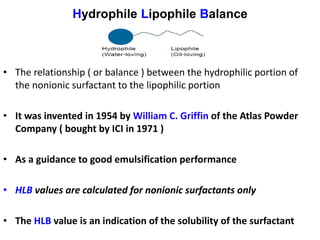
Hydrophile Lipophile Balance
• The relationship ( or balance ) between the hydrophilic portion of
the nonionic surfactant to the lipophilic portion
• It was invented in 1954 by William C. Griffin of the Atlas Powder
Company ( bought by ICI in 1971 )
• As a guidance to good emulsification performance
• HLB values are calculated for nonionic surfactants only
• The HLB value is an indication of the solubility of the surfactant
The chemistry of a nonionic surfactant ?
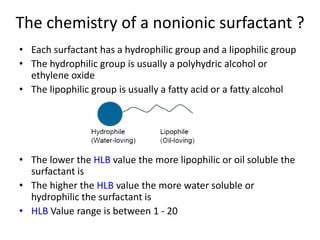
• Each surfactant has a hydrophilic group and a lipophilic group
• The hydrophilic group is usually a polyhydric alcohol or
ethylene oxide
• The lipophilic group is usually a fatty acid or a fatty alcohol
• The lower the HLB value the more lipophilic or oil soluble the
surfactant is
• The higher the HLB value the more water soluble or
hydrophilic the surfactant is
• HLB Value range is between 1 - 20
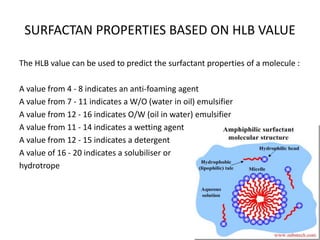
SURFACTAN PROPERTIES BASED ON HLB VALUE
The HLB value can be used to predict the surfactant properties of a molecule :
A value from 4 - 8 indicates an anti-foaming agent
A value from 7 - 11 indicates a W/O (water in oil) emulsifier
A value from 12 - 16 indicates O/W (oil in water) emulsifier
A value from 11 - 14 indicates a wetting agent
A value from 12 - 15 indicates a detergent
A value of 16 - 20 indicates a solubiliser or
hydrotrope
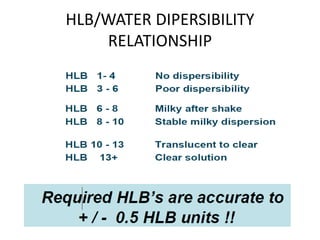
HLB/WATER DIPERSIBILITY
RELATIONSHIP
Calculating “HLB VALUE” with Grifin’s Methods
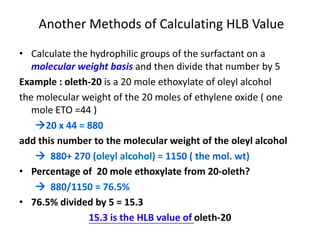
Another Methods of Calculating HLB Value
• Calculate the hydrophilic groups of the surfactant on a
molecular weight basis and then divide that number by 5
Example : oleth-20 is a 20 mole ethoxylate of oleyl alcohol
the molecular weight of the 20 moles of ethylene oxide ( one
mole ETO =44 )
20 x 44 = 880
add this number to the molecular weight of the oleyl alcohol
 880+ 270 (oleyl alcohol) = 1150 ( the mol. wt)
• Percentage of 20 mole ethoxylate from 20-oleth?
 880/1150 = 76.5%
• 76.5% divided by 5 = 15.3
15.3 is the HLB value of oleth-20
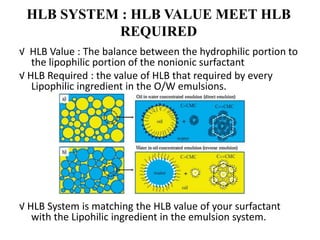
HLB SYSTEM : HLB VALUE MEET HLB
REQUIRED
√ HLB Value : The balance between the hydrophilic portion to
the lipophilic portion of the nonionic surfactant
√ HLB Required : the value of HLB that required by every
Lipophilic ingredient in the O/W emulsions.
√ HLB System is matching the HLB value of your surfactant
with the Lipohilic ingredient in the emulsion system.
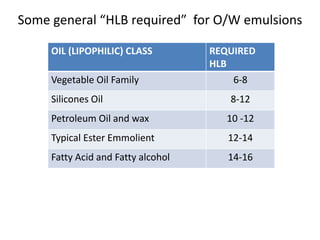
Some general “HLB required” for O/W emulsions
OIL (LIPOPHILIC) CLASS REQUIRED
HLB
Vegetable Oil Family 6-8
Silicones Oil 8-12
Petroleum Oil and wax 10 -12
Typical Ester Emmolient 12-14
Fatty Acid and Fatty alcohol 14-16
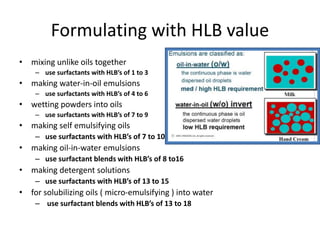
Formulating with HLB value
• mixing unlike oils together
– use surfactants with HLB’s of 1 to 3
• making water-in-oil emulsions
– use surfactants with HLB’s of 4 to 6
• wetting powders into oils
– use surfactants with HLB’s of 7 to 9
• making self emulsifying oils
– use surfactants with HLB’s of 7 to 10
• making oil-in-water emulsions
– use surfactant blends with HLB’s of 8 to16
• making detergent solutions
– use surfactants with HLB’s of 13 to 15
• for solubilizing oils ( micro-emulsifying ) into water
– use surfactant blends with HLB’s of 13 to 18
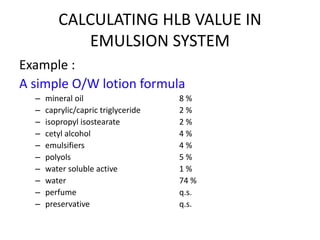
CALCULATING HLB VALUE IN
EMULSION SYSTEM
Example :
A simple O/W lotion formula
– mineral oil 8 %
– caprylic/capric triglyceride 2 %
– isopropyl isostearate 2 %
– cetyl alcohol 4 %
– emulsifiers 4 %
– polyols 5 %
– water soluble active 1 %
– water 74 %
– perfume q.s.
– preservative q.s.
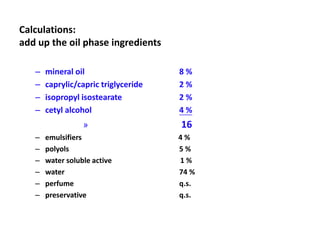
Calculations:
add up the oil phase ingredients
– mineral oil 8 %
– caprylic/capric triglyceride 2 %
– isopropyl isostearate 2 %
– cetyl alcohol 4 %
» 16
– emulsifiers 4 %
– polyols 5 %
– water soluble active 1 %
– water 74 %
– perfume q.s.
– preservative q.s.
Calculations:
divide each by the total to get the contribution
to the oil phase
• Mineral oil 8 / 16 = 50%
• caprylic/cap. trig. 2 / 16 = 12.5%
• isopropyl isostearate 2 / 16 = 12.5%
• cetyl alcohol 4 / 16 = 25%
CONCLUSIONS :
• One you know the required HLB of individual oils it is easy to
mathematically calculate the required HLB of a mixture of oils
• knowing the required HLB of an oil or an oil mixture means that
you can use the least amount of surfactant to achieve
emulsification
• Surfactant choice considerations:
1. Chemical type
– ester VS ether
– lipophilic group, e.g. lauryl VS stearyl
2. Physical form
– liquid VS solid VS beads
3. FDA “status” ( if any )
– is there an N. F. monograph
4. Price VS function
5. Blend VS single surfactant
6. Efficiency of the surfactant
Surfactant choice considerations:
1. Philip Haw, 2005, “THE HLB SYSTEM, A TIME
SAVING GUIDE TO SURFACTANT SELECTION’,
UNIQEMA
2. Bonnie Pyzowski, Mani Dhamdhere, “Rapid
HLB-Based Method for Formulating and
Improving Emulsion Stability”,
www.angus.com

Determining HLB Value

  • 1.
    By : MalaPidiyanti. R&I Dept., CV LIDAH BUAYA Januari 2014 FORMULATING WITH HLB VALUE CALCULATION
  • 2.
    Hydrophile Lipophile Balance •The relationship ( or balance ) between the hydrophilic portion of the nonionic surfactant to the lipophilic portion • It was invented in 1954 by William C. Griffin of the Atlas Powder Company ( bought by ICI in 1971 ) • As a guidance to good emulsification performance • HLB values are calculated for nonionic surfactants only • The HLB value is an indication of the solubility of the surfactant
  • 3.
    The chemistry ofa nonionic surfactant ? • Each surfactant has a hydrophilic group and a lipophilic group • The hydrophilic group is usually a polyhydric alcohol or ethylene oxide • The lipophilic group is usually a fatty acid or a fatty alcohol • The lower the HLB value the more lipophilic or oil soluble the surfactant is • The higher the HLB value the more water soluble or hydrophilic the surfactant is • HLB Value range is between 1 - 20
  • 4.
    SURFACTAN PROPERTIES BASEDON HLB VALUE The HLB value can be used to predict the surfactant properties of a molecule : A value from 4 - 8 indicates an anti-foaming agent A value from 7 - 11 indicates a W/O (water in oil) emulsifier A value from 12 - 16 indicates O/W (oil in water) emulsifier A value from 11 - 14 indicates a wetting agent A value from 12 - 15 indicates a detergent A value of 16 - 20 indicates a solubiliser or hydrotrope
  • 5.
  • 6.
    Calculating “HLB VALUE”with Grifin’s Methods
  • 7.
    Another Methods ofCalculating HLB Value • Calculate the hydrophilic groups of the surfactant on a molecular weight basis and then divide that number by 5 Example : oleth-20 is a 20 mole ethoxylate of oleyl alcohol the molecular weight of the 20 moles of ethylene oxide ( one mole ETO =44 ) 20 x 44 = 880 add this number to the molecular weight of the oleyl alcohol  880+ 270 (oleyl alcohol) = 1150 ( the mol. wt) • Percentage of 20 mole ethoxylate from 20-oleth?  880/1150 = 76.5% • 76.5% divided by 5 = 15.3 15.3 is the HLB value of oleth-20
  • 8.
    HLB SYSTEM :HLB VALUE MEET HLB REQUIRED √ HLB Value : The balance between the hydrophilic portion to the lipophilic portion of the nonionic surfactant √ HLB Required : the value of HLB that required by every Lipophilic ingredient in the O/W emulsions. √ HLB System is matching the HLB value of your surfactant with the Lipohilic ingredient in the emulsion system.
  • 9.
    Some general “HLBrequired” for O/W emulsions OIL (LIPOPHILIC) CLASS REQUIRED HLB Vegetable Oil Family 6-8 Silicones Oil 8-12 Petroleum Oil and wax 10 -12 Typical Ester Emmolient 12-14 Fatty Acid and Fatty alcohol 14-16
  • 10.
    Formulating with HLBvalue • mixing unlike oils together – use surfactants with HLB’s of 1 to 3 • making water-in-oil emulsions – use surfactants with HLB’s of 4 to 6 • wetting powders into oils – use surfactants with HLB’s of 7 to 9 • making self emulsifying oils – use surfactants with HLB’s of 7 to 10 • making oil-in-water emulsions – use surfactant blends with HLB’s of 8 to16 • making detergent solutions – use surfactants with HLB’s of 13 to 15 • for solubilizing oils ( micro-emulsifying ) into water – use surfactant blends with HLB’s of 13 to 18
  • 11.
    CALCULATING HLB VALUEIN EMULSION SYSTEM Example : A simple O/W lotion formula – mineral oil 8 % – caprylic/capric triglyceride 2 % – isopropyl isostearate 2 % – cetyl alcohol 4 % – emulsifiers 4 % – polyols 5 % – water soluble active 1 % – water 74 % – perfume q.s. – preservative q.s.
  • 12.
    Calculations: add up theoil phase ingredients – mineral oil 8 % – caprylic/capric triglyceride 2 % – isopropyl isostearate 2 % – cetyl alcohol 4 % » 16 – emulsifiers 4 % – polyols 5 % – water soluble active 1 % – water 74 % – perfume q.s. – preservative q.s.
  • 13.
    Calculations: divide each bythe total to get the contribution to the oil phase • Mineral oil 8 / 16 = 50% • caprylic/cap. trig. 2 / 16 = 12.5% • isopropyl isostearate 2 / 16 = 12.5% • cetyl alcohol 4 / 16 = 25%
  • 14.
    CONCLUSIONS : • Oneyou know the required HLB of individual oils it is easy to mathematically calculate the required HLB of a mixture of oils • knowing the required HLB of an oil or an oil mixture means that you can use the least amount of surfactant to achieve emulsification • Surfactant choice considerations: 1. Chemical type – ester VS ether – lipophilic group, e.g. lauryl VS stearyl 2. Physical form – liquid VS solid VS beads 3. FDA “status” ( if any ) – is there an N. F. monograph 4. Price VS function 5. Blend VS single surfactant 6. Efficiency of the surfactant
  • 15.
  • 17.
    1. Philip Haw,2005, “THE HLB SYSTEM, A TIME SAVING GUIDE TO SURFACTANT SELECTION’, UNIQEMA 2. Bonnie Pyzowski, Mani Dhamdhere, “Rapid HLB-Based Method for Formulating and Improving Emulsion Stability”, www.angus.com