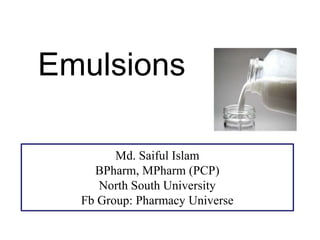
Emulsions
Md. Saiful Islam
BPharm, MPharm (PCP)
North South University
Fb Group: Pharmacy Universe
Emulsion
• Emulsion is a preparation consisting of two immiscible
liquids, usually water and oil, one of which is dispersed
as small globules in the other
• A third component, the emulsifying agent, is used to
make the dispersion stable
• In the absence of the emulsifying agent the globules
undergo coalescence to form two separate layers of
water and oil
Emulsion
Purpose of preparing emulsion or of emulsification
• To prepare a relatively stable and homogeneous mixture
of two immiscible liquids
• It permits administration of a liquid drug in the form of
minute globules rather than in bulk
• For orally administered emulsion, the o/w type permits
palatable administration of a distasteful oil by dispersing
in a sweetened, flavoured aqueous vehicle
• The reduced particle size of the oil globule permits the oil
more digestible and more readily absorbed
Distribution of formulation ingredients
between the phases of emulsion
The aqueous phase:
It contains- water soluble drugs
- preservatives
- coloring agent
- flavouring agent
It is desirable to use distilled or deionized water, since
Ca++ and Mg++ ions found in hard water may have
adverse effect on the stability of some emulsions
Distribution of formulation ingredients
between the phases of emulsion
The oil phase:
It consists of – fixed or volatile oils
- drugs that exist as oils, such as oil-soluble
vitamins and antiseptics
*** In order to keep the oil phase free from autoxidation and
consequent rancidity, an anti-oxidant and anti-microbial
agent must be used
Types of emulsion
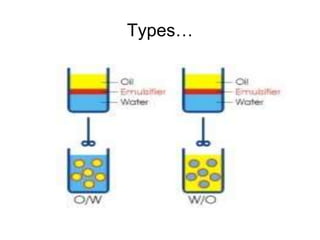
Two types:
1. Oil-in-water or o/w emulsion: In which oil is dispersed
as globules in water
2. Water-in-oil or w/o emulsion: In which water is
dispersed as globules in oil
*** In o/w emulsion, oil is referred to as the “internal phase”
and water is referred to as the “external phase”
In w/o emulsion, water is referred to as the “internal
phase” and oil is referred to as the “external phase”
Types…
Uses of emulsions
Based on the use, emulsions are divided into two
groups:
1) Emulsions for internal use: Applied orally or by IV
injection
2) Emulsions for external use: Applied to the skin or the
mucous membranes
Orally administered emulsions
Properties:
• Oil-in-water type
• The medicinal oil enveloped in a film of emulsifying
agent aids in masking the disagreeable taste and the
oily sensation which makes a palatable drug
• Flavouring agent is added to the external aqueous phase
Considerations for selecting masking
agents for oral emulsions
• The distribution of drugs and flavours between the oil
and the water phases is an important consideration in
masking unpleasant taste.
• According to distribution principle, a substance will be
found in both phases of an emulsion but will concentrate
predominantly in the phase in which it is more soluble
Considerations for selecting masking
agents for oral emulsions
• The attempt to mask the distasteful drug by oil-in-water
emulsification will be defeated –
- if the drug possesses some water solubility and passes
partially into the external phase and
- if the flavour and the masking agent are predominantly
oil soluble and concentrate primarily in the internal phase
What will be the size of emulsion
globules?
• For better absorption of fats through the intestinal wall,
the emulsified fat globules should be kept less than 1μ in
diameter
• The most efficient absorption is attained for the globules
having the diameter about 0.5μ
Considerations for preparing IV
injections of emulsions
• The choice of emulsifying agent, the size and the
uniformity of globules are critical in the preparation for IV
use
• Sterile emulsifying agents are used and they are tested
for any untoward physiological effect.
• Initially coarse emulsions are prepared, then
homogenized, collected and sealed in sterile flask and
autoclaved
• Finally the product is tested for sterility and globule size
Considerations for preparing
emulsions for external use
Emulsion to be applied to the skin may be of both o/w and
w/o type. Factors considered before preparations are:
• Nature of the therapeutic agent
• The condition of the skin
***For the unbroken skin, a w/o emulsion can usually be
applied more evenly.
*** The medicinal agent causing skin irritation is better to
prepare as o/w type
Considerations for preparing
emulsions for external use
• The desirability of an emollient or tissue softening effect
*** The w/o emulsion is more softening to the skin, because
it resist drying and removal of the preparation by contact
with water
• If the easy removal from the skin with water is desired,
an o/w emulsion is preferred
• For getting better percutaneous absorption, particle size
of the internal phase should be critically controlled
Which type is suitable for better
percutaneous absorption?
• If the drug is water soluble, better percutaneous
absorption is obtained from the o/w type preparation
•
• And if the drug is oil soluble, better percutaneous
absorption is obtained from the w/o type preparation

(Emulsion)

  • 1.
    Emulsions Md. Saiful Islam BPharm,MPharm (PCP) North South University Fb Group: Pharmacy Universe
  • 2.
    Emulsion • Emulsion isa preparation consisting of two immiscible liquids, usually water and oil, one of which is dispersed as small globules in the other • A third component, the emulsifying agent, is used to make the dispersion stable • In the absence of the emulsifying agent the globules undergo coalescence to form two separate layers of water and oil
  • 3.
  • 4.
    Purpose of preparingemulsion or of emulsification • To prepare a relatively stable and homogeneous mixture of two immiscible liquids • It permits administration of a liquid drug in the form of minute globules rather than in bulk • For orally administered emulsion, the o/w type permits palatable administration of a distasteful oil by dispersing in a sweetened, flavoured aqueous vehicle • The reduced particle size of the oil globule permits the oil more digestible and more readily absorbed
  • 5.
    Distribution of formulationingredients between the phases of emulsion The aqueous phase: It contains- water soluble drugs - preservatives - coloring agent - flavouring agent It is desirable to use distilled or deionized water, since Ca++ and Mg++ ions found in hard water may have adverse effect on the stability of some emulsions
  • 6.
    Distribution of formulationingredients between the phases of emulsion The oil phase: It consists of – fixed or volatile oils - drugs that exist as oils, such as oil-soluble vitamins and antiseptics *** In order to keep the oil phase free from autoxidation and consequent rancidity, an anti-oxidant and anti-microbial agent must be used
  • 7.
    Types of emulsion Twotypes: 1. Oil-in-water or o/w emulsion: In which oil is dispersed as globules in water 2. Water-in-oil or w/o emulsion: In which water is dispersed as globules in oil *** In o/w emulsion, oil is referred to as the “internal phase” and water is referred to as the “external phase” In w/o emulsion, water is referred to as the “internal phase” and oil is referred to as the “external phase”
  • 8.
  • 9.
    Uses of emulsions Basedon the use, emulsions are divided into two groups: 1) Emulsions for internal use: Applied orally or by IV injection 2) Emulsions for external use: Applied to the skin or the mucous membranes
  • 10.
    Orally administered emulsions Properties: •Oil-in-water type • The medicinal oil enveloped in a film of emulsifying agent aids in masking the disagreeable taste and the oily sensation which makes a palatable drug • Flavouring agent is added to the external aqueous phase
  • 11.
    Considerations for selectingmasking agents for oral emulsions • The distribution of drugs and flavours between the oil and the water phases is an important consideration in masking unpleasant taste. • According to distribution principle, a substance will be found in both phases of an emulsion but will concentrate predominantly in the phase in which it is more soluble
  • 12.
    Considerations for selectingmasking agents for oral emulsions • The attempt to mask the distasteful drug by oil-in-water emulsification will be defeated – - if the drug possesses some water solubility and passes partially into the external phase and - if the flavour and the masking agent are predominantly oil soluble and concentrate primarily in the internal phase
  • 13.
    What will bethe size of emulsion globules? • For better absorption of fats through the intestinal wall, the emulsified fat globules should be kept less than 1μ in diameter • The most efficient absorption is attained for the globules having the diameter about 0.5μ
  • 14.
    Considerations for preparingIV injections of emulsions • The choice of emulsifying agent, the size and the uniformity of globules are critical in the preparation for IV use • Sterile emulsifying agents are used and they are tested for any untoward physiological effect. • Initially coarse emulsions are prepared, then homogenized, collected and sealed in sterile flask and autoclaved • Finally the product is tested for sterility and globule size
  • 15.
    Considerations for preparing emulsionsfor external use Emulsion to be applied to the skin may be of both o/w and w/o type. Factors considered before preparations are: • Nature of the therapeutic agent • The condition of the skin ***For the unbroken skin, a w/o emulsion can usually be applied more evenly. *** The medicinal agent causing skin irritation is better to prepare as o/w type
  • 16.
    Considerations for preparing emulsionsfor external use • The desirability of an emollient or tissue softening effect *** The w/o emulsion is more softening to the skin, because it resist drying and removal of the preparation by contact with water • If the easy removal from the skin with water is desired, an o/w emulsion is preferred • For getting better percutaneous absorption, particle size of the internal phase should be critically controlled
  • 17.
    Which type issuitable for better percutaneous absorption? • If the drug is water soluble, better percutaneous absorption is obtained from the o/w type preparation • • And if the drug is oil soluble, better percutaneous absorption is obtained from the w/o type preparation