Emulsion
Emulsion
Emulsion
An emulsion is a dispersion in which the dispersed
phase is composed of small globules
small globules of a liquid
distributed throughout a vehicle in which it is
immiscible.
The dispersed phase; is referred to as the internal
phase.
 The dispersion medium as the continuous or external
phase.
To prepare a stable emulsion, a third phase is necessary
that being an emulsifying agent.
Types of Emulsion
Types of Emulsion
1- Oil in water emulsion;
Emulsions having an oleaginous internal phase and an aqueous external
phase are referred to as oil in water emulsions, and are commonly
designated as "o/w" emulsions.
2- Water in oil emulsion;
Emulsions having an aqueous internal phase and an oleaginous external
phase are termed water in oil emulsions and are referred to
as"w/o"emulsions.
 Dilution of emulsions:
 an oil in water emulsion
‑ ‑ may be diluted with water or an
aqueous preparation,
 water in oil emulsion
‑ ‑ may be diluted with an oleaginous or oil
miscible liquid
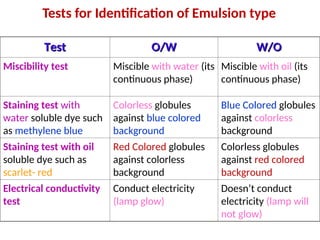
How to differentiate between O/W and W/O emulsion
1) Miscibility test
2) Staining test
3) Conductivity test
Tests for Identification of Emulsion type
Test
Test O/W
O/W W/O
W/O
Miscibility test Miscible with water (its
continuous phase)
Miscible with oil (its
continuous phase)
Staining test with
water soluble dye such
as methylene blue
Colorless globules
against blue colored
background
Blue Colored globules
against colorless
background
Staining test with oil
soluble dye such as
scarlet- red
Red Colored globules
against colorless
background
Colorless globules
against red colored
background
Electrical conductivity
test
Conduct electricity
(lamp glow)
Doesn’t conduct
electricity (lamp will
not glow)
Purpose of Emulsions
A- Pharmaceutical purpose:,
I. Preparation of relatively stable and homogeneous mixtures of
two immiscible liquids.
II. The administration of a liquid drug in the form of minute
globules rather than in bulk.
III.It permits the palatable administration of unpleasant oil by
dispersing it in a sweetened, flavoured aqueous vehicle in which
it may be carried past the taste buds and into the stomach.
IV. The reduced particle size of the oil globules may render the oil
more digestible and more readily absorbed, for example the
increased efficacy of mineral oil as a cathartic when in the
emulsified form.
B- Therapeutical purpose:
 Emulsions may be prepared as o/w or w/o emulsions,
depending on the nature of the therapeutic agents:
I. Medicinal agents that are irritating to the skin generally are less irritating if
present in the internal phase of an emulsified topical preparation than in the
external phase from which direct contact with the skin is more prevalent.
II. On the unbroken skin a water in oil emulsion can usually be applied because
the skin is covered with a thin film of sebum, and this surface is more readily
wetted by oil than by water.
III. A water in oil
‑ ‑ emulsion is also more softening to the skin, because it resists
drying out and is resistant to removal by contact with water.
IV. If it is desirable to have a preparation that is more easily removed from the skin
with water, an oil in water
‑ ‑ emulsion would be preferred.
V. Absorption through the skin (percutaneous absorption) may be enhanced by
the diminished particle size of the internal phase.
Emulsifying Agents
Emulsifying Agents
The initial step in preparation of emulsion is the selection of the
emulsifier.
Characters of ideal emulsifying agents:-
1- It must be compatible with the other formulative ingredients.
2-
2- It must not interfere with the stability or efficacy of the
therapeutic agent.
3- It should be stable in the preparation.
4- It should be nontoxic with respect to its intended use.
5- It should possess little odour, taste, or color.
6- The capability of the emulsifying agent to promote emulsification
7- It should maintain the stability of the emulsion for the intended
shelf life.
The types of emulsifiers used in pharmaceutical systems
are the following
are the following
1. Carbohydrate materials such as the naturally occurring agents
acacia, taragacanth, agar, and pectin. These materials form
hydrophilic colloids when added to water and generally produce
produce
o/w emulsions
o/w emulsions.
2. Protein substances such as gelatin, egg yolk, and casein. These
substances produce
produce o/w
o/w emulsions
emulsions.
3. High molecular weight alcohols such as stearyl alcohol, cetyl
alcohol, and glyceryl monostearate. It is used as thickening agents
and stabilizers for o/w emulsions of certain lotions and ointments.
Cholesterol and cholesterol derivatives may used in emulsions and
promote w/o emulsions.
4. Wetting agents, which may be anionic, cationic, or non-ionic.
These agents contain both hydrophilic and lipophilic groups
both hydrophilic and lipophilic groups.
 Anionic emulsifiers include various monovalent, polyvalent, and
organic soaps such as triethanolamine oleate
and sulfonates such as sodium lauryl sulfate.
 Cationic emulsifiers e.g. Benzalkonium chloride.
 Non-ionic emulsifiers include the sorbitan esters and the
polyoxyethylene derivatives (Span and Tween).
5. Finely divided solids such as colloidal clays including bentonite,
magnesium hydroxide, and aluminium hydroxide.
These generally form o/w emulsions
except bentonite is capable of forming a w/o emulsion
HLB System
HLB System
 The emulsifying agent has a hydrophilic portion and a lipophilic
portion so it considered on the basis of their hydrophile-lipophile
balance or "HLB."
 By this method, each agent is assigned an HLB value or number which
is indicative of the substance's polarity.
 The usual range of HLB is between 1 and 20.
 Materials that are highly polar or hydrophilic have been assigned
higher numbers than materials that are less polar and more
lipophilic.
 The surface-active agents having an assigned HLB value of from 3 to 6
are greatly lipophilic and produce water in oil emulsions
‑ ‑ ,
 The agents have HLB values from about 8 to 18 produce oil in-water
‑
emulsions.
Activity and HLB Value of Surfactants
Activity Assigned HLB
• Antifoaming 1 to 3
• Emulsifiers (w/o) 3 to 6
• Wetting agents 7 to 9
• Emulsifiers (o/w) 8 to 18
• Solubilizers 15 to 20
• Detergents 13 to 15
Microemulsion
Definition
Definition
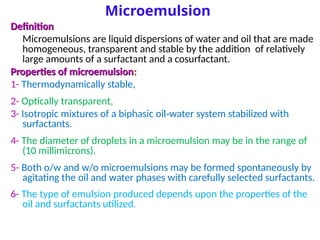
Microemulsions are liquid dispersions of water and oil that are made
homogeneous, transparent and stable by the addition of relatively
large amounts of a surfactant and a cosurfactant.
Properties of microemulsion
Properties of microemulsion:
:
1- Thermodynamically stable,
2- Optically transparent,
3- Isotropic mixtures of a biphasic oil water system stabilized with
‑
surfactants.
4- The diameter of droplets in a microemulsion may be in the range of
(10 millimicrons).
5- Both o/w and w/o microemulsions may be formed spontaneously by
agitating the oil and water phases with carefully selected surfactants.
6- The type of emulsion produced depends upon the properties of the
oil and surfactants utilized.
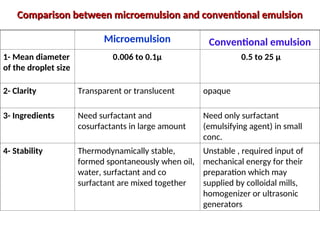
Microemulsion Conventional emulsion
1- Mean diameter
of the droplet size
0.006 to 0.1µ 0.5 to 25 µ
2- Clarity Transparent or translucent opaque
3- Ingredients Need surfactant and
cosurfactants in large amount
Need only surfactant
(emulsifying agent) in small
conc.
4- Stability Thermodynamically stable,
formed spontaneously when oil,
water, surfactant and co
surfactant are mixed together
Unstable , required input of
mechanical energy for their
preparation which may
supplied by colloidal mills,
homogenizer or ultrasonic
generators
Comparison between microemulsion and conventional emulsion
Pharmaceutical application of microemulsion
Hydrophilic surfactants may be used to produce "transparent" o/w
emulsions of many oils, including flavour oils and vitamin oils such as A,
D, and E.
Surfactants in the HLB range of 15 to 18 have been used most extensively
in the preparation of such emulsions. These emulsions are dispersions of
oil, not true solutions; however, because of the appearance of the
product, the surfactant is common] said to "solubilize" the oil.
Surfactants common used in the preparation of such oral liquid
formulations are polysorpate 60 and polysorpate 80.
The advantages cited for the use of microemulsions in drug delivery are:
more rapid and efficient oral absorption of drugs than through solid
dosage forms; enhanced transdermal drug delivery through increased
drug diffusion into the skin;
O/W microemulsions are being formulated as aqueous vehicles for oil
soluble drugs to be administered by the percutaneous, oral or parenteral
route.
Stability of Emulsions
The emulsion is considered to be physically unstable if:
a) the internal or dispersed phase upon standing tends to form
aggregates of globules.
b) Large globules or aggregates of globules rise to the top or fall to the
bottom of the emulsion to form a concentrated layer of the internal
phase.
c) If all or part of the liquid of the internal phase becomes "unemulsified"
and forms a distinct layer on the top or bottom of the emulsion as a
result of the coalescing
d) In addition
In addition, an emulsion may be adversely affected by microbial
contamination and growth and by other chemical and physical
alterations.
To increase the stability of an emulsion:
1- The globule or particle size should be reduced as fine as is
practically possible.
2- The density difference between the internal and external phases
should be minimal.
3- The viscosity of the external phase should be reasonably high
thickeners such as taragacanth and microcrystalline cellulose
are frequently added to emulsions to increase the viscosity of
the external phase.
 Upward creaming takes place in unstable emulsions of the o/w or w/o
type in which the internal phase has a lesser density than the external
phase.
 Downward creaming takes place in unstable emulsions in which the
opposite is true.
Aggregation and Coalescence
Creaming:
 Aggregates of globules of the internal phase have a greater tendency
than do individual particles to rise to the top of the emulsion or fall to
the bottom.
 Such a preparation of the globules is termed the "creaming" of the
emulsion, and provided coalescence is absent, it is a reversible process.
 The term is taken from the dairy industry and is analogous to the
creaming or the rising to the top of cream in milk that is allowed to
stand.
 The creamed portion of an emulsion may be redistributed rather
homogeneously upon shaking, but if the aggregates are difficult to
disassemble or if insufficient shaking is employed before each dose,
improper dosage of the internal phase substance may result.
 Further, the creaming of a pharmaceutical emulsion is not acceptable to
the pharmacist nor appealing to the consumer. More importantly, it
increases the risk of the coalescing of the globules
Breaking or cracking:
 Of greater destruction to an emulsion than creaming is the coalescence of
the globules of the internal phase and the separation of that phase into a
layer.
 The separation of the internal phase from the emulsion is called the
"breaking" of the emulsion, and the emulsion is described as being"
cracke& or "broken.‘
 This is irreversible, because the protective sheath about the globules of
the internal phase no longer exists.
 Attempts to re-establish the emulsion by agitation of the two separate
layers are generally unsuccessful.
 Additional emulsifying agent and reprocessing through appropriate
machinery are usually necessary to reproduce an emulsion.
Stability study of emulsion
 --- Care must be taken to protect emulsions against the extremes of
cold and heat.
 ----Freezing and thawing result in the coarsening of an emulsion and
sometimes in its breaking.
 ---Excessive heat has the same effect. Because emulsion products
may be transported to and used in various geographic locations having
varying climates and conditions of extremely high and low
temperature,. pharmaceutical manufacturers must have
predetermined knowledge of their emulsion stability before they may
be shipped
 ----For most emulsions, the industry performs tests of evaluation
under experimental conditions of 5' C, 40' C, and 50' C to determine
the product's stability.
 --- Stability at both 5' C and 40' C for 3 months is considered the
minimal stability that an emulsion should possess. Shorter exposure
periods at 50' C may be used as an alternate test.
The environmental conditions such as the presence of light, air, and
contaminating microorganisms can adversely affect the stability of
an emulsion.
 appropriate formulative and packaging steps are usually taken to
minimize such possible hazards to product stability:
1- For light sensitive
‑ emulsions, light resistant containers are used
‑ .
2- For emulsions susceptible to oxidative decomposition, antioxidants
may be included in the formulation and adequate label warning
provided to ensure that the container is tightly closed to air after each
use.
3- Many molds, yeasts, and bacteria can bring about the decomposition
of the emulsifying agent of an emulsion, thereby causing the
disruption of the system.
Preservatives are generally included in the aqueous phase of an o/w
emulsion. Combinations of methylparaben and propylparaben are
frequently employed to serve the function. And also Alcohol in the
amount of 12 to 15%.
Disperse systems
type diameter
Miceller solution 0.0025 – 0.006 um
Microemulsions 0.006 – 0.1 um
Emulsion 0.5 – 25 um
Microemulsion formations
Compound Function Content %
o/w w/o
SLS surfactant 13 10
1-pentanol cosurfactant 8 25
xylene oil 8 50
water 71 15
Examples of Emulsions
1-
1- Mineral Oil Emulsion
Mineral Oil Emulsion
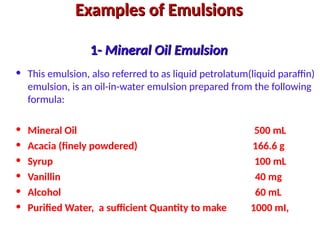
• This emulsion, also referred to as liquid petrolatum(liquid paraffin)
emulsion, is an oil-in-water emulsion prepared from the following
formula:
• Mineral Oil 500 mL
• Acacia (finely powdered) 166.6 g
• Syrup 100 mL
• Vanillin 40 mg
• Alcohol 60 mL
• Purified Water, a sufficient Quantity to make 1000 mI,
The emulsion is prepared by dry gum method as the
following
following
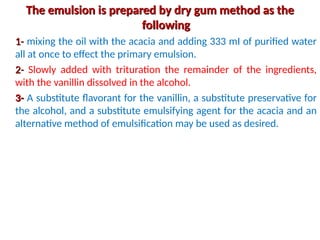
1-
1- mixing the oil with the acacia and adding 333 mI of purified water
all at once to effect the primary emulsion.
2-
2- Slowly added with trituration the remainder of the ingredients,
with the vanillin dissolved in the alcohol.
3-
3- A substitute flavorant for the vanillin, a substitute preservative for
the alcohol, and a substitute emulsifying agent for the acacia and an
alternative method of emulsification may be used as desired.
2- Castor Oil Emulsion
The application:
1- a laxative, for isolated bouts of constipation.
2- preparation of the colon for x ray and encloscopic examination.
‑
Mechanism of action:
The castor oil present in the emulsion works directly on the small intestine to
promote bowel movement. Castor oil may cause excessive loss of water and body
electrolytes if used excessively which can have a debilitating effect.
Precaution:
Precaution:
Laxatives should not be used when nausea, vomitin& or abdominal pain is present
since these symptoms may indicate appendicitis, and use of a laxative in this instance
could promote rupturing of the appendix.
The recommended doses
The amount of castor oil in commercial castor oil emulsions varies from about 35 to
67%. The amount of oil present influences the dose of the emulsion required.
Generally, for an emulsion containing about two thirds oil
‑ , the adult dose would be
45 mL, about 3 tablespoonfuls. For children 2 to 6 years of age, 15 mL is usually
sufficient and for children less than 2 years of age, 5 mI, may be given.
 Castor oil is best taken on an empty stomach, followed with one full glass of water.
3- Simethicone Emulsion
• Simethicone emulsion is a water dispersible form of simethicone used as
‑
an agent for the relief of painful symptoms of excess gas in the
gastrointestinal tract.
• Simethicone emulsion works in the stomach and intestines by changing
the surface tension of gas bubbles enabling them to coalesce; thus, freeing
the gas for easier elimination.
• The emulsion, in drop form, is useful for the relief of gas in infants due to
colic, air swallowing, or lactose intolerance. The commercial product
[Mylicon Drops (Johnson & Johnson'Merckfl contains 40 mg of simethicone
per 0.6 mL.
• Simethicone is also present in a number of antacid formulations [e.g.,
Mylanta (Johnson & johnson'Merck)l as a therapeutic adjunct to relieve
the discomfort of gas.

emulsion_iii.ppt a

  • 1.
  • 2.
    Emulsion An emulsion isa dispersion in which the dispersed phase is composed of small globules small globules of a liquid distributed throughout a vehicle in which it is immiscible. The dispersed phase; is referred to as the internal phase.  The dispersion medium as the continuous or external phase. To prepare a stable emulsion, a third phase is necessary that being an emulsifying agent.
  • 3.
    Types of Emulsion Typesof Emulsion 1- Oil in water emulsion; Emulsions having an oleaginous internal phase and an aqueous external phase are referred to as oil in water emulsions, and are commonly designated as "o/w" emulsions. 2- Water in oil emulsion; Emulsions having an aqueous internal phase and an oleaginous external phase are termed water in oil emulsions and are referred to as"w/o"emulsions.  Dilution of emulsions:  an oil in water emulsion ‑ ‑ may be diluted with water or an aqueous preparation,  water in oil emulsion ‑ ‑ may be diluted with an oleaginous or oil miscible liquid
  • 5.
    How to differentiatebetween O/W and W/O emulsion 1) Miscibility test 2) Staining test 3) Conductivity test
  • 6.
    Tests for Identificationof Emulsion type Test Test O/W O/W W/O W/O Miscibility test Miscible with water (its continuous phase) Miscible with oil (its continuous phase) Staining test with water soluble dye such as methylene blue Colorless globules against blue colored background Blue Colored globules against colorless background Staining test with oil soluble dye such as scarlet- red Red Colored globules against colorless background Colorless globules against red colored background Electrical conductivity test Conduct electricity (lamp glow) Doesn’t conduct electricity (lamp will not glow)
  • 7.
    Purpose of Emulsions A-Pharmaceutical purpose:, I. Preparation of relatively stable and homogeneous mixtures of two immiscible liquids. II. The administration of a liquid drug in the form of minute globules rather than in bulk. III.It permits the palatable administration of unpleasant oil by dispersing it in a sweetened, flavoured aqueous vehicle in which it may be carried past the taste buds and into the stomach. IV. The reduced particle size of the oil globules may render the oil more digestible and more readily absorbed, for example the increased efficacy of mineral oil as a cathartic when in the emulsified form.
  • 8.
    B- Therapeutical purpose: Emulsions may be prepared as o/w or w/o emulsions, depending on the nature of the therapeutic agents: I. Medicinal agents that are irritating to the skin generally are less irritating if present in the internal phase of an emulsified topical preparation than in the external phase from which direct contact with the skin is more prevalent. II. On the unbroken skin a water in oil emulsion can usually be applied because the skin is covered with a thin film of sebum, and this surface is more readily wetted by oil than by water. III. A water in oil ‑ ‑ emulsion is also more softening to the skin, because it resists drying out and is resistant to removal by contact with water. IV. If it is desirable to have a preparation that is more easily removed from the skin with water, an oil in water ‑ ‑ emulsion would be preferred. V. Absorption through the skin (percutaneous absorption) may be enhanced by the diminished particle size of the internal phase.
  • 9.
    Emulsifying Agents Emulsifying Agents Theinitial step in preparation of emulsion is the selection of the emulsifier. Characters of ideal emulsifying agents:- Characters of ideal emulsifying agents:- 1- It must be compatible with the other formulative ingredients. 2- 2- It must not interfere with the stability or efficacy of the therapeutic agent. 3- It should be stable in the preparation. 4- It should be nontoxic with respect to its intended use. 5- It should possess little odour, taste, or color. 6- The capability of the emulsifying agent to promote emulsification 7- It should maintain the stability of the emulsion for the intended shelf life.
  • 10.
    The types ofemulsifiers used in pharmaceutical systems The types of emulsifiers used in pharmaceutical systems are the following are the following 1. Carbohydrate materials such as the naturally occurring agents acacia, taragacanth, agar, and pectin. These materials form hydrophilic colloids when added to water and generally produce produce o/w emulsions o/w emulsions. 2. Protein substances such as gelatin, egg yolk, and casein. These substances produce produce o/w o/w emulsions emulsions. 3. High molecular weight alcohols such as stearyl alcohol, cetyl alcohol, and glyceryl monostearate. It is used as thickening agents and stabilizers for o/w emulsions of certain lotions and ointments. Cholesterol and cholesterol derivatives may used in emulsions and promote w/o emulsions.
  • 11.
    4. Wetting agents,which may be anionic, cationic, or non-ionic. These agents contain both hydrophilic and lipophilic groups both hydrophilic and lipophilic groups.  Anionic emulsifiers include various monovalent, polyvalent, and organic soaps such as triethanolamine oleate and sulfonates such as sodium lauryl sulfate.  Cationic emulsifiers e.g. Benzalkonium chloride.  Non-ionic emulsifiers include the sorbitan esters and the polyoxyethylene derivatives (Span and Tween). 5. Finely divided solids such as colloidal clays including bentonite, magnesium hydroxide, and aluminium hydroxide. These generally form o/w emulsions except bentonite is capable of forming a w/o emulsion
  • 12.
    HLB System HLB System The emulsifying agent has a hydrophilic portion and a lipophilic portion so it considered on the basis of their hydrophile-lipophile balance or "HLB."  By this method, each agent is assigned an HLB value or number which is indicative of the substance's polarity.  The usual range of HLB is between 1 and 20.  Materials that are highly polar or hydrophilic have been assigned higher numbers than materials that are less polar and more lipophilic.  The surface-active agents having an assigned HLB value of from 3 to 6 are greatly lipophilic and produce water in oil emulsions ‑ ‑ ,  The agents have HLB values from about 8 to 18 produce oil in-water ‑ emulsions.
  • 13.
    Activity and HLBValue of Surfactants Activity Assigned HLB • Antifoaming 1 to 3 • Emulsifiers (w/o) 3 to 6 • Wetting agents 7 to 9 • Emulsifiers (o/w) 8 to 18 • Solubilizers 15 to 20 • Detergents 13 to 15
  • 14.
    Microemulsion Definition Definition Microemulsions are liquiddispersions of water and oil that are made homogeneous, transparent and stable by the addition of relatively large amounts of a surfactant and a cosurfactant. Properties of microemulsion Properties of microemulsion: : 1- Thermodynamically stable, 2- Optically transparent, 3- Isotropic mixtures of a biphasic oil water system stabilized with ‑ surfactants. 4- The diameter of droplets in a microemulsion may be in the range of (10 millimicrons). 5- Both o/w and w/o microemulsions may be formed spontaneously by agitating the oil and water phases with carefully selected surfactants. 6- The type of emulsion produced depends upon the properties of the oil and surfactants utilized.
  • 15.
    Microemulsion Conventional emulsion 1-Mean diameter of the droplet size 0.006 to 0.1µ 0.5 to 25 µ 2- Clarity Transparent or translucent opaque 3- Ingredients Need surfactant and cosurfactants in large amount Need only surfactant (emulsifying agent) in small conc. 4- Stability Thermodynamically stable, formed spontaneously when oil, water, surfactant and co surfactant are mixed together Unstable , required input of mechanical energy for their preparation which may supplied by colloidal mills, homogenizer or ultrasonic generators Comparison between microemulsion and conventional emulsion Comparison between microemulsion and conventional emulsion
  • 16.
    Pharmaceutical application ofmicroemulsion Hydrophilic surfactants may be used to produce "transparent" o/w emulsions of many oils, including flavour oils and vitamin oils such as A, D, and E. Surfactants in the HLB range of 15 to 18 have been used most extensively in the preparation of such emulsions. These emulsions are dispersions of oil, not true solutions; however, because of the appearance of the product, the surfactant is common] said to "solubilize" the oil. Surfactants common used in the preparation of such oral liquid formulations are polysorpate 60 and polysorpate 80. The advantages cited for the use of microemulsions in drug delivery are: more rapid and efficient oral absorption of drugs than through solid dosage forms; enhanced transdermal drug delivery through increased drug diffusion into the skin; O/W microemulsions are being formulated as aqueous vehicles for oil soluble drugs to be administered by the percutaneous, oral or parenteral route.
  • 17.
    Stability of Emulsions Theemulsion is considered to be physically unstable if: a) the internal or dispersed phase upon standing tends to form aggregates of globules. b) Large globules or aggregates of globules rise to the top or fall to the bottom of the emulsion to form a concentrated layer of the internal phase. c) If all or part of the liquid of the internal phase becomes "unemulsified" and forms a distinct layer on the top or bottom of the emulsion as a result of the coalescing d) In addition In addition, an emulsion may be adversely affected by microbial contamination and growth and by other chemical and physical alterations.
  • 18.
    To increase thestability of an emulsion: 1- The globule or particle size should be reduced as fine as is practically possible. 2- The density difference between the internal and external phases should be minimal. 3- The viscosity of the external phase should be reasonably high thickeners such as taragacanth and microcrystalline cellulose are frequently added to emulsions to increase the viscosity of the external phase.  Upward creaming takes place in unstable emulsions of the o/w or w/o type in which the internal phase has a lesser density than the external phase.  Downward creaming takes place in unstable emulsions in which the opposite is true.
  • 19.
    Aggregation and Coalescence Creaming: Aggregates of globules of the internal phase have a greater tendency than do individual particles to rise to the top of the emulsion or fall to the bottom.  Such a preparation of the globules is termed the "creaming" of the emulsion, and provided coalescence is absent, it is a reversible process.  The term is taken from the dairy industry and is analogous to the creaming or the rising to the top of cream in milk that is allowed to stand.  The creamed portion of an emulsion may be redistributed rather homogeneously upon shaking, but if the aggregates are difficult to disassemble or if insufficient shaking is employed before each dose, improper dosage of the internal phase substance may result.  Further, the creaming of a pharmaceutical emulsion is not acceptable to the pharmacist nor appealing to the consumer. More importantly, it increases the risk of the coalescing of the globules
  • 20.
    Breaking or cracking: Of greater destruction to an emulsion than creaming is the coalescence of the globules of the internal phase and the separation of that phase into a layer.  The separation of the internal phase from the emulsion is called the "breaking" of the emulsion, and the emulsion is described as being" cracke& or "broken.‘  This is irreversible, because the protective sheath about the globules of the internal phase no longer exists.  Attempts to re-establish the emulsion by agitation of the two separate layers are generally unsuccessful.  Additional emulsifying agent and reprocessing through appropriate machinery are usually necessary to reproduce an emulsion.
  • 21.
    Stability study ofemulsion Stability study of emulsion  --- Care must be taken to protect emulsions against the extremes of cold and heat.  ----Freezing and thawing result in the coarsening of an emulsion and sometimes in its breaking.  ---Excessive heat has the same effect. Because emulsion products may be transported to and used in various geographic locations having varying climates and conditions of extremely high and low temperature,. pharmaceutical manufacturers must have predetermined knowledge of their emulsion stability before they may be shipped  ----For most emulsions, the industry performs tests of evaluation under experimental conditions of 5' C, 40' C, and 50' C to determine the product's stability.  --- Stability at both 5' C and 40' C for 3 months is considered the minimal stability that an emulsion should possess. Shorter exposure periods at 50' C may be used as an alternate test.
  • 22.
    The environmental conditionssuch as the presence of light, air, and contaminating microorganisms can adversely affect the stability of an emulsion.  appropriate formulative and packaging steps are usually taken to minimize such possible hazards to product stability: 1- For light sensitive ‑ emulsions, light resistant containers are used ‑ . 2- For emulsions susceptible to oxidative decomposition, antioxidants may be included in the formulation and adequate label warning provided to ensure that the container is tightly closed to air after each use. 3- Many molds, yeasts, and bacteria can bring about the decomposition of the emulsifying agent of an emulsion, thereby causing the disruption of the system. Preservatives are generally included in the aqueous phase of an o/w emulsion. Combinations of methylparaben and propylparaben are frequently employed to serve the function. And also Alcohol in the amount of 12 to 15%.
  • 23.
    Disperse systems type diameter Micellersolution 0.0025 – 0.006 um Microemulsions 0.006 – 0.1 um Emulsion 0.5 – 25 um Microemulsion formations Compound Function Content % o/w w/o SLS surfactant 13 10 1-pentanol cosurfactant 8 25 xylene oil 8 50 water 71 15
  • 24.
    Examples of Emulsions Examplesof Emulsions 1- 1- Mineral Oil Emulsion Mineral Oil Emulsion • This emulsion, also referred to as liquid petrolatum(liquid paraffin) emulsion, is an oil-in-water emulsion prepared from the following formula: • Mineral Oil 500 mL • Acacia (finely powdered) 166.6 g • Syrup 100 mL • Vanillin 40 mg • Alcohol 60 mL • Purified Water, a sufficient Quantity to make 1000 mI,
  • 25.
    The emulsion isprepared by dry gum method as the The emulsion is prepared by dry gum method as the following following 1- 1- mixing the oil with the acacia and adding 333 mI of purified water all at once to effect the primary emulsion. 2- 2- Slowly added with trituration the remainder of the ingredients, with the vanillin dissolved in the alcohol. 3- 3- A substitute flavorant for the vanillin, a substitute preservative for the alcohol, and a substitute emulsifying agent for the acacia and an alternative method of emulsification may be used as desired.
  • 26.
    2- Castor OilEmulsion The application: 1- a laxative, for isolated bouts of constipation. 2- preparation of the colon for x ray and encloscopic examination. ‑ Mechanism of action: The castor oil present in the emulsion works directly on the small intestine to promote bowel movement. Castor oil may cause excessive loss of water and body electrolytes if used excessively which can have a debilitating effect. Precaution: Precaution: Laxatives should not be used when nausea, vomitin& or abdominal pain is present since these symptoms may indicate appendicitis, and use of a laxative in this instance could promote rupturing of the appendix. The recommended doses The recommended doses The amount of castor oil in commercial castor oil emulsions varies from about 35 to 67%. The amount of oil present influences the dose of the emulsion required. Generally, for an emulsion containing about two thirds oil ‑ , the adult dose would be 45 mL, about 3 tablespoonfuls. For children 2 to 6 years of age, 15 mL is usually sufficient and for children less than 2 years of age, 5 mI, may be given.  Castor oil is best taken on an empty stomach, followed with one full glass of water.
  • 27.
    3- Simethicone Emulsion •Simethicone emulsion is a water dispersible form of simethicone used as ‑ an agent for the relief of painful symptoms of excess gas in the gastrointestinal tract. • Simethicone emulsion works in the stomach and intestines by changing the surface tension of gas bubbles enabling them to coalesce; thus, freeing the gas for easier elimination. • The emulsion, in drop form, is useful for the relief of gas in infants due to colic, air swallowing, or lactose intolerance. The commercial product [Mylicon Drops (Johnson & Johnson'Merckfl contains 40 mg of simethicone per 0.6 mL. • Simethicone is also present in a number of antacid formulations [e.g., Mylanta (Johnson & johnson'Merck)l as a therapeutic adjunct to relieve the discomfort of gas.