EMOTIONS
DR. M. JOTHILAKSHMI 1
INTRODUCTION
• “Feelings that generally have both physiological and cognitive
elements and that influence behavior”.
• “Complex state of feeling that results in physical and psychological
changes that influence thought and behavior”.
DR. M. JOTHILAKSHMI 2
IMPORTANCE
• Intrapersonal functions of emotion
• Refer to the role that emotions play within each of us individually.
• Interpersonal functions of emotion
• Refer to the role emotions play between individuals within a group.
• Social and cultural functions of emotion
• Refer to the role that emotions play in the maintenance of social order
within a society.DR. M. JOTHILAKSHMI 3
FEATURES
• We express our emotions to others through nonverbal behaviours,
and we learn about the emotions of others by observing them.
• Emotions are the normally adaptive mental and physiological
feeling states that direct our attention and guide our behaviour.
• Emotional states are accompanied by arousal, our experiences of the
bodily responses.
• The most fundamental emotions, known as the basic emotions, are
those of anger, disgust, fear, happiness, sadness, and surprise.DR. M. JOTHILAKSHMI 4
FEATURES
• Emotions are combined; Multiple emotions
• Emotions are universal; irrespective of gender, nationality other
biological and social factors.
• All humans and animals have emotions; for people, level and types of
emotions are determined by both biological and social factors unlike
other creatures.
• Emotions are exist and stimulated by external factors; people show
different levels of emotions either high or low.
DR. M. JOTHILAKSHMI 5
FUNCTIONS OF EMOTIONS
• Preparing for action: “Fight-Flight”
• Shape future behavior: Through learning
• Help to interact with others: Social affiliation
• Motivate people: “to balance emotions”
• Induce learning: To overcome emotions-sadness/frustration or
overjoy
• Empathy people: To put yourselves in to other shoes
• Decision making & Problem Solving
• To be successful: Personally & Professionally
• Lead us to be emotionally intelligent
DR.M.JOTHILAKSHMI
6
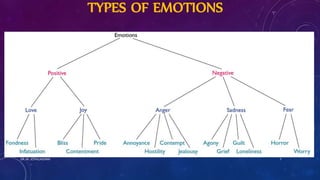
TYPES OF EMOTIONS
DR. M. JOTHILAKSHMI 7
SOURCES OF EMOTIONS
• AGE
• GENDER
• SLEEP
• HEALTH STATUS
• STRESS
• BODY EXERCIS
• SOCIAL ACTIVITIES
• FINANCIAL STATUS
• WEATHER
• PERSONALITY
DR. M. JOTHILAKSHMI 8
THEORIES OF EMOTIONS
• JAMES-LANGE THEORY
• CANNON-BARD THEORY
• SCHACHTER-SINGER THEORY
DR. M. JOTHILAKSHMI 9
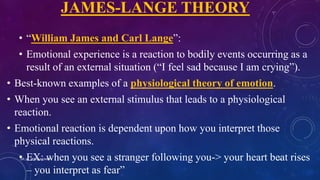
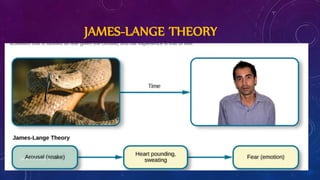
JAMES-LANGE THEORY
• “William James and Carl Lange”:
• Emotional experience is a reaction to bodily events occurring as a
result of an external situation (“I feel sad because I am crying”).
• Best-known examples of a physiological theory of emotion.
• When you see an external stimulus that leads to a physiological
reaction.
• Emotional reaction is dependent upon how you interpret those
physical reactions.
• EX: when you see a stranger following you-> your heart beat rises
– you interpret as fear”
DR. M. JOTHILAKSHMI 10
JAMES-LANGE THEORY
DR. M. JOTHILAKSHMI 11
CANNON-BARD THEORY
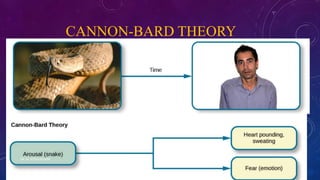
• “Walter Cannon and later Philip Bard “
• Both physiological arousal and emotional experience are produced
simultaneously by the same nerve stimulus.
• James- Lange theory has some weakness:
• You jog in a park – You have raised heartbeat->it is assumed as Fear
• Physical and psychological experience of emotion happen at the same time and that one
does not cause the other.
DR. M. JOTHILAKSHMI 12
CANNON-BARD THEORY
DR. M. JOTHILAKSHMI 13
SCHACHTER-SINGER THEORY
• Emotions are determined jointly by a nonspecific kind of physiological
arousal and its interpretation, based on environmental cues.
• Known as the two-factor theory of emotion, the Schachter-Singer Theory is an
example of a cognitive theory of emotion.
• This theory suggests that the physiological arousal occurs first, and then the
individual must identify the reason for this arousal to experience and label it as an
emotion.
• A stimulus leads to a physiological response that is then cognitively interpreted
and labeled which results in an emotion.
DR. M. JOTHILAKSHMI 14
SCHACHTER-SINGER THEORY
DR. M. JOTHILAKSHMI 15

Emotions in Psychology

  • 1.
  • 2.
    INTRODUCTION • “Feelings thatgenerally have both physiological and cognitive elements and that influence behavior”. • “Complex state of feeling that results in physical and psychological changes that influence thought and behavior”. DR. M. JOTHILAKSHMI 2
  • 3.
    IMPORTANCE • Intrapersonal functionsof emotion • Refer to the role that emotions play within each of us individually. • Interpersonal functions of emotion • Refer to the role emotions play between individuals within a group. • Social and cultural functions of emotion • Refer to the role that emotions play in the maintenance of social order within a society.DR. M. JOTHILAKSHMI 3
  • 4.
    FEATURES • We expressour emotions to others through nonverbal behaviours, and we learn about the emotions of others by observing them. • Emotions are the normally adaptive mental and physiological feeling states that direct our attention and guide our behaviour. • Emotional states are accompanied by arousal, our experiences of the bodily responses. • The most fundamental emotions, known as the basic emotions, are those of anger, disgust, fear, happiness, sadness, and surprise.DR. M. JOTHILAKSHMI 4
  • 5.
    FEATURES • Emotions arecombined; Multiple emotions • Emotions are universal; irrespective of gender, nationality other biological and social factors. • All humans and animals have emotions; for people, level and types of emotions are determined by both biological and social factors unlike other creatures. • Emotions are exist and stimulated by external factors; people show different levels of emotions either high or low. DR. M. JOTHILAKSHMI 5
  • 6.
    FUNCTIONS OF EMOTIONS •Preparing for action: “Fight-Flight” • Shape future behavior: Through learning • Help to interact with others: Social affiliation • Motivate people: “to balance emotions” • Induce learning: To overcome emotions-sadness/frustration or overjoy • Empathy people: To put yourselves in to other shoes • Decision making & Problem Solving • To be successful: Personally & Professionally • Lead us to be emotionally intelligent DR.M.JOTHILAKSHMI 6
  • 7.
    TYPES OF EMOTIONS DR.M. JOTHILAKSHMI 7
  • 8.
    SOURCES OF EMOTIONS •AGE • GENDER • SLEEP • HEALTH STATUS • STRESS • BODY EXERCIS • SOCIAL ACTIVITIES • FINANCIAL STATUS • WEATHER • PERSONALITY DR. M. JOTHILAKSHMI 8
  • 9.
    THEORIES OF EMOTIONS •JAMES-LANGE THEORY • CANNON-BARD THEORY • SCHACHTER-SINGER THEORY DR. M. JOTHILAKSHMI 9
  • 10.
    JAMES-LANGE THEORY • “WilliamJames and Carl Lange”: • Emotional experience is a reaction to bodily events occurring as a result of an external situation (“I feel sad because I am crying”). • Best-known examples of a physiological theory of emotion. • When you see an external stimulus that leads to a physiological reaction. • Emotional reaction is dependent upon how you interpret those physical reactions. • EX: when you see a stranger following you-> your heart beat rises – you interpret as fear” DR. M. JOTHILAKSHMI 10
  • 11.
  • 12.
    CANNON-BARD THEORY • “WalterCannon and later Philip Bard “ • Both physiological arousal and emotional experience are produced simultaneously by the same nerve stimulus. • James- Lange theory has some weakness: • You jog in a park – You have raised heartbeat->it is assumed as Fear • Physical and psychological experience of emotion happen at the same time and that one does not cause the other. DR. M. JOTHILAKSHMI 12
  • 13.
  • 14.
    SCHACHTER-SINGER THEORY • Emotionsare determined jointly by a nonspecific kind of physiological arousal and its interpretation, based on environmental cues. • Known as the two-factor theory of emotion, the Schachter-Singer Theory is an example of a cognitive theory of emotion. • This theory suggests that the physiological arousal occurs first, and then the individual must identify the reason for this arousal to experience and label it as an emotion. • A stimulus leads to a physiological response that is then cognitively interpreted and labeled which results in an emotion. DR. M. JOTHILAKSHMI 14
  • 15.