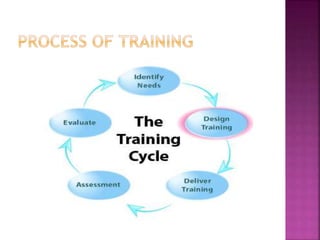
It is the continuous and systematic
process of increasing the skills and
knowledge among workers which are
required to do a job effectively or
efficiently.
It is attempt to change the attitude,
behavior, attitude, perception and
performance of employees to increase
the individual as well as
organizational outcomes.
 Training is the act of increasing the skills of
an employee for doing a particular job.
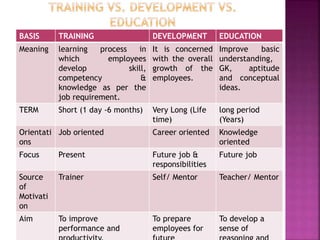
BASIS TRAINING DEVELOPMENT EDUCATION
Meaning learning process in
which employees
develop skill,
competency &
knowledge as per the
job requirement.
It is concerned
with the overall
growth of the
employees.
Improve basic
understanding,
GK, aptitude
and conceptual
ideas.
TERM Short (1 day -6 months) Very Long (Life
time)
long period
(Years)
Orientati
ons
Job oriented Career oriented Knowledge
oriented
Focus Present Future job &
responsibilities
Future job
Source
of
Motivati
on
Trainer Self/ Mentor Teacher/ Mentor
Aim To improve
performance and
To prepare
employees for
To develop a
sense of
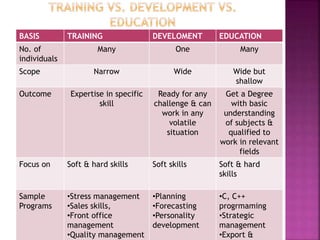
BASIS TRAINING DEVELOMENT EDUCATION
No. of
individuals
Many One Many
Scope Narrow Wide Wide but
shallow
Outcome Expertise in specific
skill
Ready for any
challenge & can
work in any
volatile
situation
Get a Degree
with basic
understanding
of subjects &
qualified to
work in relevant
fields
Focus on Soft & hard skills Soft skills Soft & hard
skills
Sample
Programs
•Stress management
•Sales skills,
•Front office
management
•Quality management
•Planning
•Forecasting
•Personality
development
•C, C++
progrmaming
•Strategic
management
•Export &
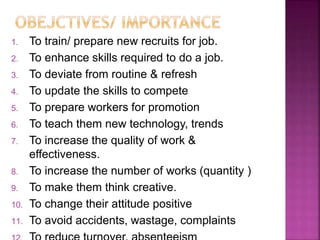
1. To train/ prepare new recruits for job.
2. To enhance skills required to do a job.
3. To deviate from routine & refresh
4. To update the skills to compete
5. To prepare workers for promotion
6. To teach them new technology, trends
7. To increase the quality of work &
effectiveness.
8. To increase the number of works (quantity )
9. To make them think creative.
10. To change their attitude positive
11. To avoid accidents, wastage, complaints
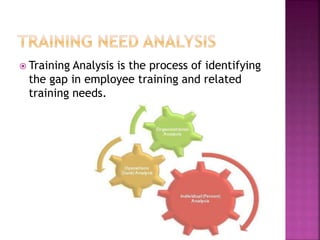
 Training Analysis is the process of identifying
the gap in employee training and related
training needs.
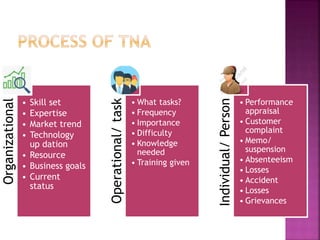
Organizational
• Skill set
• Expertise
• Market trend
• Technology
up dation
• Resource
• Business goals
• Current
status
Operational/task
• What tasks?
• Frequency
• Importance
• Difficulty
• Knowledge
needed
• Training given
Individual/Person
• Performance
appraisal
• Customer
complaint
• Memo/
suspension
• Absenteeism
• Losses
• Accident
• Losses
• Grievances
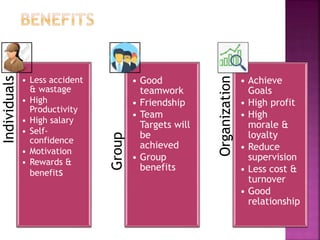
Individuals
• Less accident
& wastage
• High
Productivity
• High salary
• Self-
confidence
• Motivation
• Rewards &
benefits
Group
• Good
teamwork
• Friendship
• Team
Targets will
be
achieved
• Group
benefits
Organization
• Achieve
Goals
• High profit
• High
morale &
loyalty
• Reduce
supervision
• Less cost &
turnover
• Good
relationship
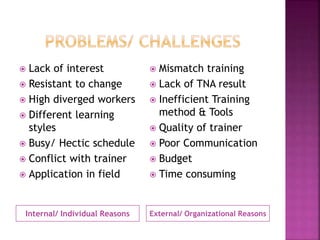
Internal/ Individual Reasons External/ Organizational Reasons
 Lack of interest
 Resistant to change
 High diverged workers
 Different learning
styles
 Busy/ Hectic schedule
 Conflict with trainer
 Application in field
 Mismatch training
 Lack of TNA result
 Inefficient Training
method & Tools
 Quality of trainer
 Poor Communication
 Budget
 Time consuming
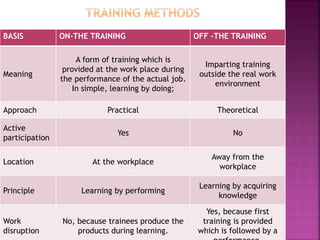
BASIS ON-THE TRAINING OFF –THE TRAINING
Meaning
A form of training which is
provided at the work place during
the performance of the actual job.
In simple, learning by doing;
Imparting training
outside the real work
environment
Approach Practical Theoretical
Active
participation
Yes No
Location At the workplace
Away from the
workplace
Principle Learning by performing
Learning by acquiring
knowledge
Work
disruption
No, because trainees produce the
products during learning.
Yes, because first
training is provided
which is followed by a
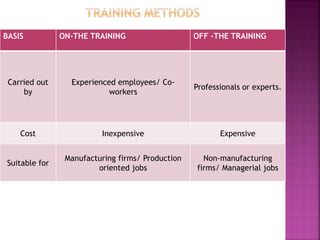
BASIS ON-THE TRAINING OFF –THE TRAINING
Carried out
by
Experienced employees/ Co-
workers
Professionals or experts.
Cost Inexpensive Expensive
Suitable for
Manufacturing firms/ Production
oriented jobs
Non-manufacturing
firms/ Managerial jobs
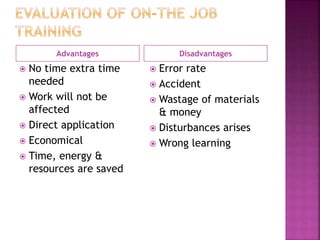
Advantages Disadvantages
 No time extra time
needed
 Work will not be
affected
 Direct application
 Economical
 Time, energy &
resources are saved
 Error rate
 Accident
 Wastage of materials
& money
 Disturbances arises
 Wrong learning
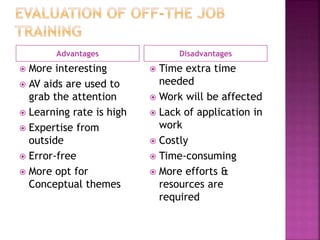
Advantages Disadvantages
 More interesting
 AV aids are used to
grab the attention
 Learning rate is high
 Expertise from
outside
 Error-free
 More opt for
Conceptual themes
 Time extra time
needed
 Work will be affected
 Lack of application in
work
 Costly
 Time-consuming
 More efforts &
resources are
required
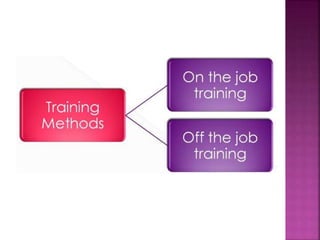
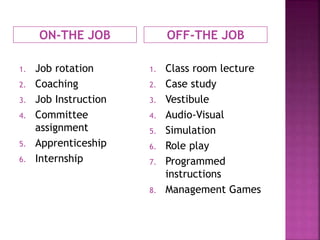
ON-THE JOB OFF-THE JOB
1. Job rotation
2. Coaching
3. Job Instruction
4. Committee
assignment
5. Apprenticeship
6. Internship
1. Class room lecture
2. Case study
3. Vestibule
4. Audio-Visual
5. Simulation
6. Role play
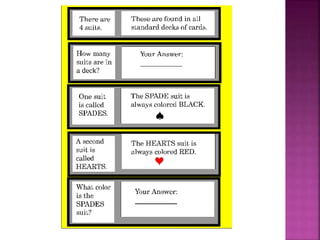
7. Programmed
instructions
8. Management Games
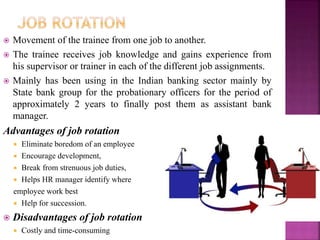
 Movement of the trainee from one job to another.
 The trainee receives job knowledge and gains experience from
his supervisor or trainer in each of the different job assignments.
 Mainly has been using in the Indian banking sector mainly by
State bank group for the probationary officers for the period of
approximately 2 years to finally post them as assistant bank
manager.
Advantages of job rotation
 Eliminate boredom of an employee
 Encourage development,
 Break from strenuous job duties,
 Helps HR manager identify where
employee work best
 Help for succession.
 Disadvantages of job rotation
 Costly and time-consuming
 The trainee is placed under a particular supervisor who
functions as a coach in training the individual.
 The supervisor provides feedback to the trainee on his
performance and offers him some suggestions for
improvement.
 Often the trainee shares some of the duties and
responsibilities of the coach and relieves him of his burden.
 A limitation of this method of training is that the trainee
may not have the freedom or opportunity to express his own
ideas.
 This method is also known as training through
step by step.
 Under this method, trainer explains the
trainee the way of doing the jobs, job
knowledge and skills and allows him to do the
job. The trainer appraises the performance of
the trainee, provides feedback information and
corrects the trainee.
 Under the committee assignment, group of
trainees are given and asked to solve an
actual organizational problem. The trainees
solve the problem jointly. It develops team
work.
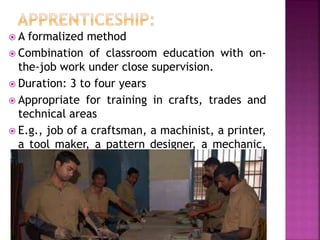
 A formalized method
 Combination of classroom education with on-
the-job work under close supervision.
 Duration: 3 to four years
 Appropriate for training in crafts, trades and
technical areas
 E.g., job of a craftsman, a machinist, a printer,
a tool maker, a pattern designer, a mechanic,
 Individuals entering industry in skilled trades like machinist, electrician and
laboratory technician are provided with thorough instruction though theoretical
and practical aspects.
 For example, TISCO, TELCO and BHEL select the candidates from
polytechnics, engineering colleges and management institutions and provide
apprenticeship training.
 Opt for white collar or managerial level employees.
 Effectively used for the purpose of teaching
administrative aspects or on management subject
to make aware of procedures and to give instructions
on particular topic.
 Advantage – It can be used for large groups. Cost per
trainee is low.
 Disadvantages – Low interest of employees. It is not
learning by practice. It is One-way communication.
No authentic feedback mechanism. Likely to lead to
boredom for employees.
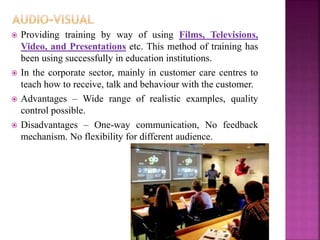
 Providing training by way of using Films, Televisions,
Video, and Presentations etc. This method of training has
been using successfully in education institutions.
 In the corporate sector, mainly in customer care centres to
teach how to receive, talk and behaviour with the customer.
 Advantages – Wide range of realistic examples, quality
control possible.
 Disadvantages – One-way communication, No feedback
mechanism. No flexibility for different audience.
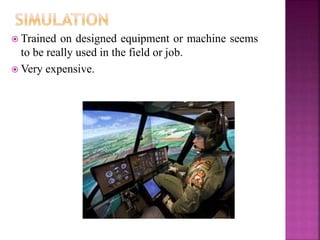
 Trained on designed equipment or machine seems
to be really used in the field or job.
 Very expensive.
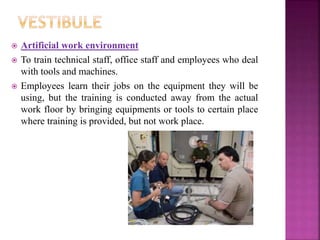
 Artificial work environment
 To train technical staff, office staff and employees who deal
with tools and machines.
 Employees learn their jobs on the equipment they will be
using, but the training is conducted away from the actual
work floor by bringing equipments or tools to certain place
where training is provided, but not work place.
 It is a written description of an actual situation
in the past in same organisation or somewhere else
 Trainees are supposed to analyze and give their
conclusions in writing.
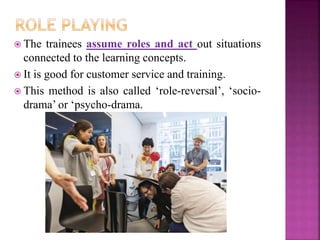
 The trainees assume roles and act out situations
connected to the learning concepts.
 It is good for customer service and training.
 This method is also called ‘role-reversal’, ‘socio-
drama’ or ‘psycho-drama.
 This involves two essential elements:
 (a) a step-by-step series of bits of knowledge, each
building upon what has gone before
 (b) a mechanism for presenting the series and checking on
the trainee’s knowledge.
 Questions are asked in proper sequence and indication given
promptly whether the answers are correct.
 This programme may be carried out with a book, a manual
or a teaching machine. It is primarily used for teaching
factual knowledge such as Mathematics, Physics, etc.
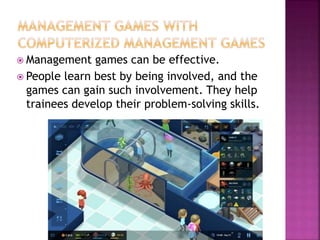
 Management games can be effective.
 People learn best by being involved, and the
games can gain such involvement. They help
trainees develop their problem-solving skills.

Training

  • 2.
    It is thecontinuous and systematic process of increasing the skills and knowledge among workers which are required to do a job effectively or efficiently. It is attempt to change the attitude, behavior, attitude, perception and performance of employees to increase the individual as well as organizational outcomes.
  • 3.
     Training isthe act of increasing the skills of an employee for doing a particular job.
  • 4.
    BASIS TRAINING DEVELOPMENTEDUCATION Meaning learning process in which employees develop skill, competency & knowledge as per the job requirement. It is concerned with the overall growth of the employees. Improve basic understanding, GK, aptitude and conceptual ideas. TERM Short (1 day -6 months) Very Long (Life time) long period (Years) Orientati ons Job oriented Career oriented Knowledge oriented Focus Present Future job & responsibilities Future job Source of Motivati on Trainer Self/ Mentor Teacher/ Mentor Aim To improve performance and To prepare employees for To develop a sense of
  • 5.
    BASIS TRAINING DEVELOMENTEDUCATION No. of individuals Many One Many Scope Narrow Wide Wide but shallow Outcome Expertise in specific skill Ready for any challenge & can work in any volatile situation Get a Degree with basic understanding of subjects & qualified to work in relevant fields Focus on Soft & hard skills Soft skills Soft & hard skills Sample Programs •Stress management •Sales skills, •Front office management •Quality management •Planning •Forecasting •Personality development •C, C++ progrmaming •Strategic management •Export &
  • 6.
    1. To train/prepare new recruits for job. 2. To enhance skills required to do a job. 3. To deviate from routine & refresh 4. To update the skills to compete 5. To prepare workers for promotion 6. To teach them new technology, trends 7. To increase the quality of work & effectiveness. 8. To increase the number of works (quantity ) 9. To make them think creative. 10. To change their attitude positive 11. To avoid accidents, wastage, complaints
  • 7.
     Training Analysisis the process of identifying the gap in employee training and related training needs.
  • 8.
    Organizational • Skill set •Expertise • Market trend • Technology up dation • Resource • Business goals • Current status Operational/task • What tasks? • Frequency • Importance • Difficulty • Knowledge needed • Training given Individual/Person • Performance appraisal • Customer complaint • Memo/ suspension • Absenteeism • Losses • Accident • Losses • Grievances
  • 10.
    Individuals • Less accident &wastage • High Productivity • High salary • Self- confidence • Motivation • Rewards & benefits Group • Good teamwork • Friendship • Team Targets will be achieved • Group benefits Organization • Achieve Goals • High profit • High morale & loyalty • Reduce supervision • Less cost & turnover • Good relationship
  • 12.
    Internal/ Individual ReasonsExternal/ Organizational Reasons  Lack of interest  Resistant to change  High diverged workers  Different learning styles  Busy/ Hectic schedule  Conflict with trainer  Application in field  Mismatch training  Lack of TNA result  Inefficient Training method & Tools  Quality of trainer  Poor Communication  Budget  Time consuming
  • 14.
    BASIS ON-THE TRAININGOFF –THE TRAINING Meaning A form of training which is provided at the work place during the performance of the actual job. In simple, learning by doing; Imparting training outside the real work environment Approach Practical Theoretical Active participation Yes No Location At the workplace Away from the workplace Principle Learning by performing Learning by acquiring knowledge Work disruption No, because trainees produce the products during learning. Yes, because first training is provided which is followed by a
  • 15.
    BASIS ON-THE TRAININGOFF –THE TRAINING Carried out by Experienced employees/ Co- workers Professionals or experts. Cost Inexpensive Expensive Suitable for Manufacturing firms/ Production oriented jobs Non-manufacturing firms/ Managerial jobs
  • 16.
    Advantages Disadvantages  Notime extra time needed  Work will not be affected  Direct application  Economical  Time, energy & resources are saved  Error rate  Accident  Wastage of materials & money  Disturbances arises  Wrong learning
  • 17.
    Advantages Disadvantages  Moreinteresting  AV aids are used to grab the attention  Learning rate is high  Expertise from outside  Error-free  More opt for Conceptual themes  Time extra time needed  Work will be affected  Lack of application in work  Costly  Time-consuming  More efforts & resources are required
  • 18.
    ON-THE JOB OFF-THEJOB 1. Job rotation 2. Coaching 3. Job Instruction 4. Committee assignment 5. Apprenticeship 6. Internship 1. Class room lecture 2. Case study 3. Vestibule 4. Audio-Visual 5. Simulation 6. Role play 7. Programmed instructions 8. Management Games
  • 19.
     Movement ofthe trainee from one job to another.  The trainee receives job knowledge and gains experience from his supervisor or trainer in each of the different job assignments.  Mainly has been using in the Indian banking sector mainly by State bank group for the probationary officers for the period of approximately 2 years to finally post them as assistant bank manager. Advantages of job rotation  Eliminate boredom of an employee  Encourage development,  Break from strenuous job duties,  Helps HR manager identify where employee work best  Help for succession.  Disadvantages of job rotation  Costly and time-consuming
  • 21.
     The traineeis placed under a particular supervisor who functions as a coach in training the individual.  The supervisor provides feedback to the trainee on his performance and offers him some suggestions for improvement.  Often the trainee shares some of the duties and responsibilities of the coach and relieves him of his burden.  A limitation of this method of training is that the trainee may not have the freedom or opportunity to express his own ideas.
  • 22.
     This methodis also known as training through step by step.  Under this method, trainer explains the trainee the way of doing the jobs, job knowledge and skills and allows him to do the job. The trainer appraises the performance of the trainee, provides feedback information and corrects the trainee.
  • 23.
     Under thecommittee assignment, group of trainees are given and asked to solve an actual organizational problem. The trainees solve the problem jointly. It develops team work.
  • 24.
     A formalizedmethod  Combination of classroom education with on- the-job work under close supervision.  Duration: 3 to four years  Appropriate for training in crafts, trades and technical areas  E.g., job of a craftsman, a machinist, a printer, a tool maker, a pattern designer, a mechanic,
  • 25.
     Individuals enteringindustry in skilled trades like machinist, electrician and laboratory technician are provided with thorough instruction though theoretical and practical aspects.  For example, TISCO, TELCO and BHEL select the candidates from polytechnics, engineering colleges and management institutions and provide apprenticeship training.
  • 27.
     Opt forwhite collar or managerial level employees.  Effectively used for the purpose of teaching administrative aspects or on management subject to make aware of procedures and to give instructions on particular topic.  Advantage – It can be used for large groups. Cost per trainee is low.  Disadvantages – Low interest of employees. It is not learning by practice. It is One-way communication. No authentic feedback mechanism. Likely to lead to boredom for employees.
  • 28.
     Providing trainingby way of using Films, Televisions, Video, and Presentations etc. This method of training has been using successfully in education institutions.  In the corporate sector, mainly in customer care centres to teach how to receive, talk and behaviour with the customer.  Advantages – Wide range of realistic examples, quality control possible.  Disadvantages – One-way communication, No feedback mechanism. No flexibility for different audience.
  • 29.
     Trained ondesigned equipment or machine seems to be really used in the field or job.  Very expensive.
  • 30.
     Artificial workenvironment  To train technical staff, office staff and employees who deal with tools and machines.  Employees learn their jobs on the equipment they will be using, but the training is conducted away from the actual work floor by bringing equipments or tools to certain place where training is provided, but not work place.
  • 31.
     It isa written description of an actual situation in the past in same organisation or somewhere else  Trainees are supposed to analyze and give their conclusions in writing.
  • 32.
     The traineesassume roles and act out situations connected to the learning concepts.  It is good for customer service and training.  This method is also called ‘role-reversal’, ‘socio- drama’ or ‘psycho-drama.
  • 33.
     This involvestwo essential elements:  (a) a step-by-step series of bits of knowledge, each building upon what has gone before  (b) a mechanism for presenting the series and checking on the trainee’s knowledge.  Questions are asked in proper sequence and indication given promptly whether the answers are correct.  This programme may be carried out with a book, a manual or a teaching machine. It is primarily used for teaching factual knowledge such as Mathematics, Physics, etc.
  • 35.
     Management gamescan be effective.  People learn best by being involved, and the games can gain such involvement. They help trainees develop their problem-solving skills.