States of Consciousness
What is Consciousness? Awareness of internal or external events or states More than a simple state of awareness. Difficult to define. Processes involved in Consciousness 1. Attention 2. Intentionality 3. Subjectivity 4. Perception 5. Learning & Memory 6. Emotions 7. Associations 8. Awareness 9. Arousal of the Nervous System
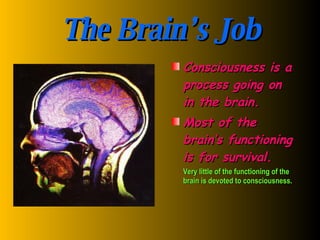
The Brain’s Job Consciousness is a process going on in the brain. Most of the brain’s functioning is for survival. Very little of the functioning of the brain is devoted to consciousness.
Altered States of Consciousness A Fundamental & Qualitative Shift in Mental Functioning which brings about a Distinctly Different Organizational Pattern of Subjective Experience Awareness is constantly shifting Altered States Drugs, alcohol, sleep, daydreaming, hypnosis, meditation, etc. Daydreaming & fantasy Not sure of the value. There is an escape value. The problem occurs when daydreaming takes over your life.
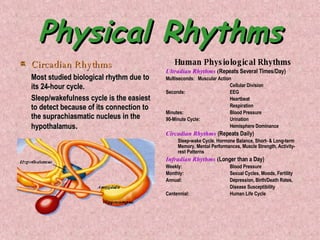
Physical Rhythms Circadian Rhythms Most studied biological rhythm due to its 24-hour cycle. Sleep/wakefulness cycle is the easiest to detect because of its connection to the suprachiasmatic nucleus in the hypothalamus . Human Physiological Rhythms Ultradian Rhythms   ( Repeats Several Times/Day) Multiseconds: Muscular Action Cellular Division Seconds: EEG Heartbeat Respiration Minutes: Blood Pressure 90-Minute Cycle: Urination Hemisphere Dominance Circadian Rhythms   (Repeats Daily) Sleep-wake Cycle, Hormone Balance, Short- & Long-term Memory, Mental Performances, Muscle Strength, Activity-rest Patterns Infradian Rhythms   ( Longer than a Day) Weekly: Blood Pressure Monthly: Sexual Cycles, Moods, Fertility Annual: Depression, Birth/Death Rates, Disease Susceptibility Centennial: Human Life Cycle
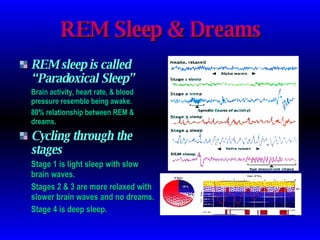
Rhythms of Sleep 4 Stages of Sleep Stages 1 through 4 constitute NREM sleep. We cycle through the stages about every 90 minutes. Sleep requirements change as we age.
REM Sleep & Dreams REM sleep is called “Paradoxical Sleep” Brain activity, heart rate, & blood pressure resemble being awake. 80% relationship between REM & dreams. Cycling through the stages Stage 1 is light sleep with slow brain waves. Stages 2 & 3 are more relaxed with slower brain waves and no dreams. Stage 4 is deep sleep.
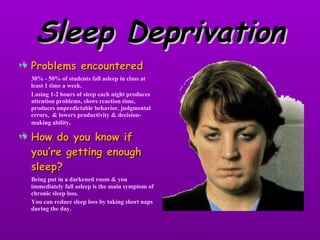
Sleep Deprivation Problems encountered 30% - 50% of students fall asleep in class at least 1 time a week. Losing 1-2 hours of sleep each night produces attention problems, slows reaction time, produces unpredictable behavior, judgmental errors,  & lowers productivity & decision-making ability . How do you know if you’re getting enough sleep? Being put in a darkened room & you immediately fall asleep is the main symptom of chronic sleep loss. You can reduce sleep loss by taking short naps during the day.
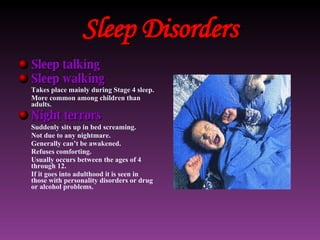
Sleep Disorders Sleep talking Sleep walking Takes place mainly during Stage 4 sleep. More common among children than adults. Night terrors Suddenly sits up in bed screaming. Not due to any nightmare. Generally can’t be awakened. Refuses comforting. Usually occurs between the ages of 4 through 12. If it goes into adulthood it is seen in those with personality disorders or drug or alcohol problems.
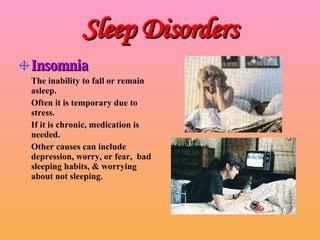
Sleep Disorders Insomnia The inability to fall or remain asleep. Often it is temporary due to stress. If it is chronic, medication is needed. Other causes can include depression, worry, or fear,  bad sleeping habits, & worrying about not sleeping.
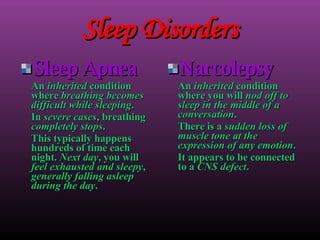
Sleep Disorders Sleep Apnea An  inherited  condition where  breathing becomes difficult while sleeping . In  severe cases , breathing  completely stops . This typically happens hundreds of time each night.  Next day , you will  feel exhausted and sleepy ,  generally falling asleep during the day . Narcolepsy An  inherited  condition where you will  nod off to sleep in the middle of a conversation . There is a  sudden loss of muscle tone at the expression of any emotion . It appears to be connected to a  CNS defect .
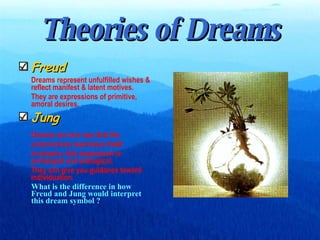
Theories of Dreams Freud Dreams represent unfulfilled wishes & reflect manifest & latent motives. They are expressions of primitive, amoral desires. Jung Dreams are one way that the unconscious expresses itself.  In dreams, this expression is archetypal and analogical.  They can give you guidance toward individuation. What is the difference in how Freud and Jung would interpret this dream symbol ?
Are your dreams in Color or Black & White?
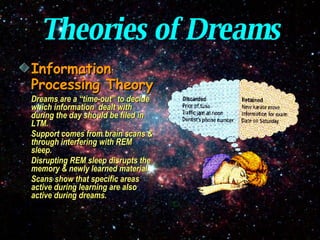
Theories of Dreams Information Processing Theory Dreams are a “time-out” to decide which information  dealt with during the day should be filed in LTM. Support comes from brain scans & through interfering with REM sleep. Disrupting REM sleep disrupts the memory & newly learned material. Scans show that specific areas active during learning are also active during dreams.
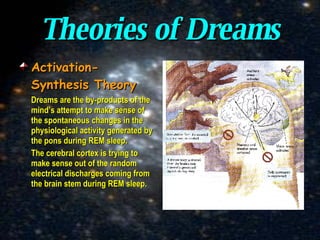
Theories of Dreams Activation-Synthesis Theory Dreams are the by-products of the mind’s attempt to make sense of the spontaneous changes in the physiological activity generated by the pons during REM sleep. The cerebral cortex is trying to make sense out of the random electrical discharges coming from the brain stem during REM sleep.
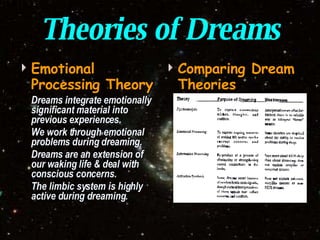
Theories of Dreams Emotional Processing Theory Dreams integrate emotionally significant material into previous experiences. We work through emotional problems during dreaming. Dreams are an extension of our waking life & deal with conscious concerns. The limbic system is highly active during dreaming. Comparing Dream Theories
 
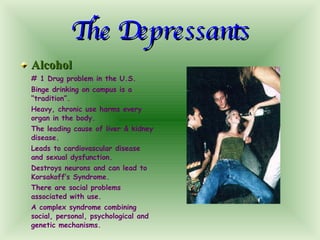
The Depressants Alcohol # 1 Drug problem in the U.S. Binge drinking on campus is a “tradition”. Heavy, chronic use harms every organ in the body. The leading cause of liver & kidney disease. Leads to cardiovascular disease and sexual dysfunction. Destroys neurons and can lead to Korsakoff’s Syndrome. There are social problems associated with use. A complex syndrome combining social, personal, psychological and genetic mechanisms.
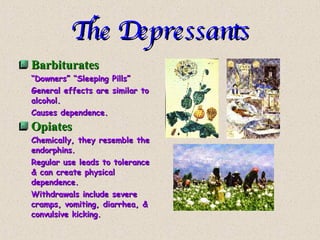
The Depressants Barbiturates “ Downers” “Sleeping Pills” General effects are similar to alcohol. Causes dependence. Opiates Chemically, they resemble the endorphins. Regular use leads to tolerance & can create physical dependence. Withdrawals include severe cramps, vomiting, diarrhea, & convulsive kicking.
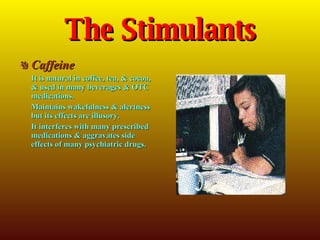
The Stimulants Caffeine It is natural in coffee, tea, & cocoa, & used in many beverages & OTC medications. Maintains wakefulness & alertness but its effects are illusory. It interferes with many prescribed medications & aggravates side effects of many psychiatric drugs.
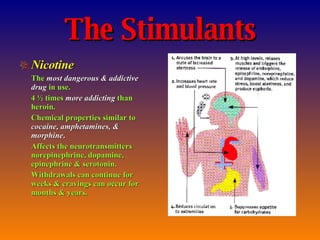
The Stimulants Nicotine The   most dangerous   & addictive   drug   in use. 4 ½ times   more addicting   than heroin. Chemical properties similar to   cocaine, amphetamines, & morphine . Affects the neurotransmitters norepinephrine, dopamine, epinephrine & serotonin. Withdrawals can continue for weeks & cravings can occur for months & years.
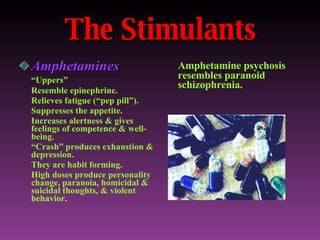
The Stimulants Amphetamines “ Uppers” Resemble epinephrine. Relieves fatigue (“pep pill”). Suppresses the appetite. Increases alertness & gives feelings of competence & well-being. “ Crash” produces exhaustion & depression. They are habit forming. High doses produce personality change, paranoia, homicidal & suicidal thoughts, & violent behavior. Amphetamine psychosis resembles paranoid schizophrenia.
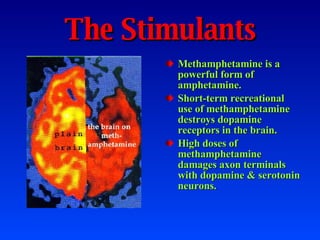
The Stimulants Methamphetamine is a powerful form of amphetamine. Short-term recreational use of methamphetamine destroys dopamine receptors in the brain. High doses of methamphetamine damages axon terminals with dopamine & serotonin neurons.
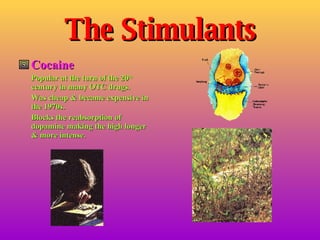
The Stimulants Cocaine Popular at the turn of the 20 th  century in many OTC drugs. Was cheap & became expensive in the 1970s. Blocks the reabsorption of dopamine making the high longer & more intense.
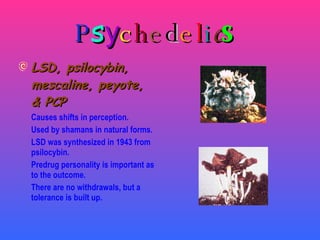
P s y c h e d e l i c s LSD, psilocybin, mescaline, peyote, & PCP Causes shifts in perception. Used by shamans in natural forms. LSD was synthesized in 1943 from psilocybin. Predrug personality is important as to the outcome. There are no withdrawals, but a tolerance is built up.
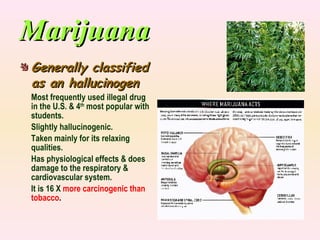
Marijuana Generally classified as an hallucinogen Most frequently used illegal drug in the U.S. & 4 th  most popular with students. Slightly hallucinogenic. Taken mainly for its relaxing qualities. Has physiological effects & does damage to the respiratory & cardiovascular system. It is 16 X   more carcinogenic than tobacco .
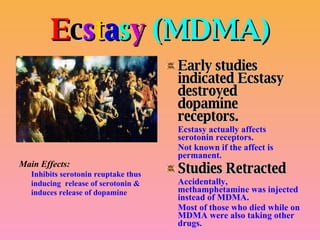
E c s t a s y  (MDMA) Main Effects: Inhibits serotonin reuptake thus inducing  release of serotonin & induces release of dopamine Early studies indicated Ecstasy destroyed dopamine receptors. Ecstasy actually affects serotonin receptors. Not known if the affect is permanent. Studies Retracted Accidentally, methamphetamine was injected instead of MDMA. Most of those who died while on MDMA were also taking other drugs.
Explaining Abuse & Addiction 3 Main Factors 1. Biological Factors Genetic predispositions Inheritance of personality factors & the body’s ability to tolerate the drug. 2. Psychological Factors Learning processes in the family (e.g. handling of stressful situations). Expectations of feeling better. Attitudes & beliefs about drugs, alcohol, etc. 3. Socio-culture Factors The social & cultural setting itself. The culture’s view of certain drugs.
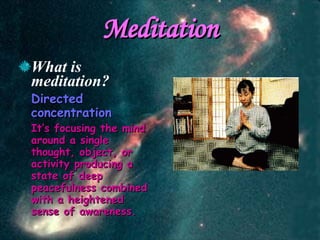
Meditation What is meditation? Directed concentration It’s focusing the mind around a single thought, object, or activity producing a state of deep peacefulness combined with a heightened sense of awareness.
Basic Meditation Procedures Structured Meditations Carefully defined in all its inner activities & what you’re working toward. Lotus Meditation & Breath Counting are examples. Unstructured Meditations There are different purposes in these meditations. You must think about a subject & stay with it & your feelings about it. The purpose is to loosen & free your personality structure in a particular area for growth in that area.
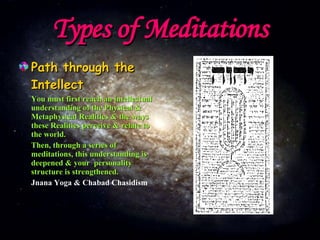
Types of Meditations Path through the Intellect You must first reach an intellectual understanding of the Physical & Metaphysical Realities & the ways these Realities perceive & relate to the world. Then, through a series of meditations, this understanding is deepened & your  personality structure is strengthened. Jnana Yoga & Chabad Chasidism
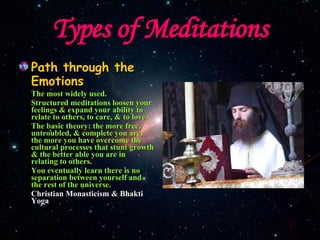
Types of Meditations Path through the Emotions The most widely used. Structured meditations loosen your feelings & expand your ability to relate to others, to care, & to love. The basic theory: the more free, untroubled, & complete you are, the more you have overcome the cultural processes that stunt growth & the better able you are in relating to others. You eventually learn there is no separation between yourself and the rest of the universe. Christian Monasticism & Bhakti Yoga
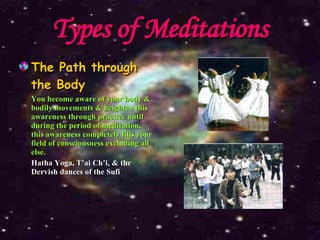
Types of Meditations The Path through the Body You become aware of your body & bodily movements & heighten this awareness through practice until during the period of meditation, this awareness completely fills your field of consciousness excluding all else. Hatha Yoga, T’ai Ch’i, & the Dervish dances of the Sufi
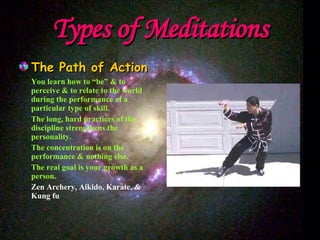
Types of Meditations The Path of Action You learn how to “be” & to perceive & to relate to the world during the performance of a particular type of skill. The long, hard practices of the discipline strengthens the personality. The concentration is on the performance & nothing else. The real goal is your growth as a person. Zen Archery, Aikido, Karate, & Kung fu
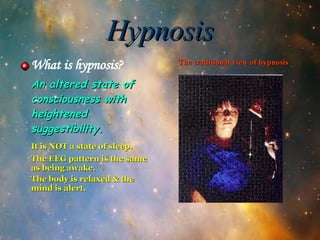
Hypnosis What is hypnosis? An altered state of consciousness with heightened suggestibility. It is NOT a state of sleep. The EEG pattern is the same as being awake. The body is relaxed & the mind is alert. The traditional view of hypnosis
Misconceptions about Hypnosis You can be made to do anything the hypnotist wants. You’re totally unconscious. You’ll fall over because you’re so relaxed. You have to be in a really deep state for suggestion to work. You can be made to go as deep as the hypnotist wants. The hypnotist is in control of you. You can be made to act like a chicken. If you’re left alone in hypnosis, you’ll be stuck there for the rest of your life. The hypnotist basically bores you into hypnosis. People who aren’t very bright make the best subject.
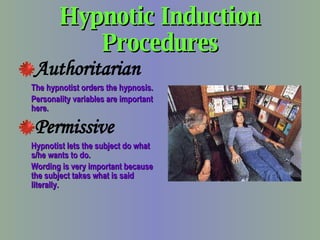
Hypnotic Induction Procedures Authoritarian The hypnotist orders the hypnosis. Personality variables are important here. Permissive Hypnotist lets the subject do what s/he wants to do. Wording is very important because the subject takes what is said literally.

Consciousness

  • 1.
  • 2.
  • 3.
    What is Consciousness?Awareness of internal or external events or states More than a simple state of awareness. Difficult to define. Processes involved in Consciousness 1. Attention 2. Intentionality 3. Subjectivity 4. Perception 5. Learning & Memory 6. Emotions 7. Associations 8. Awareness 9. Arousal of the Nervous System
  • 4.
    The Brain’s JobConsciousness is a process going on in the brain. Most of the brain’s functioning is for survival. Very little of the functioning of the brain is devoted to consciousness.
  • 5.
    Altered States ofConsciousness A Fundamental & Qualitative Shift in Mental Functioning which brings about a Distinctly Different Organizational Pattern of Subjective Experience Awareness is constantly shifting Altered States Drugs, alcohol, sleep, daydreaming, hypnosis, meditation, etc. Daydreaming & fantasy Not sure of the value. There is an escape value. The problem occurs when daydreaming takes over your life.
  • 6.
    Physical Rhythms CircadianRhythms Most studied biological rhythm due to its 24-hour cycle. Sleep/wakefulness cycle is the easiest to detect because of its connection to the suprachiasmatic nucleus in the hypothalamus . Human Physiological Rhythms Ultradian Rhythms ( Repeats Several Times/Day) Multiseconds: Muscular Action Cellular Division Seconds: EEG Heartbeat Respiration Minutes: Blood Pressure 90-Minute Cycle: Urination Hemisphere Dominance Circadian Rhythms (Repeats Daily) Sleep-wake Cycle, Hormone Balance, Short- & Long-term Memory, Mental Performances, Muscle Strength, Activity-rest Patterns Infradian Rhythms ( Longer than a Day) Weekly: Blood Pressure Monthly: Sexual Cycles, Moods, Fertility Annual: Depression, Birth/Death Rates, Disease Susceptibility Centennial: Human Life Cycle
  • 7.
    Rhythms of Sleep4 Stages of Sleep Stages 1 through 4 constitute NREM sleep. We cycle through the stages about every 90 minutes. Sleep requirements change as we age.
  • 8.
    REM Sleep &Dreams REM sleep is called “Paradoxical Sleep” Brain activity, heart rate, & blood pressure resemble being awake. 80% relationship between REM & dreams. Cycling through the stages Stage 1 is light sleep with slow brain waves. Stages 2 & 3 are more relaxed with slower brain waves and no dreams. Stage 4 is deep sleep.
  • 9.
    Sleep Deprivation Problemsencountered 30% - 50% of students fall asleep in class at least 1 time a week. Losing 1-2 hours of sleep each night produces attention problems, slows reaction time, produces unpredictable behavior, judgmental errors, & lowers productivity & decision-making ability . How do you know if you’re getting enough sleep? Being put in a darkened room & you immediately fall asleep is the main symptom of chronic sleep loss. You can reduce sleep loss by taking short naps during the day.
  • 10.
    Sleep Disorders Sleeptalking Sleep walking Takes place mainly during Stage 4 sleep. More common among children than adults. Night terrors Suddenly sits up in bed screaming. Not due to any nightmare. Generally can’t be awakened. Refuses comforting. Usually occurs between the ages of 4 through 12. If it goes into adulthood it is seen in those with personality disorders or drug or alcohol problems.
  • 11.
    Sleep Disorders InsomniaThe inability to fall or remain asleep. Often it is temporary due to stress. If it is chronic, medication is needed. Other causes can include depression, worry, or fear, bad sleeping habits, & worrying about not sleeping.
  • 12.
    Sleep Disorders SleepApnea An inherited condition where breathing becomes difficult while sleeping . In severe cases , breathing completely stops . This typically happens hundreds of time each night. Next day , you will feel exhausted and sleepy , generally falling asleep during the day . Narcolepsy An inherited condition where you will nod off to sleep in the middle of a conversation . There is a sudden loss of muscle tone at the expression of any emotion . It appears to be connected to a CNS defect .
  • 13.
    Theories of DreamsFreud Dreams represent unfulfilled wishes & reflect manifest & latent motives. They are expressions of primitive, amoral desires. Jung Dreams are one way that the unconscious expresses itself. In dreams, this expression is archetypal and analogical. They can give you guidance toward individuation. What is the difference in how Freud and Jung would interpret this dream symbol ?
  • 14.
    Are your dreamsin Color or Black & White?
  • 15.
    Theories of DreamsInformation Processing Theory Dreams are a “time-out” to decide which information dealt with during the day should be filed in LTM. Support comes from brain scans & through interfering with REM sleep. Disrupting REM sleep disrupts the memory & newly learned material. Scans show that specific areas active during learning are also active during dreams.
  • 16.
    Theories of DreamsActivation-Synthesis Theory Dreams are the by-products of the mind’s attempt to make sense of the spontaneous changes in the physiological activity generated by the pons during REM sleep. The cerebral cortex is trying to make sense out of the random electrical discharges coming from the brain stem during REM sleep.
  • 17.
    Theories of DreamsEmotional Processing Theory Dreams integrate emotionally significant material into previous experiences. We work through emotional problems during dreaming. Dreams are an extension of our waking life & deal with conscious concerns. The limbic system is highly active during dreaming. Comparing Dream Theories
  • 18.
  • 19.
    The Depressants Alcohol# 1 Drug problem in the U.S. Binge drinking on campus is a “tradition”. Heavy, chronic use harms every organ in the body. The leading cause of liver & kidney disease. Leads to cardiovascular disease and sexual dysfunction. Destroys neurons and can lead to Korsakoff’s Syndrome. There are social problems associated with use. A complex syndrome combining social, personal, psychological and genetic mechanisms.
  • 20.
    The Depressants Barbiturates“ Downers” “Sleeping Pills” General effects are similar to alcohol. Causes dependence. Opiates Chemically, they resemble the endorphins. Regular use leads to tolerance & can create physical dependence. Withdrawals include severe cramps, vomiting, diarrhea, & convulsive kicking.
  • 21.
    The Stimulants CaffeineIt is natural in coffee, tea, & cocoa, & used in many beverages & OTC medications. Maintains wakefulness & alertness but its effects are illusory. It interferes with many prescribed medications & aggravates side effects of many psychiatric drugs.
  • 22.
    The Stimulants NicotineThe most dangerous & addictive drug in use. 4 ½ times more addicting than heroin. Chemical properties similar to cocaine, amphetamines, & morphine . Affects the neurotransmitters norepinephrine, dopamine, epinephrine & serotonin. Withdrawals can continue for weeks & cravings can occur for months & years.
  • 23.
    The Stimulants Amphetamines“ Uppers” Resemble epinephrine. Relieves fatigue (“pep pill”). Suppresses the appetite. Increases alertness & gives feelings of competence & well-being. “ Crash” produces exhaustion & depression. They are habit forming. High doses produce personality change, paranoia, homicidal & suicidal thoughts, & violent behavior. Amphetamine psychosis resembles paranoid schizophrenia.
  • 24.
    The Stimulants Methamphetamineis a powerful form of amphetamine. Short-term recreational use of methamphetamine destroys dopamine receptors in the brain. High doses of methamphetamine damages axon terminals with dopamine & serotonin neurons.
  • 25.
    The Stimulants CocainePopular at the turn of the 20 th century in many OTC drugs. Was cheap & became expensive in the 1970s. Blocks the reabsorption of dopamine making the high longer & more intense.
  • 26.
    P s yc h e d e l i c s LSD, psilocybin, mescaline, peyote, & PCP Causes shifts in perception. Used by shamans in natural forms. LSD was synthesized in 1943 from psilocybin. Predrug personality is important as to the outcome. There are no withdrawals, but a tolerance is built up.
  • 27.
    Marijuana Generally classifiedas an hallucinogen Most frequently used illegal drug in the U.S. & 4 th most popular with students. Slightly hallucinogenic. Taken mainly for its relaxing qualities. Has physiological effects & does damage to the respiratory & cardiovascular system. It is 16 X more carcinogenic than tobacco .
  • 28.
    E c st a s y (MDMA) Main Effects: Inhibits serotonin reuptake thus inducing release of serotonin & induces release of dopamine Early studies indicated Ecstasy destroyed dopamine receptors. Ecstasy actually affects serotonin receptors. Not known if the affect is permanent. Studies Retracted Accidentally, methamphetamine was injected instead of MDMA. Most of those who died while on MDMA were also taking other drugs.
  • 29.
    Explaining Abuse &Addiction 3 Main Factors 1. Biological Factors Genetic predispositions Inheritance of personality factors & the body’s ability to tolerate the drug. 2. Psychological Factors Learning processes in the family (e.g. handling of stressful situations). Expectations of feeling better. Attitudes & beliefs about drugs, alcohol, etc. 3. Socio-culture Factors The social & cultural setting itself. The culture’s view of certain drugs.
  • 30.
    Meditation What ismeditation? Directed concentration It’s focusing the mind around a single thought, object, or activity producing a state of deep peacefulness combined with a heightened sense of awareness.
  • 31.
    Basic Meditation ProceduresStructured Meditations Carefully defined in all its inner activities & what you’re working toward. Lotus Meditation & Breath Counting are examples. Unstructured Meditations There are different purposes in these meditations. You must think about a subject & stay with it & your feelings about it. The purpose is to loosen & free your personality structure in a particular area for growth in that area.
  • 32.
    Types of MeditationsPath through the Intellect You must first reach an intellectual understanding of the Physical & Metaphysical Realities & the ways these Realities perceive & relate to the world. Then, through a series of meditations, this understanding is deepened & your personality structure is strengthened. Jnana Yoga & Chabad Chasidism
  • 33.
    Types of MeditationsPath through the Emotions The most widely used. Structured meditations loosen your feelings & expand your ability to relate to others, to care, & to love. The basic theory: the more free, untroubled, & complete you are, the more you have overcome the cultural processes that stunt growth & the better able you are in relating to others. You eventually learn there is no separation between yourself and the rest of the universe. Christian Monasticism & Bhakti Yoga
  • 34.
    Types of MeditationsThe Path through the Body You become aware of your body & bodily movements & heighten this awareness through practice until during the period of meditation, this awareness completely fills your field of consciousness excluding all else. Hatha Yoga, T’ai Ch’i, & the Dervish dances of the Sufi
  • 35.
    Types of MeditationsThe Path of Action You learn how to “be” & to perceive & to relate to the world during the performance of a particular type of skill. The long, hard practices of the discipline strengthens the personality. The concentration is on the performance & nothing else. The real goal is your growth as a person. Zen Archery, Aikido, Karate, & Kung fu
  • 36.
    Hypnosis What ishypnosis? An altered state of consciousness with heightened suggestibility. It is NOT a state of sleep. The EEG pattern is the same as being awake. The body is relaxed & the mind is alert. The traditional view of hypnosis
  • 37.
    Misconceptions about HypnosisYou can be made to do anything the hypnotist wants. You’re totally unconscious. You’ll fall over because you’re so relaxed. You have to be in a really deep state for suggestion to work. You can be made to go as deep as the hypnotist wants. The hypnotist is in control of you. You can be made to act like a chicken. If you’re left alone in hypnosis, you’ll be stuck there for the rest of your life. The hypnotist basically bores you into hypnosis. People who aren’t very bright make the best subject.
  • 38.
    Hypnotic Induction ProceduresAuthoritarian The hypnotist orders the hypnosis. Personality variables are important here. Permissive Hypnotist lets the subject do what s/he wants to do. Wording is very important because the subject takes what is said literally.