MANAGEMENT DEVELOPMENT
OBJECTIVES &TECHNIQUES
DEFINITIONS
•It is described as the process from which the managers learn and
improve their skills & knowledge not only to benefit themselves but
also their employing organizations.
•Management Development is a systematic process of training and
growth by which managerial personnel gain and apply skill,
knowledge, altitude and insights to manage the work in their
organisation effectively and efficiently.
REASONS/ PURPOSES
1. It is managements’ responsibility of ensuring the success of the
organization.
2. It is the management who deal with people of different background,
culture, language, etc.
3. Mergers and acquisitions, downsizing, etc. are all under management’s
control.
4. It is managements’ responsibility to ensure that the employees obtain the
required KSAs to perform the tasks.
5. It is managements’ responsibility to ensure that right people is hired for
the right job, at the right time for the right place.
REASONS/ PURPOSES
1. Manager’s job is complex i.e. for the managers understanding the training
need is not easy because his training need is determined by how well his
department is meeting its objective and goal.
2. It is the management who makes decisions on the basis of judgment and
intuition.
3. It is the management that understand the organization, its vision, mission,
ethics, values, strategies, capabilities, and how his organization fits into the
industry, and how his behavior will influence people outside the
organization
OBJECTIVES
• To develop managers/executives for better performance on their present job or
assignment
• To provide a steady source of competent persons at different levels so as to meet the
future requirements of the organisation.
• To enable the managers to understand the problems of the business organisation in
so far as they arise out of its policies and system of control.
• To create conditions and a climate which contribute to the growth process.
• To replace elderly executives, who have risen from low ranks, by highly competent
and academically qualified professionals.
• To increase morale of the managers.
• To acquire knowledge about the problems of human relations.
OBJECTIVES
• To create the second line of defence in the organization so as to meet the
emergencies.
• To broaden the outlook of the various levels of management especially top
management regarding their role, position and responsibilities.
• To help the top management to understand the economic, technical and institutional
forces in order to solve business problems.
• To increase the versatility of the managers
• To stimulate creativity in the thoughts of the managers.
• To create a sense of inter-departmental coordination among managers.
• To indicate how to apply to practical problems the knowledge of the physical and
social aspects of business problems and management.
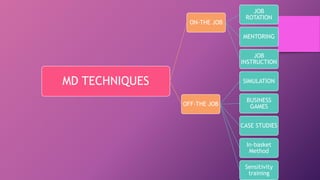
MD TECHNIQUES
ON-THE JOB
JOB
ROTATION
MENTORING
JOB
INSTRUCTION
OFF-THE JOB
SIMULATION
BUSINESS
GAMES
CASE STUDIES
In-basket
Method
Sensitivity
training
COACHING
• In coaching the trainee is placed under a senior manager who acts as an guide or
coach and teaches job knowledge and skill to the trainee.
• He instructs him what he wants him to do, how it can be done etc., and helps him
to correct errors and perform effectively.
• As the managers learn by doing.
• It also creates the opportunities for high level interaction and rapid feedback on
performance.
• But this has a limitation also as we cannot expect that alt excellent managers will be
effective coaches.
• Thus, the effectiveness of this technique relies on the ability of the concerned
'coach'.
COACHING
MERITS
• It is one-to-one interaction
• It can be done at the
convenience of CEO
• It can be done on phone,
meetings, through e-mails, chat
• It provides an opportunity to
receive feedback from an expert
DEMERITS
• This method best suits for the people at the
top because if we see on emotional front,
when a person reaches the top, he gets lonely
and it becomes difficult to find someone to
talk to.
• It helps in finding out the executive’s specific
developmental needs.
• The needs can be identified through 360
degree performance reviews.
JOB ROTATION
• It refers to the transfer or movement of executive from one job to another and from
one plan to another on some planned basis for educational learning purposes.
• Such rotation may continue for a period ranging from 6 months to 24 months.
• Under this method, the trainees are rotated over various routine jobs in a
department, division or unit before they are due for promotion as managers.
• The idea behind this is to give them the required diversified skills and a broader
outlook, which are very important at the upper management levels.
• It also increases the inter-departmental cooperation and helps in reducing the
monotony of the work.
• This also helps in turning the specialist into generalists.
•Under this job rotation can be either horizontally or
vertically.
•Vertical rotation is nothing more than promoting a worker
into a new position.
•Horizontal job transfer can be made on a planned basis or on
a situational basis
JOB ROTATION
MERITS
• Permits a greater understanding of other activities within the
company.
• People are prepared more rapidly to accept greater
responsibility, especially at upper levels.
• Ability and talent of each manager are best tested, so the
enterprise can secure his best utilization in the emergency
period.
• It provides the employees with opportunities to broaden the
horizon of knowledge, skills, and abilities by working in
different departments, business units, functions, and
countries
• Identification of Knowledge, skills, and attitudes (KSAs)
DEMERITS
• Due to this developmental costs
increase.
• It upsets the routine system of
the concern itself.
• An extensive rotation
programme can result in having
a vast number of employees
shifted in a position where their
job knowledge is very limited.
MENTORING
• Mentoring is an ongoing relationship that is developed between a senior and
junior employee. Mentoring provides guidance and clear understanding of how the
organization goes to achieve its vision and mission to the junior employee.
• Executives also have mentors. In cases where the executive is new to the
organization, a senior executive could be assigned as a mentor to assist the new
executive settled into his role.
• Once the mentor identifies the problem, weakness, and the area that needs to be
worked upon, the mentor can advise relevant training. The mentor can also
provide opportunities to work on special processes and projects that require use
of proficiency.
KEY POINTS TO BE REMEMBERED
• Mentoring focus on attitude development.
• Conducted for management-level employees.
• Mentoring is done by someone inside the company.
• It is one-to-one interaction.
• It helps in identifying weaknesses and focus on the area that
needs improvement.
JOB INSTRUCTION TECHNIQUE(JIT)
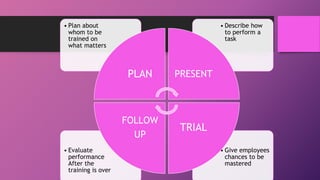
•Job Instruction Technique (JIT) uses a strategy with
focus on knowledge (factual and procedural), skills and
attitudes development.
• Give employees
chances to be
mastered
• Evaluate
performance
After the
training is over
• Describe how
to perform a
task
• Plan about
whom to be
trained on
what matters
PLAN PRESENT
TRIAL
FOLLOW
UP
CASE STUDIES
• Case Studies try to simulate decision-making situation that trainees may find at their
work place.
• It reflects the situations and complex problems faced by managers, staff, HR, CEO, etc.
• The objective of the case study method is to get trainees to apply known concepts and
ideologies and ascertain new ones.
• The case study method emphasize on approach to see a particular problem rather
than a solution.
• Their solutions are not as important as the understanding of advantages and
disadvantages.
Case Study method focuses on
• Building decision making skills
• Assessing and developing Knowledge, Skills and Attitudes (KSAs)
• Developing communication and interpersonal skills
• Developing management skills
• Developing procedural and strategic knowledge
Procedure of the Case Study Method
• The trainee is given with some written material, and the some complex situations of a real or
imaginary organization. A case study may range from 50 to 200 pages depending upon the
problem of the organization.
• A series of questions usually appears at the end of the case study.
• The longer case studies provide enough of the information to be examined while the shorter
ones require the trainee to explore and conduct research to gather appropriate amount of
information.
• The trainee then makes certain judgment and opines about the case by identifying and
giving possible solutions to the problem.
• In between trainees are given time to digest the information. If there is enough time left,
they are also allowed to collect relevant information that supports their solution.
• Once the individuals reach the solution of a problem, they meet in small groups to discuss
the options, solutions generated.
• Then, the trainee meets with the trainer, who further discusses the case.
BUSINESS GAMES METHOD
• Under this, scheme an atmosphere is created in which the participants play a
dynamic role.
• Each team consists of 2 to 6 persons.
• Each team has to make discussion and to arrive at decisions concerning such as
production; pricing, research expenditure.
• The participants are assigned such roles as Managing Director, General Manager etc.
• They make decisions affecting price level, production volume and inventory levels etc.
• These business games are intended to teach trainees how to take management
decisions in an integrated manner.
• The results of their decisions are then compared by a computer programme.
• The participants learn by analyzing problems and by making trial and error method
EQUIPMENT SIMULATORS
• This is the technique of working up a real thing, in which a situation is created and
attempt is to made to make it resembled to the actual situation. So a duplicate
atmosphere but like original sense is created.
• Equipment simulators can be used in giving training to:
• 1. Air Traffic Controllers
• 2. Taxi Drivers
• 3. Telephone Operators
• 4. Ship Navigators
• 5. Maintenance Workers
• 6. Product Development Engineers
• 7. Airline Pilots
• 8. Military Officers
IN-BASKET TECHNIQUE
• In this method, each team of trainees is given the different files of
correspondence of the business problems.
• These are also called business papers like memoranda, reports and
telephone messages and other general papers which come across the table
of the manager.
• The trainees are asked to study them, analyse them and make their
comments on the file.
Procedure of the In-basket Technique
• In this technique, trainee is given some information about the role to be
played such as, description, responsibilities, general context about the role.
• The trainee is then given the log of materials that make up the in-basket
and asked to respond to materials within a particular time period.
• After all the trainees complete in-basket, a discussion with the trainer takes
place.
• In this discussion the trainee describes the justification for the decisions.
• The trainer then provides feedback, reinforcing decisions made suitably or
encouraging the trainee to increase alternatives for those made unsuitably.
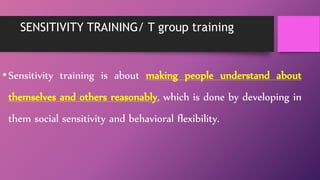
SENSITIVITY TRAINING/ T group training
•Sensitivity training is about making people understand about
themselves and others reasonably, which is done by developing in
them social sensitivity and behavioral flexibility.
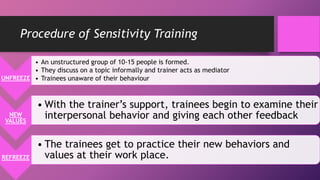
Procedure of Sensitivity Training
UNFREEZE
• An unstructured group of 10-15 people is formed.
• They discuss on a topic informally and trainer acts as mediator
• Trainees unaware of their behaviour
NEW
VALUES
• With the trainer’s support, trainees begin to examine their
interpersonal behavior and giving each other feedback
REFREEZE
• The trainees get to practice their new behaviors and
values at their work place.

Management development

  • 1.
  • 2.
    DEFINITIONS •It is describedas the process from which the managers learn and improve their skills & knowledge not only to benefit themselves but also their employing organizations. •Management Development is a systematic process of training and growth by which managerial personnel gain and apply skill, knowledge, altitude and insights to manage the work in their organisation effectively and efficiently.
  • 3.
    REASONS/ PURPOSES 1. Itis managements’ responsibility of ensuring the success of the organization. 2. It is the management who deal with people of different background, culture, language, etc. 3. Mergers and acquisitions, downsizing, etc. are all under management’s control. 4. It is managements’ responsibility to ensure that the employees obtain the required KSAs to perform the tasks. 5. It is managements’ responsibility to ensure that right people is hired for the right job, at the right time for the right place.
  • 4.
    REASONS/ PURPOSES 1. Manager’sjob is complex i.e. for the managers understanding the training need is not easy because his training need is determined by how well his department is meeting its objective and goal. 2. It is the management who makes decisions on the basis of judgment and intuition. 3. It is the management that understand the organization, its vision, mission, ethics, values, strategies, capabilities, and how his organization fits into the industry, and how his behavior will influence people outside the organization
  • 5.
    OBJECTIVES • To developmanagers/executives for better performance on their present job or assignment • To provide a steady source of competent persons at different levels so as to meet the future requirements of the organisation. • To enable the managers to understand the problems of the business organisation in so far as they arise out of its policies and system of control. • To create conditions and a climate which contribute to the growth process. • To replace elderly executives, who have risen from low ranks, by highly competent and academically qualified professionals. • To increase morale of the managers. • To acquire knowledge about the problems of human relations.
  • 6.
    OBJECTIVES • To createthe second line of defence in the organization so as to meet the emergencies. • To broaden the outlook of the various levels of management especially top management regarding their role, position and responsibilities. • To help the top management to understand the economic, technical and institutional forces in order to solve business problems. • To increase the versatility of the managers • To stimulate creativity in the thoughts of the managers. • To create a sense of inter-departmental coordination among managers. • To indicate how to apply to practical problems the knowledge of the physical and social aspects of business problems and management.
  • 7.
    MD TECHNIQUES ON-THE JOB JOB ROTATION MENTORING JOB INSTRUCTION OFF-THEJOB SIMULATION BUSINESS GAMES CASE STUDIES In-basket Method Sensitivity training
  • 8.
    COACHING • In coachingthe trainee is placed under a senior manager who acts as an guide or coach and teaches job knowledge and skill to the trainee. • He instructs him what he wants him to do, how it can be done etc., and helps him to correct errors and perform effectively. • As the managers learn by doing. • It also creates the opportunities for high level interaction and rapid feedback on performance. • But this has a limitation also as we cannot expect that alt excellent managers will be effective coaches. • Thus, the effectiveness of this technique relies on the ability of the concerned 'coach'.
  • 9.
    COACHING MERITS • It isone-to-one interaction • It can be done at the convenience of CEO • It can be done on phone, meetings, through e-mails, chat • It provides an opportunity to receive feedback from an expert DEMERITS • This method best suits for the people at the top because if we see on emotional front, when a person reaches the top, he gets lonely and it becomes difficult to find someone to talk to. • It helps in finding out the executive’s specific developmental needs. • The needs can be identified through 360 degree performance reviews.
  • 10.
    JOB ROTATION • Itrefers to the transfer or movement of executive from one job to another and from one plan to another on some planned basis for educational learning purposes. • Such rotation may continue for a period ranging from 6 months to 24 months. • Under this method, the trainees are rotated over various routine jobs in a department, division or unit before they are due for promotion as managers. • The idea behind this is to give them the required diversified skills and a broader outlook, which are very important at the upper management levels. • It also increases the inter-departmental cooperation and helps in reducing the monotony of the work. • This also helps in turning the specialist into generalists.
  • 11.
    •Under this jobrotation can be either horizontally or vertically. •Vertical rotation is nothing more than promoting a worker into a new position. •Horizontal job transfer can be made on a planned basis or on a situational basis
  • 12.
    JOB ROTATION MERITS • Permitsa greater understanding of other activities within the company. • People are prepared more rapidly to accept greater responsibility, especially at upper levels. • Ability and talent of each manager are best tested, so the enterprise can secure his best utilization in the emergency period. • It provides the employees with opportunities to broaden the horizon of knowledge, skills, and abilities by working in different departments, business units, functions, and countries • Identification of Knowledge, skills, and attitudes (KSAs) DEMERITS • Due to this developmental costs increase. • It upsets the routine system of the concern itself. • An extensive rotation programme can result in having a vast number of employees shifted in a position where their job knowledge is very limited.
  • 13.
    MENTORING • Mentoring isan ongoing relationship that is developed between a senior and junior employee. Mentoring provides guidance and clear understanding of how the organization goes to achieve its vision and mission to the junior employee. • Executives also have mentors. In cases where the executive is new to the organization, a senior executive could be assigned as a mentor to assist the new executive settled into his role. • Once the mentor identifies the problem, weakness, and the area that needs to be worked upon, the mentor can advise relevant training. The mentor can also provide opportunities to work on special processes and projects that require use of proficiency.
  • 14.
    KEY POINTS TOBE REMEMBERED • Mentoring focus on attitude development. • Conducted for management-level employees. • Mentoring is done by someone inside the company. • It is one-to-one interaction. • It helps in identifying weaknesses and focus on the area that needs improvement.
  • 15.
    JOB INSTRUCTION TECHNIQUE(JIT) •JobInstruction Technique (JIT) uses a strategy with focus on knowledge (factual and procedural), skills and attitudes development.
  • 16.
    • Give employees chancesto be mastered • Evaluate performance After the training is over • Describe how to perform a task • Plan about whom to be trained on what matters PLAN PRESENT TRIAL FOLLOW UP
  • 17.
    CASE STUDIES • CaseStudies try to simulate decision-making situation that trainees may find at their work place. • It reflects the situations and complex problems faced by managers, staff, HR, CEO, etc. • The objective of the case study method is to get trainees to apply known concepts and ideologies and ascertain new ones. • The case study method emphasize on approach to see a particular problem rather than a solution. • Their solutions are not as important as the understanding of advantages and disadvantages.
  • 18.
    Case Study methodfocuses on • Building decision making skills • Assessing and developing Knowledge, Skills and Attitudes (KSAs) • Developing communication and interpersonal skills • Developing management skills • Developing procedural and strategic knowledge
  • 19.
    Procedure of theCase Study Method • The trainee is given with some written material, and the some complex situations of a real or imaginary organization. A case study may range from 50 to 200 pages depending upon the problem of the organization. • A series of questions usually appears at the end of the case study. • The longer case studies provide enough of the information to be examined while the shorter ones require the trainee to explore and conduct research to gather appropriate amount of information. • The trainee then makes certain judgment and opines about the case by identifying and giving possible solutions to the problem. • In between trainees are given time to digest the information. If there is enough time left, they are also allowed to collect relevant information that supports their solution. • Once the individuals reach the solution of a problem, they meet in small groups to discuss the options, solutions generated. • Then, the trainee meets with the trainer, who further discusses the case.
  • 20.
    BUSINESS GAMES METHOD •Under this, scheme an atmosphere is created in which the participants play a dynamic role. • Each team consists of 2 to 6 persons. • Each team has to make discussion and to arrive at decisions concerning such as production; pricing, research expenditure. • The participants are assigned such roles as Managing Director, General Manager etc. • They make decisions affecting price level, production volume and inventory levels etc. • These business games are intended to teach trainees how to take management decisions in an integrated manner. • The results of their decisions are then compared by a computer programme. • The participants learn by analyzing problems and by making trial and error method
  • 21.
    EQUIPMENT SIMULATORS • Thisis the technique of working up a real thing, in which a situation is created and attempt is to made to make it resembled to the actual situation. So a duplicate atmosphere but like original sense is created. • Equipment simulators can be used in giving training to: • 1. Air Traffic Controllers • 2. Taxi Drivers • 3. Telephone Operators • 4. Ship Navigators • 5. Maintenance Workers • 6. Product Development Engineers • 7. Airline Pilots • 8. Military Officers
  • 22.
    IN-BASKET TECHNIQUE • Inthis method, each team of trainees is given the different files of correspondence of the business problems. • These are also called business papers like memoranda, reports and telephone messages and other general papers which come across the table of the manager. • The trainees are asked to study them, analyse them and make their comments on the file.
  • 23.
    Procedure of theIn-basket Technique • In this technique, trainee is given some information about the role to be played such as, description, responsibilities, general context about the role. • The trainee is then given the log of materials that make up the in-basket and asked to respond to materials within a particular time period. • After all the trainees complete in-basket, a discussion with the trainer takes place. • In this discussion the trainee describes the justification for the decisions. • The trainer then provides feedback, reinforcing decisions made suitably or encouraging the trainee to increase alternatives for those made unsuitably.
  • 24.
    SENSITIVITY TRAINING/ Tgroup training •Sensitivity training is about making people understand about themselves and others reasonably, which is done by developing in them social sensitivity and behavioral flexibility.
  • 25.
    Procedure of SensitivityTraining UNFREEZE • An unstructured group of 10-15 people is formed. • They discuss on a topic informally and trainer acts as mediator • Trainees unaware of their behaviour NEW VALUES • With the trainer’s support, trainees begin to examine their interpersonal behavior and giving each other feedback REFREEZE • The trainees get to practice their new behaviors and values at their work place.