Dialectical Behavior Therapy
Techniques
Emotion Regulation
Presented by: Dr. Dawn-Elise Snipes Executive Director, AllCEUs
Podcast Host: Counselor Toolbox & Happiness isn’t Brain Surgery with Doc Snipes
President: Recovery and Resilience International
AllCEUs.com Unlimited CEUs and Specialty Certifications $59
Objectives
 Review the basic premises of DBT
 Learn about the HPA-Axis
 Define emotion regulation
 Identify why emotion regulation is important and
how it can help clients
 Explore emotion regulation techniques
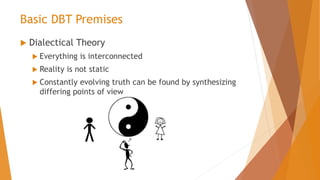
Basic DBT Premises
 Dialectical Theory
 Everything is interconnected
 Reality is not static
 Constantly evolving truth can be found by synthesizing
differing points of view
DBT Assumptions
 People do their best
 People want to get better/be happy
 Clients need to work harder and be more motivated
to make changes in their lives
 Even if people didn’t create their problems, they still
must solve them
 The lives of suicidal [or addicted] people are
unbearable
 People need to learn how to live skillfully in all areas
of their lives.
 People cannot fail in treatment
What is Emotion Regulation
 Emotional dysregulation results from a combination of
 High emotional vulnerability
 Extended time needed to return to baseline
 Inability to regulate or modulate one’s emotions
 Emotional vulnerability refers to [situation] in which an
individual is more emotionally sensitive or reactive than
others
 Differences in the central nervous system and HPA Axis
play a role in making a person more emotionally
vulnerable/reactive
 The environments of people who are more emotionally
reactive are often invalidating
What is Emotion Regulation
 According to Linehan, “Emotional regulation is
the ability to control or influence which emotions
you have, when you have them, and how you
experience and express them.”
 Emotion Regulation
 Prevents unwanted emotions by reducing vulnerabilities
 Changes painful emotions once they start
 Teaches that:
Emotions in and of themselves are not good or bad
Suppresses emotions makes things worse
Emotion Regulation
 Emotions are effective when:
 Acting on the emotion is in your best interest.
 Expressing your emotion gets you closer to your
[ultimate] goals.
 Expressing your emotions will influence others in ways
that will help you.
 Your emotions are sending you an important message.
The HPA-Axis
 Hypothalamic Pituitary Adrenal (HPA) axis is our
central stress response system
 Hypothalamus
releases a compound called corticotrophin releasing
factor (CRF)
 Pituitary
Triggers the release of adrenocorticotrophic hormone
(ACTH)
 Adrenal
ACTH is released and causes the adrenal gland to
release the stress hormones, particularly cortisol and
adrenaline
HPA Axis
 The Adrenals
 Control chemical reactions over large parts of your
body, including your ‘fight-or-flight’ response.
 Produce even more hormones than the pituitary gland
Steroid hormones like cortisol (a glucocorticoid)
increasing availability of glucose and fat
Sex hormones like DHEA, estrogen
Stress hormones like adrenaline
 Once the perceived threat passes, cortisol levels
return to normal
 What if the threat never passes?
HPA Axis
 The amygdala and hippocampus are intertwined with
the stress response (Higgins & George, 2013)
 The amygdala modulates anger and fear / fight or flight
 The hippocampus helps to develop and store memories
 The brain of a child or adolescent is particularly
vulnerable because of its high state of plasticity.
 Bad things are learned
 Emotional upset prevents learning new, positive things to
counterbalance
 People who live in a chronically stressful environment
may also have an overactive HPA-Axis
The Brain and Stress
 What happens to the brain when there is a chronic
threat to safety and a constant underlay of anxiety?
 As it learns, people’s brains forge synaptic connections
from experience and prune away connections that are not
utilized.
 People who feel a lack of control over their
environment are particularly vulnerable to excessive
stimulation of the HPA response.
 Abused and neglected children
 Abused and neglected adults
 Adults with anxiety or depressive disorders
The Brain and Stress
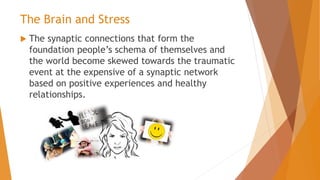
 The synaptic connections that form the
foundation people’s schema of themselves and
the world become skewed towards the traumatic
event at the expensive of a synaptic network
based on positive experiences and healthy
relationships.
 The hypervigilant state activated by the HPA
response:
 Disrupts the ability to focus and learn
 Impairs the ability to form new memories and recall
information due to the physiologic changes to the
hippocampus (cannot rebalance a skewed system)
 Is associated with emotional and behavioral
dysregulation.
 Example: A Relationship
https://campuspress.yale.edu/exploringmentalhealth/stress-and-the-hpa-axis/
Emotion Regulation
 Transdiagnostic or useful with many different
disorders
 Increasing present focused emotion awareness
 Increasing cognitive flexibility
 Identifying and preventing patterns of
 Emotion avoidance
 Emotion-driven behaviors
 Increasing awareness and tolerance of emotion-
related physical sensations
 Using emotion focused exposure procedures
Understanding Emotions
 Emotional behavior is functional to the person
 To change the behavior, it is necessary to identify
the functions and reinforcers of that behavior
 Emotions function to:
 Communicate to others and influence and control their
behaviors
 Serve as an alert or alarm which motivate one’s own
behaviors
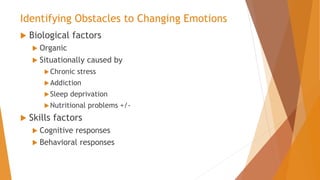
Identifying Obstacles to Changing Emotions
 Biological factors
 Organic
 Situationally caused by
Chronic stress
Addiction
Sleep deprivation
Nutritional problems +/-
 Skills factors
 Cognitive responses
 Behavioral responses
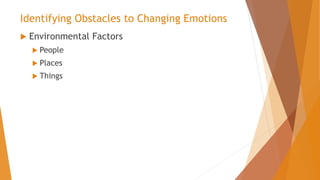
Identifying Obstacles to Changing Emotions
 Environmental Factors
 People
 Places
 Things
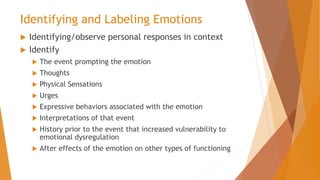
Identifying and Labeling Emotions
 Identifying/observe personal responses in context
 Identify
 The event prompting the emotion
 Thoughts
 Physical Sensations
 Urges
 Expressive behaviors associated with the emotion
 Interpretations of that event
 History prior to the event that increased vulnerability to
emotional dysregulation
 After effects of the emotion on other types of functioning
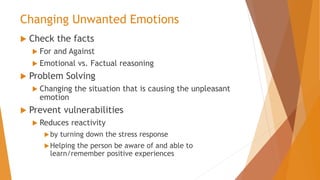
Changing Unwanted Emotions
 Check the facts
 For and Against
 Emotional vs. Factual reasoning
 Problem Solving
 Changing the situation that is causing the unpleasant
emotion
 Prevent vulnerabilities
 Reduces reactivity
by turning down the stress response
Helping the person be aware of and able to
learn/remember positive experiences
Reducing Vulnerability to the Emotional Mind
 Building mastery through
 Activities that build self-efficacy, self-control and
competence
 Mental Rehearsal
 Physical Body-Mind Care
 Pain and illness treatment
 [Laughter]
 Eating to support mental and physical health
 Addictive or mood altering drugs or behaviors
 Sleep
 Exercise
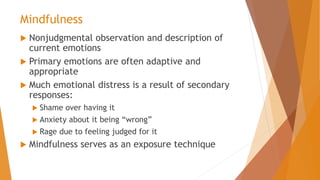
Mindfulness
 Nonjudgmental observation and description of
current emotions
 Primary emotions are often adaptive and
appropriate
 Much emotional distress is a result of secondary
responses:
 Shame over having it
 Anxiety about it being “wrong”
 Rage due to feeling judged for it
 Mindfulness serves as an exposure technique
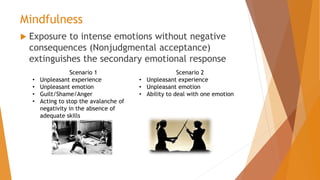
Mindfulness
 Exposure to intense emotions without negative
consequences (Nonjudgmental acceptance)
extinguishes the secondary emotional response
Scenario 1
• Unpleasant experience
• Unpleasant emotion
• Guilt/Shame/Anger
• Acting to stop the avalanche of
negativity in the absence of
adequate skills
Scenario 2
• Unpleasant experience
• Unpleasant emotion
• Ability to deal with one emotion
Summary
 Emotional dysregulation is common in many disorders
 People with dysregulated emotions have a stronger and
longer lasting response to stimuli
 Emotional dysregulation is often punished or
invalidated, increasing hopelessness and isolation
 Emotional regulation means
 Using mindfulness to
 Be aware of and reduce vulnerabilities
 Identify the function and reinforcers for current emotions
 Checking for facts
 Problem solving
Subscribe
Counselor Toolbox Podcast
Youtube.com/AllCEUsEducation
Facebook: Facebook.com/AllCEUs/
AllCEUs.com Unlimited CEUs $59 | Specialty Certificates $89 | Live Webinars $5

Emotion Regulation and Vulnerability Prevention

  • 1.
    Dialectical Behavior Therapy Techniques EmotionRegulation Presented by: Dr. Dawn-Elise Snipes Executive Director, AllCEUs Podcast Host: Counselor Toolbox & Happiness isn’t Brain Surgery with Doc Snipes President: Recovery and Resilience International AllCEUs.com Unlimited CEUs and Specialty Certifications $59
  • 2.
    Objectives  Review thebasic premises of DBT  Learn about the HPA-Axis  Define emotion regulation  Identify why emotion regulation is important and how it can help clients  Explore emotion regulation techniques
  • 3.
    Basic DBT Premises Dialectical Theory  Everything is interconnected  Reality is not static  Constantly evolving truth can be found by synthesizing differing points of view
  • 4.
    DBT Assumptions  Peopledo their best  People want to get better/be happy  Clients need to work harder and be more motivated to make changes in their lives  Even if people didn’t create their problems, they still must solve them  The lives of suicidal [or addicted] people are unbearable  People need to learn how to live skillfully in all areas of their lives.  People cannot fail in treatment
  • 5.
    What is EmotionRegulation  Emotional dysregulation results from a combination of  High emotional vulnerability  Extended time needed to return to baseline  Inability to regulate or modulate one’s emotions  Emotional vulnerability refers to [situation] in which an individual is more emotionally sensitive or reactive than others  Differences in the central nervous system and HPA Axis play a role in making a person more emotionally vulnerable/reactive  The environments of people who are more emotionally reactive are often invalidating
  • 6.
    What is EmotionRegulation  According to Linehan, “Emotional regulation is the ability to control or influence which emotions you have, when you have them, and how you experience and express them.”  Emotion Regulation  Prevents unwanted emotions by reducing vulnerabilities  Changes painful emotions once they start  Teaches that: Emotions in and of themselves are not good or bad Suppresses emotions makes things worse
  • 7.
    Emotion Regulation  Emotionsare effective when:  Acting on the emotion is in your best interest.  Expressing your emotion gets you closer to your [ultimate] goals.  Expressing your emotions will influence others in ways that will help you.  Your emotions are sending you an important message.
  • 8.
    The HPA-Axis  HypothalamicPituitary Adrenal (HPA) axis is our central stress response system  Hypothalamus releases a compound called corticotrophin releasing factor (CRF)  Pituitary Triggers the release of adrenocorticotrophic hormone (ACTH)  Adrenal ACTH is released and causes the adrenal gland to release the stress hormones, particularly cortisol and adrenaline
  • 9.
    HPA Axis  TheAdrenals  Control chemical reactions over large parts of your body, including your ‘fight-or-flight’ response.  Produce even more hormones than the pituitary gland Steroid hormones like cortisol (a glucocorticoid) increasing availability of glucose and fat Sex hormones like DHEA, estrogen Stress hormones like adrenaline  Once the perceived threat passes, cortisol levels return to normal  What if the threat never passes?
  • 10.
    HPA Axis  Theamygdala and hippocampus are intertwined with the stress response (Higgins & George, 2013)  The amygdala modulates anger and fear / fight or flight  The hippocampus helps to develop and store memories  The brain of a child or adolescent is particularly vulnerable because of its high state of plasticity.  Bad things are learned  Emotional upset prevents learning new, positive things to counterbalance  People who live in a chronically stressful environment may also have an overactive HPA-Axis
  • 11.
    The Brain andStress  What happens to the brain when there is a chronic threat to safety and a constant underlay of anxiety?  As it learns, people’s brains forge synaptic connections from experience and prune away connections that are not utilized.  People who feel a lack of control over their environment are particularly vulnerable to excessive stimulation of the HPA response.  Abused and neglected children  Abused and neglected adults  Adults with anxiety or depressive disorders
  • 12.
    The Brain andStress  The synaptic connections that form the foundation people’s schema of themselves and the world become skewed towards the traumatic event at the expensive of a synaptic network based on positive experiences and healthy relationships.
  • 13.
     The hypervigilantstate activated by the HPA response:  Disrupts the ability to focus and learn  Impairs the ability to form new memories and recall information due to the physiologic changes to the hippocampus (cannot rebalance a skewed system)  Is associated with emotional and behavioral dysregulation.  Example: A Relationship https://campuspress.yale.edu/exploringmentalhealth/stress-and-the-hpa-axis/
  • 14.
    Emotion Regulation  Transdiagnosticor useful with many different disorders  Increasing present focused emotion awareness  Increasing cognitive flexibility  Identifying and preventing patterns of  Emotion avoidance  Emotion-driven behaviors  Increasing awareness and tolerance of emotion- related physical sensations  Using emotion focused exposure procedures
  • 15.
    Understanding Emotions  Emotionalbehavior is functional to the person  To change the behavior, it is necessary to identify the functions and reinforcers of that behavior  Emotions function to:  Communicate to others and influence and control their behaviors  Serve as an alert or alarm which motivate one’s own behaviors
  • 16.
    Identifying Obstacles toChanging Emotions  Biological factors  Organic  Situationally caused by Chronic stress Addiction Sleep deprivation Nutritional problems +/-  Skills factors  Cognitive responses  Behavioral responses
  • 17.
    Identifying Obstacles toChanging Emotions  Environmental Factors  People  Places  Things
  • 18.
    Identifying and LabelingEmotions  Identifying/observe personal responses in context  Identify  The event prompting the emotion  Thoughts  Physical Sensations  Urges  Expressive behaviors associated with the emotion  Interpretations of that event  History prior to the event that increased vulnerability to emotional dysregulation  After effects of the emotion on other types of functioning
  • 19.
    Changing Unwanted Emotions Check the facts  For and Against  Emotional vs. Factual reasoning  Problem Solving  Changing the situation that is causing the unpleasant emotion  Prevent vulnerabilities  Reduces reactivity by turning down the stress response Helping the person be aware of and able to learn/remember positive experiences
  • 20.
    Reducing Vulnerability tothe Emotional Mind  Building mastery through  Activities that build self-efficacy, self-control and competence  Mental Rehearsal  Physical Body-Mind Care  Pain and illness treatment  [Laughter]  Eating to support mental and physical health  Addictive or mood altering drugs or behaviors  Sleep  Exercise
  • 21.
    Mindfulness  Nonjudgmental observationand description of current emotions  Primary emotions are often adaptive and appropriate  Much emotional distress is a result of secondary responses:  Shame over having it  Anxiety about it being “wrong”  Rage due to feeling judged for it  Mindfulness serves as an exposure technique
  • 22.
    Mindfulness  Exposure tointense emotions without negative consequences (Nonjudgmental acceptance) extinguishes the secondary emotional response Scenario 1 • Unpleasant experience • Unpleasant emotion • Guilt/Shame/Anger • Acting to stop the avalanche of negativity in the absence of adequate skills Scenario 2 • Unpleasant experience • Unpleasant emotion • Ability to deal with one emotion
  • 23.
    Summary  Emotional dysregulationis common in many disorders  People with dysregulated emotions have a stronger and longer lasting response to stimuli  Emotional dysregulation is often punished or invalidated, increasing hopelessness and isolation  Emotional regulation means  Using mindfulness to  Be aware of and reduce vulnerabilities  Identify the function and reinforcers for current emotions  Checking for facts  Problem solving
  • 24.
    Subscribe Counselor Toolbox Podcast Youtube.com/AllCEUsEducation Facebook:Facebook.com/AllCEUs/ AllCEUs.com Unlimited CEUs $59 | Specialty Certificates $89 | Live Webinars $5