THE PSYCHOLOGY OF
EMOTION
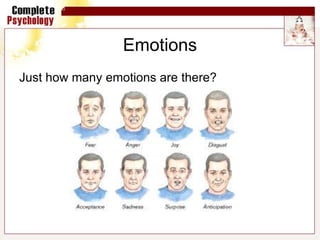
Emotions
Just how many emotions are there?
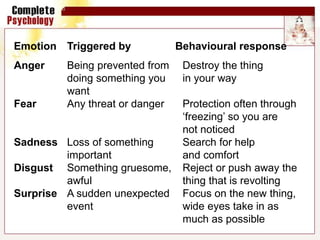
Emotion Triggered by Behavioural response
Anger Being prevented from Destroy the thing
doing something you in your way
want
Fear Any threat or danger Protection often through
‘freezing’ so you are
not noticed
Sadness Loss of something Search for help
important and comfort
Disgust Something gruesome, Reject or push away the
awful thing that is revolting
Surprise A sudden unexpected Focus on the new thing,
event wide eyes take in as
much as possible
What Exactly are Emotions?
• An emotion involves physiological arousal,
expressive behavior and conscious experience
• What psychologists do agree on is that emotions
contain both a cognitive and physiological
element
• What they do not agree on is, which comes first?
When we encounter a situation that scares us, do
we become aroused and from this state of
arousal deduce that we are scared? Or do we
decide mentally that the situation is scary, which
then causes our physiology to react?
• Pure emotions do not last long and have a short duration.
Mood, on the other hand, tends to last longer
• Emotional experience can act as a motivation for action.
The disgusted diner, for example, sending his uncooked steak
back to the chef and putting his coat on to leave the restaurant.
Where motivations are internal stimuli, emotions are reactions
(responses)
• Emotional experience is elicited in part by conscious
mental assessments. Such perceptual assessment can lead to
very different emotional expressions. So getting an annual bonus
might bring joy, which might turn to anger when you learn your
co-workers all got bigger bonuses than you. Therefore cognitive
appraisal is central to emotional experience
• Emotional experience is either positive or negative,
pleasant or unpleasant to us
Basic Characteristics of Emotions
What are the Functions
of Emotions?
1. They are a source of information
2. They prepare us for action
3. They help us communicate with others, e.g.
facial expressions and attachment
4. They regulate social behaviour
5. They can create cognitive bias and maintain
self-esteem
Basis of Emotional Experience:
Physiology or Cognition?
• At one extreme, emotions can be seen as
biological responses to situations over which we
have little control
• At the other extreme, there are psychologists
who define emotions more by the conscious
experience rather than by the biological
response (Lazarus, 1991)
Biological Explanations of Emotion
• Theorists such as William James and Carl
Lange suggest that emotional experience is a
direct result of physiological arousal
• For some, physiological arousal is seen to cause
the emotion (James & Lange); while for others,
such arousal is a signal system for the brain to
act and produce emotions (Cannon)
James-Lange Somatic Theory of
Emotions
• The body informs the mind (we know we are
sad because we cry)
• Distinctive body changes/symptoms are
accompanied by different emotions
• Perception of these changes/symptoms
determines the experience of emotion
• Differences between emotions are a direct
result of the different patterns of physiological
response associated with them
Evidence for the Physiological
Basis of Emotion
• Levenson, Ekman & Friesen (1990) reported
distinctive patterns of autonomic nervous
system (ANS) activity for anger, fear and disgust
• Rimm-Kaufman & Kagan (1996) have reported
that hand and face temperatures were different in
a sample of females viewing different film clips
• facial feedback hypothesis of emotion (Davis &
Palladino, 2000)
Challenges to the James-Lange
Theory
• Cannon (1927): emotional encounters are
emergency situations which directly trigger a
central brain process in the thalamus. Which
lead to two simultaneous but independent
outcomes:
– heightened arousal system which prepares the
body to cope with the emergency
– the conscious experience of the emotion is
registered in the cortex
• Cannon argues the James-Lange theory is too
slow in accounting for instantaneous emotional
feeling
• Yet his own theory also contains a flaw. If the
brain decides upon emotional experience
based upon physiological arousal, then
individuals who receive no physiological
arousal signals should not experience emotion
• Chwalisz et al. (1988) reported that people who
had sustained spinal injuries do experience
them!
Can we Judge our own Arousal?
• Two other theories of emotion point to how
inaccurate we are at our levels of physiological
arousal
– False autonomic feedback (Valins, 1966)
– Excitation transfer theory (Zillman, 1978)
• Both theories suggest that there has to be more
to emotional experience than mere
physiological arousal
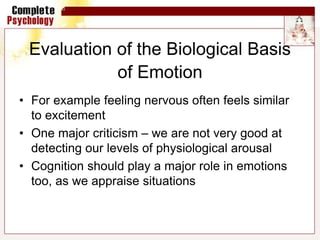
Evaluation of the Biological Basis
of Emotion
• For example feeling nervous often feels similar
to excitement
• One major criticism – we are not very good at
detecting our levels of physiological arousal
• Cognition should play a major role in emotions
too, as we appraise situations
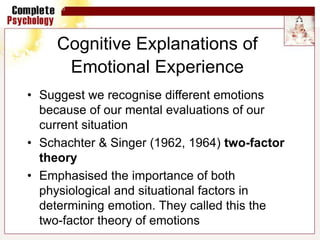
Cognitive Explanations of
Emotional Experience
• Suggest we recognise different emotions
because of our mental evaluations of our
current situation
• Schachter & Singer (1962, 1964) two-factor
theory
• Emphasised the importance of both
physiological and situational factors in
determining emotion. They called this the
two-factor theory of emotions
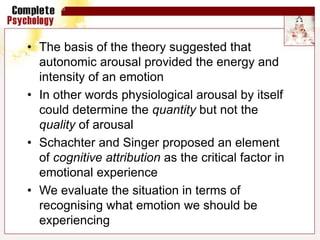
• The basis of the theory suggested that
autonomic arousal provided the energy and
intensity of an emotion
• In other words physiological arousal by itself
could determine the quantity but not the
quality of arousal
• Schachter and Singer proposed an element
of cognitive attribution as the critical factor in
emotional experience
• We evaluate the situation in terms of
recognising what emotion we should be
experiencing
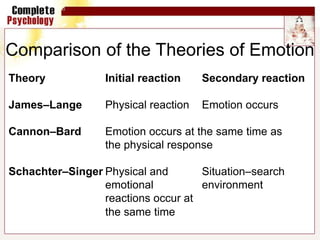
Comparison of the Theories of Emotion
Theory Initial reaction Secondary reaction
James–Lange Physical reaction Emotion occurs
Cannon–Bard Emotion occurs at the same time as
the physical response
Schachter–Singer Physical and Situation–search
emotional environment
reactions occur at
the same time
Cognitive Appraisal Model: Lazarus
• Cognitive appraisal of the situation determines
the level of physiological arousal and the
specific type of emotion to be experienced
• We learn what to expect from stimuli from
previous experience with it
– e.g. phobias
Measurement of Emotions
• Physiological events such as heart rate,
breathing, electro-dermal activity and muscle
tension, have all been used as physiological
indicators of emotional arousal. Many of
these are measured by a polygraph
• The problem here is that we cannot deduce
easily what the emotion is being experienced
from the physiological arousal input. All we
can do is look at the levels of general arousal
• self-report questionnaires are a more
specific way to measure the nature of the
emotional experience
• Examples of questionnaires:
– Positive and Negative Affect Schedule
(PANAS)
• Problem – how do we know people are:
1. Aware what they are feeling accurately
2. Being honest with their answers!

26 emotions.ppt

  • 1.
  • 2.
    Emotions Just how manyemotions are there?
  • 3.
    Emotion Triggered byBehavioural response Anger Being prevented from Destroy the thing doing something you in your way want Fear Any threat or danger Protection often through ‘freezing’ so you are not noticed Sadness Loss of something Search for help important and comfort Disgust Something gruesome, Reject or push away the awful thing that is revolting Surprise A sudden unexpected Focus on the new thing, event wide eyes take in as much as possible
  • 4.
    What Exactly areEmotions? • An emotion involves physiological arousal, expressive behavior and conscious experience • What psychologists do agree on is that emotions contain both a cognitive and physiological element • What they do not agree on is, which comes first? When we encounter a situation that scares us, do we become aroused and from this state of arousal deduce that we are scared? Or do we decide mentally that the situation is scary, which then causes our physiology to react?
  • 5.
    • Pure emotionsdo not last long and have a short duration. Mood, on the other hand, tends to last longer • Emotional experience can act as a motivation for action. The disgusted diner, for example, sending his uncooked steak back to the chef and putting his coat on to leave the restaurant. Where motivations are internal stimuli, emotions are reactions (responses) • Emotional experience is elicited in part by conscious mental assessments. Such perceptual assessment can lead to very different emotional expressions. So getting an annual bonus might bring joy, which might turn to anger when you learn your co-workers all got bigger bonuses than you. Therefore cognitive appraisal is central to emotional experience • Emotional experience is either positive or negative, pleasant or unpleasant to us Basic Characteristics of Emotions
  • 6.
    What are theFunctions of Emotions? 1. They are a source of information 2. They prepare us for action 3. They help us communicate with others, e.g. facial expressions and attachment 4. They regulate social behaviour 5. They can create cognitive bias and maintain self-esteem
  • 7.
    Basis of EmotionalExperience: Physiology or Cognition? • At one extreme, emotions can be seen as biological responses to situations over which we have little control • At the other extreme, there are psychologists who define emotions more by the conscious experience rather than by the biological response (Lazarus, 1991)
  • 8.
    Biological Explanations ofEmotion • Theorists such as William James and Carl Lange suggest that emotional experience is a direct result of physiological arousal • For some, physiological arousal is seen to cause the emotion (James & Lange); while for others, such arousal is a signal system for the brain to act and produce emotions (Cannon)
  • 9.
    James-Lange Somatic Theoryof Emotions • The body informs the mind (we know we are sad because we cry) • Distinctive body changes/symptoms are accompanied by different emotions • Perception of these changes/symptoms determines the experience of emotion • Differences between emotions are a direct result of the different patterns of physiological response associated with them
  • 10.
    Evidence for thePhysiological Basis of Emotion • Levenson, Ekman & Friesen (1990) reported distinctive patterns of autonomic nervous system (ANS) activity for anger, fear and disgust • Rimm-Kaufman & Kagan (1996) have reported that hand and face temperatures were different in a sample of females viewing different film clips • facial feedback hypothesis of emotion (Davis & Palladino, 2000)
  • 11.
    Challenges to theJames-Lange Theory • Cannon (1927): emotional encounters are emergency situations which directly trigger a central brain process in the thalamus. Which lead to two simultaneous but independent outcomes: – heightened arousal system which prepares the body to cope with the emergency – the conscious experience of the emotion is registered in the cortex
  • 12.
    • Cannon arguesthe James-Lange theory is too slow in accounting for instantaneous emotional feeling • Yet his own theory also contains a flaw. If the brain decides upon emotional experience based upon physiological arousal, then individuals who receive no physiological arousal signals should not experience emotion • Chwalisz et al. (1988) reported that people who had sustained spinal injuries do experience them!
  • 13.
    Can we Judgeour own Arousal? • Two other theories of emotion point to how inaccurate we are at our levels of physiological arousal – False autonomic feedback (Valins, 1966) – Excitation transfer theory (Zillman, 1978) • Both theories suggest that there has to be more to emotional experience than mere physiological arousal
  • 14.
    Evaluation of theBiological Basis of Emotion • For example feeling nervous often feels similar to excitement • One major criticism – we are not very good at detecting our levels of physiological arousal • Cognition should play a major role in emotions too, as we appraise situations
  • 15.
    Cognitive Explanations of EmotionalExperience • Suggest we recognise different emotions because of our mental evaluations of our current situation • Schachter & Singer (1962, 1964) two-factor theory • Emphasised the importance of both physiological and situational factors in determining emotion. They called this the two-factor theory of emotions
  • 16.
    • The basisof the theory suggested that autonomic arousal provided the energy and intensity of an emotion • In other words physiological arousal by itself could determine the quantity but not the quality of arousal • Schachter and Singer proposed an element of cognitive attribution as the critical factor in emotional experience • We evaluate the situation in terms of recognising what emotion we should be experiencing
  • 17.
    Comparison of theTheories of Emotion Theory Initial reaction Secondary reaction James–Lange Physical reaction Emotion occurs Cannon–Bard Emotion occurs at the same time as the physical response Schachter–Singer Physical and Situation–search emotional environment reactions occur at the same time
  • 18.
    Cognitive Appraisal Model:Lazarus • Cognitive appraisal of the situation determines the level of physiological arousal and the specific type of emotion to be experienced • We learn what to expect from stimuli from previous experience with it – e.g. phobias
  • 19.
    Measurement of Emotions •Physiological events such as heart rate, breathing, electro-dermal activity and muscle tension, have all been used as physiological indicators of emotional arousal. Many of these are measured by a polygraph • The problem here is that we cannot deduce easily what the emotion is being experienced from the physiological arousal input. All we can do is look at the levels of general arousal
  • 20.
    • self-report questionnairesare a more specific way to measure the nature of the emotional experience • Examples of questionnaires: – Positive and Negative Affect Schedule (PANAS) • Problem – how do we know people are: 1. Aware what they are feeling accurately 2. Being honest with their answers!