Cognitive Behavioral Therapy and Mindfulness in Addiction Treatment Tony Pacione, LCSW, CSADC
Objectives On our Slate for today… Why CBT/Mindfulness for addictions? Role of automatic thoughts  Identifying and changing thought patterns  Self management of mood, and craving states  Understand and Define Mindfulness Meditation (Dr. Angres) For HRC… Implement CBT and Mindfulness Disclaimers…
In Early Recovery, Cover Your… A S S ccountability tructure upport Pacione and Buino, 2009
Accountability… … for WHAT you are responsible in recovery Understanding your thoughts Identifying thinking patterns Willingness to change ineffective thinking
Structure…  … HOW you achieve your goals in recovery Thought log Challenging thoughts ‘Acting as if’ strategies Meditation/mindfulness techniques
Support … …WHO will support your efforts Treatment Counselors Sponsor Therapist Psychiatrist  Self-help Family/friends
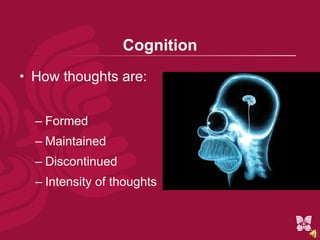
Cognition How thoughts are: Formed Maintained  Discontinued Intensity of thoughts
Cognitive Schema:  A Beck, 1993 Automatic Thoughts (Mental) Reactions to situations Real Imaginary/perceived Anticipatory Association among feelings, mood, and beliefs, behaviors
Cognitive Schema Conditional Beliefs More general than automatic thoughts Boolean logic: “If… than; and/or” Assumptions Roles/expectations Attitudes/values
Cognitive Schema More general than conditional beliefs Strongly held beliefs, underlying assumptions about who we are and our world Develop early in life and are often reinforced as we age Can become a ‘filter’ for interpreting life experiences (“self-fulfilling prophecies”)  Can be identified and changed! Core Beliefs (Self Efficacy)
Cognitive Schema:  Core Beliefs Two ‘varieties’ of defective core beliefs -  Beck 1993 Un-lovable unworthy; irrelevant; needy; self-centered Incompetent defective; helpless; failure; screw-up
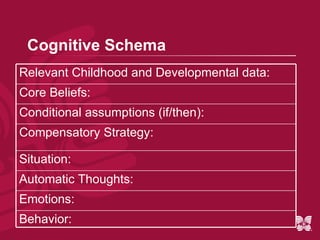
The Complete Cognitive Schema Relevant Childhood and Developmental data: Core Beliefs: Conditional assumptions (if/then): Compensatory Strategy: Situation: Automatic Thoughts: Emotions: Behavior:
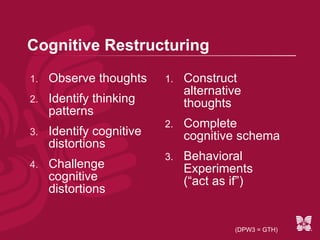
Cognitive Restructuring Observe thoughts Identify thinking patterns Identify cognitive distortions Challenge cognitive distortions Construct alternative thoughts/beliefs Complete cognitive schema Behavioral Experiments  (“act as if”) Validate (#1) (DPW3 = GTH)
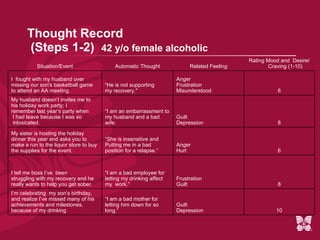
Thought Record  (Steps 1-2)  42 y/o female alcoholic Situation/Event Automatic Thought Related Feeling Rating Mood and  Desire/Craving (1-10) I  fought with my husband over missing our son's basketball game to attend an AA meeting. “ He is not supporting my recovery." Anger  Frustration Misunderstood 6 My husband invites me to  his holiday work party; I  remember last year’s party when I had leave because I was so intoxicated. “ I am an embarrassment to  my husband and a bad  wife. Guilt Depression 8 My sister is hosting the holiday dinner this year and asks me to make a run to the liquor store to buy the supplies for the event. “ She is insensitive and Putting me in a bad position for a relapse.” Anger Hurt 6 I tell me boss I’ve  been struggling with my recovery and he really wants to help me get sober. “ I am a bad employee for  letting my drinking affect my  work.” Frustration Guilt 8 I’m celebrating my son’s birthday,  and realize I’ve missed many of his achievements and milestones  because of my drinking “ I am a bad mother for letting him down for so long.” Guilt Depression 10
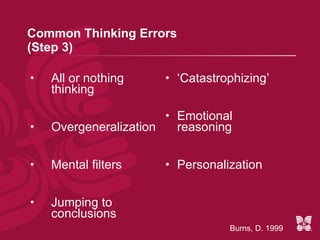
Common Cognitive Distortions (Step 3) Dichotomous thinking  Overgeneralization Mental filters Jumping to conclusions ‘ Catastrophizing’ Emotional reasoning Personalization Burns, D. 1999
Thought Record - Cognitive Distortions (Steps 3)  42 y/o female alcoholic Overgeneralization and catastrophizing Emotional reasoning and dichotomous thinking Catastrophizing Emotional reasoning and dichotomous thinking Emotional reasoning and dichotomous thinking “ He is not supporting my recovery.”   “ I am an embarrassment to my  husband and a bad wife.” “ She is insensitive and putting me in  a bad position for a relapse.” “ I am a bad employee for letting my drinking affect my  work.” “ I am a bad mother for letting him down for so long.”
 
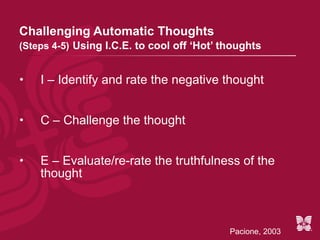
Challenging Automatic Thoughts (Steps 4-5)   Using I.C.E. to cool off ‘Hot’ thoughts I – Identify/rate the thought C – Challenge the thought E – Evaluate/re-rate the truthfulness of the thought A. Pacione, 2003
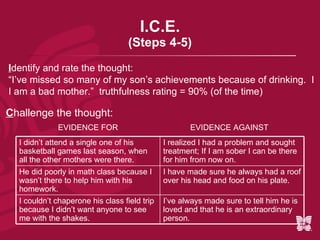
I.C.E. (Steps 4-5) I dentify and rate the thought:  “I’ve missed so many of my son’s achievements because of drinking.  I I am a bad mother.”  truthfulness rating = 90% (of the time) C hallenge the thought: I didn’t attend a single one of his basketball games last season, when all the other mothers were there. I realized I had a problem and sought treatment; If I am sober I can be there for him from now on. He did poorly in math class because I wasn’t there to help him with his homework. I have made sure he always had a roof over his head and food on his plate. I couldn’t chaperone his class field trip because I didn’t want anyone to see me with the shakes. I’ve always made sure to tell him he is loved and that he is an extraordinary person. EVIDENCE FOR EVIDENCE AGAINST
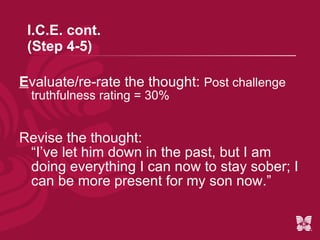
I.C.E. cont. (Step 4-5) E valuate/re-rate the thought:  Post challenge truthfulness rating = 30% Revise the thought:  “I’ve let him down in the past, but I am doing everything I can now to stay sober; I can be more present for my son.”
Practice Time! ICE your colleague
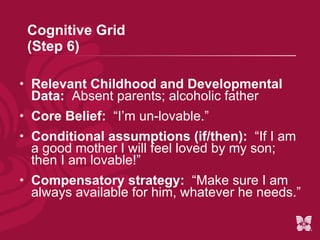
Cognitive Grid (Step 6) Relevant Childhood and Developmental Data:  Absent mother; alcoholic father Core Belief:  “I’m un-lovable.” Conditional assumptions (if/then):  “If I am a good mother I will feel loved by my son; then I am lovable!” Compensatory strategy:  “Make sure I am always available for him, whatever he needs.”
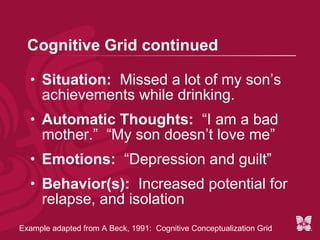
Cognitive Grid continued Situation:  Missed a lot of my son’s achievements while drinking. Automatic Thoughts:  “I am a bad mother.”  “My son doesn’t love me” Emotions:  “Depression and guilt” Behavior(s):  Increased potential for isolation, self-sabotage, and relapse
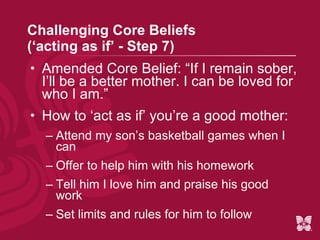
Challenging Core Beliefs (‘acting as if’ - Step 7) Amended Core Belief: “If I remain sober, I’ll be a better mother. I can be loved for who I am.”  How to ‘act as if’ you’re a good mother: Attend my son’s basketball games when I can Offer to help him with his homework Tell him I love him and praise his good work Set limits and rules for him to follow
Practice Time! Create a Cognitive Grid
Mindfulness =  Becoming More Aware More Often  “ A powerful influence taking us away from being ‘fully present’ in each moment is our automatic tendency to judge our experience as being not quite right in some way—that it is not what should be happening, not good enough, or not what we expected or wanted.  These judgments can lead to sequences of thoughts about blame, what needs to be changed or how things could or should be different.  Often, these thoughts will take us, quite automatically down some fairly well-worn paths in our minds.  In this way, we may lose awareness of the moment, and also the freedom to choose what if any, action needs to be taken.” Segal, et al. 2002
Mindfulness in recovery Thoughts     Judgments      Actions   Consequences Becoming more aware more often of Thinking patters Situations that activate your core belief Urges and craving to use
CBT + Mindfulness CBT = modifying  perception  beliefs and thoughts judgment Mindfulness = being more aware more often less interested in thought content focus on arising and ceasing of thought (DPW3= GTH)
Principles of Mindfulness Non-judging Patience Fresh Mind Trust Non-striving Acceptance Letting Go Kabat-Zinn, 1990
1. Non-judging Become aware of the judging thoughts Notice how often we label and categorize – assigning value to people and experiences Pain Vs. Suffering
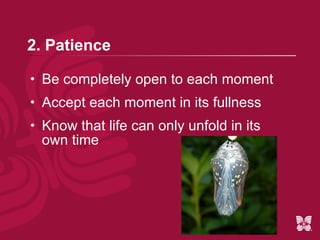
2. Patience Be completely open to each moment Accept each moment in its fullness Know that life can only unfold in its own time
3. Fresh Mind See things as if for the first time Be receptive to new possibilities – prevents getting stuck Experiment Try having a fresh mind with your partner, child, patient, or someone else familiar to you
4. Trust Develop trust within yourself  Knowing when to seek help You can’t have all the answers Don’t compare yourself to others The more we trust ourselves, the easier it is trust others and seek help
5. Non-striving Allowing anything we experience from moment to moment to  just be here Thinking of how you “should” be implies you are not ok right now “ IF  I weren’t so stressed at work,  THEN  I would be able to stay sober.”
6. Acceptance We have to accept ourselves and situations as they really are before things can change. Acceptance does NOT mean: You have to like everything  That you have to tolerate things as they “have to be” That you should stop trying or give up
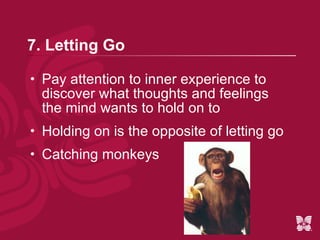
7. Letting Go Pay attention to inner experience to discover what thoughts and feelings the mind wants to hold on to Holding on is the opposite of letting go Example: Catching monkeys
Practice Time! De-centering Meditation
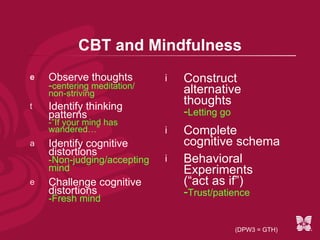
CBT and Mindfulness Observe thoughts - Centering meditation/ non-striving Identify thinking patterns - “If your mind has wandered…” Identify cognitive distortions -Non-judging/accepting mind   Challenge cognitive distortions -Fresh mind Construct alternative thoughts - Letting go Complete cognitive schema Behavioral Experiments  (“act as if”) - T rust/patience (DPW3 = GTH)
Bibliography Beck, A., Wright, F., Newman, C. Liese, B. (1993).  Cognitive Therapy of Substance Abuse .  New York: The Guilford Press, Inc. Burns, David.  (1999).  Feeling Good (revised edition) .  New York: Avon Books. Kabat-Zinn, John. (1994).  Wherever you go there you are: mindfulness meditation in everyday life .  New York: Hyperion. Kabat-Zinn, John.  (1990).  Full catastrophe living: using the wisdom of your body and mind to face stress, pain, and illness .  New York: Dell Publishing. Project MATCH Research Group. (1993 and 2000). Project MATCH: Rationale and methods for a multisite clinical trial matching patients to alcoholism treatment.  Alcoholism: Clinical and Experimental Research, 17,  1130-1145.  Segal, ZV, Williams, JM, Teasdal, JD.  (2002).  Mindfulness-Based Cognitive therapy for Depression: A new approach to preventing relapse.   New York: The Gilford Press.

Cognitive Behavioral Therapy and Mindfulness

  • 1.
    Cognitive Behavioral Therapyand Mindfulness in Addiction Treatment Tony Pacione, LCSW, CSADC
  • 2.
    Objectives On ourSlate for today… Why CBT/Mindfulness for addictions? Role of automatic thoughts Identifying and changing thought patterns Self management of mood, and craving states Understand and Define Mindfulness Meditation (Dr. Angres) For HRC… Implement CBT and Mindfulness Disclaimers…
  • 3.
    In Early Recovery,Cover Your… A S S ccountability tructure upport Pacione and Buino, 2009
  • 4.
    Accountability… … forWHAT you are responsible in recovery Understanding your thoughts Identifying thinking patterns Willingness to change ineffective thinking
  • 5.
    Structure… …HOW you achieve your goals in recovery Thought log Challenging thoughts ‘Acting as if’ strategies Meditation/mindfulness techniques
  • 6.
    Support … …WHOwill support your efforts Treatment Counselors Sponsor Therapist Psychiatrist Self-help Family/friends
  • 7.
    Cognition How thoughtsare: Formed Maintained Discontinued Intensity of thoughts
  • 8.
    Cognitive Schema: A Beck, 1993 Automatic Thoughts (Mental) Reactions to situations Real Imaginary/perceived Anticipatory Association among feelings, mood, and beliefs, behaviors
  • 9.
    Cognitive Schema ConditionalBeliefs More general than automatic thoughts Boolean logic: “If… than; and/or” Assumptions Roles/expectations Attitudes/values
  • 10.
    Cognitive Schema Moregeneral than conditional beliefs Strongly held beliefs, underlying assumptions about who we are and our world Develop early in life and are often reinforced as we age Can become a ‘filter’ for interpreting life experiences (“self-fulfilling prophecies”) Can be identified and changed! Core Beliefs (Self Efficacy)
  • 11.
    Cognitive Schema: Core Beliefs Two ‘varieties’ of defective core beliefs - Beck 1993 Un-lovable unworthy; irrelevant; needy; self-centered Incompetent defective; helpless; failure; screw-up
  • 12.
    The Complete CognitiveSchema Relevant Childhood and Developmental data: Core Beliefs: Conditional assumptions (if/then): Compensatory Strategy: Situation: Automatic Thoughts: Emotions: Behavior:
  • 13.
    Cognitive Restructuring Observethoughts Identify thinking patterns Identify cognitive distortions Challenge cognitive distortions Construct alternative thoughts/beliefs Complete cognitive schema Behavioral Experiments (“act as if”) Validate (#1) (DPW3 = GTH)
  • 14.
    Thought Record (Steps 1-2) 42 y/o female alcoholic Situation/Event Automatic Thought Related Feeling Rating Mood and Desire/Craving (1-10) I fought with my husband over missing our son's basketball game to attend an AA meeting. “ He is not supporting my recovery." Anger Frustration Misunderstood 6 My husband invites me to his holiday work party; I remember last year’s party when I had leave because I was so intoxicated. “ I am an embarrassment to my husband and a bad wife. Guilt Depression 8 My sister is hosting the holiday dinner this year and asks me to make a run to the liquor store to buy the supplies for the event. “ She is insensitive and Putting me in a bad position for a relapse.” Anger Hurt 6 I tell me boss I’ve been struggling with my recovery and he really wants to help me get sober. “ I am a bad employee for letting my drinking affect my work.” Frustration Guilt 8 I’m celebrating my son’s birthday, and realize I’ve missed many of his achievements and milestones because of my drinking “ I am a bad mother for letting him down for so long.” Guilt Depression 10
  • 15.
    Common Cognitive Distortions(Step 3) Dichotomous thinking Overgeneralization Mental filters Jumping to conclusions ‘ Catastrophizing’ Emotional reasoning Personalization Burns, D. 1999
  • 16.
    Thought Record -Cognitive Distortions (Steps 3) 42 y/o female alcoholic Overgeneralization and catastrophizing Emotional reasoning and dichotomous thinking Catastrophizing Emotional reasoning and dichotomous thinking Emotional reasoning and dichotomous thinking “ He is not supporting my recovery.” “ I am an embarrassment to my husband and a bad wife.” “ She is insensitive and putting me in a bad position for a relapse.” “ I am a bad employee for letting my drinking affect my work.” “ I am a bad mother for letting him down for so long.”
  • 17.
  • 18.
    Challenging Automatic Thoughts(Steps 4-5) Using I.C.E. to cool off ‘Hot’ thoughts I – Identify/rate the thought C – Challenge the thought E – Evaluate/re-rate the truthfulness of the thought A. Pacione, 2003
  • 19.
    I.C.E. (Steps 4-5)I dentify and rate the thought: “I’ve missed so many of my son’s achievements because of drinking. I I am a bad mother.” truthfulness rating = 90% (of the time) C hallenge the thought: I didn’t attend a single one of his basketball games last season, when all the other mothers were there. I realized I had a problem and sought treatment; If I am sober I can be there for him from now on. He did poorly in math class because I wasn’t there to help him with his homework. I have made sure he always had a roof over his head and food on his plate. I couldn’t chaperone his class field trip because I didn’t want anyone to see me with the shakes. I’ve always made sure to tell him he is loved and that he is an extraordinary person. EVIDENCE FOR EVIDENCE AGAINST
  • 20.
    I.C.E. cont. (Step4-5) E valuate/re-rate the thought: Post challenge truthfulness rating = 30% Revise the thought: “I’ve let him down in the past, but I am doing everything I can now to stay sober; I can be more present for my son.”
  • 21.
    Practice Time! ICEyour colleague
  • 22.
    Cognitive Grid (Step6) Relevant Childhood and Developmental Data: Absent mother; alcoholic father Core Belief: “I’m un-lovable.” Conditional assumptions (if/then): “If I am a good mother I will feel loved by my son; then I am lovable!” Compensatory strategy: “Make sure I am always available for him, whatever he needs.”
  • 23.
    Cognitive Grid continuedSituation: Missed a lot of my son’s achievements while drinking. Automatic Thoughts: “I am a bad mother.” “My son doesn’t love me” Emotions: “Depression and guilt” Behavior(s): Increased potential for isolation, self-sabotage, and relapse
  • 24.
    Challenging Core Beliefs(‘acting as if’ - Step 7) Amended Core Belief: “If I remain sober, I’ll be a better mother. I can be loved for who I am.” How to ‘act as if’ you’re a good mother: Attend my son’s basketball games when I can Offer to help him with his homework Tell him I love him and praise his good work Set limits and rules for him to follow
  • 25.
    Practice Time! Createa Cognitive Grid
  • 26.
    Mindfulness = Becoming More Aware More Often “ A powerful influence taking us away from being ‘fully present’ in each moment is our automatic tendency to judge our experience as being not quite right in some way—that it is not what should be happening, not good enough, or not what we expected or wanted. These judgments can lead to sequences of thoughts about blame, what needs to be changed or how things could or should be different. Often, these thoughts will take us, quite automatically down some fairly well-worn paths in our minds. In this way, we may lose awareness of the moment, and also the freedom to choose what if any, action needs to be taken.” Segal, et al. 2002
  • 27.
    Mindfulness in recoveryThoughts  Judgments  Actions  Consequences Becoming more aware more often of Thinking patters Situations that activate your core belief Urges and craving to use
  • 28.
    CBT + MindfulnessCBT = modifying perception beliefs and thoughts judgment Mindfulness = being more aware more often less interested in thought content focus on arising and ceasing of thought (DPW3= GTH)
  • 29.
    Principles of MindfulnessNon-judging Patience Fresh Mind Trust Non-striving Acceptance Letting Go Kabat-Zinn, 1990
  • 30.
    1. Non-judging Becomeaware of the judging thoughts Notice how often we label and categorize – assigning value to people and experiences Pain Vs. Suffering
  • 31.
    2. Patience Becompletely open to each moment Accept each moment in its fullness Know that life can only unfold in its own time
  • 32.
    3. Fresh MindSee things as if for the first time Be receptive to new possibilities – prevents getting stuck Experiment Try having a fresh mind with your partner, child, patient, or someone else familiar to you
  • 33.
    4. Trust Developtrust within yourself Knowing when to seek help You can’t have all the answers Don’t compare yourself to others The more we trust ourselves, the easier it is trust others and seek help
  • 34.
    5. Non-striving Allowinganything we experience from moment to moment to just be here Thinking of how you “should” be implies you are not ok right now “ IF I weren’t so stressed at work, THEN I would be able to stay sober.”
  • 35.
    6. Acceptance Wehave to accept ourselves and situations as they really are before things can change. Acceptance does NOT mean: You have to like everything That you have to tolerate things as they “have to be” That you should stop trying or give up
  • 36.
    7. Letting GoPay attention to inner experience to discover what thoughts and feelings the mind wants to hold on to Holding on is the opposite of letting go Example: Catching monkeys
  • 37.
  • 38.
    CBT and MindfulnessObserve thoughts - Centering meditation/ non-striving Identify thinking patterns - “If your mind has wandered…” Identify cognitive distortions -Non-judging/accepting mind Challenge cognitive distortions -Fresh mind Construct alternative thoughts - Letting go Complete cognitive schema Behavioral Experiments (“act as if”) - T rust/patience (DPW3 = GTH)
  • 39.
    Bibliography Beck, A.,Wright, F., Newman, C. Liese, B. (1993). Cognitive Therapy of Substance Abuse . New York: The Guilford Press, Inc. Burns, David. (1999). Feeling Good (revised edition) . New York: Avon Books. Kabat-Zinn, John. (1994). Wherever you go there you are: mindfulness meditation in everyday life . New York: Hyperion. Kabat-Zinn, John. (1990). Full catastrophe living: using the wisdom of your body and mind to face stress, pain, and illness . New York: Dell Publishing. Project MATCH Research Group. (1993 and 2000). Project MATCH: Rationale and methods for a multisite clinical trial matching patients to alcoholism treatment. Alcoholism: Clinical and Experimental Research, 17, 1130-1145. Segal, ZV, Williams, JM, Teasdal, JD. (2002). Mindfulness-Based Cognitive therapy for Depression: A new approach to preventing relapse. New York: The Gilford Press.

Editor's Notes

  • #5 Accountability – what you are responsible for bringing to recovery
  • #6 Structure – what tools are available to help you accomplish CBT goals in recovery
  • #7 Support – who is available to assist you in putting together your strengths + the tools to help you on the path for recovery
  • #16 All or nothing thinking : If your performance falls short of perfection, you see yourself as a total failure Overgeneralization : You see a single negative event as a never-ending pattern of defeat Mental filters : you may dwell on a single negative event; until it distorts your view of things as they really are. You are apt to disqualify the positives in your experience because they “don’t count” Jumping to conclusions : You may generate negative interpretations of events before all the facts are in ‘ Catastrophizing’ : You may exaggerate the importance of negative events; or conversely, minimize the importance of positive events Emotional reasoning: You believe your bad feeling about events are an accurate reflection on how events really are—“I feel like a loser, so I must be” Personalization: You erroneously believe that you are the primary cause of negative events, you may not have responsibility for
  • #28 Perhaps you have struggled with the thought that “this class won’t work; I tried to change my stress level but it seems only to get worse.” If you take hold of thoughts like this, or most other troubling thoughts, too often they can lead to disastrous consequences. You can very quickly and efficiently convince yourself that this thought (and others like it) must be true—“I think therefore I am!” If I tried and failed before, I ‘know’ it won’t work, then why bother to seek help at all. Thoughts and feelings can lead to judgments, which lead to actions, and actions lead to consequences.