COMPENSA
TION
OBJECTIVES &
TYPES
INTRODUCTION
“Payment given to an employee for his/her services or work performed
and in the form of wage/salary”.
“Establishment and implementation of sound policies, programmes
and practices of employee compensation”
Both remuneration and compensation are not interchangeable.
Compensation as referring to monetary payments while
Remuneration refers to both monetary and non-monetary
payments.
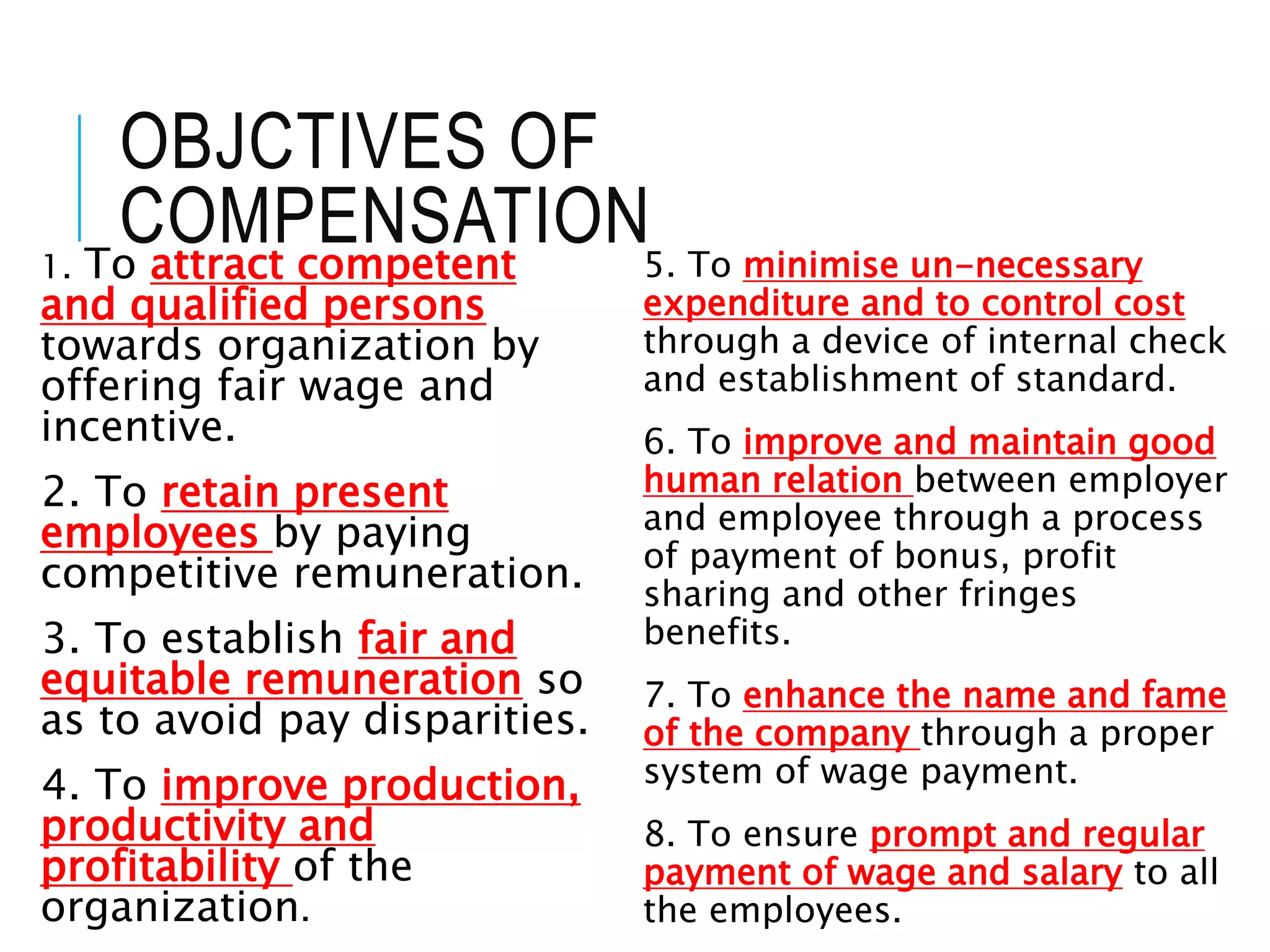
OBJCTIVES OF
COMPENSATION1. To attract competent
and qualified persons
towards organization by
offering fair wage and
incentive.
2. To retain present
employees by paying
competitive remuneration.
3. To establish fair and
equitable remuneration so
as to avoid pay disparities.
4. To improve production,
productivity and
profitability of the
organization.
5. To minimise un-necessary
expenditure and to control cost
through a device of internal check
and establishment of standard.
6. To improve and maintain good
human relation between employer
and employee through a process
of payment of bonus, profit
sharing and other fringes
benefits.
7. To enhance the name and fame
of the company through a proper
system of wage payment.
8. To ensure prompt and regular
payment of wage and salary to all
the employees.
FACTORS INFLUENCING
COMPENSATION
Ability of the organization to pay
Supply and Demand of labor
Prevailing Market Rate
The Cost of Living
Strength of labor union
The living wage
Government regulations
Productivity of Employees
Skill Levels Available in the Market
Uniqueness of the job
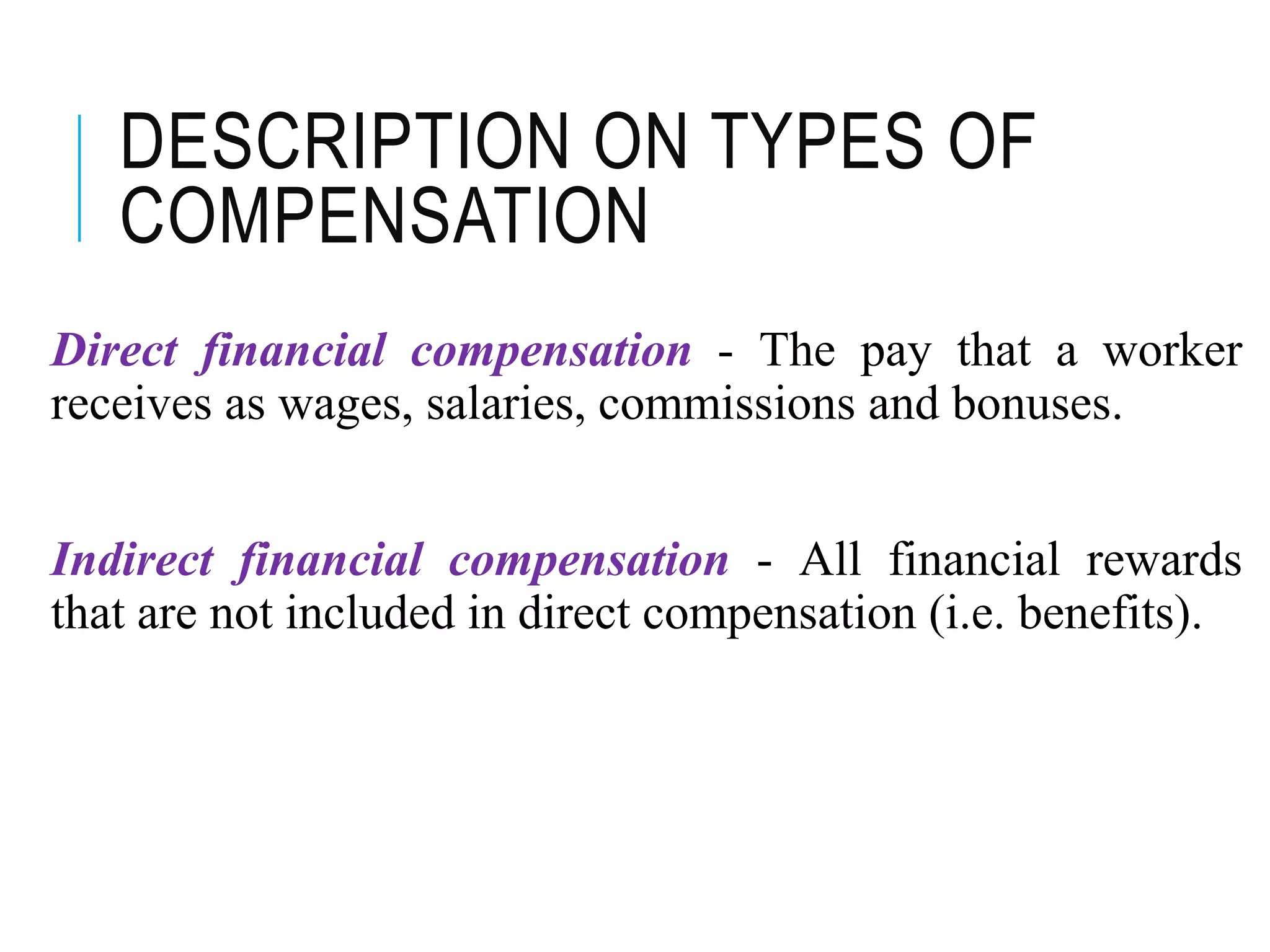
DESCRIPTION ON TYPES OF
COMPENSATION
Direct financial compensation - The pay that a worker
receives as wages, salaries, commissions and bonuses.
Indirect financial compensation - All financial rewards
that are not included in direct compensation (i.e. benefits).
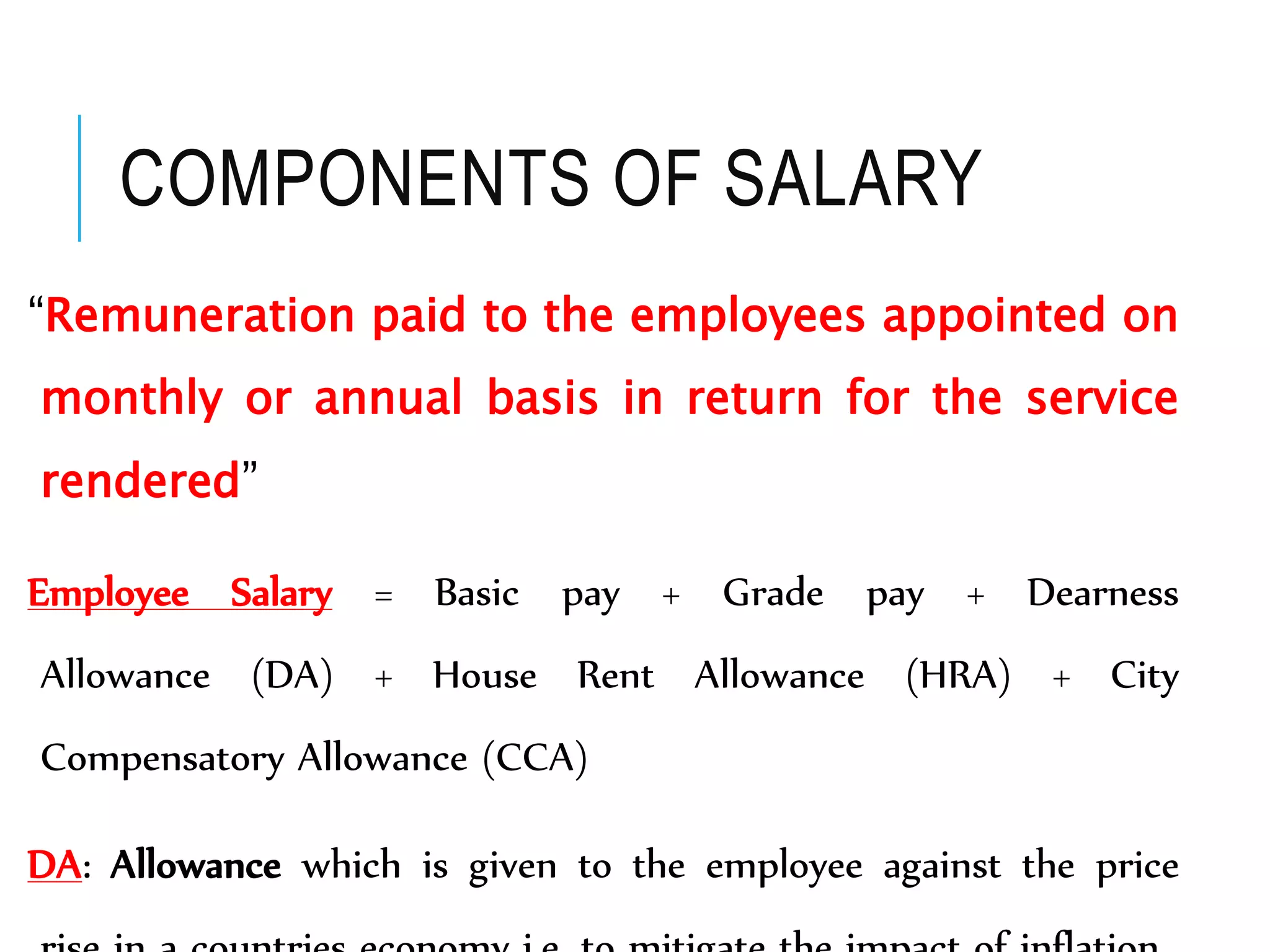
COMPONENTS OF SALARY
“Remuneration paid to the employees appointed on
monthly or annual basis in return for the service
rendered”
Employee Salary = Basic pay + Grade pay + Dearness
Allowance (DA) + House Rent Allowance (HRA) + City
Compensatory Allowance (CCA)
DA: Allowance which is given to the employee against the price
FRINGE BENEFITS
It is a general term used to describe any of a
variety of non-wage or supplemental benefits
that employees receive in addition to their
regular wages.
These include such employee benefits as
provident fund, gratuity, medical care,
hospitalization, accident relief, paid holidays,
PERQUISITES
Called as perks
They are the special benefits made
available only to the top executives of an
organisation.
These may include company car,
furnished house, stock option scheme,
club membership, paid holidays etc.
WAGES
Remuneration paid to the workers
appointed on hourly, daily or
weekly basis in return for the
service rendered.
TYPES:
Fair wage
Minimum wage
Living wage
MINIMUM WAGE
It is that wage which is sufficient to
meet the basic need of a worker and his
family.
This minimum wage has to be paid to
the worker irrespective of the capacity
of the industry to pay.
Minimum wage must provide some
measures of education, medical
requirements and amenities”.
FAIR WAGE
According to committee on fair wage “fair wage is the
wage which is above the minimum wage but, below the
living wage”.
It is fixed between the minimum wage and capacity to
pay by the industry.
The lower limit of the fair wage is the minimum wage;
the upper limit is set by the capacity of the industry to
pay.
Factors determining Fair Wage:
(a)The productivity of labour
(b) The prevailing rates of wage in the same or
neighboring localities.
LIVING WAGE
It is the wage that provides some of the comforts of
life.
For the well-being of the worker.
According to Fair Wage Committee “the living wage
should enable the male earner to provide for himself
and his family not merely the bare essentials of food,
clothing and shelter but also a measure of frugal (using
only as much money or food as is necessary) comfort
including
education for children,
protection against ill health,
requirements of essential social needs and
measure of insurance against mis-fortunes including
TYPES OF DIRECT
COMPENSATION
Salary
Wage
Incentive
Bonus
Commission
Overtime pay
Vacation pay
Performance-related payments
INDIRECT COMPENSATION
Restaurant coupons
• Movie tickets
• Recognition of birthdays
• Free lunches, snacks, or
beverages
• Employee discounts
• Tuition Reimbursement
• Flex time • Personalized
items (shirts, jackets, brief
cases, planners, mugs, hats)
Loan assistance
Paid sabbaticals (Leave
For Education)
Healthcare benefits
Additional life insurance
Free cell phone or other
technology products

Compensation Management

  • 1.
  • 2.
    INTRODUCTION “Payment given toan employee for his/her services or work performed and in the form of wage/salary”. “Establishment and implementation of sound policies, programmes and practices of employee compensation” Both remuneration and compensation are not interchangeable. Compensation as referring to monetary payments while Remuneration refers to both monetary and non-monetary payments.
  • 3.
    OBJCTIVES OF COMPENSATION1. Toattract competent and qualified persons towards organization by offering fair wage and incentive. 2. To retain present employees by paying competitive remuneration. 3. To establish fair and equitable remuneration so as to avoid pay disparities. 4. To improve production, productivity and profitability of the organization. 5. To minimise un-necessary expenditure and to control cost through a device of internal check and establishment of standard. 6. To improve and maintain good human relation between employer and employee through a process of payment of bonus, profit sharing and other fringes benefits. 7. To enhance the name and fame of the company through a proper system of wage payment. 8. To ensure prompt and regular payment of wage and salary to all the employees.
  • 4.
    FACTORS INFLUENCING COMPENSATION Ability ofthe organization to pay Supply and Demand of labor Prevailing Market Rate The Cost of Living Strength of labor union The living wage Government regulations Productivity of Employees Skill Levels Available in the Market Uniqueness of the job
  • 5.
    DESCRIPTION ON TYPESOF COMPENSATION Direct financial compensation - The pay that a worker receives as wages, salaries, commissions and bonuses. Indirect financial compensation - All financial rewards that are not included in direct compensation (i.e. benefits).
  • 7.
    COMPONENTS OF SALARY “Remunerationpaid to the employees appointed on monthly or annual basis in return for the service rendered” Employee Salary = Basic pay + Grade pay + Dearness Allowance (DA) + House Rent Allowance (HRA) + City Compensatory Allowance (CCA) DA: Allowance which is given to the employee against the price
  • 8.
    FRINGE BENEFITS It isa general term used to describe any of a variety of non-wage or supplemental benefits that employees receive in addition to their regular wages. These include such employee benefits as provident fund, gratuity, medical care, hospitalization, accident relief, paid holidays,
  • 9.
    PERQUISITES Called as perks Theyare the special benefits made available only to the top executives of an organisation. These may include company car, furnished house, stock option scheme, club membership, paid holidays etc.
  • 10.
    WAGES Remuneration paid tothe workers appointed on hourly, daily or weekly basis in return for the service rendered. TYPES: Fair wage Minimum wage Living wage
  • 11.
    MINIMUM WAGE It isthat wage which is sufficient to meet the basic need of a worker and his family. This minimum wage has to be paid to the worker irrespective of the capacity of the industry to pay. Minimum wage must provide some measures of education, medical requirements and amenities”.
  • 12.
    FAIR WAGE According tocommittee on fair wage “fair wage is the wage which is above the minimum wage but, below the living wage”. It is fixed between the minimum wage and capacity to pay by the industry. The lower limit of the fair wage is the minimum wage; the upper limit is set by the capacity of the industry to pay. Factors determining Fair Wage: (a)The productivity of labour (b) The prevailing rates of wage in the same or neighboring localities.
  • 13.
    LIVING WAGE It isthe wage that provides some of the comforts of life. For the well-being of the worker. According to Fair Wage Committee “the living wage should enable the male earner to provide for himself and his family not merely the bare essentials of food, clothing and shelter but also a measure of frugal (using only as much money or food as is necessary) comfort including education for children, protection against ill health, requirements of essential social needs and measure of insurance against mis-fortunes including
  • 14.
  • 15.
    INDIRECT COMPENSATION Restaurant coupons •Movie tickets • Recognition of birthdays • Free lunches, snacks, or beverages • Employee discounts • Tuition Reimbursement • Flex time • Personalized items (shirts, jackets, brief cases, planners, mugs, hats) Loan assistance Paid sabbaticals (Leave For Education) Healthcare benefits Additional life insurance Free cell phone or other technology products