EMOTION RECOGNITION USING SMARTPHONES 
-Madhusudhan (17)
OBJECTIVE 
• To propose the development of android applications 
that can be used for sensing the emotions of people 
for their better health. 
• To provide better services and also better Human-machine 
interactions
INTRODUCTION 
• Emotions control your thinking, behavior and 
actions. 
• Emotions affect your physical bodies as much as 
your body affects your feelings and thinking. 
• People who ignore, dismiss or repress their 
emotions, are setting themselves up for physical 
illness.
DETECTION 
• Detection of emotional info can be done with 
passive sensors which capture data about the user's 
physical state or behavior without interpreting the 
input. 
• A video camera might capture facial expressions, 
body posture and gestures. 
• A microphone can capture speech.
• A pressure sensor/accelerometer can capture heart 
rate. 
• Other sensors detect emotional cues from skin 
temperature.
RECOGNIZING 
• Extraction of information for meaningful patterns 
from the gathered data 
• Speech recognition, natural language processing, 
or facial expression detection 
• These techniques should either produce labels or 
efficient inference algorithms to extract high-level 
information from the data.
SPEECH 
• Requires the creation of a reliable database 
or knowledge base as well as the selection of a 
successful classifier which will allow for quick and 
accurate emotion identification. 
• Currently, the most frequently used classifiers are 
linear discriminant classifiers (LDC), k-nearest 
neighbour (k-NN), Gaussian mixture model (GMM), 
support vector machines (SVM), artificial neural 
networks (ANN), decision tree algorithms and 
hidden Markov models (HMMs).
FACIAL EXPRESSIONS 
• Defining expressions in terms of muscle actions A 
system has been conceived in order to formally 
categorize the physical expression of emotions. 
• By studying the contraction or a relaxation of one or 
more muscles. 
• The concept of the Facial Action Coding System, or 
FACS created by Paul Ekman and Wallace V. 
Friesen in 1978 
• Eg. Affdex
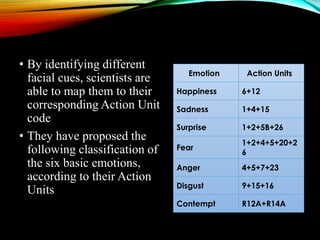
• By identifying different 
facial cues, scientists are 
able to map them to their 
corresponding Action Unit 
code 
• They have proposed the 
following classification of 
the six basic emotions, 
according to their Action 
Units 
Emotion Action Units 
Happiness 6+12 
Sadness 1+4+15 
Surprise 1+2+5B+26 
Fear 
1+2+4+5+20+2 
6 
Anger 4+5+7+23 
Disgust 9+15+16 
Contempt R12A+R14A
HEART BEAT 
• One of the most commonly used techniques is by 
using pressure sensors/accelerometer. 
• The heart rate can also be collected using the Optical 
pulse sensor Eg. Samsung galaxy S5. 
• Heart Rate Variability (HRV) signals is derived from 
ECG signals through QRS detection algorithm.
• It is used as a statistical feature to distinguish the 
emotional stress, through a nonlinear classifier (K 
Nearest Neighbor (KNN))into three different classes 
namely, negative emotions, positive emotions 
(surprise and happy) and neutral.
CONCLUSION 
• To understand the emotions with the help of 
smartphones will help in achieving greater success 
in the lives of people. 
• Using smartphones to do this will make it much 
more easier for researchers and scientists.
REFERENCES 
• http://www.mkprojects.com/fa_emotions.html by By Mary 
Kurus 
• Emotion Recognition from Speech by Ankur Sapra, Nikhil 
Panwar, Sohan Panwar -Jaypee Institute of Information 
Technology, Noida 
• http://en.wikipedia.org/wiki/Affective_computing#Emotional_s 
peech 
• Mobile Sensor Data Collector using Android Smartphone by 
Won-Jae Yi, Weidi Jia, and Jafar Saniie - Department of 
Electrical and Computer Engineering, Illinois Institute of 
Technology 
• EmotionSense: A Mobile Phones based Adaptive Platform for 
Experimental Social Psychology Research
THANK YOU

Emotion recognition

  • 1.
    EMOTION RECOGNITION USINGSMARTPHONES -Madhusudhan (17)
  • 2.
    OBJECTIVE • Topropose the development of android applications that can be used for sensing the emotions of people for their better health. • To provide better services and also better Human-machine interactions
  • 3.
    INTRODUCTION • Emotionscontrol your thinking, behavior and actions. • Emotions affect your physical bodies as much as your body affects your feelings and thinking. • People who ignore, dismiss or repress their emotions, are setting themselves up for physical illness.
  • 5.
    DETECTION • Detectionof emotional info can be done with passive sensors which capture data about the user's physical state or behavior without interpreting the input. • A video camera might capture facial expressions, body posture and gestures. • A microphone can capture speech.
  • 6.
    • A pressuresensor/accelerometer can capture heart rate. • Other sensors detect emotional cues from skin temperature.
  • 7.
    RECOGNIZING • Extractionof information for meaningful patterns from the gathered data • Speech recognition, natural language processing, or facial expression detection • These techniques should either produce labels or efficient inference algorithms to extract high-level information from the data.
  • 8.
    SPEECH • Requiresthe creation of a reliable database or knowledge base as well as the selection of a successful classifier which will allow for quick and accurate emotion identification. • Currently, the most frequently used classifiers are linear discriminant classifiers (LDC), k-nearest neighbour (k-NN), Gaussian mixture model (GMM), support vector machines (SVM), artificial neural networks (ANN), decision tree algorithms and hidden Markov models (HMMs).
  • 9.
    FACIAL EXPRESSIONS •Defining expressions in terms of muscle actions A system has been conceived in order to formally categorize the physical expression of emotions. • By studying the contraction or a relaxation of one or more muscles. • The concept of the Facial Action Coding System, or FACS created by Paul Ekman and Wallace V. Friesen in 1978 • Eg. Affdex
  • 10.
    • By identifyingdifferent facial cues, scientists are able to map them to their corresponding Action Unit code • They have proposed the following classification of the six basic emotions, according to their Action Units Emotion Action Units Happiness 6+12 Sadness 1+4+15 Surprise 1+2+5B+26 Fear 1+2+4+5+20+2 6 Anger 4+5+7+23 Disgust 9+15+16 Contempt R12A+R14A
  • 11.
    HEART BEAT •One of the most commonly used techniques is by using pressure sensors/accelerometer. • The heart rate can also be collected using the Optical pulse sensor Eg. Samsung galaxy S5. • Heart Rate Variability (HRV) signals is derived from ECG signals through QRS detection algorithm.
  • 12.
    • It isused as a statistical feature to distinguish the emotional stress, through a nonlinear classifier (K Nearest Neighbor (KNN))into three different classes namely, negative emotions, positive emotions (surprise and happy) and neutral.
  • 13.
    CONCLUSION • Tounderstand the emotions with the help of smartphones will help in achieving greater success in the lives of people. • Using smartphones to do this will make it much more easier for researchers and scientists.
  • 14.
    REFERENCES • http://www.mkprojects.com/fa_emotions.htmlby By Mary Kurus • Emotion Recognition from Speech by Ankur Sapra, Nikhil Panwar, Sohan Panwar -Jaypee Institute of Information Technology, Noida • http://en.wikipedia.org/wiki/Affective_computing#Emotional_s peech • Mobile Sensor Data Collector using Android Smartphone by Won-Jae Yi, Weidi Jia, and Jafar Saniie - Department of Electrical and Computer Engineering, Illinois Institute of Technology • EmotionSense: A Mobile Phones based Adaptive Platform for Experimental Social Psychology Research
  • 15.

Editor's Notes

  • #10 Affdex is an award-winning neuromarketing tool that reads emotional states such as liking and attention from facial expressions using an ordinary webcam...to give marketers faster, more accurate insight into consumer response to brands, advertising and media.
  • #12 The QRS complex is a name for the combination of three of the graphical deflections seen on a typical electrocardiogram (ECG). It is usually the central and most visually obvious part of the tracing. It corresponds to the depolarization of the right and left ventricles of the human heart.