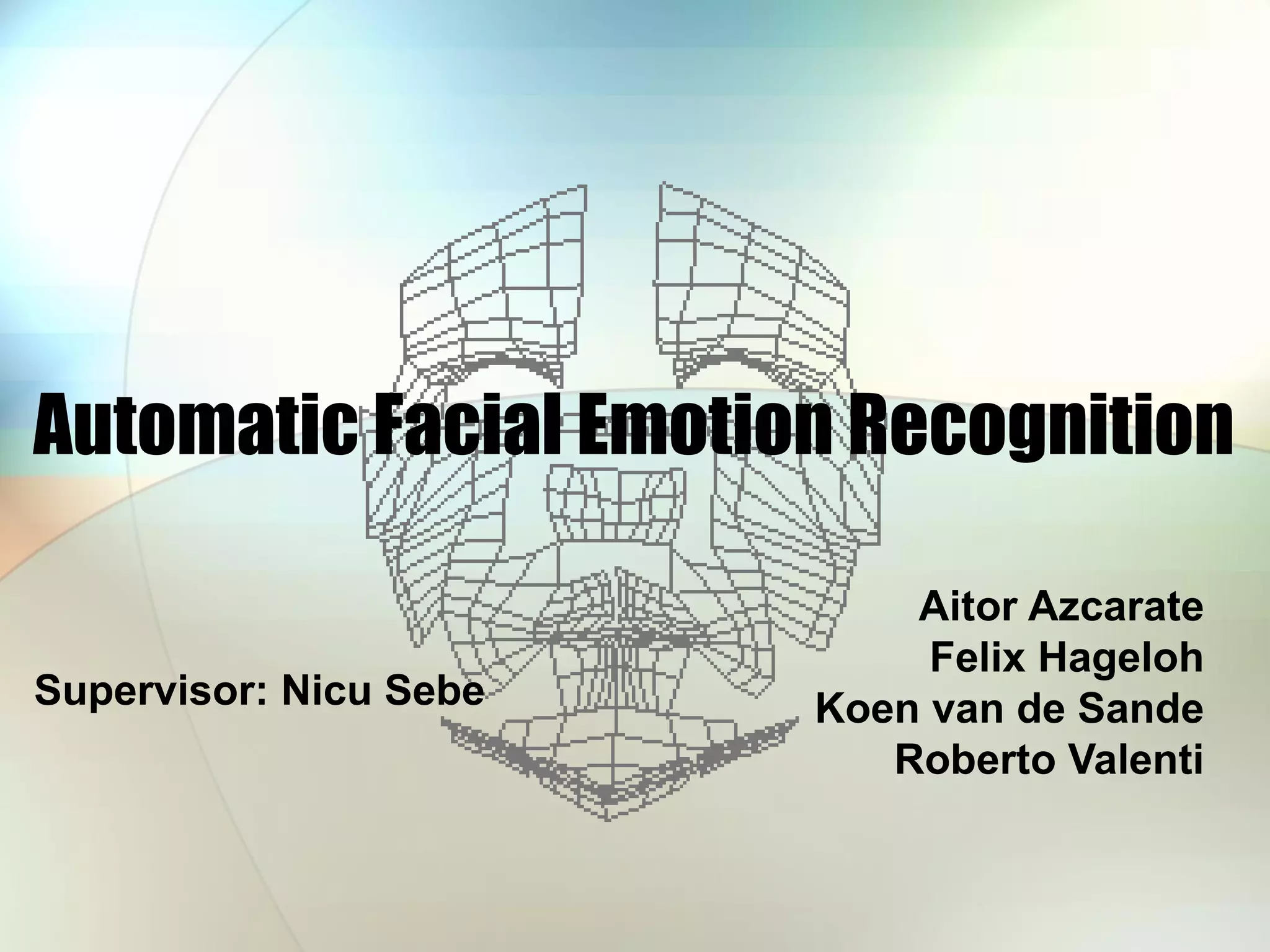
Automatic Facial Emotion Recognition
Aitor Azcarate
Felix Hageloh
Koen van de Sande
Roberto Valenti
Supervisor: Nicu Sebe
Overview
INTRODUCTION
RELATED WORK
EMOTION RECOGNITION

CLASSIFICATION
VISUALIZATION

FACE DETECTOR
DEMO

EVALUATION
FUTURE WORKS
CONCLUSION
QUESTIONS
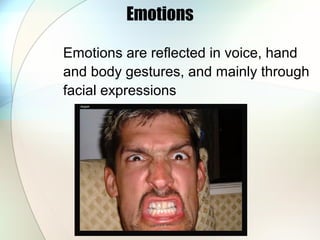
Emotions
Emotions are reflected in voice, hand
and body gestures, and mainly through
facial expressions
Emotions (2)
Why is it important to recognize emotions?
• Human beings express emotions in day to
day interactions
• Understanding emotions and knowing how
to react to people’s expressions greatly
enriches the interaction
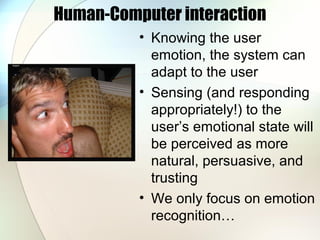
Human-Computer interaction
• Knowing the user
emotion, the system can
adapt to the user
• Sensing (and responding
appropriately!) to the
user’s emotional state will
be perceived as more
natural, persuasive, and
trusting
• We only focus on emotion
recognition…
Related work
Cross-cultural research by Ekman shows
that some emotional expressions are
universal:
• Happiness
• Sadness
• Anger
• Fear
• Disgust (maybe)
• Surprise (maybe)
Other emotional expressions are
culturally variable.
Related work (2)
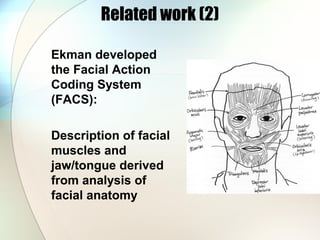
Ekman developed
the Facial Action
Coding System
(FACS):
Description of facial
muscles and
jaw/tongue derived
from analysis of
facial anatomy
Facial Expression Recognition
• Pantic & Rothkrantz in PAMI 2000
performed a survey of the field
• Recognize a generic procedure
amongst all systems:
• Extract features (provided by a tracking
system, for example)
• Feed the features into a classifier
• Classify to one of the pre-selected emotion
categories (6 universal emotions, or
6+neutral, or 4+neutral, etc)
Field overview: Extracting features
Systems have a model of the face and
update the model using video frames:
• Wavelets
• Dual-view point-based model
• Optical flow
• Surface patches in Bezier volumes
• Many, many more
From these models, features are
extracted.
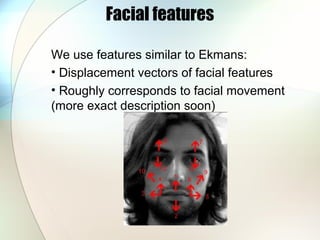
Facial features
We use features similar to Ekmans:
• Displacement vectors of facial features
• Roughly corresponds to facial movement
(more exact description soon)
Our Facial Model
Nice to use certain
features, but how do
we get them?
• Face tracking, based
on a system
developed by Tao and
Huang [CVPR98],
subsequently used by
Cohen, Sebe et al
[ICPR02]
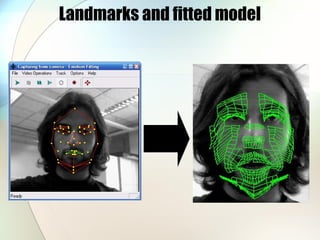
• First, landmark facial
features (e.g., eye
corners) are selected
interactively
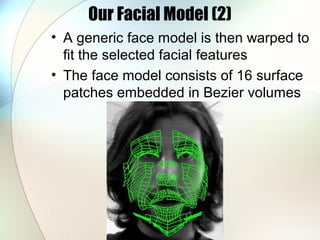
Our Facial Model (2)
• A generic face model is then warped to
fit the selected facial features
• The face model consists of 16 surface
patches embedded in Bezier volumes
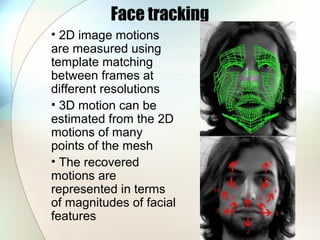
Face tracking
• 2D image motions
are measured using
template matching
between frames at
different resolutions
• 3D motion can be
estimated from the 2D
motions of many
points of the mesh
• The recovered
motions are
represented in terms
of magnitudes of facial
features
Related work: Classifiers
• People have used the whole range of
classifiers available on their set of
features (rule-based, Bayesian
networks, Neural networks, HMM, NB,
k-Nearest Neighbour, etc).
• See Pantic & Rothkrantz for an
overview of their performance.
• Boils down to: there is little training data
available, so if you need to estimate
many parameters for your classifier, you
can get in trouble.
Overview
INTRODUCTION
RELATED WORK
EMOTION RECOGNITION

CLASSIFICATION
VISUALIZATION

FACE DETECTOR
DEMO

EVALUATION
FUTURE WORKS
CONCLUSION
QUESTIONS
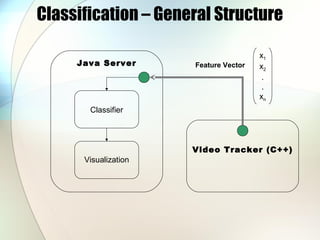
Classification – General Structure
Java Server
Classifier
Visualization
Video Tracker (C++)
x1
x2
.
.
xn
Feature Vector
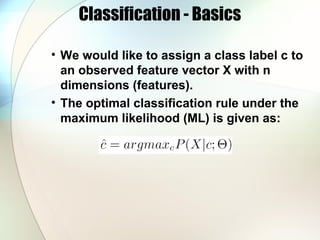
Classification - Basics
• We would like to assign a class label c to
an observed feature vector X with n
dimensions (features).
• The optimal classification rule under the
maximum likelihood (ML) is given as:
Classification - Basics
• Our feature vector has 12 features
• Classifier identifies 7 basic
emotions:
• Happiness
• Sadness
• Anger
• Fear
• Disgust
• Surprise
• No emotion (neutral)
The Classifiers
• Naïve Bayes
• Implemented ourselves
• TAN
• Used existing code
We compared two different
classifiers for emotion detection
The Classifiers - Naïve Bayes
• Well known classification method
• Easy to implement
• Known to give surprisingly good
results
• Simplicity stems from the
independence assumption
The Classifiers - Naïve Bayes
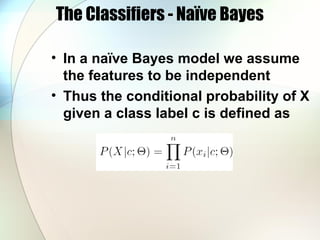
• In a naïve Bayes model we assume
the features to be independent
• Thus the conditional probability of X
given a class label c is defined as
The Classifiers - Naïve Bayes
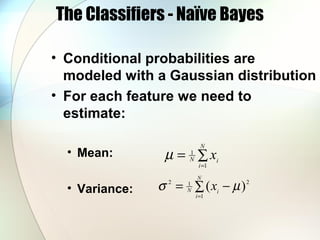
• Conditional probabilities are
modeled with a Gaussian distribution
• For each feature we need to
estimate:
• Mean:
• Variance:
∑=
=
N
i
iN x
1
1
µ
∑ −=
=
N
i
iN x
1
212
)( µσ
The Classifiers - Naïve Bayes
• Problems with Naïve Bayes:
• Independence assumption is weak
• Intuitively we can expect that there are
dependencies among features in facial
expressions
• We should try to model these
dependencies
The Classifiers - TAN
• Tree-Augmented-Naive Bayes
• Subclass of Bayesian network
classifiers
• Bayesian networks are an easy and
intuitive way to model joint
distributions
• (Naïve Bayes is actually a special
case of Bayesian networks)
The Classifiers - TAN
• The structure of the Baysian Network
is crucial for classification
• Ideally it should be learned from the
data set using ML
• But searching through all possible
dependencies is NP-Complete
• We should restrict ourselves to a
subclass of possible structures
The Classifiers - TAN
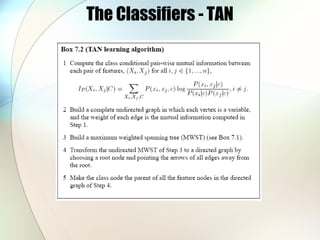
• TAN models are such a subclass
• Advantage: There exist an efficient
algorithm [Chow-Liu] to compute the
optimal TAN model
The Classifiers - TAN
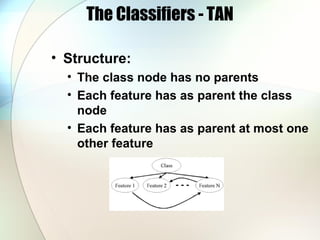
• Structure:
• The class node has no parents
• Each feature has as parent the class
node
• Each feature has as parent at most one
other feature
The Classifiers - TAN
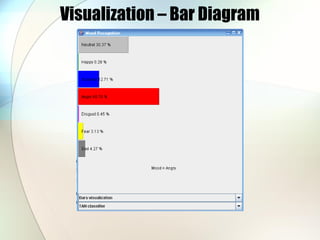
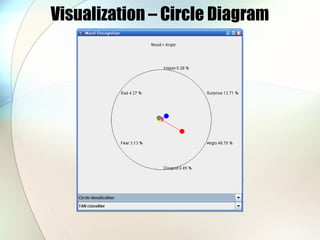
Visualization
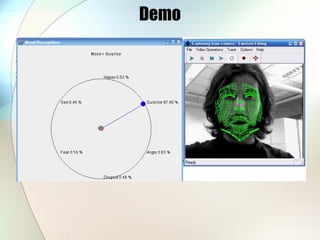
• Classification results are visualized
in two different ways
• Bar Diagram
• Circle Diagram
• Both implemented in java
Visualization – Bar Diagram
Visualization – Circle Diagram
Overview
INTRODUCTION
RELATED WORK
EMOTION RECOGNITION

CLASSIFICATION
VISUALIZATION

FACE DETECTOR
DEMO

EVALUATION
FUTURE WORKS
CONCLUSION
QUESTIONS
Landmarks and fitted model
Problems
• Mask fitting
• Scale independent
• Initialization “in place”
• Fitted Model
• Reinitialize the mesh in the correct
position when it gets lost
Solution?
FACE DETECTOR
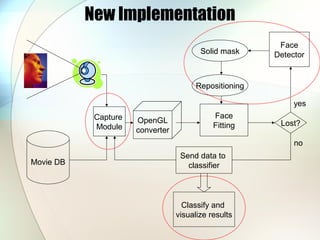
New Implementation
Movie DB
OpenGL
converter
Capture
Module
Face
Detector
Face
Fitting
Send data to
classifier
Lost?
Repositioning
yes
no
Classify and
visualize results
Solid mask
Face Detector
• Looking for a fast and reliable one
• Using the one proposed by Viola and
Jones
• Three main contributions:
• Integral Images
• Adaboost
• Classifiers in a cascade structure
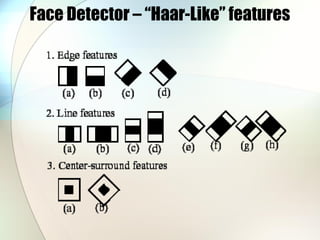
• Uses Haar-Like features to recognize
objects
Face Detector – “Haar-Like” features
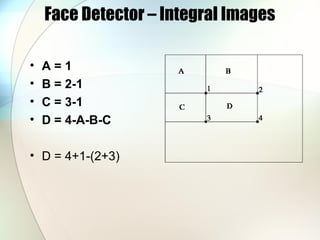
Face Detector – Integral Images
• A = 1
• B = 2-1
• C = 3-1
• D = 4-A-B-C
• D = 4+1-(2+3)
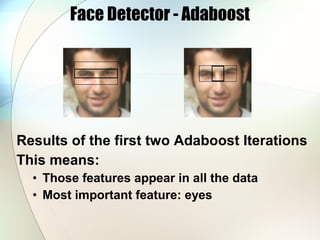
Face Detector - Adaboost
Results of the first two Adaboost Iterations
This means:
• Those features appear in all the data
• Most important feature: eyes
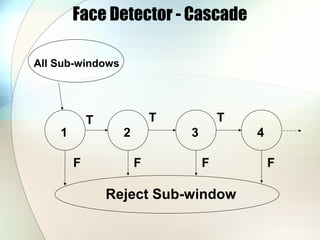
Face Detector - Cascade
All Sub-windows
T T T
Reject Sub-window
F F F F
1 2 3 4
Demo
Overview
INTRODUCTION
RELATED WORK
EMOTION RECOGNITION

CLASSIFICATION
VISUALIZATION

FACE DETECTOR
DEMO

EVALUATION
FUTURE WORKS
CONCLUSION
QUESTIONS
Evaluation
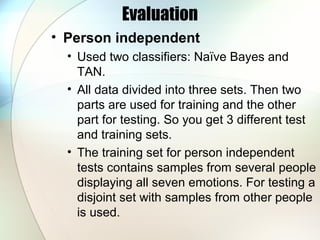
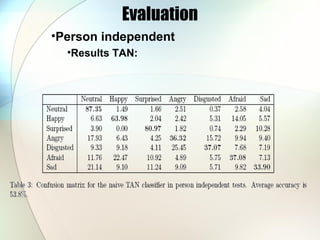
• Person independent
• Used two classifiers: Naïve Bayes and
TAN.
• All data divided into three sets. Then two
parts are used for training and the other
part for testing. So you get 3 different test
and training sets.
• The training set for person independent
tests contains samples from several people
displaying all seven emotions. For testing a
disjoint set with samples from other people
is used.
Evaluation
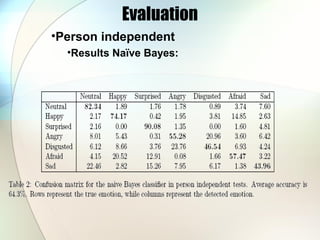
•Person independent
•Results Naïve Bayes:
Evaluation
•Person independent
•Results TAN:
Evaluation
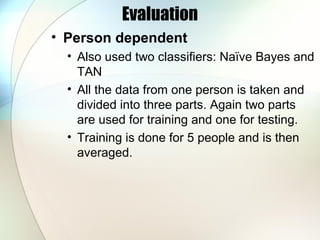
• Person dependent
• Also used two classifiers: Naïve Bayes and
TAN
• All the data from one person is taken and
divided into three parts. Again two parts
are used for training and one for testing.
• Training is done for 5 people and is then
averaged.
Evaluation
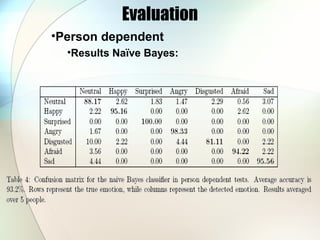
•Person dependent
•Results Naïve Bayes:
Evaluation
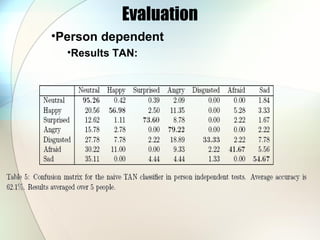
•Person dependent
•Results TAN:
Evaluation
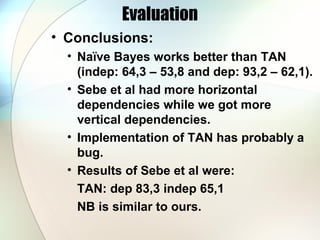
• Conclusions:
• Naïve Bayes works better than TAN
(indep: 64,3 – 53,8 and dep: 93,2 – 62,1).
• Sebe et al had more horizontal
dependencies while we got more
vertical dependencies.
• Implementation of TAN has probably a
bug.
• Results of Sebe et al were:
TAN: dep 83,3 indep 65,1
NB is similar to ours.
Future Work
• Handle partial occlusions better.
• Make it more robust (lighting
conditions etc.)
• More person independent (fit mask
automatically).
• Use other classifiers (dynamics).
• Apply emotion recognition in
applications. For example games.
Conclusions
• Our implementation is faster (due to
server connection)
• Can get input from different camera’s
• Changed code to be more efficient
• We have visualizations
• Use face detection
• Mask loading and recovery
Questions
?

4837410 automatic-facial-emotion-recognition

  • 1.
    Automatic Facial EmotionRecognition Aitor Azcarate Felix Hageloh Koen van de Sande Roberto Valenti Supervisor: Nicu Sebe
  • 2.
  • 3.
    Emotions Emotions are reflectedin voice, hand and body gestures, and mainly through facial expressions
  • 4.
    Emotions (2) Why isit important to recognize emotions? • Human beings express emotions in day to day interactions • Understanding emotions and knowing how to react to people’s expressions greatly enriches the interaction
  • 5.
    Human-Computer interaction • Knowingthe user emotion, the system can adapt to the user • Sensing (and responding appropriately!) to the user’s emotional state will be perceived as more natural, persuasive, and trusting • We only focus on emotion recognition…
  • 6.
    Related work Cross-cultural researchby Ekman shows that some emotional expressions are universal: • Happiness • Sadness • Anger • Fear • Disgust (maybe) • Surprise (maybe) Other emotional expressions are culturally variable.
  • 7.
    Related work (2) Ekmandeveloped the Facial Action Coding System (FACS): Description of facial muscles and jaw/tongue derived from analysis of facial anatomy
  • 8.
    Facial Expression Recognition •Pantic & Rothkrantz in PAMI 2000 performed a survey of the field • Recognize a generic procedure amongst all systems: • Extract features (provided by a tracking system, for example) • Feed the features into a classifier • Classify to one of the pre-selected emotion categories (6 universal emotions, or 6+neutral, or 4+neutral, etc)
  • 9.
    Field overview: Extractingfeatures Systems have a model of the face and update the model using video frames: • Wavelets • Dual-view point-based model • Optical flow • Surface patches in Bezier volumes • Many, many more From these models, features are extracted.
  • 10.
    Facial features We usefeatures similar to Ekmans: • Displacement vectors of facial features • Roughly corresponds to facial movement (more exact description soon)
  • 11.
    Our Facial Model Niceto use certain features, but how do we get them? • Face tracking, based on a system developed by Tao and Huang [CVPR98], subsequently used by Cohen, Sebe et al [ICPR02] • First, landmark facial features (e.g., eye corners) are selected interactively
  • 12.
    Our Facial Model(2) • A generic face model is then warped to fit the selected facial features • The face model consists of 16 surface patches embedded in Bezier volumes
  • 13.
    Face tracking • 2Dimage motions are measured using template matching between frames at different resolutions • 3D motion can be estimated from the 2D motions of many points of the mesh • The recovered motions are represented in terms of magnitudes of facial features
  • 14.
    Related work: Classifiers •People have used the whole range of classifiers available on their set of features (rule-based, Bayesian networks, Neural networks, HMM, NB, k-Nearest Neighbour, etc). • See Pantic & Rothkrantz for an overview of their performance. • Boils down to: there is little training data available, so if you need to estimate many parameters for your classifier, you can get in trouble.
  • 15.
  • 16.
    Classification – GeneralStructure Java Server Classifier Visualization Video Tracker (C++) x1 x2 . . xn Feature Vector
  • 17.
    Classification - Basics •We would like to assign a class label c to an observed feature vector X with n dimensions (features). • The optimal classification rule under the maximum likelihood (ML) is given as:
  • 18.
    Classification - Basics •Our feature vector has 12 features • Classifier identifies 7 basic emotions: • Happiness • Sadness • Anger • Fear • Disgust • Surprise • No emotion (neutral)
  • 19.
    The Classifiers • NaïveBayes • Implemented ourselves • TAN • Used existing code We compared two different classifiers for emotion detection
  • 20.
    The Classifiers -Naïve Bayes • Well known classification method • Easy to implement • Known to give surprisingly good results • Simplicity stems from the independence assumption
  • 21.
    The Classifiers -Naïve Bayes • In a naïve Bayes model we assume the features to be independent • Thus the conditional probability of X given a class label c is defined as
  • 22.
    The Classifiers -Naïve Bayes • Conditional probabilities are modeled with a Gaussian distribution • For each feature we need to estimate: • Mean: • Variance: ∑= = N i iN x 1 1 µ ∑ −= = N i iN x 1 212 )( µσ
  • 23.
    The Classifiers -Naïve Bayes • Problems with Naïve Bayes: • Independence assumption is weak • Intuitively we can expect that there are dependencies among features in facial expressions • We should try to model these dependencies
  • 24.
    The Classifiers -TAN • Tree-Augmented-Naive Bayes • Subclass of Bayesian network classifiers • Bayesian networks are an easy and intuitive way to model joint distributions • (Naïve Bayes is actually a special case of Bayesian networks)
  • 25.
    The Classifiers -TAN • The structure of the Baysian Network is crucial for classification • Ideally it should be learned from the data set using ML • But searching through all possible dependencies is NP-Complete • We should restrict ourselves to a subclass of possible structures
  • 26.
    The Classifiers -TAN • TAN models are such a subclass • Advantage: There exist an efficient algorithm [Chow-Liu] to compute the optimal TAN model
  • 27.
    The Classifiers -TAN • Structure: • The class node has no parents • Each feature has as parent the class node • Each feature has as parent at most one other feature
  • 28.
  • 29.
    Visualization • Classification resultsare visualized in two different ways • Bar Diagram • Circle Diagram • Both implemented in java
  • 30.
  • 31.
  • 32.
  • 33.
  • 34.
    Problems • Mask fitting •Scale independent • Initialization “in place” • Fitted Model • Reinitialize the mesh in the correct position when it gets lost Solution? FACE DETECTOR
  • 35.
    New Implementation Movie DB OpenGL converter Capture Module Face Detector Face Fitting Senddata to classifier Lost? Repositioning yes no Classify and visualize results Solid mask
  • 36.
    Face Detector • Lookingfor a fast and reliable one • Using the one proposed by Viola and Jones • Three main contributions: • Integral Images • Adaboost • Classifiers in a cascade structure • Uses Haar-Like features to recognize objects
  • 37.
    Face Detector –“Haar-Like” features
  • 38.
    Face Detector –Integral Images • A = 1 • B = 2-1 • C = 3-1 • D = 4-A-B-C • D = 4+1-(2+3)
  • 39.
    Face Detector -Adaboost Results of the first two Adaboost Iterations This means: • Those features appear in all the data • Most important feature: eyes
  • 40.
    Face Detector -Cascade All Sub-windows T T T Reject Sub-window F F F F 1 2 3 4
  • 41.
  • 42.
  • 43.
    Evaluation • Person independent •Used two classifiers: Naïve Bayes and TAN. • All data divided into three sets. Then two parts are used for training and the other part for testing. So you get 3 different test and training sets. • The training set for person independent tests contains samples from several people displaying all seven emotions. For testing a disjoint set with samples from other people is used.
  • 44.
  • 45.
  • 46.
    Evaluation • Person dependent •Also used two classifiers: Naïve Bayes and TAN • All the data from one person is taken and divided into three parts. Again two parts are used for training and one for testing. • Training is done for 5 people and is then averaged.
  • 47.
  • 48.
  • 49.
    Evaluation • Conclusions: • NaïveBayes works better than TAN (indep: 64,3 – 53,8 and dep: 93,2 – 62,1). • Sebe et al had more horizontal dependencies while we got more vertical dependencies. • Implementation of TAN has probably a bug. • Results of Sebe et al were: TAN: dep 83,3 indep 65,1 NB is similar to ours.
  • 50.
    Future Work • Handlepartial occlusions better. • Make it more robust (lighting conditions etc.) • More person independent (fit mask automatically). • Use other classifiers (dynamics). • Apply emotion recognition in applications. For example games.
  • 51.
    Conclusions • Our implementationis faster (due to server connection) • Can get input from different camera’s • Changed code to be more efficient • We have visualizations • Use face detection • Mask loading and recovery
  • 52.

Editor's Notes

  • #5 Example with the audience
  • #7 Facial expressions of blind and normally sighted children are similar; thus emotional expression (smiling) is probably inherited and not learned
  • #13 So: from this mask, which can be tracked, we get our 12 features