ACompactDeepLearningModelforRobustFacialEmotion
RecognitionwithAnacondaPythonKerasandPandaspackages
UnderTheGuidanceof: Asst. Prof. Mr.Akhil Mathew Philip
DEPARTMENTOFCOMPUTERAPPLICATIONS
VISHNU V
ROLL N0 :60
REGISTRATION NO:LMGP16MCA061
DEPT OF COMPUTER APPLICATIONS
SAINTGITS COLLEGE OF ENGINEERING
2017-2019 BATCH
ORGANIZATION DETAILS
ABSTRACT
• User’s emotion using its facial expressions will be detected.
These expressions can be derived from the live feed via
system's camera or any pre-existing image available in the
memory. Emotions possessed by humans can be recognized
and has a vast scope of study in the computer vision industry
upon which several researches have already been done.
• We propose a compact CNN model for facial expression
recognition.
• The work has been implemented using Python Open Source
Computer Vision Library (OpenCV) and NumPy,pandas,keras
packages. The scanned image (testing dataset) is being
compared to training dataset and thus emotion is predicted.
OBJECTIVES
• The objective of this paper is to develop a system which can
analyze the image and predict the expression of the person.
• Development of this software is more useful for police
officers to predict the current emotional state of prisoners and
criminals.
• This project is also useful for doctor's to predict expression of
children which are affected by autism.
• The major application of this work would be to predict a
person’s emotion based on his face images, video frames etc.
This can even be applied for evaluating the public option
relating to a particular movie form the video reaction posts on
social Medias.
CHALLENGES
• low-intensity expressions which are difficult to
distinguish with insufficient image resolution.
• Data collection for facial expression recognition is
expensive and time-consuming.
• Recognizing precise expression from a variety of
expression forms of different people would be a huge
problem. To solve this problem, this project generates an
Emotion Detection Model to extract emotion from video
frame image input.
FACIALEXPRESSION
• Facial expression is one of the most powerful, natural and
universal signals for human beings to convey their emotional
states and intentions.
• The frame-to-sequence approach successfully exploits
temporal information and it improves the accuracies on the
public benchmarking databases.
• Prototypical facial expressions are anger, disgust, fear,
happiness, sadness, neutral and surprise. Contempt was
subsequently added as one of the basic emotions.
• Behaviors, actions, poses, facial expressions and speech;
these are considered as channels that convey human emotions.
STEPS IN PROCESS
• This work mainly focuses on psychological approach of
COLOUR CIRCLE-EMOTION relation to find the accurate
emotion behind the video frame input image (image input).
• At first the whole image will be image preprocessed and pixel by
pixel data studied.
• The combinations of these circles based on combined data will
result into a new color.
• This resulted color will be directly linked to a particular
emotion..
PACKAGES USED
• Numpy- NumPy is a library for the Python programming language,
adding support for large, multi-dimensional arrays and matrices, along with
a large collection of high-level mathematical functions to operate on these
arrays.
• Scipy-SciPy is a free and open-source Python library used for scientific
computing and technical computing. SciPy contains modules for
optimization, linear algebra, integration, interpolation, special functions,
FFT, signal and image processing, ODE solvers and other tasks common in
science and engineering.
• Mathplotlib- Matplotlib is a Python 2D plotting library which produces
publication quality figures in a variety of hardcopy formats and interactive
environments across platforms.
• Opencv- OpenCV is a Python library which is designed to solve computer
vision problems. OpenCV supports a wide variety of programming
languages such as C++, Python, Java etc. Support for multiple platforms
including Windows, Linux, and Mac OS.
PACKAGES USED
• Pandas- pandas is an open source, BSD-licensed library providing high-
performance, easy-to-use data structures and data analysis tools for the
Python programming language. pandas is a NumFOCUS sponsored
project. This will help ensure the success of development of pandas as a
world-class open-source project, and makes it possible to donate to the
project.
• Theano-Theano is a Python library that allows you to define, optimize,
and evaluate mathematical expressions involving multi-dimensional arrays
efficiently. Theano features: tight integration with NumPy, transparent use
of a GPU , efficient symbolic differentiation , speed and stability
optimizations, dynamic C code generation, extensive unit-testing and self-
verification
• Keras- Keras is an open-source neural-network library written in Python.
It is capable of running on top of Tensor Flow, Microsoft Cognitive
Toolkit, Theano, or PlaidML. Designed to enable fast experimentation
with deep neural networks, it focuses on being user-friendly, modular, and
extensible.
PACKAGES USED
• Seaborn- Seaborn is a Python data visualization library based on
matplotlib. It provides a high-level interface for drawing attractive and
informative statistical graphics.
• H5py- The h5py package is a Pythonic interface to the HDF5 binary data
format.HDF5 lets you store huge amounts of numerical data, and easily
manipulate that data from NumPy.
• Tensor flow-Tensor Flow is a free and open-source software library for
dataflow and differentiable programming across a range of tasks. It is a
symbolic math library, and is also used for machine learning applications
such as neural networks.
• Python-dateutil-The dateutil module provides powerful extensions to the
standard date time module, available in Python 2.3+.
• Pytz- pytz brings the Olson tz database into Python. This library allows
accurate and cross platform time zone calculations using Python 2.4 or
higher. It also solves the issue of ambiguous times at the end of daylight
saving time.
PACKAGES USED
• Pyyaml-YAML is a data serialization format designed for human
readability and interaction with scripting languages.PyYAML is a
YAML parser and emitter for the Python programming language.
WORKING
• This paper proposes a prototype system which automatically
recognizes the emotion represented on a face.
• Thus a neural network based solution combined with image
processing is used in classifying the universal emotions.
• Happiness, Sadness, Anger, Disgust, Surprise and Fear.
Colored frontal face images are given as input to the prototype
system.
• There are basically 22 expression are there ,for our purpose
we only use basic 7 emotions.
WORKING
• After the face is detected, image processing based feature point
extraction method is used to extract a set of selected feature
points.
• Finally, a set of values obtained after processing those
extracted feature points are given as input to the neural
network to recognize the emotion contained .
• The three main steps that are common in automatic deep FER,
i.e., pre-processing, deep feature learning and deep feature
classification.
WORKING
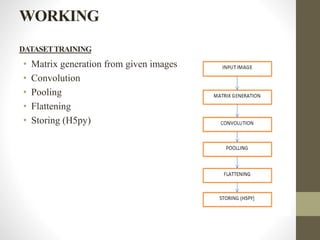
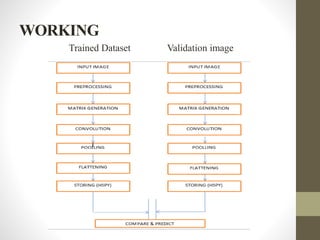
DATASETTRAINING
• Matrix generation from given images
• Convolution
• Pooling
• Flattening
• Storing (H5py)
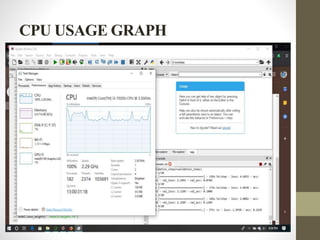
CPU USAGE GRAPH
WORKING
Trained Dataset Validation image
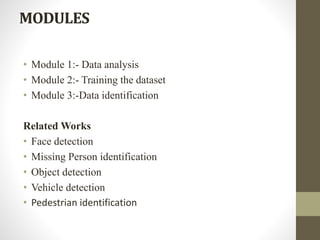
MODULES
• Module 1:- Data analysis
• Module 2:- Training the dataset
• Module 3:-Data identification
Related Works
• Face detection
• Missing Person identification
• Object detection
• Vehicle detection
• Pedestrian identification
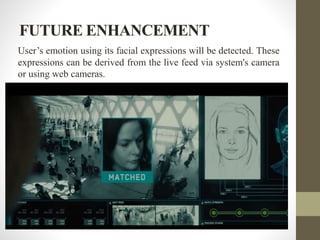
FUTURE ENHANCEMENT
User’s emotion using its facial expressions will be detected. These
expressions can be derived from the live feed via system's camera
or using web cameras.
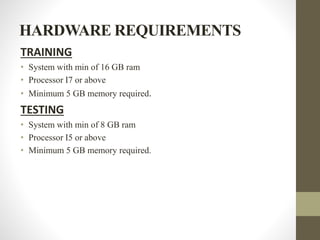
HARDWARE REQUIREMENTS
TRAINING
• System with min of 16 GB ram
• Processor I7 or above
• Minimum 5 GB memory required.
TESTING
• System with min of 8 GB ram
• Processor I5 or above
• Minimum 5 GB memory required.
EXPERIMENTS WITH DATASET
DATASET
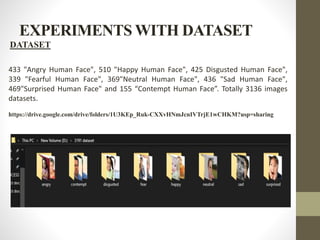
433 "Angry Human Face", 510 "Happy Human Face", 425 Disgusted Human Face",
339 "Fearful Human Face", 369"Neutral Human Face", 436 "Sad Human Face",
469"Surprised Human Face" and 155 “Contempt Human Face”. Totally 3136 images
datasets.
https://drive.google.com/drive/folders/1U3KEp_Ruk-CXXvHNmJcnIVTrjE1wCHKM?usp=sharing
SCREEN SHOTS
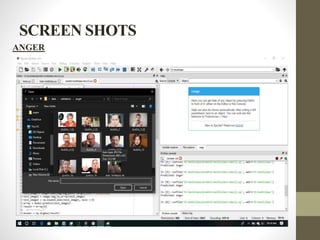
ANGER
SCREEN SHOTS
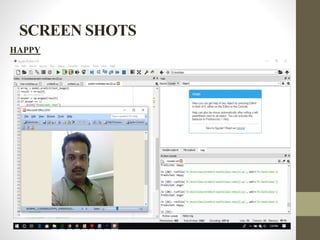
HAPPY
SCREEN SHOTS
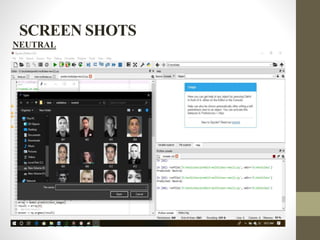
NEUTRAL
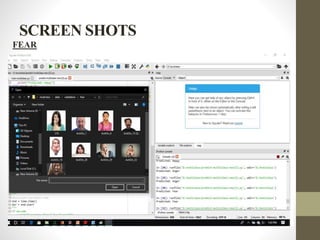
SCREEN SHOTS
FEAR
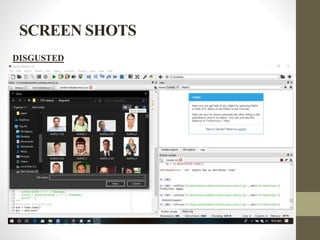
SCREEN SHOTS
DISGUSTED
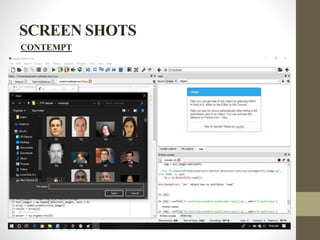
SCREEN SHOTS
CONTEMPT
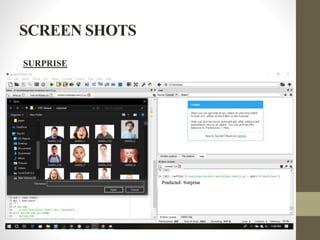
SCREEN SHOTS
SURPRISE
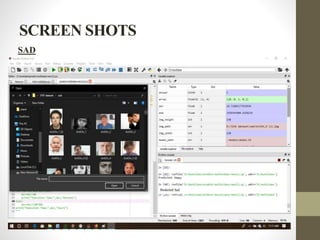
SCREEN SHOTS
SAD
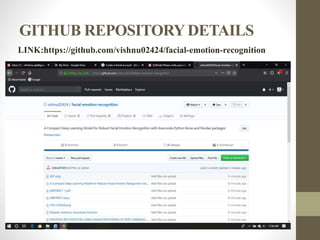
GITHUB REPOSITORYDETAILS
LINK:https://github.com/vishnu02424/facial-emotion-recognition
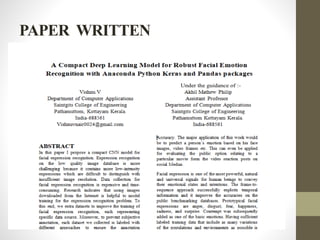
PAPER WRITTEN
END

Emotion recognition using image processing in deep learning

  • 1.
    ACompactDeepLearningModelforRobustFacialEmotion RecognitionwithAnacondaPythonKerasandPandaspackages UnderTheGuidanceof: Asst. Prof.Mr.Akhil Mathew Philip DEPARTMENTOFCOMPUTERAPPLICATIONS VISHNU V ROLL N0 :60 REGISTRATION NO:LMGP16MCA061 DEPT OF COMPUTER APPLICATIONS SAINTGITS COLLEGE OF ENGINEERING 2017-2019 BATCH
  • 2.
  • 3.
    ABSTRACT • User’s emotionusing its facial expressions will be detected. These expressions can be derived from the live feed via system's camera or any pre-existing image available in the memory. Emotions possessed by humans can be recognized and has a vast scope of study in the computer vision industry upon which several researches have already been done. • We propose a compact CNN model for facial expression recognition. • The work has been implemented using Python Open Source Computer Vision Library (OpenCV) and NumPy,pandas,keras packages. The scanned image (testing dataset) is being compared to training dataset and thus emotion is predicted.
  • 4.
    OBJECTIVES • The objectiveof this paper is to develop a system which can analyze the image and predict the expression of the person. • Development of this software is more useful for police officers to predict the current emotional state of prisoners and criminals. • This project is also useful for doctor's to predict expression of children which are affected by autism. • The major application of this work would be to predict a person’s emotion based on his face images, video frames etc. This can even be applied for evaluating the public option relating to a particular movie form the video reaction posts on social Medias.
  • 5.
    CHALLENGES • low-intensity expressionswhich are difficult to distinguish with insufficient image resolution. • Data collection for facial expression recognition is expensive and time-consuming. • Recognizing precise expression from a variety of expression forms of different people would be a huge problem. To solve this problem, this project generates an Emotion Detection Model to extract emotion from video frame image input.
  • 6.
    FACIALEXPRESSION • Facial expressionis one of the most powerful, natural and universal signals for human beings to convey their emotional states and intentions. • The frame-to-sequence approach successfully exploits temporal information and it improves the accuracies on the public benchmarking databases. • Prototypical facial expressions are anger, disgust, fear, happiness, sadness, neutral and surprise. Contempt was subsequently added as one of the basic emotions. • Behaviors, actions, poses, facial expressions and speech; these are considered as channels that convey human emotions.
  • 7.
    STEPS IN PROCESS •This work mainly focuses on psychological approach of COLOUR CIRCLE-EMOTION relation to find the accurate emotion behind the video frame input image (image input). • At first the whole image will be image preprocessed and pixel by pixel data studied. • The combinations of these circles based on combined data will result into a new color. • This resulted color will be directly linked to a particular emotion..
  • 8.
    PACKAGES USED • Numpy-NumPy is a library for the Python programming language, adding support for large, multi-dimensional arrays and matrices, along with a large collection of high-level mathematical functions to operate on these arrays. • Scipy-SciPy is a free and open-source Python library used for scientific computing and technical computing. SciPy contains modules for optimization, linear algebra, integration, interpolation, special functions, FFT, signal and image processing, ODE solvers and other tasks common in science and engineering. • Mathplotlib- Matplotlib is a Python 2D plotting library which produces publication quality figures in a variety of hardcopy formats and interactive environments across platforms. • Opencv- OpenCV is a Python library which is designed to solve computer vision problems. OpenCV supports a wide variety of programming languages such as C++, Python, Java etc. Support for multiple platforms including Windows, Linux, and Mac OS.
  • 9.
    PACKAGES USED • Pandas-pandas is an open source, BSD-licensed library providing high- performance, easy-to-use data structures and data analysis tools for the Python programming language. pandas is a NumFOCUS sponsored project. This will help ensure the success of development of pandas as a world-class open-source project, and makes it possible to donate to the project. • Theano-Theano is a Python library that allows you to define, optimize, and evaluate mathematical expressions involving multi-dimensional arrays efficiently. Theano features: tight integration with NumPy, transparent use of a GPU , efficient symbolic differentiation , speed and stability optimizations, dynamic C code generation, extensive unit-testing and self- verification • Keras- Keras is an open-source neural-network library written in Python. It is capable of running on top of Tensor Flow, Microsoft Cognitive Toolkit, Theano, or PlaidML. Designed to enable fast experimentation with deep neural networks, it focuses on being user-friendly, modular, and extensible.
  • 10.
    PACKAGES USED • Seaborn-Seaborn is a Python data visualization library based on matplotlib. It provides a high-level interface for drawing attractive and informative statistical graphics. • H5py- The h5py package is a Pythonic interface to the HDF5 binary data format.HDF5 lets you store huge amounts of numerical data, and easily manipulate that data from NumPy. • Tensor flow-Tensor Flow is a free and open-source software library for dataflow and differentiable programming across a range of tasks. It is a symbolic math library, and is also used for machine learning applications such as neural networks. • Python-dateutil-The dateutil module provides powerful extensions to the standard date time module, available in Python 2.3+. • Pytz- pytz brings the Olson tz database into Python. This library allows accurate and cross platform time zone calculations using Python 2.4 or higher. It also solves the issue of ambiguous times at the end of daylight saving time.
  • 11.
    PACKAGES USED • Pyyaml-YAMLis a data serialization format designed for human readability and interaction with scripting languages.PyYAML is a YAML parser and emitter for the Python programming language.
  • 12.
    WORKING • This paperproposes a prototype system which automatically recognizes the emotion represented on a face. • Thus a neural network based solution combined with image processing is used in classifying the universal emotions. • Happiness, Sadness, Anger, Disgust, Surprise and Fear. Colored frontal face images are given as input to the prototype system. • There are basically 22 expression are there ,for our purpose we only use basic 7 emotions.
  • 13.
    WORKING • After theface is detected, image processing based feature point extraction method is used to extract a set of selected feature points. • Finally, a set of values obtained after processing those extracted feature points are given as input to the neural network to recognize the emotion contained . • The three main steps that are common in automatic deep FER, i.e., pre-processing, deep feature learning and deep feature classification.
  • 14.
    WORKING DATASETTRAINING • Matrix generationfrom given images • Convolution • Pooling • Flattening • Storing (H5py)
  • 15.
  • 16.
  • 17.
    MODULES • Module 1:-Data analysis • Module 2:- Training the dataset • Module 3:-Data identification Related Works • Face detection • Missing Person identification • Object detection • Vehicle detection • Pedestrian identification
  • 18.
    FUTURE ENHANCEMENT User’s emotionusing its facial expressions will be detected. These expressions can be derived from the live feed via system's camera or using web cameras.
  • 19.
    HARDWARE REQUIREMENTS TRAINING • Systemwith min of 16 GB ram • Processor I7 or above • Minimum 5 GB memory required. TESTING • System with min of 8 GB ram • Processor I5 or above • Minimum 5 GB memory required.
  • 20.
    EXPERIMENTS WITH DATASET DATASET 433"Angry Human Face", 510 "Happy Human Face", 425 Disgusted Human Face", 339 "Fearful Human Face", 369"Neutral Human Face", 436 "Sad Human Face", 469"Surprised Human Face" and 155 “Contempt Human Face”. Totally 3136 images datasets. https://drive.google.com/drive/folders/1U3KEp_Ruk-CXXvHNmJcnIVTrjE1wCHKM?usp=sharing
  • 21.
  • 22.
  • 23.
  • 24.
  • 25.
  • 26.
  • 27.
  • 28.
  • 29.
  • 30.
  • 31.