Copyright © 2018 PATHPARTNER TECHNOLOGY PVT LTD 1
Dakala Jayachandra
22, May 2018
Understanding and Implementing Face
Landmark Detection and Tracking
Copyright © 2018 PATHPARTNER TECHNOLOGY PVT LTD 2
Outline
● Introduction
● Face landmark detection
● Cascaded shape regressors (CSR)
● Extension to CSRs
● Face landmark tracking
● Definition
● Approaches
● Online learning
● Notes on embedded implementation
Disclaimer: Focus is on ideas rather than on
numbers!
Copyright © 2018 PATHPARTNER TECHNOLOGY PVT LTD 3
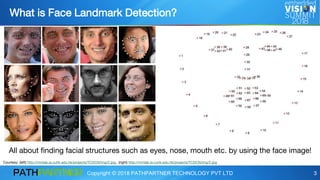
What is Face Landmark Detection?
All about finding facial structures such as eyes, nose, mouth etc. by using the face image!
Courtesy: (left) http://mmlab.ie.cuhk.edu.hk/projects/TCDCN/img/2.jpg, (right) http://mmlab.ie.cuhk.edu.hk/projects/TCDCN/img/2.jpg
Copyright © 2018 PATHPARTNER TECHNOLOGY PVT LTD 4
Applications [1]
Facial
landmarks
Facial behavior analysis
Facial attributes
(face recognition, gender, age, etc.)
Facial image editing (digital makeup, CG, etc.)
Sign-language prediction, lip-reading
Surveillance
Human-computer interaction
Copyright © 2018 PATHPARTNER TECHNOLOGY PVT LTD 5
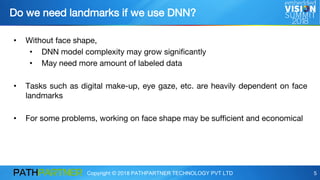
• Without face shape,
• DNN model complexity may grow significantly
• May need more amount of labeled data
• Tasks such as digital make-up, eye gaze, etc. are heavily dependent on face
landmarks
• For some problems, working on face shape may be sufficient and economical
Do we need landmarks if we use DNN?
Copyright © 2018 PATHPARTNER TECHNOLOGY PVT LTD 6
• For instance, in face recognition, face shape acts a strong priori
• Face recognition accuracy on LFW dataset using Deep Face [10]
Do we need landmark if we use DNN?
With only face detection module 87.9 %
With face and landmark
detection modules
94.3 %
Copyright © 2018 PATHPARTNER TECHNOLOGY PVT LTD 7
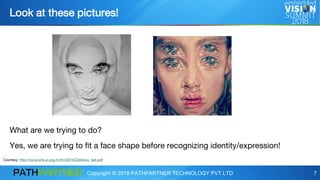
Look at these pictures!
What are we trying to do?
Yes, we are trying to fit a face shape before recognizing identity/expression!
Courtesy: http://www.arts-pi.org.tn/rfmi2016/Zafeiriou_talk.pdf
Copyright © 2018 PATHPARTNER TECHNOLOGY PVT LTD 8
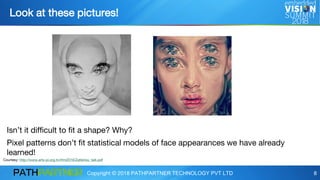
Look at these pictures!
Isn’t it difficult to fit a shape? Why?
Pixel patterns don’t fit statistical models of face appearances we have already
learned!
Courtesy: http://www.arts-pi.org.tn/rfmi2016/Zafeiriou_talk.pdf
Copyright © 2018 PATHPARTNER TECHNOLOGY PVT LTD 9
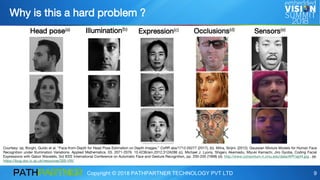
Why is this a hard problem ?
Head pose(a) Occlusions(d)Illumination(b)
Expression(c) Sensors(e)
Courtesy: (a). Borghi, Guido et al. “Face-from-Depth for Head Pose Estimation on Depth Images.” CoRR abs/1712.05277 (2017), (b). Mitra, Sinjini. (2012). Gaussian Mixture Models for Human Face
Recognition under Illumination Variations. Applied Mathematics. 03. 2071-2079. 10.4236/am.2012.312A286 (c). Michael J. Lyons, Shigeru Akemastu, Miyuki Kamachi, Jiro Gyoba, Coding Facial
Expressions with Gabor Wavelets, 3rd IEEE International Conference on Automatic Face and Gesture Recognition, pp. 200-205 (1998) (d). http://www.consortium.ri.cmu.edu/data/APF/apf4.jpg , (e).
https://ibug.doc.ic.ac.uk/resources/300-VW/
Copyright © 2018 PATHPARTNER TECHNOLOGY PVT LTD 10
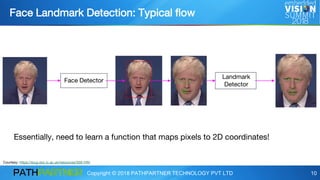
Face Landmark Detection: Typical flow
Face Detector
Landmark
Detector
Essentially, need to learn a function that maps pixels to 2D coordinates!
Courtesy: https://ibug.doc.ic.ac.uk/resources/300-VW/
Copyright © 2018 PATHPARTNER TECHNOLOGY PVT LTD 11
Approaches (broadly) [1]
Recently, with availability of data sets, discriminative models surpassed generative
models !!
Generative mels
• Analysis by synthesis methods
learn joint distribution, P(x,y)
• Examples: Active Shape Models
(ASM), Active Appearance Models
(AAM) etc.
Discriminative models
• Regression based methods learn
conditional distribution, P(y|x)
• Examples: Cascaded Shape Regression
based models like Supervised Descent
Methods (SDM), Constrained Local
Models (CLMs), etc.
Copyright © 2018 PATHPARTNER TECHNOLOGY PVT LTD 12
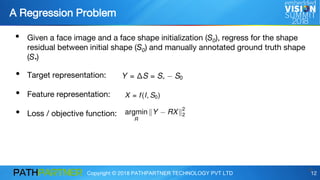
A Regression Problem
12
• Given a face image and a face shape initialization (S0), regress for the shape
residual between initial shape (S0) and manually annotated ground truth shape
(S*)
• Target representation:
• Feature representation:
• Loss / objective function:
Copyright © 2018 PATHPARTNER TECHNOLOGY PVT LTD 13
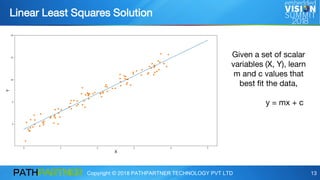
Given a set of scalar
variables (X, Y), learn
m and c values that
best fit the data,
y = mx + c
Linear Least Squares Solution
Copyright © 2018 PATHPARTNER TECHNOLOGY PVT LTD 14
Linear Least Squares Solution
R
Feature space
(X)
Target space
(Y)
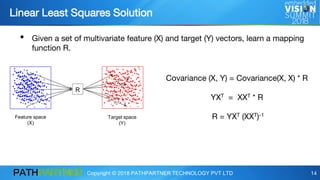
Covariance (X, Y) = Covariance(X, X) * R
YXT = XXT * R
R = YXT (XXT)-1
• Given a set of multivariate feature (X) and target (Y) vectors, learn a mapping
function R.
Copyright © 2018 PATHPARTNER TECHNOLOGY PVT LTD 15
• Is linear least squares good enough for landmark detection?
Linear Least Squares Solution
Copyright © 2018 PATHPARTNER TECHNOLOGY PVT LTD 16
● Inherent mapping function of feature descriptors of face appearance to the
target variables is non-linear in nature
Need for Non-Linear Least Squares Solution
Copyright © 2018 PATHPARTNER TECHNOLOGY PVT LTD 17
● Inherent mapping function of feature descriptors of face appearance to the
target variables is non-linear in nature
● Due to the wide variety of possible face appearances for the same face shape
Need for Non-Linear Least Squares Solution
Copyright © 2018 PATHPARTNER TECHNOLOGY PVT LTD 18
● Inherent mapping function of feature descriptors of face appearance to the
target variables is non-linear in nature
● Due to the wide variety of possible face appearances for the same face shape
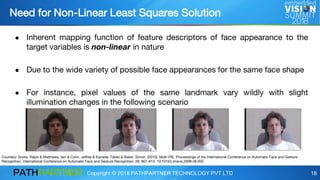
● For instance, pixel values of the same landmark vary wildly with slight
illumination changes in the following scenario
Courtesy: Gross, Ralph & Matthews, Iain & Cohn, Jeffrey & Kanade, Takeo & Baker, Simon. (2010). Multi-PIE. Proceedings of the International Conference on Automatic Face and Gesture
Recognition. International Conference on Automatic Face and Gesture Recognition. 28. 807-813. 10.1016/j.imavis.2009.08.002.
Need for Non-Linear Least Squares Solution
Copyright © 2018 PATHPARTNER TECHNOLOGY PVT LTD 19
Newton’s Method: To Solve Non-Linear Least
Squares Problem
Courtesy: (right) http://www.mathcentre.ac.uk/resources/uploaded/mc-ty-maxmin-2009-1.pdf
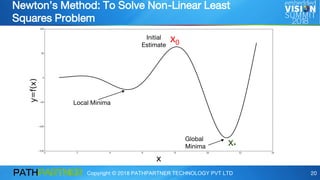
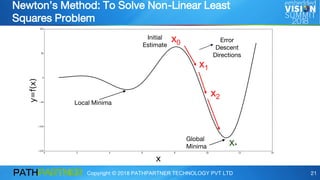
● Given a function f(x) = x2, find an x value at which f(x) is minimum
● Value of x at which gradient of f(x) is zero is the global minima of f(x)
Copyright © 2018 PATHPARTNER TECHNOLOGY PVT LTD 20
Newton’s Method: To Solve Non-Linear Least
Squares Problem
Local Minima
Global
Minima x*
x0
Initial
Estimate
Copyright © 2018 PATHPARTNER TECHNOLOGY PVT LTD 21
Newton’s Method: To Solve Non-Linear Least
Squares Problem
x0
Local Minima
Global
Minima x*
x1
x2
Error
Descent
Directions
Initial
Estimate
Copyright © 2018 PATHPARTNER TECHNOLOGY PVT LTD 22
Newton’s Method: To Solve Non-Linear Least
Squares Problem
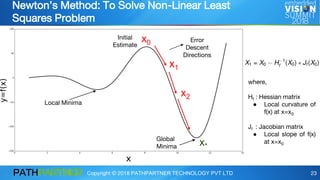
● A twice differentiable smooth function f(x) can be approximated using
Jacobian and Hessian of f(x)
● Given a loss function f(x), Newton’s method solves for error descent direction
along x that minimizes the loss
Copyright © 2018 PATHPARTNER TECHNOLOGY PVT LTD 23
Newton’s Method: To Solve Non-Linear Least
Squares Problem
x0
Local Minima
Global
Minima x*
x1
x2
where,
Hf : Hessian matrix
● Local curvature of
f(x) at x=x0
Jf : Jacobian matrix
● Local slope of f(x)
at x=x0
Error
Descent
Directions
Initial
Estimate
Copyright © 2018 PATHPARTNER TECHNOLOGY PVT LTD 24
Challenges in Applying Newton’s Method to
Computer Vision [2]
● Hessian must be a positive definite in order to compute optimal global minima.
● Appearance feature descriptors may not be differentiable analytically. Numerical
gradient and Hessian computation are computationally expensive.
● With very high dimensional features, Hessian matrix is too large. Inverting large matrices
is expensive.
Copyright © 2018 PATHPARTNER TECHNOLOGY PVT LTD 25
Cascaded Shape Regressors (CSR’s) [2]
Idea: Learn a cascade of linear shape regressors!
● Essentially, learn error descent directions from the training data
● Equivalent to piecewise linear approximation of a nonlinear mapping function
Copyright © 2018 PATHPARTNER TECHNOLOGY PVT LTD 26
Cascaded Shape Regressors [2]
Feature extraction: f(I,S0)
Courtesy: https://ibug.doc.ic.ac.uk/resources/300-VW/
Copyright © 2018 PATHPARTNER TECHNOLOGY PVT LTD 27
Cascaded Shape Regressors [2]
Face image with
mean shape as
init (s0)
Cascade 1 Cascade 2 Cascade 3 Final shape
estimation result
(s3)
Feature extraction: f(I,S0)
Courtesy: https://ibug.doc.ic.ac.uk/resources/300-VW/
Copyright © 2018 PATHPARTNER TECHNOLOGY PVT LTD 28
Cascaded Shape Regressors [2]
What are the optimal representations of face appearance and face shape?
Copyright © 2018 PATHPARTNER TECHNOLOGY PVT LTD 29
Optimal Face Appearance Representation
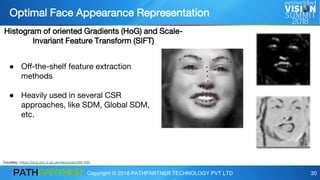
● Histogram of oriented Gradients (HoG) and Scale-Invariant Feature Transform
(SIFT)
● Local Binary Features (LBF) [7]
● Convolutional Neural Networks for feature learning
Copyright © 2018 PATHPARTNER TECHNOLOGY PVT LTD 30
● Off-the-shelf feature extraction
methods
● Heavily used in several CSR
approaches, like SDM, Global SDM,
etc.
Optimal Face Appearance Representation
Courtesy: https://ibug.doc.ic.ac.uk/resources/300-VW/
Histogram of oriented Gradients (HoG) and Scale-
Invariant Feature Transform (SIFT)
Copyright © 2018 PATHPARTNER TECHNOLOGY PVT LTD 31
● Learns feature mapping
functions from data using
ensembles of regression trees
● Computationally very efficient
during inference time
Optimal Face Appearance Representation
Courtesy: http://freesouls.github.io/2015/06/07/face-alignment-local-binary-feature/index.html
Local Binary Features (LBF) [7]
Copyright © 2018 PATHPARTNER TECHNOLOGY PVT LTD 32
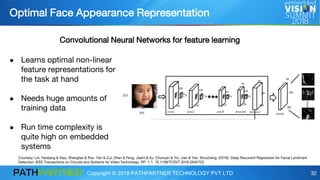
● Learns optimal non-linear
feature representations for
the task at hand
● Needs huge amounts of
training data
● Run time complexity is
quite high on embedded
systems
Optimal Face Appearance Representation
Courtesy: Lai, Hanjiang & Xiao, Shengtao & Pan, Yan & Cui, Zhen & Feng, Jiashi & Xu, Chunyan & Yin, Jian & Yan, Shuicheng. (2016). Deep Recurrent Regression for Facial Landmark
Detection. IEEE Transactions on Circuits and Systems for Video Technology. PP. 1-1. 10.1109/TCSVT.2016.2645723.
Convolutional Neural Networks for feature learning
Copyright © 2018 PATHPARTNER TECHNOLOGY PVT LTD 33
Optimal Face Shape Representation
● Point Distribution Model (PDM):
● A shape (S) is parameterized in terms of p = [q, c] where
• q represents rigid shape parameters and
• c represents flexible shape parameters
• S0 - mean face shape
• Bs - Orthogonal basis of flexible face shape deformations
● Structured Point Distribution Model (SPDM):
● In addition to 2D landmark coordinates, visibility labels (1,0) of each landmark is
also taken into account
● Combines the PCA bases of rigid, non-rigid and visibility components of face
shapes and generates a joint parametric form
Copyright © 2018 PATHPARTNER TECHNOLOGY PVT LTD 34
Why Cascaded Shape Regressors Can’t Solve
Multiview Face Alignment? [3]
Courtesy: Gross, Ralph & Matthews, Iain & Cohn, Jeffrey & Kanade, Takeo & Baker, Simon. (2010). Multi-PIE. Proceedings of the International Conference on Automatic Face and Gesture
Recognition. International Conference on Automatic Face and Gesture Recognition. 28. 807-813. 10.1016/j.imavis.2009.08.002.
Copyright © 2018 PATHPARTNER TECHNOLOGY PVT LTD 35
Why Cascaded Shape Regressors Can’t Solve
Multiview Face Alignment? [3]
Conflicting error
descent
directions !!!
Courtesy: Gross, Ralph & Matthews, Iain & Cohn, Jeffrey & Kanade, Takeo & Baker, Simon. (2010). Multi-PIE. Proceedings of the International Conference on Automatic Face and Gesture
Recognition. International Conference on Automatic Face and Gesture Recognition. 28. 807-813. 10.1016/j.imavis.2009.08.002.
Copyright © 2018 PATHPARTNER TECHNOLOGY PVT LTD 36
Why Cascaded Shape Regressors Can’t Solve
Multiview Face Alignment? [3]
Conflicting error
descent
directions !!!
Solution - Extended CSR
Learn different regressors
for different descent
directions ...
Courtesy: Gross, Ralph & Matthews, Iain & Cohn, Jeffrey & Kanade, Takeo & Baker, Simon. (2010). Multi-PIE. Proceedings of the International Conference on Automatic Face and Gesture
Recognition. International Conference on Automatic Face and Gesture Recognition. 28. 807-813. 10.1016/j.imavis.2009.08.002.
Copyright © 2018 PATHPARTNER TECHNOLOGY PVT LTD 37
Extended CSR Approaches:
Global Supervised Descent Method (GSDM) [3]
C
0
C
1
C
2
C
3
C
4
C
5
C
6
Copyright © 2018 PATHPARTNER TECHNOLOGY PVT LTD 38
Extended CSR Approaches:
Global Supervised Descent Method (GSDM) [3] Branching Cascaded Regression (BCR) [4]
C
0
Clustering + Classification on
Clustering + Classification on Clustering + Classification
on
C
1
C
2
C
3
C
4
C
5
C
6
C
0
C
1
C
2
C
3
C
4
C
5
C
6
Copyright © 2018 PATHPARTNER TECHNOLOGY PVT LTD 39
Extended CSR Approaches:
Global Supervised Descent Method (GSDM) [3] Branching Cascaded Regression (BCR) [4]
● Loss surface partition logic:
● During training:
● Groups the training samples
based on the sign of dot product
of shape residuals
● Needs ground truth face shape to
decide the descent direction
● During inference:
● Previous frame’s estimated
landmarks are used to decide the
branching direction
● Loss surface partition logic:
● During training:
● Applies a clustering algorithm to shape
residuals
● Learns a classifier to build a
separating hyperplane between the
clusters
● During inference:
● Employs the classifier models learned
during training to decide which error
descent direction to take for a given
test sample
Copyright © 2018 PATHPARTNER TECHNOLOGY PVT LTD 40
Extended CSR Approaches:
Mnemonic Descent Method (MDM) [5]
● Unlike GSDM and BCR, MDM avoids the need of explicit split by using
RNNs
● Jointly trains a convolutional recurrent neural network in an end-to-end
fashion
CNN RNN
Copyright © 2018 PATHPARTNER TECHNOLOGY PVT LTD 41
Global Supervised Descent
Method (GSDM) [3]
Branching Cascaded
Regression (BCR) [4]
Mnemonic Descent Method
(MDM) [5]
● Introduces the idea
learning Domain of
Homogenous Descent
(DHD) directions by
partitioning the
parameter space
● Doesn’t weight feature
descriptors of a
landmark based on its
visibility
● By learning a tree of
cascaded shape
regressors, this
method addresses the
problem of loss
surface partition
● Weights feature
descriptors of a
landmark based on its
visibility
● Unlike GSDM and
BCR, MDM avoids the
need of explicit split
by using RNNs
● Jointly trains a
convolutional
recurrent neural
network in an end-to-
end fashion
Summary: Extended CSR Approaches
Copyright © 2018 PATHPARTNER TECHNOLOGY PVT LTD 42
● Euclidean error normalized by Inter Ocular Distance (IOD)
● Area Under Curve (AUC) of Cumulative Error Distribution (CED)
Evaluation Protocols for Benchmarking
Courtesy: Shen, Jie & Zafeiriou, Stefanos & G Chrysos, Grigorios & Kossaifi, Jean & Tzimiropoulos, Georgios & Pantic, Maja. (2015). The First Facial Landmark Tracking in-the-Wild Challenge:
Benchmark and Results.
Copyright © 2018 PATHPARTNER TECHNOLOGY PVT LTD 43
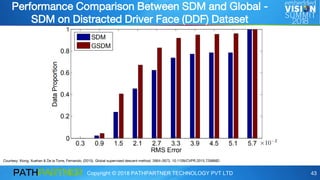
Performance Comparison Between SDM and Global -
SDM on Distracted Driver Face (DDF) Dataset
Courtesy: Xiong, Xuehan & De la Torre, Fernando. (2015). Global supervised descent method. 2664-2673. 10.1109/CVPR.2015.7298882.
Copyright © 2018 PATHPARTNER TECHNOLOGY PVT LTD 44
Face Landmark Tracking [6]
Aim of a landmark tracker is to exploit temporal coherence of faces in a video
sequence
Landmark
Detector
Landmark
Tracker
Courtesy: https://ibug.doc.ic.ac.uk/resources/300-VW/
Copyright © 2018 PATHPARTNER TECHNOLOGY PVT LTD 45
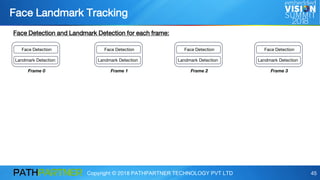
Face Landmark Tracking
Face Detection and Landmark Detection for each frame:
Face Detection
Landmark Detection
Face Detection
Landmark Detection
Face Detection
Landmark Detection
Face Detection
Landmark Detection
Frame 0 Frame 1 Frame 2 Frame 3
Copyright © 2018 PATHPARTNER TECHNOLOGY PVT LTD 46
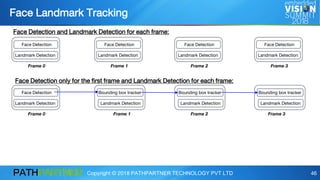
Face Landmark Tracking
Face Detection only for the first frame and Landmark Detection for each frame:
Face Detection
Landmark Detection
Bounding box tracker
Landmark Detection
Frame 0 Frame 1 Frame 2 Frame 3
Bounding box tracker
Landmark Detection
Bounding box tracker
Landmark Detection
Face Detection and Landmark Detection for each frame:
Face Detection
Landmark Detection
Face Detection
Landmark Detection
Face Detection
Landmark Detection
Face Detection
Landmark Detection
Frame 0 Frame 1 Frame 2 Frame 3
Copyright © 2018 PATHPARTNER TECHNOLOGY PVT LTD 47
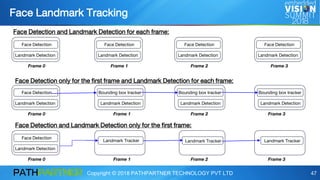
Face Landmark Tracking
Face Detection only for the first frame and Landmark Detection for each frame:
Face Detection and Landmark Detection only for the first frame:
Face Detection
Landmark Detection
Bounding box tracker
Landmark Detection
Frame 0 Frame 1 Frame 2 Frame 3
Bounding box tracker
Landmark Detection
Bounding box tracker
Landmark Detection
Face Detection
Landmark Detection
Landmark Tracker
Frame 0 Frame 1 Frame 2 Frame 3
Landmark Tracker Landmark Tracker
Face Detection and Landmark Detection for each frame:
Face Detection
Landmark Detection
Face Detection
Landmark Detection
Face Detection
Landmark Detection
Face Detection
Landmark Detection
Frame 0 Frame 1 Frame 2 Frame 3
Copyright © 2018 PATHPARTNER TECHNOLOGY PVT LTD 48
Landmark Tracking: High-level directions
Tracking long-term
temporal dynamics of
only shape
deformations
Examples: Kalman filters
and particle filters, etc.
Tracking short-term
temporal dynamics of
shape deformations by
using face appearance
Examples: Parallel SDM and
Continuous Cascaded
Regressors, etc.
Tracking long-term
temporal dynamics
of both shape and
appearance
Examples: Dynamic facial
analysis using RNNs [8]
** All the above tracking approaches suffer from drift issues. So, mechanisms for
failure checking and re-initializing are imperative.
Copyright © 2018 PATHPARTNER TECHNOLOGY PVT LTD 49
Learning a Face Landmark Tracking Model [6]
Training a landmark detector
● Same shape initialization i.e., S0,
for all training samples
Copyright © 2018 PATHPARTNER TECHNOLOGY PVT LTD 50
Learning a Face Landmark Tracking Model [6]
Training a landmark detector Training a landmark tracker
● Same shape initialization i.e., S0,
for all training samples
● Shape initializations are drawn from the
statistics of frame-to-frame landmark
displacement statistics
Copyright © 2018 PATHPARTNER TECHNOLOGY PVT LTD 51
Learning a Face Landmark Tracking Model [6]
● Similar to that of a detector, except for the face shape initializations
● Given a previous frame’s detected/tracked landmarks, estimate the current
frame’s face landmarks
● During training, simulate frame-to-frame landmark displacements through
learning the displacement statistics from offline face video sequences
● Add shape perturbations to the ground truth landmarks and use the resultant
face shapes as initializations
Copyright © 2018 PATHPARTNER TECHNOLOGY PVT LTD 52
Online Incremental Learning [6]
● Is it possible to train regression model with all possible variations?
● May be no!
● Enabling the model to learn incrementally on the fly may help in adapting to
the changing environment
Copyright © 2018 PATHPARTNER TECHNOLOGY PVT LTD 53
Online Incremental Learning [6]
● A naive approach to recomputing the regression model:
● X = {Xtrain; Xtest} , Y = {Ytrain; Ytest} , compute
● But, this approach is computationally quite heavy!
● Incremental Linear Least Squares approaches address the above problem
Copyright © 2018 PATHPARTNER TECHNOLOGY PVT LTD 54
Online Learning Approaches
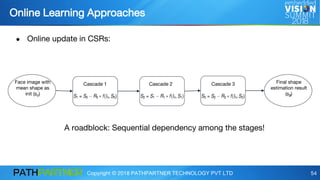
● Online update in CSRs:
Face image with
mean shape as
init (s0)
Cascade 1 Cascade 2 Cascade 3 Final shape
estimation result
(s3)
A roadblock: Sequential dependency among the stages!
Copyright © 2018 PATHPARTNER TECHNOLOGY PVT LTD 55
Online Learning Approaches
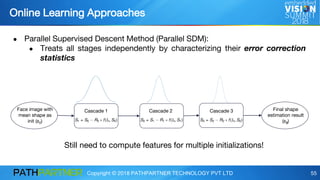
● Parallel Supervised Descent Method (Parallel SDM):
● Treats all stages independently by characterizing their error correction
statistics
Face image with
mean shape as
init (s0)
Cascade 1 Cascade 2 Cascade 3 Final shape
estimation result
(s3)
Still need to compute features for multiple initializations!
Copyright © 2018 PATHPARTNER TECHNOLOGY PVT LTD 56
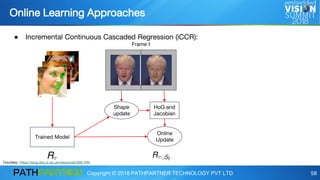
● Incremental Continuous Cascaded Regression (iCCR):
● Approximate feature space using first-order Taylor series expansion:
where Jj
* is the Jacobian matrix of feature descriptors at ground truth
landmarks
Online Learning Approaches
Copyright © 2018 PATHPARTNER TECHNOLOGY PVT LTD 57
● Incremental Continuous Cascaded Regression (iCCR):
Online Learning Approaches
Trained Model
Courtesy: https://ibug.doc.ic.ac.uk/resources/300-VW/
Copyright © 2018 PATHPARTNER TECHNOLOGY PVT LTD 58
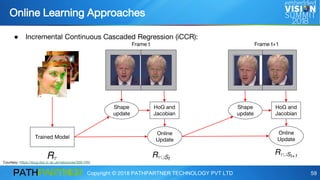
● Incremental Continuous Cascaded Regression (iCCR):
Online Learning Approaches
Trained Model
Online
Update
Shape
update
HoG and
Jacobian
Frame t
Courtesy: https://ibug.doc.ic.ac.uk/resources/300-VW/
Copyright © 2018 PATHPARTNER TECHNOLOGY PVT LTD 59
● Incremental Continuous Cascaded Regression (iCCR):
Online Learning Approaches
Trained Model
Online
Update
Online
Update
Shape
update
Shape
update
HoG and
Jacobian
HoG and
Jacobian
Frame t Frame t+1
Courtesy: https://ibug.doc.ic.ac.uk/resources/300-VW/
Copyright © 2018 PATHPARTNER TECHNOLOGY PVT LTD 60
Sample results with / without online learning
CCR iCCR
Category 1 0.4807 0.5171
Category 2 0.4680 0.5232
Category 3 0.3198 0.4044
Courtesy: Sánchez-Lozano, Enrique & Martinez, Brais & Tzimiropoulos, Georgios & Valstar, Michel. (2016). Cascaded Continuous Regression for Real-time Incremental Face Tracking,
https://arxiv.org/pdf/1608.01137.pdf
AUC values for three different categories of
300 VW benchmark
CED curves for the most challenging
category of 300 VW benchmark
Copyright © 2018 PATHPARTNER TECHNOLOGY PVT LTD 61
In summary, notes for embedded
● Feature representation:
• Use computationally less intensive descriptors: HoG, SIFT, LBF
● Target representation:
• Use a compact representation of (x,y) coordinates such as PDM and SPDM
• This reduces the cost of an inference call by reducing the size of the regression
weight matrix
● Incremental online learning:
• Use feature space approximation to support real-time online update
● Inexpensive model-free tracking methods for improving the accuracy:
• Employ model-free trackers such as Kalman to get better shape initializations for
landmark tracking
Copyright © 2018 PATHPARTNER TECHNOLOGY PVT LTD 62
References
1. G. G. Chrysos, E. Antonakos, P. Snape, A. Asthana, and S. Zafeiriou. A comprehensive performance evaluation of deformable face tracking
”in-the-wild”. CoRR, abs/1603.06015, 2016.
2. Xiong, X., la Torre, F.D.: Supervised descent method for solving nonlinear least squares problems in computer vision, arXiv abs/1405.0601,
2014.
3. Xiong, X., De la Torre, F.: Global supervised descent method. In: Proceedings of the IEEE Conference on Computer Vision and Pattern
Recognition. , 20152664– 2673, 2015.
4. Smith, B. M., and C. R. Dyer. Efficient Branching Cascaded Regression for Face Alignment Under Significant Head Rotation. ArXiv e-prints
1611.01584, 2016.
5. G. Trigeorgis, P. Snape, E. Antonakos, M. A. Nicolaou, and S. Zafeiriou. Mnemonic Descent Method: A recurrent process applied for end-to-
end face alignment. In Proceedings of the International Conference on Computer Vision and Pattern Recognition, 2016.
6. E. Sánchez-Lozano, B. Martinez, G. Tzimiropoulos, M. Valstar, Cascaded continuous regression for real-time incremental face tracking,
European Conference on Computer Vision - ECCV 2016 Part VIII, pp. 645-661, 2016.1611.01584, 2016.
7. S. Ren, X. Cao, Y. Wei, and J. Sun. Face alignment at 3000 fps via regressing local binary features. In: Proceedings of the IEEE Conference
on Computer Vision and Pattern Recognition, 2014.
8. Gu J., Yang X., De Mello S., Kautz J., Dynamic Facial Analysis: from Bayesian Filtering to Recurrent 385 Neural Network, IEEE Conference on
Computer Vision and Pattern Recognition (CVPR), pp. 1531-1540, 2017.
9. A. Asthana, S. Zafeiriou, S. Cheng, M. Pantic, "Incremental face alignment in the wild", Proc. IEEE Comput. Soc. Conf. Comput. Vis. Pattern
Recognit., pp. 1859-1866, 2014.
10. Taigman, Yaniv & Yang, Ming & Ranzato, Marc'Aurelio & Wolf, Lior. (2014). DeepFace: Closing the Gap to Human-Level Performance in Face
Verification. Proceedings of the IEEE Computer Society Conference on Computer Vision and Pattern Recognition. 10.1109/CVPR.2014.220.
Copyright © 2018 PATHPARTNER TECHNOLOGY PVT LTD 63
PathPartner is a top-notch design engineering services company and works with several
semiconductor companies, OEMs and ODMs in embedded media-centric devices and intelligent
systems.
About PathPartner
• Incorporated in July 2006; HQ in Bangalore, India
• R&D Centers: Bangalore, India, and California, USA
• Marketing representatives in USA, Europe, Japan and
India
• PathPartner is a member of Embedded Vision
Alliance and partner of various semiconductor
companies
• Semiconductor Companies
• OEMs and ODMs
• Present company strength is ~280
• Quality : ISO 9001:2015, 27001:2013
• R&D Workforce : >10%
+91 80 6772 2000 |
+1 408 242 7411 |
+81 9055466819
sales.india@pathpartnertech.com |
sales.usa@pathpartnertech.com |
sales.japan@pathpartnertech.com
Copyright © 2018 PATHPARTNER TECHNOLOGY PVT LTD 64
Thanks!!
Questions?

"Understanding and Implementing Face Landmark Detection and Tracking," a Presentation from PathPartner Technology

  • 1.
    Copyright © 2018PATHPARTNER TECHNOLOGY PVT LTD 1 Dakala Jayachandra 22, May 2018 Understanding and Implementing Face Landmark Detection and Tracking
  • 2.
    Copyright © 2018PATHPARTNER TECHNOLOGY PVT LTD 2 Outline ● Introduction ● Face landmark detection ● Cascaded shape regressors (CSR) ● Extension to CSRs ● Face landmark tracking ● Definition ● Approaches ● Online learning ● Notes on embedded implementation Disclaimer: Focus is on ideas rather than on numbers!
  • 3.
    Copyright © 2018PATHPARTNER TECHNOLOGY PVT LTD 3 What is Face Landmark Detection? All about finding facial structures such as eyes, nose, mouth etc. by using the face image! Courtesy: (left) http://mmlab.ie.cuhk.edu.hk/projects/TCDCN/img/2.jpg, (right) http://mmlab.ie.cuhk.edu.hk/projects/TCDCN/img/2.jpg
  • 4.
    Copyright © 2018PATHPARTNER TECHNOLOGY PVT LTD 4 Applications [1] Facial landmarks Facial behavior analysis Facial attributes (face recognition, gender, age, etc.) Facial image editing (digital makeup, CG, etc.) Sign-language prediction, lip-reading Surveillance Human-computer interaction
  • 5.
    Copyright © 2018PATHPARTNER TECHNOLOGY PVT LTD 5 • Without face shape, • DNN model complexity may grow significantly • May need more amount of labeled data • Tasks such as digital make-up, eye gaze, etc. are heavily dependent on face landmarks • For some problems, working on face shape may be sufficient and economical Do we need landmarks if we use DNN?
  • 6.
    Copyright © 2018PATHPARTNER TECHNOLOGY PVT LTD 6 • For instance, in face recognition, face shape acts a strong priori • Face recognition accuracy on LFW dataset using Deep Face [10] Do we need landmark if we use DNN? With only face detection module 87.9 % With face and landmark detection modules 94.3 %
  • 7.
    Copyright © 2018PATHPARTNER TECHNOLOGY PVT LTD 7 Look at these pictures! What are we trying to do? Yes, we are trying to fit a face shape before recognizing identity/expression! Courtesy: http://www.arts-pi.org.tn/rfmi2016/Zafeiriou_talk.pdf
  • 8.
    Copyright © 2018PATHPARTNER TECHNOLOGY PVT LTD 8 Look at these pictures! Isn’t it difficult to fit a shape? Why? Pixel patterns don’t fit statistical models of face appearances we have already learned! Courtesy: http://www.arts-pi.org.tn/rfmi2016/Zafeiriou_talk.pdf
  • 9.
    Copyright © 2018PATHPARTNER TECHNOLOGY PVT LTD 9 Why is this a hard problem ? Head pose(a) Occlusions(d)Illumination(b) Expression(c) Sensors(e) Courtesy: (a). Borghi, Guido et al. “Face-from-Depth for Head Pose Estimation on Depth Images.” CoRR abs/1712.05277 (2017), (b). Mitra, Sinjini. (2012). Gaussian Mixture Models for Human Face Recognition under Illumination Variations. Applied Mathematics. 03. 2071-2079. 10.4236/am.2012.312A286 (c). Michael J. Lyons, Shigeru Akemastu, Miyuki Kamachi, Jiro Gyoba, Coding Facial Expressions with Gabor Wavelets, 3rd IEEE International Conference on Automatic Face and Gesture Recognition, pp. 200-205 (1998) (d). http://www.consortium.ri.cmu.edu/data/APF/apf4.jpg , (e). https://ibug.doc.ic.ac.uk/resources/300-VW/
  • 10.
    Copyright © 2018PATHPARTNER TECHNOLOGY PVT LTD 10 Face Landmark Detection: Typical flow Face Detector Landmark Detector Essentially, need to learn a function that maps pixels to 2D coordinates! Courtesy: https://ibug.doc.ic.ac.uk/resources/300-VW/
  • 11.
    Copyright © 2018PATHPARTNER TECHNOLOGY PVT LTD 11 Approaches (broadly) [1] Recently, with availability of data sets, discriminative models surpassed generative models !! Generative mels • Analysis by synthesis methods learn joint distribution, P(x,y) • Examples: Active Shape Models (ASM), Active Appearance Models (AAM) etc. Discriminative models • Regression based methods learn conditional distribution, P(y|x) • Examples: Cascaded Shape Regression based models like Supervised Descent Methods (SDM), Constrained Local Models (CLMs), etc.
  • 12.
    Copyright © 2018PATHPARTNER TECHNOLOGY PVT LTD 12 A Regression Problem 12 • Given a face image and a face shape initialization (S0), regress for the shape residual between initial shape (S0) and manually annotated ground truth shape (S*) • Target representation: • Feature representation: • Loss / objective function:
  • 13.
    Copyright © 2018PATHPARTNER TECHNOLOGY PVT LTD 13 Given a set of scalar variables (X, Y), learn m and c values that best fit the data, y = mx + c Linear Least Squares Solution
  • 14.
    Copyright © 2018PATHPARTNER TECHNOLOGY PVT LTD 14 Linear Least Squares Solution R Feature space (X) Target space (Y) Covariance (X, Y) = Covariance(X, X) * R YXT = XXT * R R = YXT (XXT)-1 • Given a set of multivariate feature (X) and target (Y) vectors, learn a mapping function R.
  • 15.
    Copyright © 2018PATHPARTNER TECHNOLOGY PVT LTD 15 • Is linear least squares good enough for landmark detection? Linear Least Squares Solution
  • 16.
    Copyright © 2018PATHPARTNER TECHNOLOGY PVT LTD 16 ● Inherent mapping function of feature descriptors of face appearance to the target variables is non-linear in nature Need for Non-Linear Least Squares Solution
  • 17.
    Copyright © 2018PATHPARTNER TECHNOLOGY PVT LTD 17 ● Inherent mapping function of feature descriptors of face appearance to the target variables is non-linear in nature ● Due to the wide variety of possible face appearances for the same face shape Need for Non-Linear Least Squares Solution
  • 18.
    Copyright © 2018PATHPARTNER TECHNOLOGY PVT LTD 18 ● Inherent mapping function of feature descriptors of face appearance to the target variables is non-linear in nature ● Due to the wide variety of possible face appearances for the same face shape ● For instance, pixel values of the same landmark vary wildly with slight illumination changes in the following scenario Courtesy: Gross, Ralph & Matthews, Iain & Cohn, Jeffrey & Kanade, Takeo & Baker, Simon. (2010). Multi-PIE. Proceedings of the International Conference on Automatic Face and Gesture Recognition. International Conference on Automatic Face and Gesture Recognition. 28. 807-813. 10.1016/j.imavis.2009.08.002. Need for Non-Linear Least Squares Solution
  • 19.
    Copyright © 2018PATHPARTNER TECHNOLOGY PVT LTD 19 Newton’s Method: To Solve Non-Linear Least Squares Problem Courtesy: (right) http://www.mathcentre.ac.uk/resources/uploaded/mc-ty-maxmin-2009-1.pdf ● Given a function f(x) = x2, find an x value at which f(x) is minimum ● Value of x at which gradient of f(x) is zero is the global minima of f(x)
  • 20.
    Copyright © 2018PATHPARTNER TECHNOLOGY PVT LTD 20 Newton’s Method: To Solve Non-Linear Least Squares Problem Local Minima Global Minima x* x0 Initial Estimate
  • 21.
    Copyright © 2018PATHPARTNER TECHNOLOGY PVT LTD 21 Newton’s Method: To Solve Non-Linear Least Squares Problem x0 Local Minima Global Minima x* x1 x2 Error Descent Directions Initial Estimate
  • 22.
    Copyright © 2018PATHPARTNER TECHNOLOGY PVT LTD 22 Newton’s Method: To Solve Non-Linear Least Squares Problem ● A twice differentiable smooth function f(x) can be approximated using Jacobian and Hessian of f(x) ● Given a loss function f(x), Newton’s method solves for error descent direction along x that minimizes the loss
  • 23.
    Copyright © 2018PATHPARTNER TECHNOLOGY PVT LTD 23 Newton’s Method: To Solve Non-Linear Least Squares Problem x0 Local Minima Global Minima x* x1 x2 where, Hf : Hessian matrix ● Local curvature of f(x) at x=x0 Jf : Jacobian matrix ● Local slope of f(x) at x=x0 Error Descent Directions Initial Estimate
  • 24.
    Copyright © 2018PATHPARTNER TECHNOLOGY PVT LTD 24 Challenges in Applying Newton’s Method to Computer Vision [2] ● Hessian must be a positive definite in order to compute optimal global minima. ● Appearance feature descriptors may not be differentiable analytically. Numerical gradient and Hessian computation are computationally expensive. ● With very high dimensional features, Hessian matrix is too large. Inverting large matrices is expensive.
  • 25.
    Copyright © 2018PATHPARTNER TECHNOLOGY PVT LTD 25 Cascaded Shape Regressors (CSR’s) [2] Idea: Learn a cascade of linear shape regressors! ● Essentially, learn error descent directions from the training data ● Equivalent to piecewise linear approximation of a nonlinear mapping function
  • 26.
    Copyright © 2018PATHPARTNER TECHNOLOGY PVT LTD 26 Cascaded Shape Regressors [2] Feature extraction: f(I,S0) Courtesy: https://ibug.doc.ic.ac.uk/resources/300-VW/
  • 27.
    Copyright © 2018PATHPARTNER TECHNOLOGY PVT LTD 27 Cascaded Shape Regressors [2] Face image with mean shape as init (s0) Cascade 1 Cascade 2 Cascade 3 Final shape estimation result (s3) Feature extraction: f(I,S0) Courtesy: https://ibug.doc.ic.ac.uk/resources/300-VW/
  • 28.
    Copyright © 2018PATHPARTNER TECHNOLOGY PVT LTD 28 Cascaded Shape Regressors [2] What are the optimal representations of face appearance and face shape?
  • 29.
    Copyright © 2018PATHPARTNER TECHNOLOGY PVT LTD 29 Optimal Face Appearance Representation ● Histogram of oriented Gradients (HoG) and Scale-Invariant Feature Transform (SIFT) ● Local Binary Features (LBF) [7] ● Convolutional Neural Networks for feature learning
  • 30.
    Copyright © 2018PATHPARTNER TECHNOLOGY PVT LTD 30 ● Off-the-shelf feature extraction methods ● Heavily used in several CSR approaches, like SDM, Global SDM, etc. Optimal Face Appearance Representation Courtesy: https://ibug.doc.ic.ac.uk/resources/300-VW/ Histogram of oriented Gradients (HoG) and Scale- Invariant Feature Transform (SIFT)
  • 31.
    Copyright © 2018PATHPARTNER TECHNOLOGY PVT LTD 31 ● Learns feature mapping functions from data using ensembles of regression trees ● Computationally very efficient during inference time Optimal Face Appearance Representation Courtesy: http://freesouls.github.io/2015/06/07/face-alignment-local-binary-feature/index.html Local Binary Features (LBF) [7]
  • 32.
    Copyright © 2018PATHPARTNER TECHNOLOGY PVT LTD 32 ● Learns optimal non-linear feature representations for the task at hand ● Needs huge amounts of training data ● Run time complexity is quite high on embedded systems Optimal Face Appearance Representation Courtesy: Lai, Hanjiang & Xiao, Shengtao & Pan, Yan & Cui, Zhen & Feng, Jiashi & Xu, Chunyan & Yin, Jian & Yan, Shuicheng. (2016). Deep Recurrent Regression for Facial Landmark Detection. IEEE Transactions on Circuits and Systems for Video Technology. PP. 1-1. 10.1109/TCSVT.2016.2645723. Convolutional Neural Networks for feature learning
  • 33.
    Copyright © 2018PATHPARTNER TECHNOLOGY PVT LTD 33 Optimal Face Shape Representation ● Point Distribution Model (PDM): ● A shape (S) is parameterized in terms of p = [q, c] where • q represents rigid shape parameters and • c represents flexible shape parameters • S0 - mean face shape • Bs - Orthogonal basis of flexible face shape deformations ● Structured Point Distribution Model (SPDM): ● In addition to 2D landmark coordinates, visibility labels (1,0) of each landmark is also taken into account ● Combines the PCA bases of rigid, non-rigid and visibility components of face shapes and generates a joint parametric form
  • 34.
    Copyright © 2018PATHPARTNER TECHNOLOGY PVT LTD 34 Why Cascaded Shape Regressors Can’t Solve Multiview Face Alignment? [3] Courtesy: Gross, Ralph & Matthews, Iain & Cohn, Jeffrey & Kanade, Takeo & Baker, Simon. (2010). Multi-PIE. Proceedings of the International Conference on Automatic Face and Gesture Recognition. International Conference on Automatic Face and Gesture Recognition. 28. 807-813. 10.1016/j.imavis.2009.08.002.
  • 35.
    Copyright © 2018PATHPARTNER TECHNOLOGY PVT LTD 35 Why Cascaded Shape Regressors Can’t Solve Multiview Face Alignment? [3] Conflicting error descent directions !!! Courtesy: Gross, Ralph & Matthews, Iain & Cohn, Jeffrey & Kanade, Takeo & Baker, Simon. (2010). Multi-PIE. Proceedings of the International Conference on Automatic Face and Gesture Recognition. International Conference on Automatic Face and Gesture Recognition. 28. 807-813. 10.1016/j.imavis.2009.08.002.
  • 36.
    Copyright © 2018PATHPARTNER TECHNOLOGY PVT LTD 36 Why Cascaded Shape Regressors Can’t Solve Multiview Face Alignment? [3] Conflicting error descent directions !!! Solution - Extended CSR Learn different regressors for different descent directions ... Courtesy: Gross, Ralph & Matthews, Iain & Cohn, Jeffrey & Kanade, Takeo & Baker, Simon. (2010). Multi-PIE. Proceedings of the International Conference on Automatic Face and Gesture Recognition. International Conference on Automatic Face and Gesture Recognition. 28. 807-813. 10.1016/j.imavis.2009.08.002.
  • 37.
    Copyright © 2018PATHPARTNER TECHNOLOGY PVT LTD 37 Extended CSR Approaches: Global Supervised Descent Method (GSDM) [3] C 0 C 1 C 2 C 3 C 4 C 5 C 6
  • 38.
    Copyright © 2018PATHPARTNER TECHNOLOGY PVT LTD 38 Extended CSR Approaches: Global Supervised Descent Method (GSDM) [3] Branching Cascaded Regression (BCR) [4] C 0 Clustering + Classification on Clustering + Classification on Clustering + Classification on C 1 C 2 C 3 C 4 C 5 C 6 C 0 C 1 C 2 C 3 C 4 C 5 C 6
  • 39.
    Copyright © 2018PATHPARTNER TECHNOLOGY PVT LTD 39 Extended CSR Approaches: Global Supervised Descent Method (GSDM) [3] Branching Cascaded Regression (BCR) [4] ● Loss surface partition logic: ● During training: ● Groups the training samples based on the sign of dot product of shape residuals ● Needs ground truth face shape to decide the descent direction ● During inference: ● Previous frame’s estimated landmarks are used to decide the branching direction ● Loss surface partition logic: ● During training: ● Applies a clustering algorithm to shape residuals ● Learns a classifier to build a separating hyperplane between the clusters ● During inference: ● Employs the classifier models learned during training to decide which error descent direction to take for a given test sample
  • 40.
    Copyright © 2018PATHPARTNER TECHNOLOGY PVT LTD 40 Extended CSR Approaches: Mnemonic Descent Method (MDM) [5] ● Unlike GSDM and BCR, MDM avoids the need of explicit split by using RNNs ● Jointly trains a convolutional recurrent neural network in an end-to-end fashion CNN RNN
  • 41.
    Copyright © 2018PATHPARTNER TECHNOLOGY PVT LTD 41 Global Supervised Descent Method (GSDM) [3] Branching Cascaded Regression (BCR) [4] Mnemonic Descent Method (MDM) [5] ● Introduces the idea learning Domain of Homogenous Descent (DHD) directions by partitioning the parameter space ● Doesn’t weight feature descriptors of a landmark based on its visibility ● By learning a tree of cascaded shape regressors, this method addresses the problem of loss surface partition ● Weights feature descriptors of a landmark based on its visibility ● Unlike GSDM and BCR, MDM avoids the need of explicit split by using RNNs ● Jointly trains a convolutional recurrent neural network in an end-to- end fashion Summary: Extended CSR Approaches
  • 42.
    Copyright © 2018PATHPARTNER TECHNOLOGY PVT LTD 42 ● Euclidean error normalized by Inter Ocular Distance (IOD) ● Area Under Curve (AUC) of Cumulative Error Distribution (CED) Evaluation Protocols for Benchmarking Courtesy: Shen, Jie & Zafeiriou, Stefanos & G Chrysos, Grigorios & Kossaifi, Jean & Tzimiropoulos, Georgios & Pantic, Maja. (2015). The First Facial Landmark Tracking in-the-Wild Challenge: Benchmark and Results.
  • 43.
    Copyright © 2018PATHPARTNER TECHNOLOGY PVT LTD 43 Performance Comparison Between SDM and Global - SDM on Distracted Driver Face (DDF) Dataset Courtesy: Xiong, Xuehan & De la Torre, Fernando. (2015). Global supervised descent method. 2664-2673. 10.1109/CVPR.2015.7298882.
  • 44.
    Copyright © 2018PATHPARTNER TECHNOLOGY PVT LTD 44 Face Landmark Tracking [6] Aim of a landmark tracker is to exploit temporal coherence of faces in a video sequence Landmark Detector Landmark Tracker Courtesy: https://ibug.doc.ic.ac.uk/resources/300-VW/
  • 45.
    Copyright © 2018PATHPARTNER TECHNOLOGY PVT LTD 45 Face Landmark Tracking Face Detection and Landmark Detection for each frame: Face Detection Landmark Detection Face Detection Landmark Detection Face Detection Landmark Detection Face Detection Landmark Detection Frame 0 Frame 1 Frame 2 Frame 3
  • 46.
    Copyright © 2018PATHPARTNER TECHNOLOGY PVT LTD 46 Face Landmark Tracking Face Detection only for the first frame and Landmark Detection for each frame: Face Detection Landmark Detection Bounding box tracker Landmark Detection Frame 0 Frame 1 Frame 2 Frame 3 Bounding box tracker Landmark Detection Bounding box tracker Landmark Detection Face Detection and Landmark Detection for each frame: Face Detection Landmark Detection Face Detection Landmark Detection Face Detection Landmark Detection Face Detection Landmark Detection Frame 0 Frame 1 Frame 2 Frame 3
  • 47.
    Copyright © 2018PATHPARTNER TECHNOLOGY PVT LTD 47 Face Landmark Tracking Face Detection only for the first frame and Landmark Detection for each frame: Face Detection and Landmark Detection only for the first frame: Face Detection Landmark Detection Bounding box tracker Landmark Detection Frame 0 Frame 1 Frame 2 Frame 3 Bounding box tracker Landmark Detection Bounding box tracker Landmark Detection Face Detection Landmark Detection Landmark Tracker Frame 0 Frame 1 Frame 2 Frame 3 Landmark Tracker Landmark Tracker Face Detection and Landmark Detection for each frame: Face Detection Landmark Detection Face Detection Landmark Detection Face Detection Landmark Detection Face Detection Landmark Detection Frame 0 Frame 1 Frame 2 Frame 3
  • 48.
    Copyright © 2018PATHPARTNER TECHNOLOGY PVT LTD 48 Landmark Tracking: High-level directions Tracking long-term temporal dynamics of only shape deformations Examples: Kalman filters and particle filters, etc. Tracking short-term temporal dynamics of shape deformations by using face appearance Examples: Parallel SDM and Continuous Cascaded Regressors, etc. Tracking long-term temporal dynamics of both shape and appearance Examples: Dynamic facial analysis using RNNs [8] ** All the above tracking approaches suffer from drift issues. So, mechanisms for failure checking and re-initializing are imperative.
  • 49.
    Copyright © 2018PATHPARTNER TECHNOLOGY PVT LTD 49 Learning a Face Landmark Tracking Model [6] Training a landmark detector ● Same shape initialization i.e., S0, for all training samples
  • 50.
    Copyright © 2018PATHPARTNER TECHNOLOGY PVT LTD 50 Learning a Face Landmark Tracking Model [6] Training a landmark detector Training a landmark tracker ● Same shape initialization i.e., S0, for all training samples ● Shape initializations are drawn from the statistics of frame-to-frame landmark displacement statistics
  • 51.
    Copyright © 2018PATHPARTNER TECHNOLOGY PVT LTD 51 Learning a Face Landmark Tracking Model [6] ● Similar to that of a detector, except for the face shape initializations ● Given a previous frame’s detected/tracked landmarks, estimate the current frame’s face landmarks ● During training, simulate frame-to-frame landmark displacements through learning the displacement statistics from offline face video sequences ● Add shape perturbations to the ground truth landmarks and use the resultant face shapes as initializations
  • 52.
    Copyright © 2018PATHPARTNER TECHNOLOGY PVT LTD 52 Online Incremental Learning [6] ● Is it possible to train regression model with all possible variations? ● May be no! ● Enabling the model to learn incrementally on the fly may help in adapting to the changing environment
  • 53.
    Copyright © 2018PATHPARTNER TECHNOLOGY PVT LTD 53 Online Incremental Learning [6] ● A naive approach to recomputing the regression model: ● X = {Xtrain; Xtest} , Y = {Ytrain; Ytest} , compute ● But, this approach is computationally quite heavy! ● Incremental Linear Least Squares approaches address the above problem
  • 54.
    Copyright © 2018PATHPARTNER TECHNOLOGY PVT LTD 54 Online Learning Approaches ● Online update in CSRs: Face image with mean shape as init (s0) Cascade 1 Cascade 2 Cascade 3 Final shape estimation result (s3) A roadblock: Sequential dependency among the stages!
  • 55.
    Copyright © 2018PATHPARTNER TECHNOLOGY PVT LTD 55 Online Learning Approaches ● Parallel Supervised Descent Method (Parallel SDM): ● Treats all stages independently by characterizing their error correction statistics Face image with mean shape as init (s0) Cascade 1 Cascade 2 Cascade 3 Final shape estimation result (s3) Still need to compute features for multiple initializations!
  • 56.
    Copyright © 2018PATHPARTNER TECHNOLOGY PVT LTD 56 ● Incremental Continuous Cascaded Regression (iCCR): ● Approximate feature space using first-order Taylor series expansion: where Jj * is the Jacobian matrix of feature descriptors at ground truth landmarks Online Learning Approaches
  • 57.
    Copyright © 2018PATHPARTNER TECHNOLOGY PVT LTD 57 ● Incremental Continuous Cascaded Regression (iCCR): Online Learning Approaches Trained Model Courtesy: https://ibug.doc.ic.ac.uk/resources/300-VW/
  • 58.
    Copyright © 2018PATHPARTNER TECHNOLOGY PVT LTD 58 ● Incremental Continuous Cascaded Regression (iCCR): Online Learning Approaches Trained Model Online Update Shape update HoG and Jacobian Frame t Courtesy: https://ibug.doc.ic.ac.uk/resources/300-VW/
  • 59.
    Copyright © 2018PATHPARTNER TECHNOLOGY PVT LTD 59 ● Incremental Continuous Cascaded Regression (iCCR): Online Learning Approaches Trained Model Online Update Online Update Shape update Shape update HoG and Jacobian HoG and Jacobian Frame t Frame t+1 Courtesy: https://ibug.doc.ic.ac.uk/resources/300-VW/
  • 60.
    Copyright © 2018PATHPARTNER TECHNOLOGY PVT LTD 60 Sample results with / without online learning CCR iCCR Category 1 0.4807 0.5171 Category 2 0.4680 0.5232 Category 3 0.3198 0.4044 Courtesy: Sánchez-Lozano, Enrique & Martinez, Brais & Tzimiropoulos, Georgios & Valstar, Michel. (2016). Cascaded Continuous Regression for Real-time Incremental Face Tracking, https://arxiv.org/pdf/1608.01137.pdf AUC values for three different categories of 300 VW benchmark CED curves for the most challenging category of 300 VW benchmark
  • 61.
    Copyright © 2018PATHPARTNER TECHNOLOGY PVT LTD 61 In summary, notes for embedded ● Feature representation: • Use computationally less intensive descriptors: HoG, SIFT, LBF ● Target representation: • Use a compact representation of (x,y) coordinates such as PDM and SPDM • This reduces the cost of an inference call by reducing the size of the regression weight matrix ● Incremental online learning: • Use feature space approximation to support real-time online update ● Inexpensive model-free tracking methods for improving the accuracy: • Employ model-free trackers such as Kalman to get better shape initializations for landmark tracking
  • 62.
    Copyright © 2018PATHPARTNER TECHNOLOGY PVT LTD 62 References 1. G. G. Chrysos, E. Antonakos, P. Snape, A. Asthana, and S. Zafeiriou. A comprehensive performance evaluation of deformable face tracking ”in-the-wild”. CoRR, abs/1603.06015, 2016. 2. Xiong, X., la Torre, F.D.: Supervised descent method for solving nonlinear least squares problems in computer vision, arXiv abs/1405.0601, 2014. 3. Xiong, X., De la Torre, F.: Global supervised descent method. In: Proceedings of the IEEE Conference on Computer Vision and Pattern Recognition. , 20152664– 2673, 2015. 4. Smith, B. M., and C. R. Dyer. Efficient Branching Cascaded Regression for Face Alignment Under Significant Head Rotation. ArXiv e-prints 1611.01584, 2016. 5. G. Trigeorgis, P. Snape, E. Antonakos, M. A. Nicolaou, and S. Zafeiriou. Mnemonic Descent Method: A recurrent process applied for end-to- end face alignment. In Proceedings of the International Conference on Computer Vision and Pattern Recognition, 2016. 6. E. Sánchez-Lozano, B. Martinez, G. Tzimiropoulos, M. Valstar, Cascaded continuous regression for real-time incremental face tracking, European Conference on Computer Vision - ECCV 2016 Part VIII, pp. 645-661, 2016.1611.01584, 2016. 7. S. Ren, X. Cao, Y. Wei, and J. Sun. Face alignment at 3000 fps via regressing local binary features. In: Proceedings of the IEEE Conference on Computer Vision and Pattern Recognition, 2014. 8. Gu J., Yang X., De Mello S., Kautz J., Dynamic Facial Analysis: from Bayesian Filtering to Recurrent 385 Neural Network, IEEE Conference on Computer Vision and Pattern Recognition (CVPR), pp. 1531-1540, 2017. 9. A. Asthana, S. Zafeiriou, S. Cheng, M. Pantic, "Incremental face alignment in the wild", Proc. IEEE Comput. Soc. Conf. Comput. Vis. Pattern Recognit., pp. 1859-1866, 2014. 10. Taigman, Yaniv & Yang, Ming & Ranzato, Marc'Aurelio & Wolf, Lior. (2014). DeepFace: Closing the Gap to Human-Level Performance in Face Verification. Proceedings of the IEEE Computer Society Conference on Computer Vision and Pattern Recognition. 10.1109/CVPR.2014.220.
  • 63.
    Copyright © 2018PATHPARTNER TECHNOLOGY PVT LTD 63 PathPartner is a top-notch design engineering services company and works with several semiconductor companies, OEMs and ODMs in embedded media-centric devices and intelligent systems. About PathPartner • Incorporated in July 2006; HQ in Bangalore, India • R&D Centers: Bangalore, India, and California, USA • Marketing representatives in USA, Europe, Japan and India • PathPartner is a member of Embedded Vision Alliance and partner of various semiconductor companies • Semiconductor Companies • OEMs and ODMs • Present company strength is ~280 • Quality : ISO 9001:2015, 27001:2013 • R&D Workforce : >10% +91 80 6772 2000 | +1 408 242 7411 | +81 9055466819 sales.india@pathpartnertech.com | sales.usa@pathpartnertech.com | sales.japan@pathpartnertech.com
  • 64.
    Copyright © 2018PATHPARTNER TECHNOLOGY PVT LTD 64 Thanks!! Questions?