Facial Emotion Recognition with
Facial Gestures
By Ashwin Kedari Rachha
3263
Why Emotion Detection?
● The motivation behind choosing this topic specifically lies in the huge
investments large corporations do in feedbacks and surveys but fail to get
equitable response on their investments.
● Emotion Detection through facial gestures is a technology that aims to improve
product and services performance by monitoring customer behavior to certain
products or service staff by their evaluation
Some Companies that make us of emotion detection...
● While Disney uses emotion-detection tech to find out opinion on a completed
project, other brands have used it to directly inform advertising and digital
marketing.
● Kellogg’s is just one high-profile example, having used Affectiva’s software to test
audience reaction to ads for its cereal.
● Unilever does this, using HireVue’s AI-powered technology to screen prospective
candidates based on factors like body language and mood. In doing so, the
company is able to find the person whose personality and characteristics are best
suited to the job.
Emotion Expression Recognition Using SVM
What are Support Vector Machines?
SVMs plot the training vectors in high-dimensional
feature space, and label each vector with its class. A
hyperplane is drawn between the training vectors
that maximizes the distance between the different
classes. The hyperplane is determined through a
kernel function (radial basis, linear, polynomial or
sigmoid), which is given as input to the classification
software. [1999][Joachims, 1998b].
Facial Expression Detection using Fuzzy Classifier
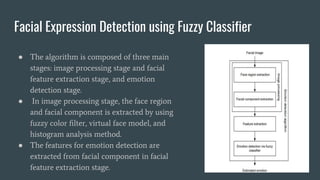
● The algorithm is composed of three main
stages: image processing stage and facial
feature extraction stage, and emotion
detection stage.
● In image processing stage, the face region
and facial component is extracted by using
fuzzy color filter, virtual face model, and
histogram analysis method.
● The features for emotion detection are
extracted from facial component in facial
feature extraction stage.
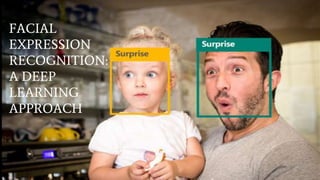
FACIAL
EXPRESSION
RECOGNITION:
A DEEP
LEARNING
APPROACH
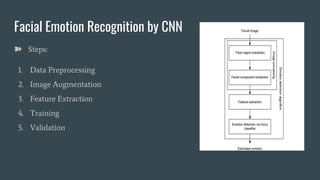
Facial Emotion Recognition by CNN
➽ Steps:
1. Data Preprocessing
2. Image Augmentation
3. Feature Extraction
4. Training
5. Validation
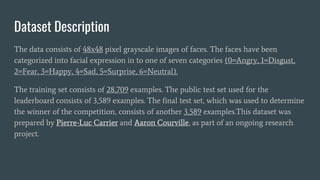
Dataset Description
The data consists of 48x48 pixel grayscale images of faces. The faces have been
categorized into facial expression in to one of seven categories (0=Angry, 1=Disgust,
2=Fear, 3=Happy, 4=Sad, 5=Surprise, 6=Neutral).
The training set consists of 28,709 examples. The public test set used for the
leaderboard consists of 3,589 examples. The final test set, which was used to determine
the winner of the competition, consists of another 3,589 examples.This dataset was
prepared by Pierre-Luc Carrier and Aaron Courville, as part of an ongoing research
project.
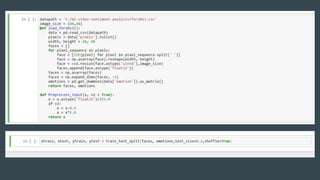
Data Preprocessing
● The fer2013.csv consists of three columns namely emotion, pixels and purpose.
● The column in pixel first of all is stored in a list format.
● Since computational complexity is high for computing pixel values in the range of
(0-255), the data in pixel field is normalized to values between [0-1].
● The face objects stored are reshaped and resized to the mentioned size of 48 X 48.
● The respective emotion labels and their respective pixel values are stored in
objects.
● We use scikit-learn’s train_test_split() function to split the dataset into training
and testing data. The test_size being 0.2 meaning, 20% of data is for validation
while 80% of the data will be trained.
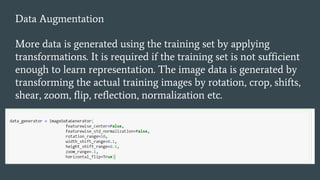
More data is generated using the training set by applying
transformations. It is required if the training set is not sufficient
enough to learn representation. The image data is generated by
transforming the actual training images by rotation, crop, shifts,
shear, zoom, flip, reflection, normalization etc.
Data Augmentation
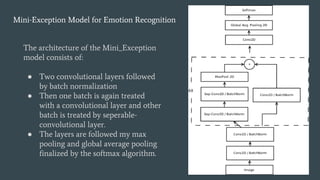
Mini-Exception Model for Emotion Recognition
The architecture of the Mini_Exception
model consists of:
● Two convolutional layers followed
by batch normalization
● Then one batch is again treated
with a convolutional layer and other
batch is treated by seperable-
convolutional layer.
● The layers are followed my max
pooling and global average pooling
finalized by the softmax algorithm.
Convolutional 2D
The 2D convolution is a fairly simple operation at heart: you start with a kernel, which
is simply a small matrix of weights. This kernel “slides” over the 2D input data,
performing an elementwise multiplication with the part of the input it is currently on,
and then summing up the results into a single output pixel.
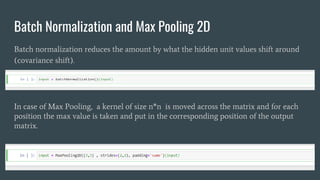
Batch Normalization and Max Pooling 2D
Batch normalization reduces the amount by what the hidden unit values shift around
(covariance shift).
In case of Max Pooling, a kernel of size n*n is moved across the matrix and for each
position the max value is taken and put in the corresponding position of the output
matrix.
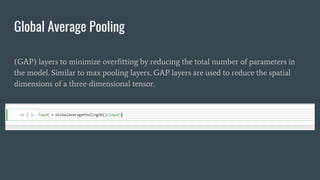
Global Average Pooling
(GAP) layers to minimize overfitting by reducing the total number of parameters in
the model. Similar to max pooling layers, GAP layers are used to reduce the spatial
dimensions of a three-dimensional tensor.
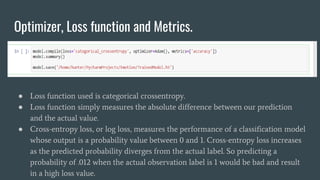
Optimizer, Loss function and Metrics.
● Loss function used is categorical crossentropy.
● Loss function simply measures the absolute difference between our prediction
and the actual value.
● Cross-entropy loss, or log loss, measures the performance of a classification model
whose output is a probability value between 0 and 1. Cross-entropy loss increases
as the predicted probability diverges from the actual label. So predicting a
probability of .012 when the actual observation label is 1 would be bad and result
in a high loss value.
● Optimizer used is the Adam() optimizer.
● Adam stands for Adaptive Moment Estimation. Adaptive
Moment Estimation (Adam) is another method that
computes adaptive learning rates for each parameter. In
addition to storing an exponentially decaying average of
past squared gradients like AdaDelta ,Adam also keeps
an exponentially decaying average of past gradients M(t),
similar to momentum:
Validation
● In the validation phase, various OpenCV functions and Keras functions have been
used.
● Initially the video frame is stored in a video object.
● An LBP cascade classifier is used to detect facial region of interest
● The image frame is converted into grayscale and resized and reshaped with the
help of numpy.
● This resized image is fed to the predictor which is loaded by
keras.models.load_model() function.
● The max argument is output.
● A rectangle is drawn around the facial regions and the output is formatted above
the rectangular box.
Performance Evaluation
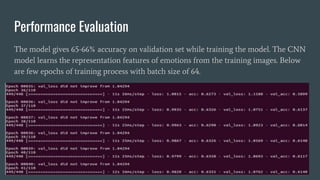
The model gives 65-66% accuracy on validation set while training the model. The CNN
model learns the representation features of emotions from the training images. Below
are few epochs of training process with batch size of 64.
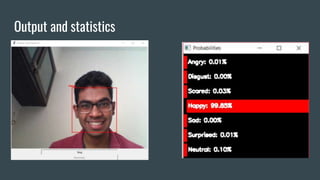
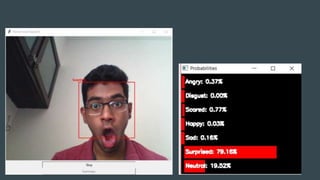
Output and statistics
Facial Emotion Recognition: A Deep Learning approach

Facial Emotion Recognition: A Deep Learning approach

  • 1.
    Facial Emotion Recognitionwith Facial Gestures By Ashwin Kedari Rachha 3263
  • 2.
    Why Emotion Detection? ●The motivation behind choosing this topic specifically lies in the huge investments large corporations do in feedbacks and surveys but fail to get equitable response on their investments. ● Emotion Detection through facial gestures is a technology that aims to improve product and services performance by monitoring customer behavior to certain products or service staff by their evaluation
  • 3.
    Some Companies thatmake us of emotion detection... ● While Disney uses emotion-detection tech to find out opinion on a completed project, other brands have used it to directly inform advertising and digital marketing. ● Kellogg’s is just one high-profile example, having used Affectiva’s software to test audience reaction to ads for its cereal. ● Unilever does this, using HireVue’s AI-powered technology to screen prospective candidates based on factors like body language and mood. In doing so, the company is able to find the person whose personality and characteristics are best suited to the job.
  • 4.
    Emotion Expression RecognitionUsing SVM What are Support Vector Machines? SVMs plot the training vectors in high-dimensional feature space, and label each vector with its class. A hyperplane is drawn between the training vectors that maximizes the distance between the different classes. The hyperplane is determined through a kernel function (radial basis, linear, polynomial or sigmoid), which is given as input to the classification software. [1999][Joachims, 1998b].
  • 5.
    Facial Expression Detectionusing Fuzzy Classifier ● The algorithm is composed of three main stages: image processing stage and facial feature extraction stage, and emotion detection stage. ● In image processing stage, the face region and facial component is extracted by using fuzzy color filter, virtual face model, and histogram analysis method. ● The features for emotion detection are extracted from facial component in facial feature extraction stage.
  • 6.
  • 7.
    Facial Emotion Recognitionby CNN ➽ Steps: 1. Data Preprocessing 2. Image Augmentation 3. Feature Extraction 4. Training 5. Validation
  • 8.
    Dataset Description The dataconsists of 48x48 pixel grayscale images of faces. The faces have been categorized into facial expression in to one of seven categories (0=Angry, 1=Disgust, 2=Fear, 3=Happy, 4=Sad, 5=Surprise, 6=Neutral). The training set consists of 28,709 examples. The public test set used for the leaderboard consists of 3,589 examples. The final test set, which was used to determine the winner of the competition, consists of another 3,589 examples.This dataset was prepared by Pierre-Luc Carrier and Aaron Courville, as part of an ongoing research project.
  • 9.
    Data Preprocessing ● Thefer2013.csv consists of three columns namely emotion, pixels and purpose. ● The column in pixel first of all is stored in a list format. ● Since computational complexity is high for computing pixel values in the range of (0-255), the data in pixel field is normalized to values between [0-1]. ● The face objects stored are reshaped and resized to the mentioned size of 48 X 48. ● The respective emotion labels and their respective pixel values are stored in objects. ● We use scikit-learn’s train_test_split() function to split the dataset into training and testing data. The test_size being 0.2 meaning, 20% of data is for validation while 80% of the data will be trained.
  • 11.
    More data isgenerated using the training set by applying transformations. It is required if the training set is not sufficient enough to learn representation. The image data is generated by transforming the actual training images by rotation, crop, shifts, shear, zoom, flip, reflection, normalization etc. Data Augmentation
  • 12.
    Mini-Exception Model forEmotion Recognition The architecture of the Mini_Exception model consists of: ● Two convolutional layers followed by batch normalization ● Then one batch is again treated with a convolutional layer and other batch is treated by seperable- convolutional layer. ● The layers are followed my max pooling and global average pooling finalized by the softmax algorithm.
  • 13.
    Convolutional 2D The 2Dconvolution is a fairly simple operation at heart: you start with a kernel, which is simply a small matrix of weights. This kernel “slides” over the 2D input data, performing an elementwise multiplication with the part of the input it is currently on, and then summing up the results into a single output pixel.
  • 14.
    Batch Normalization andMax Pooling 2D Batch normalization reduces the amount by what the hidden unit values shift around (covariance shift). In case of Max Pooling, a kernel of size n*n is moved across the matrix and for each position the max value is taken and put in the corresponding position of the output matrix.
  • 15.
    Global Average Pooling (GAP)layers to minimize overfitting by reducing the total number of parameters in the model. Similar to max pooling layers, GAP layers are used to reduce the spatial dimensions of a three-dimensional tensor.
  • 16.
    Optimizer, Loss functionand Metrics. ● Loss function used is categorical crossentropy. ● Loss function simply measures the absolute difference between our prediction and the actual value. ● Cross-entropy loss, or log loss, measures the performance of a classification model whose output is a probability value between 0 and 1. Cross-entropy loss increases as the predicted probability diverges from the actual label. So predicting a probability of .012 when the actual observation label is 1 would be bad and result in a high loss value.
  • 17.
    ● Optimizer usedis the Adam() optimizer. ● Adam stands for Adaptive Moment Estimation. Adaptive Moment Estimation (Adam) is another method that computes adaptive learning rates for each parameter. In addition to storing an exponentially decaying average of past squared gradients like AdaDelta ,Adam also keeps an exponentially decaying average of past gradients M(t), similar to momentum:
  • 18.
    Validation ● In thevalidation phase, various OpenCV functions and Keras functions have been used. ● Initially the video frame is stored in a video object. ● An LBP cascade classifier is used to detect facial region of interest ● The image frame is converted into grayscale and resized and reshaped with the help of numpy. ● This resized image is fed to the predictor which is loaded by keras.models.load_model() function. ● The max argument is output. ● A rectangle is drawn around the facial regions and the output is formatted above the rectangular box.
  • 19.
    Performance Evaluation The modelgives 65-66% accuracy on validation set while training the model. The CNN model learns the representation features of emotions from the training images. Below are few epochs of training process with batch size of 64.
  • 20.