INFECTIOUS DISEASE
EPIDEMIOLOGY
INFECTION
• Entry and development or multiplication of an infectious
agent in the body of man or animals
• Does not always cause illness
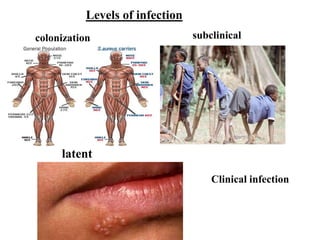
colonization subclinical
latent
Clinical infection
Levels of infection
CONTAMINATION
• The presence of an infectious agent on a body surface
• Contamination on a body surface does not imply a
carrier state
• Pollution : the presence of offensive, but not necessarily
infectious matter in the environment
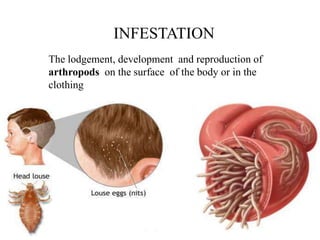
The lodgement, development and reproduction of
arthropods on the surface of the body or in the
clothing
INFESTATION
HOST
• A person or other animal, that affords lodgement to an
infectious agent under natural conditions
• Obligate host : the only host
• Eg: Man in measles & typhoid fever
HOST
• Primary or definitive host: hosts in which the parasite
attains maturity or passes its sexual stage
• Secondary or intermediate hosts: the parasite is in a
larval or asexual state
• Transport host is a carrier in which the organism
remains alive but does not undergo development
INFECTIOUS DISEASE
A clinically manifest disease of man or animals
resulting from an infection
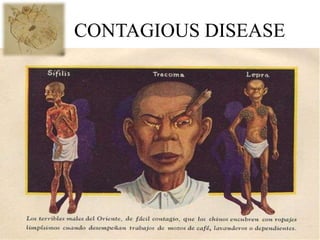
CONTAGIOUS DISEASE
COMMUNICABLE DISEASE
An illness due to a specific infectious agent
or its toxic products capable of being directly or indirectly
transmitted from man to man, animal to animal, or from the
environment to man or animal
Eg: Varicella, Polio
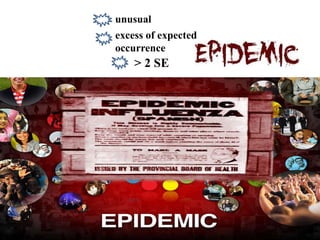
unusual
excess of expected
occurrence
> 2 SE
Endemic
• The constant presence of a disease or infectious agent
within a given geographic area or population group
without importation from outside
• When conditions are favourable may burst into an
epidemic
• Eg:Hepatitis A,Typhoid fever,Leptospirosis,Common
cold
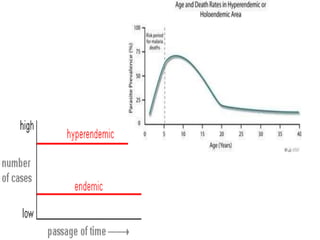
• Hyperendemic: the disease is constantly present at a
high incidence and/or prevalence rate and affects all age
groups equally
• Holoendemic: a high level of infection beginning early
in life and affecting most of the child
population, leading to a state of equilibrium such that
the adult population shows evidence of the disease
much less commonly than do the children
Eg: Malaria
SPORADIC
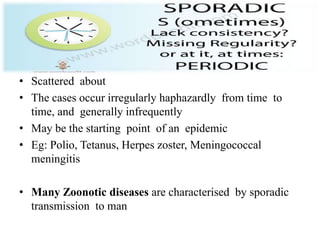
• Scattered about
• The cases occur irregularly haphazardly from time to
time, and generally infrequently
• May be the starting point of an epidemic
• Eg: Polio, Tetanus, Herpes zoster, Meningococcal
meningitis
• Many Zoonotic diseases are characterised by sporadic
transmission to man
PANDEMIC
• An epidemic usually affecting a large proportion of the
population
• Eg: Influenza pandemics of 1918 and 1957,
• Cholera El Tor in 1962
• Acute haemorrhagic conjunctivitis in 1971 and 1981
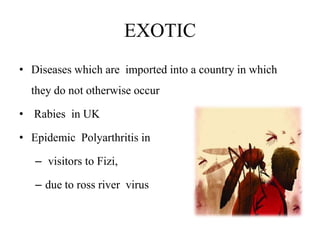
EXOTIC
• Diseases which are imported into a country in which
they do not otherwise occur
• Rabies in UK
• Epidemic Polyarthritis in
– visitors to Fizi,
– due to ross river virus
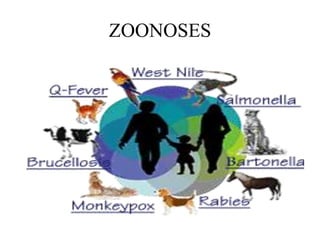
ZOONOSES
• Anthropozoonoses : infections transmitted to man from
vertebrate animals,
Eg: Rabies, Plague, Hydatid disease, Anthrax
• Zooanthroponoses :infections transmitted from man to
vertebrate animals.
Eg: Human Tuberculosis in cattle
• Amphixenoses :infections maintained in both man and
lower vertebrate animals that may be transmitted in
either direction
Eg: T.Cruzi, S.Joponicum
• EPIZOOTIC: An outbreak
(epidemic) of disease in an animal
population
Eg:
Anthrax, Brucellosis, Rabies, Influenza
, Q fever
• EPORNITHIC: An outbreak
(epidemic) of disease in a bird
population
• ENZOOTIC: An endemic
occurring in animals
Eg:
Anthrax, Rabies, Brucellosis, Bovine
tuberculosis,
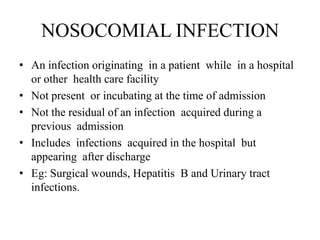
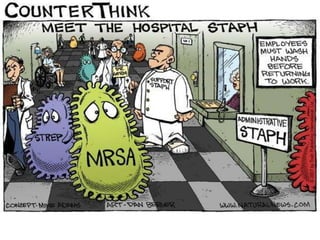
NOSOCOMIAL INFECTION
• An infection originating in a patient while in a hospital
or other health care facility
• Not present or incubating at the time of admission
• Not the residual of an infection acquired during a
previous admission
• Includes infections acquired in the hospital but
appearing after discharge
• Eg: Surgical wounds, Hepatitis B and Urinary tract
infections.
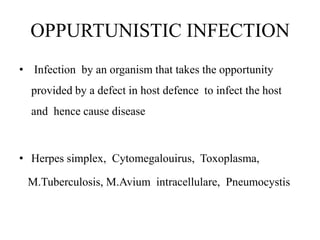
OPPURTUNISTIC INFECTION
• Infection by an organism that takes the opportunity
provided by a defect in host defence to infect the host
and hence cause disease
• Herpes simplex, Cytomegalouirus, Toxoplasma,
M.Tuberculosis, M.Avium intracellulare, Pneumocystis
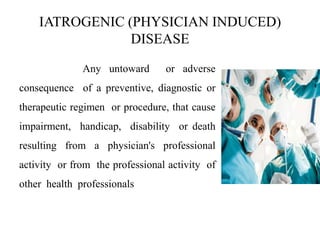
IATROGENIC (PHYSICIAN INDUCED)
DISEASE
Any untoward or adverse
consequence of a preventive, diagnostic or
therapeutic regimen or procedure, that cause
impairment, handicap, disability or death
resulting from a physician's professional
activity or from the professional activity of
other health professionals
• Disease may be serious enough to prolong the hospital
stay, require special treatment or actually threaten life
• Reactions to penicillin,
• childhood leukaemia due to prenatal x-rays,
• hepatitis B following blood transfusion
• These are all preventable
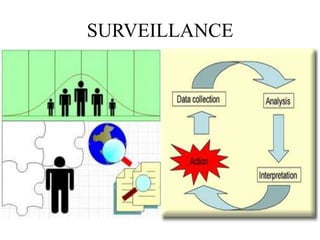
SURVEILLANCE
ERADlCATlON
• Termination of all transmission of infection by
extermination of the infectious agent through
surveillance and containment
• Absolute process, an "all or none" phenomenon
• Eg: Smallpox
• Diseases which are amenable to eradication are
measles, diphtheria, polio and guinea worm
Infectious disease epidemiology   copy - copy

Infectious disease epidemiology copy - copy

  • 1.
  • 2.
    INFECTION • Entry anddevelopment or multiplication of an infectious agent in the body of man or animals • Does not always cause illness
  • 3.
  • 4.
    CONTAMINATION • The presenceof an infectious agent on a body surface • Contamination on a body surface does not imply a carrier state • Pollution : the presence of offensive, but not necessarily infectious matter in the environment
  • 5.
    The lodgement, developmentand reproduction of arthropods on the surface of the body or in the clothing INFESTATION
  • 6.
    HOST • A personor other animal, that affords lodgement to an infectious agent under natural conditions • Obligate host : the only host • Eg: Man in measles & typhoid fever
  • 7.
    HOST • Primary ordefinitive host: hosts in which the parasite attains maturity or passes its sexual stage • Secondary or intermediate hosts: the parasite is in a larval or asexual state • Transport host is a carrier in which the organism remains alive but does not undergo development
  • 8.
    INFECTIOUS DISEASE A clinicallymanifest disease of man or animals resulting from an infection
  • 9.
  • 10.
    COMMUNICABLE DISEASE An illnessdue to a specific infectious agent or its toxic products capable of being directly or indirectly transmitted from man to man, animal to animal, or from the environment to man or animal Eg: Varicella, Polio
  • 11.
  • 12.
    Endemic • The constantpresence of a disease or infectious agent within a given geographic area or population group without importation from outside • When conditions are favourable may burst into an epidemic • Eg:Hepatitis A,Typhoid fever,Leptospirosis,Common cold
  • 14.
    • Hyperendemic: thedisease is constantly present at a high incidence and/or prevalence rate and affects all age groups equally • Holoendemic: a high level of infection beginning early in life and affecting most of the child population, leading to a state of equilibrium such that the adult population shows evidence of the disease much less commonly than do the children Eg: Malaria
  • 16.
    SPORADIC • Scattered about •The cases occur irregularly haphazardly from time to time, and generally infrequently • May be the starting point of an epidemic • Eg: Polio, Tetanus, Herpes zoster, Meningococcal meningitis • Many Zoonotic diseases are characterised by sporadic transmission to man
  • 17.
    PANDEMIC • An epidemicusually affecting a large proportion of the population • Eg: Influenza pandemics of 1918 and 1957, • Cholera El Tor in 1962 • Acute haemorrhagic conjunctivitis in 1971 and 1981
  • 19.
    EXOTIC • Diseases whichare imported into a country in which they do not otherwise occur • Rabies in UK • Epidemic Polyarthritis in – visitors to Fizi, – due to ross river virus
  • 20.
  • 21.
    • Anthropozoonoses :infections transmitted to man from vertebrate animals, Eg: Rabies, Plague, Hydatid disease, Anthrax • Zooanthroponoses :infections transmitted from man to vertebrate animals. Eg: Human Tuberculosis in cattle • Amphixenoses :infections maintained in both man and lower vertebrate animals that may be transmitted in either direction Eg: T.Cruzi, S.Joponicum
  • 22.
    • EPIZOOTIC: Anoutbreak (epidemic) of disease in an animal population Eg: Anthrax, Brucellosis, Rabies, Influenza , Q fever • EPORNITHIC: An outbreak (epidemic) of disease in a bird population • ENZOOTIC: An endemic occurring in animals Eg: Anthrax, Rabies, Brucellosis, Bovine tuberculosis,
  • 23.
    NOSOCOMIAL INFECTION • Aninfection originating in a patient while in a hospital or other health care facility • Not present or incubating at the time of admission • Not the residual of an infection acquired during a previous admission • Includes infections acquired in the hospital but appearing after discharge • Eg: Surgical wounds, Hepatitis B and Urinary tract infections.
  • 25.
    OPPURTUNISTIC INFECTION • Infectionby an organism that takes the opportunity provided by a defect in host defence to infect the host and hence cause disease • Herpes simplex, Cytomegalouirus, Toxoplasma, M.Tuberculosis, M.Avium intracellulare, Pneumocystis
  • 26.
    IATROGENIC (PHYSICIAN INDUCED) DISEASE Anyuntoward or adverse consequence of a preventive, diagnostic or therapeutic regimen or procedure, that cause impairment, handicap, disability or death resulting from a physician's professional activity or from the professional activity of other health professionals
  • 27.
    • Disease maybe serious enough to prolong the hospital stay, require special treatment or actually threaten life • Reactions to penicillin, • childhood leukaemia due to prenatal x-rays, • hepatitis B following blood transfusion • These are all preventable
  • 28.
  • 29.
    ERADlCATlON • Termination ofall transmission of infection by extermination of the infectious agent through surveillance and containment • Absolute process, an "all or none" phenomenon • Eg: Smallpox • Diseases which are amenable to eradication are measles, diphtheria, polio and guinea worm

Editor's Notes

  • #6 The lodgement, development and reproduction of arthropods on the surface of the body or in the clothingEg: Lice, itch miteInvasion of the gut by parasitic worms Eg: Ascariasis
  • #8 Cat lung worm –snail (IMH)-cat (DH)-mouse (TH)
  • #11 Direct transmission: direct contact, droplet ,trans placental (kissing,skin to skin,sexual),direct contact with substances harbouring infectious agentIndirect: vector born,vehicle borne, air borne,water
  • #12  The "unusual" occurrence in a community or region of disease, specific health-related behaviour or other health-related events clearly in excess of "expected occurrence". The modern "slow" epidemics of non-communicable diseases eg: CHD, lung cancerEpidemic threshold: arbitrary limit of two standard errors from the endemic frequency
  • #21 An infection or infectious disease transmissible under natural conditions from vertebrate animals to man
  • #24 Denotes a NEW disorder associated with being in the hospital
  • #29 The continuous scrutiny the factors that determine the occurrence and distribution of disease and other conditions of ill health Essential for effective control and preventionIncludes the collection, analysis, interpretation and distribution of relevant data for action Main purpose is to detect changes in trend and distribution of disease in order to initiate investigative or control measures