DR. SWATI SHIKHA
Preventive and Social Medicine.
 To describe the design of case control study
 To describe matching and its types and selection of
multiple controls
 To describe measure of association in case control
study and its interpretation
 To discuss potential biases in case control study
2
Let us consider a hypothetical situation in which from
the hospital record we get n number of CHD patients
and we wish to find out the various risk factors for
this disease and also see the association of smoking
with the development of CHD.
So our research question would be:
whether the patients with coronary heart disease were
more exposed to smoking as compared to healthy
individuals??
3
population
cases
controls
Exposed
Not exposed
EEExposed
Not exposed
Direction of study
Time
4
 An analytical observational study
 Proceeds from outcome to exposure
 Also called as Retrospective study design
5
 The disease is rare
 The disease has a long incubation and latent period
 Data on exposure is difficult or expensive to obtain
 The study population is dynamic
 The risk factors for the disease is not known
6
Research Question:
Whether there is an association between coffee
drinking and occurence of pancreatic carcinoma??
7
exposure Cases
(pancreatic
carcinoma)
Controls
(healthy
individuals)
total
Coffee drinking
+
90 20 110
Coffee drinking
-
10 80 90
total 100 100 200
Research Question:
Whether there is any association between the
development of lung cancer and history of uranium
exposure through mining??
8
Exposure Cases
(lung cancer
pts.)
Controls
(Healthy
individuals)
Total
Uranium mining
+
23 0 23
Uranium mining
-
9 64 73
Total 32 64 96
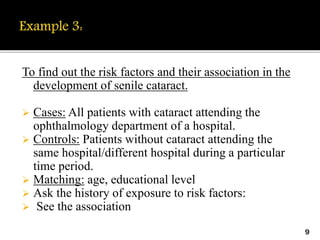
To find out the risk factors and their association in the
development of senile cataract.
 Cases: All patients with cataract attending the
ophthalmology department of a hospital.
 Controls: Patients without cataract attending the
same hospital/different hospital during a particular
time period.
 Matching: age, educational level
 Ask the history of exposure to risk factors:
 See the association
9
 Selection of cases
 Selection of controls
 Ascertainment of exposure
 Analysis
10
 Clear case definition for accurate classification of
diseased and non-diseased
 Efficient and accurate sources should be used to
identify cases
 Incident cases are preferable to prevalent cases
 Sources of cases:
Hospital, registries, Special surveys .
11
 Most important step
 The guiding principle for valid selection of cases and
controls is that they represent the same base
population
 Controls must be sampled independently of exposure
status
 Sources
Population controls
Hospital or clinic controls
Dead controls
Friend, spouse and relative controls (case nominate)
Neighborhood controls
12
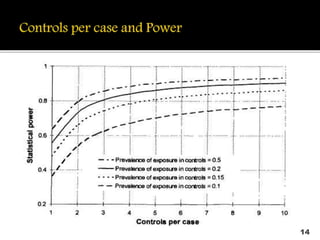
 At least 1 control for each case.
 Can select 2 /3/ 4 … 100 controls per case: BUT
More Controls, More Resources
 Do not gain much statistical power if more that 4
Controls per case are enrolled
 Multiple controls a) Same type
b) Different type
13
14
 Cases and controls might differ in the characteristic or
exposure that is targeted for the study
 Matching is of two types:
(a) group matching
(b) individual matching
 Unplanned matching
15
Matching of variables other than those which we are
sure are not risk factors for the disease of interest
either in a planned manner or inadvertent manner is
called overmatching.
16
 Standardized methods should be used
 Methods should be applied similarly in both case and
control groups
 Variety of sources to obtain exposure data is
available: records, biomarkers etc
 Selection on particular source depends on
availability, accuracy, logistics and cost
 Accuracy is a particular concern in case-control study
17
 Compare rates of exposure across cases and
controls i.e Proportion exposed rates among cases
and controls
 Measure of Associations
Odds Ratios
18
a b
c d
19
Cases [CHD]
(with disease)
Controls[no CHD]
(without disease)
Exposed
[Smokers]
Not Exposed
[NonSmokers]
a + c b + dTotals
Proportions Exposed a / a+c b / b+d
Exposure Diseased Non diseased Total
Yes a b a + b
No c d c + d
Total a + c b + d a + b + c + d
20
 Odds that cases were exposed = a/c
Odds that controls were exposed = b/d
= Odds that cases were exposed
Odds that controls were exposed
= a/c
b/d
= a * d
b * c
21
 OR = 1 Exposure is not related to the
disease
 OR >1 Exposure is positively related to the
disease i.e causal to disease
 OR <1 Exposure is negatively related to the
disease i.e protective to the disease
22
 When cases are representative of the population
 When controls are representative of the population
 When the disease being studied is rare
23
 Odds ratio in an unmatched case control study
 Odds ratio in a matched pairs case control study
24
 Confounding
 Selection bias
Interviewers Bias
 Ascertainment bias
Recall bias
25
 A situation in which an association between an
exposure and an outcome is entirely or partially due
to another exposure which is called confounder
 Must be associated with exposure of interest
 Must be a risk factor for outcome of interest
 Must not be on the causal pathway
26
27
Confounder
(Smoking)
Exposure of
interest
( Drinking
coffee)
Outcome of
interest
(Carcinoma
pancreas)
 Arises when cases and control may not be
representative of cases and control in the general
population.
 There may be systematic differences in the
characteristic of cases and control
 Berkesonian bias is a type of selection bias
28
 When interviewer knows the hypothesis and also
knows who the cases are. Eg: OCP consumption
leads to breast carcinoma.
 Check on this type of bias can be made by noting the
time of interview of cases and control.
 Eliminated by double blinding.
29
 Also called as memory bias
Eg: A study to find out whether maternal infection
during pregnancy leads to congenital malformation in
the neonate.
 Cases can better recall the past history as compared
to controls
30
ADVANTAGES
 Can obtain findings quickly
 Can often be undertaken
with minimal funding
 Efficient for rare diseases
 Can study multiple
exposures
 Generally requires few
study subjects
DISADVANTAGES
 Inefficient for rare exposure
 Subject to bias
 Difficult if record keeping
is either inadequate or
unreliable
 Selection of controls can be
difficult
 Difficult to ascertain
temporal relationship
31
32

Case control study

  • 1.
    DR. SWATI SHIKHA Preventiveand Social Medicine.
  • 2.
     To describethe design of case control study  To describe matching and its types and selection of multiple controls  To describe measure of association in case control study and its interpretation  To discuss potential biases in case control study 2
  • 3.
    Let us considera hypothetical situation in which from the hospital record we get n number of CHD patients and we wish to find out the various risk factors for this disease and also see the association of smoking with the development of CHD. So our research question would be: whether the patients with coronary heart disease were more exposed to smoking as compared to healthy individuals?? 3
  • 4.
  • 5.
     An analyticalobservational study  Proceeds from outcome to exposure  Also called as Retrospective study design 5
  • 6.
     The diseaseis rare  The disease has a long incubation and latent period  Data on exposure is difficult or expensive to obtain  The study population is dynamic  The risk factors for the disease is not known 6
  • 7.
    Research Question: Whether thereis an association between coffee drinking and occurence of pancreatic carcinoma?? 7 exposure Cases (pancreatic carcinoma) Controls (healthy individuals) total Coffee drinking + 90 20 110 Coffee drinking - 10 80 90 total 100 100 200
  • 8.
    Research Question: Whether thereis any association between the development of lung cancer and history of uranium exposure through mining?? 8 Exposure Cases (lung cancer pts.) Controls (Healthy individuals) Total Uranium mining + 23 0 23 Uranium mining - 9 64 73 Total 32 64 96
  • 9.
    To find outthe risk factors and their association in the development of senile cataract.  Cases: All patients with cataract attending the ophthalmology department of a hospital.  Controls: Patients without cataract attending the same hospital/different hospital during a particular time period.  Matching: age, educational level  Ask the history of exposure to risk factors:  See the association 9
  • 10.
     Selection ofcases  Selection of controls  Ascertainment of exposure  Analysis 10
  • 11.
     Clear casedefinition for accurate classification of diseased and non-diseased  Efficient and accurate sources should be used to identify cases  Incident cases are preferable to prevalent cases  Sources of cases: Hospital, registries, Special surveys . 11
  • 12.
     Most importantstep  The guiding principle for valid selection of cases and controls is that they represent the same base population  Controls must be sampled independently of exposure status  Sources Population controls Hospital or clinic controls Dead controls Friend, spouse and relative controls (case nominate) Neighborhood controls 12
  • 13.
     At least1 control for each case.  Can select 2 /3/ 4 … 100 controls per case: BUT More Controls, More Resources  Do not gain much statistical power if more that 4 Controls per case are enrolled  Multiple controls a) Same type b) Different type 13
  • 14.
  • 15.
     Cases andcontrols might differ in the characteristic or exposure that is targeted for the study  Matching is of two types: (a) group matching (b) individual matching  Unplanned matching 15
  • 16.
    Matching of variablesother than those which we are sure are not risk factors for the disease of interest either in a planned manner or inadvertent manner is called overmatching. 16
  • 17.
     Standardized methodsshould be used  Methods should be applied similarly in both case and control groups  Variety of sources to obtain exposure data is available: records, biomarkers etc  Selection on particular source depends on availability, accuracy, logistics and cost  Accuracy is a particular concern in case-control study 17
  • 18.
     Compare ratesof exposure across cases and controls i.e Proportion exposed rates among cases and controls  Measure of Associations Odds Ratios 18
  • 19.
    a b c d 19 Cases[CHD] (with disease) Controls[no CHD] (without disease) Exposed [Smokers] Not Exposed [NonSmokers] a + c b + dTotals Proportions Exposed a / a+c b / b+d
  • 20.
    Exposure Diseased Nondiseased Total Yes a b a + b No c d c + d Total a + c b + d a + b + c + d 20  Odds that cases were exposed = a/c Odds that controls were exposed = b/d
  • 21.
    = Odds thatcases were exposed Odds that controls were exposed = a/c b/d = a * d b * c 21
  • 22.
     OR =1 Exposure is not related to the disease  OR >1 Exposure is positively related to the disease i.e causal to disease  OR <1 Exposure is negatively related to the disease i.e protective to the disease 22
  • 23.
     When casesare representative of the population  When controls are representative of the population  When the disease being studied is rare 23
  • 24.
     Odds ratioin an unmatched case control study  Odds ratio in a matched pairs case control study 24
  • 25.
     Confounding  Selectionbias Interviewers Bias  Ascertainment bias Recall bias 25
  • 26.
     A situationin which an association between an exposure and an outcome is entirely or partially due to another exposure which is called confounder  Must be associated with exposure of interest  Must be a risk factor for outcome of interest  Must not be on the causal pathway 26
  • 27.
  • 28.
     Arises whencases and control may not be representative of cases and control in the general population.  There may be systematic differences in the characteristic of cases and control  Berkesonian bias is a type of selection bias 28
  • 29.
     When interviewerknows the hypothesis and also knows who the cases are. Eg: OCP consumption leads to breast carcinoma.  Check on this type of bias can be made by noting the time of interview of cases and control.  Eliminated by double blinding. 29
  • 30.
     Also calledas memory bias Eg: A study to find out whether maternal infection during pregnancy leads to congenital malformation in the neonate.  Cases can better recall the past history as compared to controls 30
  • 31.
    ADVANTAGES  Can obtainfindings quickly  Can often be undertaken with minimal funding  Efficient for rare diseases  Can study multiple exposures  Generally requires few study subjects DISADVANTAGES  Inefficient for rare exposure  Subject to bias  Difficult if record keeping is either inadequate or unreliable  Selection of controls can be difficult  Difficult to ascertain temporal relationship 31
  • 32.