HISTORY
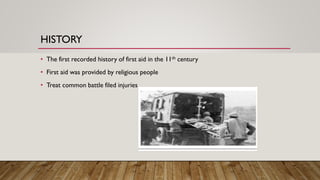
• The firstrecorded history of first aid in the 11th century
• First aid was provided by religious people
• Treat common battle filed injuries
3.
INTRODUCTION
❖A person whogives treatment to the one suffering to disease or an accident, to improve his/her
condition is called an “aides” and the medical treatment given an aid is called” first aid” .
❖First aid is the initial assistance given to a victims of injury or illness.
❖It involves a simple technique that can be performed by rudimentary equipment
❖First aid usually carried out by a lay person until professional medical persons arrives.
❖It Is the immediate assistance or treatment given to someone before the arrival of medical staff/
ambulance
4.
THE KEY GUIDINGPRINCIPLE AND PURPOSE OF
FIRST AID IS OFTEN GIVENTO MNEMONIC3PS
This three points govern all the action is undertaken by the first aider
1.Prevent further injury
✓ Control bleeding
✓ Treat probable cause of shock
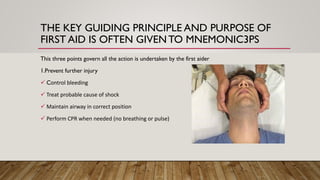
✓ Maintain airway in correct position
✓ Perform CPR when needed (no breathing or pulse)
5.
……
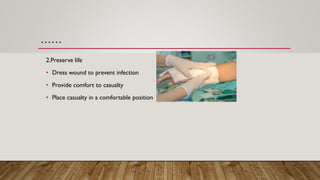
2.Preserve life
• Dresswound to prevent infection
• Provide comfort to casualty
• Place casualty in a comfortable position
7.
…….
3. Promote recovery
✓Relieve casualty from anxiety
✓ Encourage confidence and trust
✓ Attempt to relieve pain and discomfort
✓ Handle casualty gently
✓ Protect casualty from cold and wet
8.
PRINCIPLES OF EMERGENCYCARE
❖Collect the detailed history of the accident either from the victims or any one who has
witnessed the accident
❖The victims injury can be examined thoroughly ,taking notes to every symptom’s to
know the correct diagnosis
❖By the help of diagnosis ,treat the people until the doctor arrives or shift the victims to
the hospital and aid the patient during transport
❖Call the doctors or shift the patient to the hospital as soon as possible so that the
patient can recover soon from the doctors treatment instead of prolonging the first aid
9.
PRINCIPLES OF FIRSTAID 4CS
• Call for help
• Calmly take charge
• Check the scene and the causality
• Carefully apply first aid
10.
PHILOSOPHY OF FIRSTAID
• In the pre hospital setting the key contributors to survival and recovery from illness and
injury are prompt and effective maintenance of the body primary function .
1.Airway
2.Breathing
3.Circulation
4.Bleeding control(life threatening)
12.
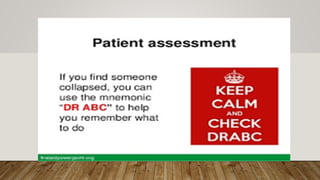
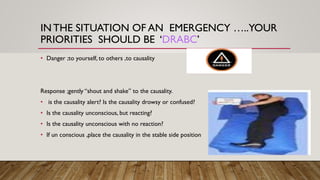
IN THE SITUATIONOF AN EMERGENCY …..YOUR
PRIORITIES SHOULD BE ‘DRABC’
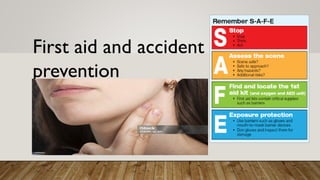
• Danger ;to yourself, to others ,to causality
Response ;gently “shout and shake” to the causality.
• is the causality alert? Is the causality drowsy or confused?
• Is the causality unconscious, but reacting?
• Is the causality unconscious with no reaction?
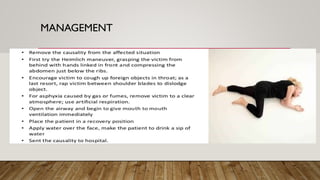
• If un conscious ,place the causality in the stable side position
13.
……
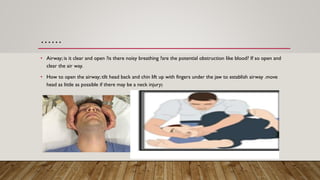
• Airway; isit clear and open ?is there noisy breathing ?are the potential obstruction like blood? If so open and
clear the air way.
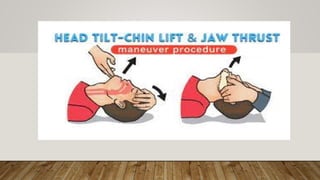
• How to open the airway; tilt head back and chin lift up with fingers under the jaw to establish airway .move
head as little as possible if there may be a neck injury)
14.
……
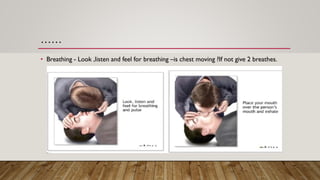
• Breathing -Look ,listen and feel for breathing –is chest moving ?If not give 2 breathes.
15.
……
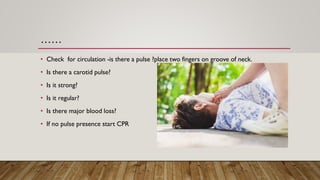
• Check forcirculation -is there a pulse ?place two fingers on groove of neck.
• Is there a carotid pulse?
• Is it strong?
• Is it regular?
• Is there major blood loss?
• If no pulse presence start CPR
16.
DEFINITION OF CP R
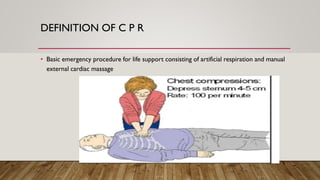
• Basic emergency procedure for life support consisting of artificial respiration and manual
external cardiac massage
17.
PURPOSE
❑To establish effectiveventilation and circulation
❑To prevent irreversible brain damage
❑To decrease immature mortality rate of patient in the hospital
18.
INDICATIONS CPR
1.Respiratory arrestresulting from
✓ Drowning
✓ Stroke
✓ Foreign body
✓ Drug overdose
✓ Smoke inhalation
✓ Suffocation
✓ Myocardial infraction
✓ Coma of any cause leads to air way obstruction
19.
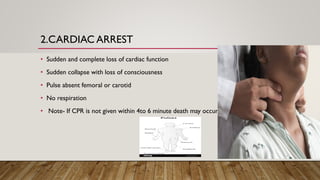
2.CARDIAC ARREST
• Suddenand complete loss of cardiac function
• Sudden collapse with loss of consciousness
• Pulse absent femoral or carotid
• No respiration
• Note- If CPR is not given within 4to 6 minute death may occur
20.
TYPES OF CPR
•Basic life support
• Advanced life support
Basic life support
• It is the sequence of procedure performed to restore the circulation of oxygenated
blood after a sudden pulmonary and or cardiac arrest
• Chest compression and pulmonary ventilation performed by any one ,who knows how
to do it, any where ,immediately ,without any other equipment
21.
AIM
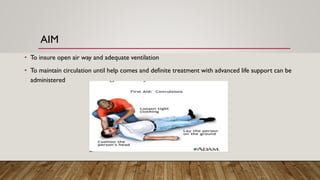
• To insureopen air way and adequate ventilation
• To maintain circulation until help comes and definite treatment with advanced life support can be
administered
22.
ADVANCED LIFE SUPPORT
•Air way secured with advanced technology ,
• Breathing is maintain with some means of breathing apparatuses
• Circulation is maintained by BLS as long as with
IV access
Defibrillator and appropriate drugs
24.
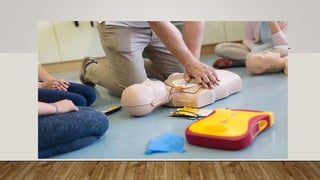
PROCEDURE OF CP R
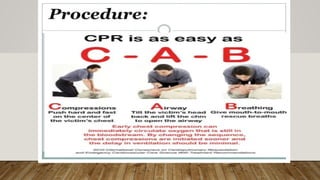
✓ Check for responsiveness of victim .
✓ If suspect that victim has sustained spinal or neck injury ,do not shake or move him
,otherwise shake victim gently and shout ;”Are you okay” to see .
✓ If there is any response no breathing quickly call emergency and following steps; Circulations
assessment .
✓ Establish presence or absence of carotid pulse by placing two finger tips on his carotid artery
for 5 to 10 sec
✓ Start chest compression immediately if the carotid pulse is absent or questionable
25.
……..
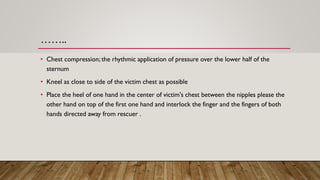
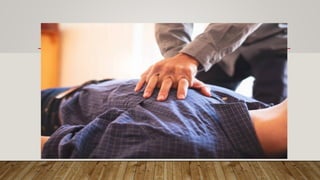
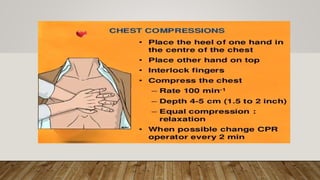
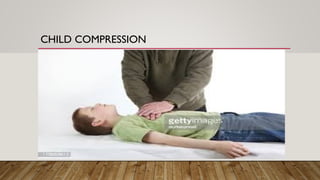
• Chest compression;the rhythmic application of pressure over the lower half of the
sternum
• Kneel as close to side of the victim chest as possible
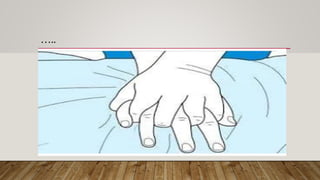
• Place the heel of one hand in the center of victim's chest between the nipples please the
other hand on top of the first one hand and interlock the finger and the fingers of both
hands directed away from rescuer .
CONTD
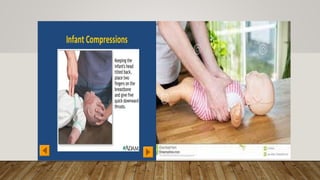
• In childrenit is done with one hand where as in infants it is done with two fingers index and middle
finger
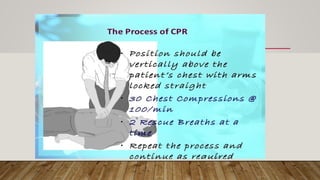
• Compression rate 100compression /minute with a compression depth of approximately 4 to 5 cm
• Allow the chest return to its normal position completely after each compression with equal
compression and relaxation
• Asses after 1minute if circulation present heart beat returns back stop compression immediately but
continue rescue breathing and check circulation in each minute
• If the victims is un responsive check the air way
31.
ASSES AIRWAY
• Assessany visible obstruction in the airway
• Clear the air way by removing any loose obstruction (mucus, blood, foreign body from
mouth and pharynx)
• In case of unconscious victim, tongue is the most common cause of airway obstruction
• If the victim still not breathing then open airway by head tilt and chin left or jaw thrust
• The jaw thrust is a technique used on patients with a suspected spinal injury and use on
a supine patient
• If the victim is not breathing on his own assist him
33.
ASSESS BREATHING
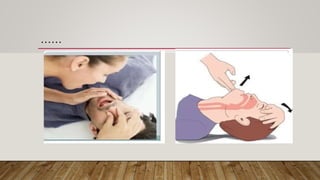
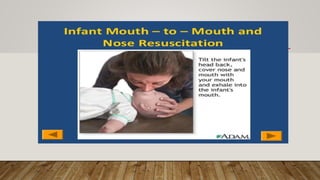
• Looklisten and feel place ear on the victim mouth and nose looking toward the victims
stomach
• Watch to see if the victim’s chest is raising
• Pinch the nostrils closed with the thumb and index finger of the hand that is on the fore
head
• Take deep breath open mouth wide please it outside of the victims mouth making a
tight seal
….
• Inflate thevictim’s lung by two full breaths each breath one minute
• inflate the victims lungs to relax If resistance experienced recheck airways
• Continue the cycle of 30 chest compression and two rescue breathes until spontaneous
circulation is returned or until the arrival of medical help.
Avoid rapid or force full breath
Rate 10-12 breaths per minute
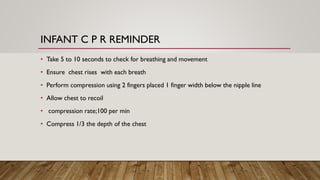
INFANT C PR REMINDER
• Take 5 to 10 seconds to check for breathing and movement
• Ensure chest rises with each breath
• Perform compression using 2 fingers placed 1 finger width below the nipple line
• Allow chest to recoil
• compression rate;100 per min
• Compress 1/3 the depth of the chest
41.
REMINDER
• All CPRequipment is to be checked at the beginning of each shift
• Ratio of cardiac compression to ventilation 30;2
• Compression rate 100 com/min
• Compression depth
• Adult 5cm
• Child 4cm
• Neonate 3cm
GUIDELINE FOR TERMINATIONOF
RESUSCITATION
❖Return of spontaneous circulation
❖Arrival of arrest team or medical help
❖If the rescuer became exhausted
❖When death is confirmed
45.
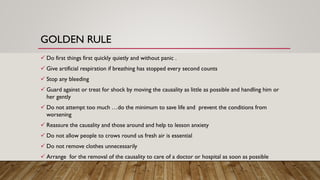
GOLDEN RULE
✓ Dofirst things first quickly quietly and without panic .
✓ Give artificial respiration if breathing has stopped every second counts
✓ Stop any bleeding
✓ Guard against or treat for shock by moving the causality as little as possible and handling him or
her gently
✓ Do not attempt too much …do the minimum to save life and prevent the conditions from
worsening
✓ Reassure the causality and those around and help to lesson anxiety
✓ Do not allow people to crows round us fresh air is essential
✓ Do not remove clothes unnecessarily
✓ Arrange for the removal of the causality to care of a doctor or hospital as soon as possible
SHOCK
• Poor circulationto the vital organs .shock is very serious and life threatening .The
causality may not know that they are in shock.
• Causes ;dilated blood vessels ,bleeding severe dehydration,all leading to a drop of blood
pressure .
ASPHYXIA
Definition
• Asphyxia meansone of the respiratory problems where lungs do not get sufficient
supply of air from breathing
• Sign/symptoms; blue discoloration face ,tongue ,and lips; gasping ,inability to speak;
unconsciousness
HEIMLICH MANEUVER
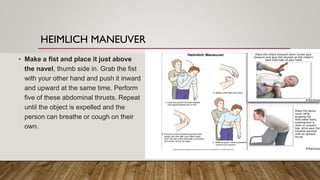
• Makea fist and place it just above
the navel, thumb side in. Grab the fist
with your other hand and push it inward
and upward at the same time. Perform
five of these abdominal thrusts. Repeat
until the object is expelled and the
person can breathe or cough on their
own.
55.
DROWNING
• Is theresult of complete immersion of the nose and the mouth in water or any other liquid.
water enters the wind pipe and lungs ,clogging the lungs completely.
Management
✓ Remove the victims from water
✓ Clean the mouth from sands and other foreign bodies
✓ Put him or her on the floor and raise his or her body
✓ Start CPR
✓ Call for medical help
56.
ELECTRIC SHOCK
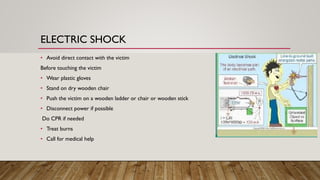
• Avoiddirect contact with the victim
Before touching the victim
• Wear plastic gloves
• Stand on dry wooden chair
• Push the victim on a wooden ladder or chair or wooden stick
• Disconnect power if possible
Do CPR if needed
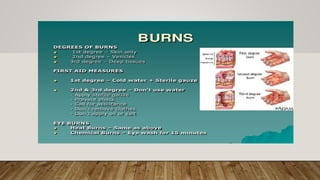
• Treat burns
• Call for medical help
57.
NOSE BLEED OREPISTAXIS'S
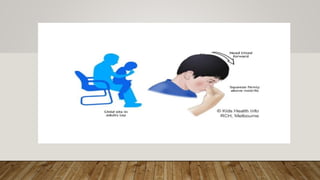
• Have the person rest, have them pinch their nose just below the bone and lean slightly
forward
• If bleeding is sever if it does not stop in 10 to 15 minutes or if there is an injury to the
head to the face ,medical attention needed
• Do not have a person to lean their head back as all this does is have them swallow their
Blood which is not desired
58.
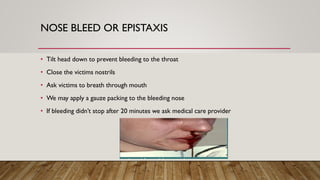
NOSE BLEED OREPISTAXIS
• Tilt head down to prevent bleeding to the throat
• Close the victims nostrils
• Ask victims to breath through mouth
• We may apply a gauze packing to the bleeding nose
• If bleeding didn’t stop after 20 minutes we ask medical care provider
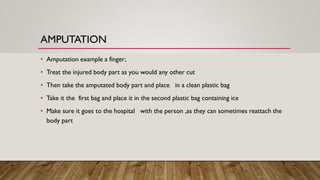
AMPUTATION
• Amputation examplea finger;
• Treat the injured body part as you would any other cut
• Then take the amputated body part and place in a clean plastic bag
• Take it the first bag and place it in the second plastic bag containing ice
• Make sure it goes to the hospital with the person ,as they can sometimes reattach the
body part
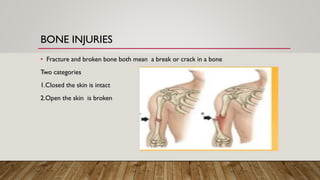
BONE INJURIES
• Fractureand broken bone both mean a break or crack in a bone
Two categories
1.Closed the skin is intact
2.Open the skin is broken
81.
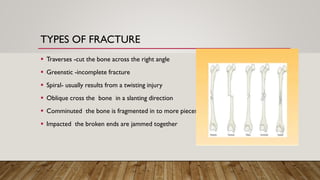
TYPES OF FRACTURE
▪Traverses -cut the bone across the right angle
▪ Greenstic -incomplete fracture
▪ Spiral- usually results from a twisting injury
▪ Oblique cross the bone in a slanting direction
▪ Comminuted the bone is fragmented in to more pieces
▪ Impacted the broken ends are jammed together
82.
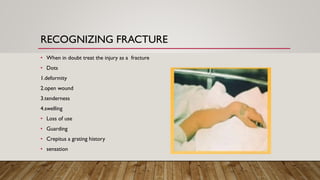
RECOGNIZING FRACTURE
• Whenin doubt treat the injury as a fracture
• Dots
1.deformity
2.open wound
3.tenderness
4.swelling
• Loss of use
• Guarding
• Crepitus a grating history
• sensation
83.
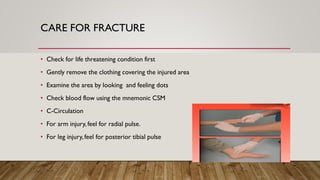
CARE FOR FRACTURE
•Check for life threatening condition first
• Gently remove the clothing covering the injured area
• Examine the area by looking and feeling dots
• Check blood flow using the mnemonic CSM
• C-Circulation
• For arm injury, feel for radial pulse.
• For leg injury, feel for posterior tibial pulse
84.
……
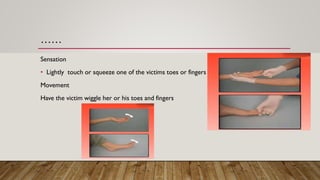
Sensation
• Lightly touchor squeeze one of the victims toes or fingers
Movement
Have the victim wiggle her or his toes and fingers
85.
…….
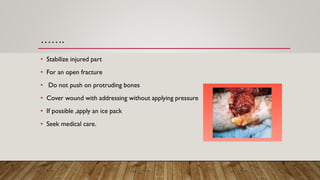
• Stabilize injuredpart
• For an open fracture
• Do not push on protruding bones
• Cover wound with addressing without applying pressure
• If possible ,apply an ice pack
• Seek medical care.
86.
JOINT INJURIES
• Ajoint is where to or more bones come together
Dislocations
• A dislocation occurs when a joint comes stays apart with the bones ends no longer in
contact.
87.
CARE FOR DISLOCATION
•Check for CSM
• Use the RICE procedure
• Rest
• Ice
• Compression
• Elevation
• Use a splint to stabilize the joint
• Do not try to reduce the joint
• Seek medical care
88.
SPRAINS
• A sprainoccurs when a joint is twisted or stretched beyond its normal range of motion
Recognizing sprains
• Show similar signs and symptoms to a fracture
• Severe pain
• Pain prevents the victim from moving or using the joint
• Swelling
• Skin around the joint may discolored
89.
CARE FOR SPRAINS
•Follow the RICE procedure
• apply ice packs for 20 minutes
• Apply compression for 3 to 4 hours
• Repeat the cycles
• Raise the injured
• Use cold promptly
90.
MUSCLE INJURY
• Muscleinjuries pose no real emergency
Strains
• also known as a muscle pull
• Occurs when a muscle is stretched beyond its normal range of motion and tears the muscle
• Inflammation begins immediately after an injury
• Can take 24 to 72 hours for pains and stiffness to begin
Care for strains
Follow the RICE procedure
91.
RECOGNIZING STRAINS
• Suddensharp pain in affected muscle
• Extreme tenderness when touched
• Swelling
• Weakness and in ability to use injured part
• stiffness and pain when victim moves the muscle
• after a few days the skin around the injury may be discolored
92.
CRAMPS
• Occurs whena muscle goes in to un controlled spasm and contraction
• Associated with diabetes ,atherosclerosis and physical activity
• Two categories
• Night cramps ;occurs at night or at rest
• Heat cramps; related to dehydration and electrolyte imbalance
CARE FOR CRAMPS
•Gently stretch the muscle
• Relax the muscle
• Apply ice pack
• pinch the upper lip hard
• Drink lightly salted cool water
• Drink commercial sports water
95.
MUSCLE CONTUSION
• Amuscle contusion or bruise results from a blow to muscle
Recognizing contusion
• Swelling
• Pain and tenderness
• After a few days, as skin in the area became discolored
Care for contusion
Follow the RICE