Life threatening
emergencies
BLS/CPR
BASIC LIFE SUPPORT
CARDIOPULMONARY RESUSCITATION P R E P A R E D B Y M A N I G O T E , I R I S G O N Z A L E S - B S R T
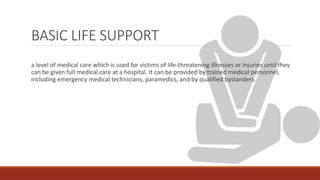
BASIC LIFE SUPPORT
a level of medical care which is used for victims of life-threatening illnesses or injuries until they
can be given full medical care at a hospital. It can be provided by trained medical personnel,
including emergency medical technicians, paramedics, and by qualified bystanders.
CARDIOPULMONARY RESUSCITATION
an emergency procedure that combines chest compressions often with artificial ventilation in an
effort to manually preserve intact brain function until further measures are taken to restore
spontaneous blood circulation and breathing in a person who is in cardiac arrest.
BACKGROUND
Heart diseases are the number 1 killer in our country, accounting for close to 20% of all causes
of death according to the latest Department of Health statistics.
Approximately half of all deaths from cardiovascular disease occur as Sudden Cardiac Arrest.
*SCA is NOT a heart attack – it’s worse.
A heart attack (myocardial infarction) occurs when blood supply to the heart muscle is blocked,
but the heart keeps beating. Patient has ~80% chance of survival, unlike SCA, px only has ~8%.
SUDDEN CARDIAC ARREST
• Can happen any time, to anyone, anywhere w/o warning
• Most common mode of death in patients w/ coronary artery disease (CAD)
• Although pre-existing heart disease is a common cause, it may strike people with no history of
cardiac disease of symptoms
• In sudden cardiac arrest or sudden cardiac death, the heart usually goes into a fatal arrhythmia
called “Ventricular Fibrillation” (VF) wherein it suddenly goes into very irregular fast ineffective
contradictions, the heart stops beating, the victim loses consciousness, and if untreated, dies.
Unfortunately, approximately less than 10% of sudden cardiac arrest victims
survive because majority of those witnessing the arrest are people who do not
know how to perform CPR.
CPR is an emergency procedure used when someone’s heart stops beating.
• It is a simple inexpensive procedure that can be learned by anyone, and consist of a manual
technique using repetitive pressing to the chest and breathing into the person’s airways that
keeps enough oxygen and blood flowing to the brain.
• requires no special medical skills and training is available for the ordinary person nationwide
• if effectively done immediately after cardiac arrest, it can double a victim’s chance of survival.
Early CPR and defibrillation within the first 3-5 minutes after collapse, plus early advanced care
can result in high (greater than 50%) long-term survival rates for witnessed ventricular
fibrillation (VF).
If bystander CPR is not provided, a cardiac arrest victim’s chances of survival fall 7% to 10% for
every minute of delay until defibrillation.
This is a concept which
aims to improve the
outcome for victims of
cardiopulmonary arrest.
–THE CHAIN OF
SURVIVAL
1) EARLY ACCESS
2) EARLY CPR
3) EARLY DEFIBRILLATION
4) EARLY ADVANCED CARDIAC LIFE
SUPPORT (ACLS)
The First Link-Early Access
 A well-informed person—key in the early access link
 Recognition of signs of heart attack and respiratory failure
 Call for help immediately if needed
 Activate the Emergency Medical System (EMS)
Second Link-Early CPR
 Life-saving technique for cardiac & respiratory arrest
 Chest compressions +/- rescue breathing
Why is early CPR important?
--CPR is the best treatment for cardiac arrest until the arrival of ALS (Advanced Life Support)
 Prevents VF from deteriorating to asystole
 May increase the success of defibrillation
 Significantly improves survival
THE STEPS IN BASIC LIFE
SUPPORT
FOR HEALTHCARE PROVIDERS
IF YOU SEE A PERSON DROP DEAD, OR LOSE CONSCIOUSNESS, WITH PRESUMED
SUDDEN CARDIAC ARREST
1 CHECK AREA SAFETY.
-Survey the scene.
-See if the scene is safe to do CPR.
2 CHECK UNRESPONSIVENESS.
-Tap or gently shake the victim
-Rescuer shouts “Are you OK?”
-Quick check for normal breathing
-If the victim is unconscious, rescuer calls for
help.
3 CALL FOR HELP.
-Rescuer ACTIVATES the EMERGENCY MEDICAL
SERVICES.
-Get AED/Defibrillator!
PULSE CHECK
 Palpate for Carotid Pulse w/in 10 seconds
 (at the same time CHECK FOR BREATHING)
 For trained healthcare providers only
If with definite pulse but no breathing
Do Mouth to Mouth Breathing
 Give one breath every 5-6 seconds (about 12
breaths/min)
 Recheck pulse every 2 minutes
MOUTH TO MOUTH BREATHING and PULSE
CHECK
 For trained healthcare providers only
 As short and quick as possible
 Pulse check not more than 10 seconds
 If unsure, proceed directly to CHEST
COMPRESSIONS
C - A - B
After determining unconsciousness,
C. COMPRESSION Do chest compressions first
A. AIRWAY Does the victim have an open
airway (air passage that allows
the victim to breathe)?
B. BREATHING Is the victim breathing?
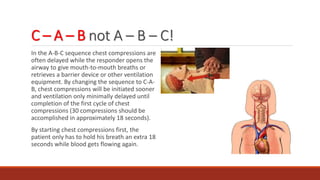
C – A – B not A – B – C!
In the A-B-C sequence chest compressions are
often delayed while the responder opens the
airway to give mouth-to-mouth breaths or
retrieves a barrier device or other ventilation
equipment. By changing the sequence to C-A-
B, chest compressions will be initiated sooner
and ventilation only minimally delayed until
completion of the first cycle of chest
compressions (30 compressions should be
accomplished in approximately 18 seconds).
By starting chest compressions first, the
patient only has to hold his breath an extra 18
seconds while blood gets flowing again.
C - Compression
 Kneel facing the victim’s chest
 Place the heel of your hand on the center of the victim’s
chest. Put your other hand on top of the first with your
fingers interlaced.
(to assist CIRCULATION)
After determining
unconsciousness and calling for
help, proceed immediately to
do CHEST COMPRESSIONS!
C - Compression
Give Chest Compressions at 100 – 120 per minute
Compress breast bone 2-2.4 inches deep (5-6 cm)
Compress 30 times initially
Allow chest to recoil between compressions
(30 compressions should take 15-18 seconds)
(to assist CIRCULATION)
After determining
unconsciousness and calling for
help, proceed immediately to
do CHEST COMPRESSIONS!
A - AIRWAY
 Open the Airway:
Use the head tilt/chin
lift method
o Place one hand on the
victim’s forehead
o Place fingers of other hand
under the bony part of lower
jaw near chin
o Tilt head and lift jaw– avoid
closing victim’s mouth
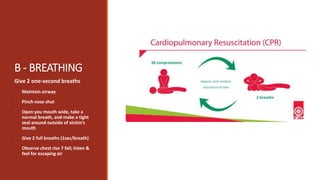
B - BREATHING
Give 2 one-second breaths
• Maintain airway
• Pinch nose shut
• Open you mouth wide, take a
normal breath, and make a tight
seal around outside of victim’s
mouth
• Give 2 full breaths (1sec/breath)
• Observe chest rise 7 fall; listen &
feel for escaping air
PULSE CHECK
RECHECK PULSE EVERY 2 MINUTES
(equivalent to 5 cycles of CPR)
Very brief pulse check – should take less than
10 seconds (at the same time check for normal
breathing)
In case there is any doubt about the presence
or absence of pulse, CONTINUE CHEST
COMPRESSIONS
For trained healthcare providers only
CONTINUE CPR
UNTIL….
•HELP ARRIVES.
(Emergency Services, Ambulance, Doctor, AED)
•PERSON IS REVIVED.
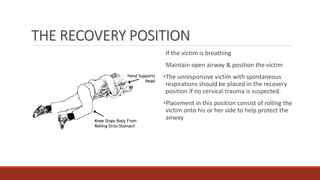
THE RECOVERY POSITION
If the victim is breathing
Maintain open airway & position the victim
•The unresponsive victim with spontaneous
respirations should be placed in the recovery
position if no cervical trauma is suspected.
•Placement in this position consist of rolling the
victim onto his or her side to help protect the
airway
MEMORIZE THE STEPS!
Survey the scene
Check responsiveness – hey hey are you okay?
Call for help! Activate EMS
[Quick check pulse w/in 10secs at the same time check for breathing] IF NO BREATHING NO PULSE.
C-Chest Compressions: 30x 100/min; 2in deep; push hard and fast. Count 1-2-3-4-…26-27-28-29-and 1!
A-Airway: head tilt, chin lift
B-Breathing: 2 full breaths (1 breath/sec)
Chest compressions 30x
Continue cycles 30:2 compression-ventilation. Count 1-2-3-4-….26-27-28-29 and 5!
[Quick check pulse every 2 mins – approx. 5 cycles]
[If no breathing but with pulse, do artificial breathing: give 1 breath every 5 seconds. Count 1-2-3-1blow….up to 1-2-3-12-blow. (12
cycles)
Until. –EMS arrives (AED, Doctor, ambulance) –patient has signs of life

BLS CPR presentation

  • 1.
    Life threatening emergencies BLS/CPR BASIC LIFESUPPORT CARDIOPULMONARY RESUSCITATION P R E P A R E D B Y M A N I G O T E , I R I S G O N Z A L E S - B S R T
  • 2.
    BASIC LIFE SUPPORT alevel of medical care which is used for victims of life-threatening illnesses or injuries until they can be given full medical care at a hospital. It can be provided by trained medical personnel, including emergency medical technicians, paramedics, and by qualified bystanders.
  • 3.
    CARDIOPULMONARY RESUSCITATION an emergencyprocedure that combines chest compressions often with artificial ventilation in an effort to manually preserve intact brain function until further measures are taken to restore spontaneous blood circulation and breathing in a person who is in cardiac arrest.
  • 4.
    BACKGROUND Heart diseases arethe number 1 killer in our country, accounting for close to 20% of all causes of death according to the latest Department of Health statistics. Approximately half of all deaths from cardiovascular disease occur as Sudden Cardiac Arrest. *SCA is NOT a heart attack – it’s worse. A heart attack (myocardial infarction) occurs when blood supply to the heart muscle is blocked, but the heart keeps beating. Patient has ~80% chance of survival, unlike SCA, px only has ~8%.
  • 5.
    SUDDEN CARDIAC ARREST •Can happen any time, to anyone, anywhere w/o warning • Most common mode of death in patients w/ coronary artery disease (CAD) • Although pre-existing heart disease is a common cause, it may strike people with no history of cardiac disease of symptoms • In sudden cardiac arrest or sudden cardiac death, the heart usually goes into a fatal arrhythmia called “Ventricular Fibrillation” (VF) wherein it suddenly goes into very irregular fast ineffective contradictions, the heart stops beating, the victim loses consciousness, and if untreated, dies.
  • 6.
    Unfortunately, approximately lessthan 10% of sudden cardiac arrest victims survive because majority of those witnessing the arrest are people who do not know how to perform CPR.
  • 7.
    CPR is anemergency procedure used when someone’s heart stops beating. • It is a simple inexpensive procedure that can be learned by anyone, and consist of a manual technique using repetitive pressing to the chest and breathing into the person’s airways that keeps enough oxygen and blood flowing to the brain. • requires no special medical skills and training is available for the ordinary person nationwide • if effectively done immediately after cardiac arrest, it can double a victim’s chance of survival.
  • 8.
    Early CPR anddefibrillation within the first 3-5 minutes after collapse, plus early advanced care can result in high (greater than 50%) long-term survival rates for witnessed ventricular fibrillation (VF). If bystander CPR is not provided, a cardiac arrest victim’s chances of survival fall 7% to 10% for every minute of delay until defibrillation.
  • 9.
    This is aconcept which aims to improve the outcome for victims of cardiopulmonary arrest. –THE CHAIN OF SURVIVAL 1) EARLY ACCESS 2) EARLY CPR 3) EARLY DEFIBRILLATION 4) EARLY ADVANCED CARDIAC LIFE SUPPORT (ACLS)
  • 11.
    The First Link-EarlyAccess  A well-informed person—key in the early access link  Recognition of signs of heart attack and respiratory failure  Call for help immediately if needed  Activate the Emergency Medical System (EMS)
  • 12.
    Second Link-Early CPR Life-saving technique for cardiac & respiratory arrest  Chest compressions +/- rescue breathing Why is early CPR important? --CPR is the best treatment for cardiac arrest until the arrival of ALS (Advanced Life Support)  Prevents VF from deteriorating to asystole  May increase the success of defibrillation  Significantly improves survival
  • 13.
    THE STEPS INBASIC LIFE SUPPORT FOR HEALTHCARE PROVIDERS
  • 14.
    IF YOU SEEA PERSON DROP DEAD, OR LOSE CONSCIOUSNESS, WITH PRESUMED SUDDEN CARDIAC ARREST 1 CHECK AREA SAFETY. -Survey the scene. -See if the scene is safe to do CPR. 2 CHECK UNRESPONSIVENESS. -Tap or gently shake the victim -Rescuer shouts “Are you OK?” -Quick check for normal breathing -If the victim is unconscious, rescuer calls for help. 3 CALL FOR HELP. -Rescuer ACTIVATES the EMERGENCY MEDICAL SERVICES. -Get AED/Defibrillator! PULSE CHECK  Palpate for Carotid Pulse w/in 10 seconds  (at the same time CHECK FOR BREATHING)  For trained healthcare providers only
  • 15.
    If with definitepulse but no breathing Do Mouth to Mouth Breathing  Give one breath every 5-6 seconds (about 12 breaths/min)  Recheck pulse every 2 minutes MOUTH TO MOUTH BREATHING and PULSE CHECK  For trained healthcare providers only  As short and quick as possible  Pulse check not more than 10 seconds  If unsure, proceed directly to CHEST COMPRESSIONS
  • 16.
    C - A- B After determining unconsciousness, C. COMPRESSION Do chest compressions first A. AIRWAY Does the victim have an open airway (air passage that allows the victim to breathe)? B. BREATHING Is the victim breathing?
  • 17.
    C – A– B not A – B – C! In the A-B-C sequence chest compressions are often delayed while the responder opens the airway to give mouth-to-mouth breaths or retrieves a barrier device or other ventilation equipment. By changing the sequence to C-A- B, chest compressions will be initiated sooner and ventilation only minimally delayed until completion of the first cycle of chest compressions (30 compressions should be accomplished in approximately 18 seconds). By starting chest compressions first, the patient only has to hold his breath an extra 18 seconds while blood gets flowing again.
  • 18.
    C - Compression Kneel facing the victim’s chest  Place the heel of your hand on the center of the victim’s chest. Put your other hand on top of the first with your fingers interlaced. (to assist CIRCULATION) After determining unconsciousness and calling for help, proceed immediately to do CHEST COMPRESSIONS!
  • 19.
    C - Compression GiveChest Compressions at 100 – 120 per minute Compress breast bone 2-2.4 inches deep (5-6 cm) Compress 30 times initially Allow chest to recoil between compressions (30 compressions should take 15-18 seconds) (to assist CIRCULATION) After determining unconsciousness and calling for help, proceed immediately to do CHEST COMPRESSIONS!
  • 20.
    A - AIRWAY Open the Airway: Use the head tilt/chin lift method o Place one hand on the victim’s forehead o Place fingers of other hand under the bony part of lower jaw near chin o Tilt head and lift jaw– avoid closing victim’s mouth
  • 21.
    B - BREATHING Give2 one-second breaths • Maintain airway • Pinch nose shut • Open you mouth wide, take a normal breath, and make a tight seal around outside of victim’s mouth • Give 2 full breaths (1sec/breath) • Observe chest rise 7 fall; listen & feel for escaping air
  • 22.
    PULSE CHECK RECHECK PULSEEVERY 2 MINUTES (equivalent to 5 cycles of CPR) Very brief pulse check – should take less than 10 seconds (at the same time check for normal breathing) In case there is any doubt about the presence or absence of pulse, CONTINUE CHEST COMPRESSIONS For trained healthcare providers only CONTINUE CPR UNTIL…. •HELP ARRIVES. (Emergency Services, Ambulance, Doctor, AED) •PERSON IS REVIVED.
  • 23.
    THE RECOVERY POSITION Ifthe victim is breathing Maintain open airway & position the victim •The unresponsive victim with spontaneous respirations should be placed in the recovery position if no cervical trauma is suspected. •Placement in this position consist of rolling the victim onto his or her side to help protect the airway
  • 24.
    MEMORIZE THE STEPS! Surveythe scene Check responsiveness – hey hey are you okay? Call for help! Activate EMS [Quick check pulse w/in 10secs at the same time check for breathing] IF NO BREATHING NO PULSE. C-Chest Compressions: 30x 100/min; 2in deep; push hard and fast. Count 1-2-3-4-…26-27-28-29-and 1! A-Airway: head tilt, chin lift B-Breathing: 2 full breaths (1 breath/sec) Chest compressions 30x Continue cycles 30:2 compression-ventilation. Count 1-2-3-4-….26-27-28-29 and 5! [Quick check pulse every 2 mins – approx. 5 cycles] [If no breathing but with pulse, do artificial breathing: give 1 breath every 5 seconds. Count 1-2-3-1blow….up to 1-2-3-12-blow. (12 cycles) Until. –EMS arrives (AED, Doctor, ambulance) –patient has signs of life