QUALITY CONTROL OF
SUPPOSITORIES
PRESENTED BY GROUP # 3
SUPPOSITORIES
 Suppositories are solid dosage forms intended
for insertion into body orifices where they melt,
soften, or dissolve and exert localized or
systemic effects.
 It is comes under semi solid preperation
because it is prepared by melting all ingredient
.
TYPES OF SUPPOSITORIES
SIZE OF SUPPOSITOIRES
SIZE OF SUPPOSITORIES
ADVANTAGES AND DISADVANTAGES
ADVANTAGES OF
SUPPOSITOIRES
DISADVANTAGES OF
SUPPOSITORIES
QUALITY CONTROL OF SUPPOSITORIES
1. APPEARANCE
 It includes
 Odour
 colour
 surface condition
 shape.
WEIGHT UNIFORMITY
 Weigh 20 suppositories individually. w1, w2,
w3….w20
 Weigh all the suppositories together
 Calculate the average weight = W/20.
 Limit: Not more than 2 suppositories differ from
the average weight by more than 5%, and no
suppository differs from the average weight by
more than 10%
MELTING RANGE TEST
 1-The suppository is completely immersed in
the constant temperature water bath, and the
time for the entire suppository to melt or
disperse in the surrounding water is
measured.
DISINTEGRATION TEST…
 The suppository is considered disintegrated
when:
 A- It is completely dissolved or
 B- Dispersed into its component part.
 C- Become soft “change in shape” with formation of
core which is not resistant to pressure with glass rod.
 Method: Place a suppository on the lower perforated disc of metal
device and then insert the device into the cylinder and attach this to
the sleeve.
 Repeat the same operation with further two suppositories, metal
device and sleeve. Place each piece of apparatus in a vessel
containing at least five liters of water at 37C and fitted with a slow
stirrer and by means of holding the top of apparatus 90 mm below
the surface of water. After every 10 minutes invert each apparatus
without removing it from water.
 Disintegration is complete when molded suppositories are:
 Completely dissolved.
 Dispersed into its components.
 Have become soft.
 Disintegration occurs in not more than 30 minutes for fat based
suppositories and for water-soluble suppositories disintegration
occurs in not more than 60 minutes.
LIQUEFACATION TIME OR
SOFTENING
TIME TEST
 In this test a U tube is partially immersed in a
constant temperature bath and is maintained at a
temperature between 35 to 37°C. There is a
constriction in the tube in which the suppository is
kept and above the suppository, a glass rod is
kept. The time taken for the glass rod to go
through the suppository and reach the constriction
is known as the liquefaction time or softening time
 Another apparatus is there for finding “softening
time” which mimics in vivo conditions. It uses a
cellophane tube, and the temperature is
maintained by water circulation. Time taken for the
suppository to melt is noted
BREAKING TEST (
HARDNESS)
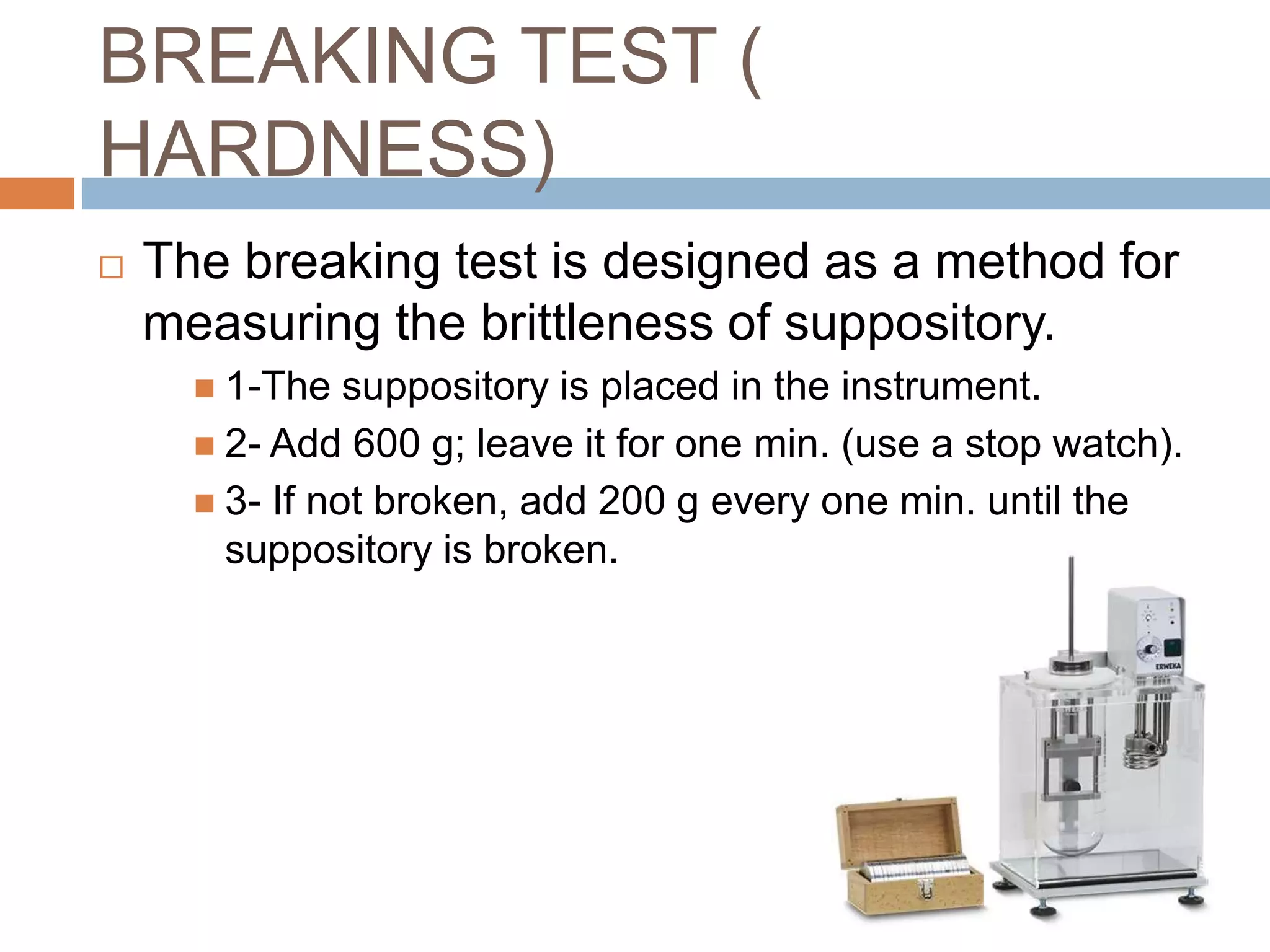
 The breaking test is designed as a method for
measuring the brittleness of suppository.
 1-The suppository is placed in the instrument.
 2- Add 600 g; leave it for one min. (use a stop watch).
 3- If not broken, add 200 g every one min. until the
suppository is broken.
 Calculations: The hardness of the suppository
is calculated by adding the weights together.
 if the suppository is broken before the end of
the last min. the last weight is canceled
DISSOLUTION TEST
 By using different types of apparatus such as
wire mesh basket, or dialysis tubing is used to
test for in vitro release from suppositories
 Two types of apparatus are avaliable for
testing the dissolution rate. They are,
 SUPPOSITORY DIALYSIS CELL- lipophilic
suppositories are tested using suppository
dialysis cell.
 STATIONARY BASKET – rotating paddle
apparatus( USP dissolution test apparatus).
Hydrophilic suppositories are tested using
stationary basket.
STABILITY TESTING
 Cocoa butter suppositories on storage,
“bloom”; i.e., they form a white powdery
deposit on the surface. This can be avoided by
storing the suppositories at uniform cool
temperatures and by wrapping them in foils.
CONTINUED…
 Fat based suppository harden on storage
 There is an upward shift in melting range due to
slow crystalization to the more stable polymeric
forms of the base.
 The softening time test and differential scanning
calorimetry can be used as stability indicating test
methods.
 if we store the suppositories at an elevated
temperature, just below its melting range,
immediately after manufacture, the aging process
is speeded
Quality control of suppositories

Quality control of suppositories

  • 1.
  • 2.
    SUPPOSITORIES  Suppositories aresolid dosage forms intended for insertion into body orifices where they melt, soften, or dissolve and exert localized or systemic effects.  It is comes under semi solid preperation because it is prepared by melting all ingredient .
  • 3.
  • 4.
  • 5.
  • 6.
  • 7.
  • 8.
  • 9.
  • 10.
    QUALITY CONTROL OFSUPPOSITORIES
  • 11.
    1. APPEARANCE  Itincludes  Odour  colour  surface condition  shape.
  • 12.
    WEIGHT UNIFORMITY  Weigh20 suppositories individually. w1, w2, w3….w20  Weigh all the suppositories together  Calculate the average weight = W/20.  Limit: Not more than 2 suppositories differ from the average weight by more than 5%, and no suppository differs from the average weight by more than 10%
  • 13.
    MELTING RANGE TEST 1-The suppository is completely immersed in the constant temperature water bath, and the time for the entire suppository to melt or disperse in the surrounding water is measured.
  • 14.
    DISINTEGRATION TEST…  Thesuppository is considered disintegrated when:  A- It is completely dissolved or  B- Dispersed into its component part.  C- Become soft “change in shape” with formation of core which is not resistant to pressure with glass rod.
  • 15.
     Method: Placea suppository on the lower perforated disc of metal device and then insert the device into the cylinder and attach this to the sleeve.  Repeat the same operation with further two suppositories, metal device and sleeve. Place each piece of apparatus in a vessel containing at least five liters of water at 37C and fitted with a slow stirrer and by means of holding the top of apparatus 90 mm below the surface of water. After every 10 minutes invert each apparatus without removing it from water.  Disintegration is complete when molded suppositories are:  Completely dissolved.  Dispersed into its components.  Have become soft.  Disintegration occurs in not more than 30 minutes for fat based suppositories and for water-soluble suppositories disintegration occurs in not more than 60 minutes.
  • 16.
    LIQUEFACATION TIME OR SOFTENING TIMETEST  In this test a U tube is partially immersed in a constant temperature bath and is maintained at a temperature between 35 to 37°C. There is a constriction in the tube in which the suppository is kept and above the suppository, a glass rod is kept. The time taken for the glass rod to go through the suppository and reach the constriction is known as the liquefaction time or softening time  Another apparatus is there for finding “softening time” which mimics in vivo conditions. It uses a cellophane tube, and the temperature is maintained by water circulation. Time taken for the suppository to melt is noted
  • 17.
    BREAKING TEST ( HARDNESS) The breaking test is designed as a method for measuring the brittleness of suppository.  1-The suppository is placed in the instrument.  2- Add 600 g; leave it for one min. (use a stop watch).  3- If not broken, add 200 g every one min. until the suppository is broken.
  • 18.
     Calculations: Thehardness of the suppository is calculated by adding the weights together.  if the suppository is broken before the end of the last min. the last weight is canceled
  • 19.
    DISSOLUTION TEST  Byusing different types of apparatus such as wire mesh basket, or dialysis tubing is used to test for in vitro release from suppositories
  • 20.
     Two typesof apparatus are avaliable for testing the dissolution rate. They are,  SUPPOSITORY DIALYSIS CELL- lipophilic suppositories are tested using suppository dialysis cell.  STATIONARY BASKET – rotating paddle apparatus( USP dissolution test apparatus). Hydrophilic suppositories are tested using stationary basket.
  • 21.
    STABILITY TESTING  Cocoabutter suppositories on storage, “bloom”; i.e., they form a white powdery deposit on the surface. This can be avoided by storing the suppositories at uniform cool temperatures and by wrapping them in foils.
  • 22.
    CONTINUED…  Fat basedsuppository harden on storage  There is an upward shift in melting range due to slow crystalization to the more stable polymeric forms of the base.  The softening time test and differential scanning calorimetry can be used as stability indicating test methods.  if we store the suppositories at an elevated temperature, just below its melting range, immediately after manufacture, the aging process is speeded