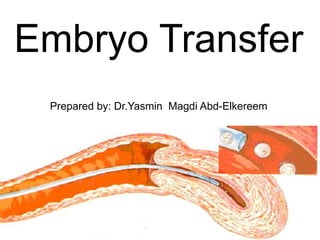
Embryo Transfer
Prepared by: Dr.Yasmin Magdi Abd-Elkereem
Embryo Transfer
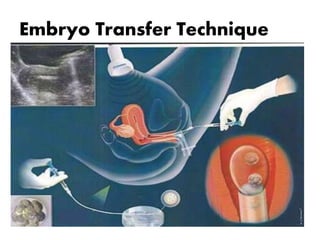
• Final and most crucial step in ART in which embryos are
placed in female uterus.
• Close collaboration between clinician and embryologist.
• A successful transfer is a gentle and nontraumatic procedure.
• A number of studies have shown that significant
improvements in clinical pregnancy rates can be achieved by
giving due attention to ET technique.
(Fanchin et al. 1998)
Factors affecting embryo transfer
1. Implantation capacity of the embryo
2. Endometrial receptivity
3. Embryo Transfer technique
The Embryo
• Failure of the embryo to implant is the major limiting step determining
Assisted Reproductive Techniques (ART) success rates.
• A number of strategies aimed at increasing the chance of embryo to
successfully implant, such as
Preimplantation Genetic Diagnosis
Assisted hatching
Co-culture with human endometrial epithelial cells
Embryo Glue
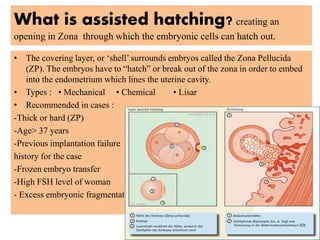
What is assisted hatching?creating an
opening in Zona through which the embryonic cells can hatch out.
• The covering layer, or ‘shell’ surrounds embryos called the Zona Pellucida
(ZP). The embryos have to “hatch” or break out of the zona in order to embed
into the endometrium which lines the uterine cavity.
• Types : • Mechanical • Chemical • Lisar
• Recommended in cases :
-Thick or hard (ZP)
-Age> 37 years
-Previous implantation failure
history for the case
-Frozen embryo transfer
-High FSH level of woman
- Excess embryonic fragmentation
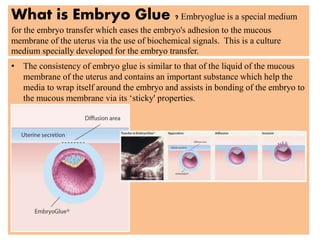
What is Embryo Glue ? Embryoglue is a special medium
for the embryo transfer which eases the embryo's adhesion to the mucous
membrane of the uterus via the use of biochemical signals. This is a culture
medium specially developed for the embryo transfer.
• The consistency of embryo glue is similar to that of the liquid of the mucous
membrane of the uterus and contains an important substance which help the
media to wrap itself around the embryo and assists in bonding of the embryo to
the mucous membrane via its ‘sticky' properties.
Media used in Embryo transfer are primarily based on the role of
ions, amino acids, and we must focus on the role of different
macromolecules in embryo culture media such as albumin and hyaluronan .
Albumin
• highly abundant in the female
reproduction tract
• source of energy
• reservoir for the release of
hormones, vitamins, and metals.
• Gives useful physical properties of
lubrication and viscosity
• promotes ease of handling the
embryos
• prevents its adherence to the culture
dish.
• Source: patient’s own serum, fetal
cord serum, commercially pooled
human serum albumin (HSA) and
lately, recombinant human
albumin (rHA).
hyaluronan (hyaluronic acid)
• major glycosaminoglycans present
in the cervical mucus, the cumulus,
follicular fluid, and seminal plasma
• increases up to the time of
implantation (in Vivo)
• have an implantation-promoting
effect
• Increases the viscosity
• the adhesion and apposition of
embryo can be achieved faster
• Source: rooster comb or as a
recombinant substance.
(Simon A, et all 2003) (Schoolcraft W,et all 2002)
The endometrium
• Uterine receptivity is defined as a restricted period when the uterus
supports blastocyst attachment and this maternally driven ‘window’ of
receptivity takes place from approximately day 19-24 in a normal
menstrual cycle
(Wilcox et al. 1999;Navot et al. 1991)
Embryo Transfer Technique
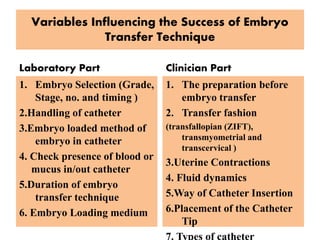
Variables Influencing the Success of Embryo
Transfer Technique
Laboratory Part
1. Embryo Selection (Grade,
Stage, no. and timing )
2.Handling of catheter
3.Embryo loaded method of
embryo in catheter
4. Check presence of blood or
mucus in/out catheter
5.Duration of embryo
transfer technique
6. Embryo Loading medium
Clinician Part
1. The preparation before
embryo transfer
2. Transfer fashion
(transfallopian (ZIFT),
transmyometrial and
transcervical )
3.Uterine Contractions
4. Fluid dynamics
5.Way of Catheter Insertion
6.Placement of the Catheter
Tip
7. Types of catheter
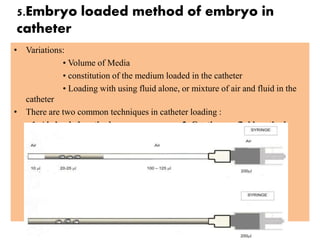
5.Embryo loaded method of embryo in
catheter
• Variations:
• Volume of Media
• constitution of the medium loaded in the catheter
• Loading with using fluid alone, or mixture of air and fluid in the
catheter
• There are two common techniques in catheter loading :
1. Air loaded method 2. Continuous fluid method
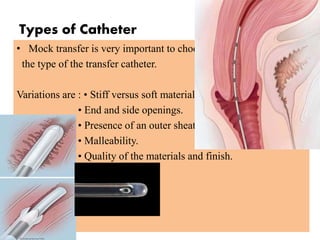
Types of Catheter
• Mock transfer is very important to choose
the type of the transfer catheter.
Variations are : • Stiff versus soft materials.
• End and side openings.
• Presence of an outer sheath.
• Malleability.
• Quality of the materials and finish.
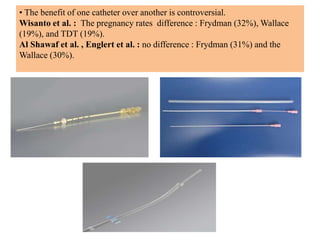
• The benefit of one catheter over another is controversial.
Wisanto et al. : The pregnancy rates difference : Frydman (32%), Wallace
(19%), and TDT (19%).
Al Shawaf et al. , Englert et al. : no difference : Frydman (31%) and the
Wallace (30%).
Check presence of blood or mucus in/out
catheter
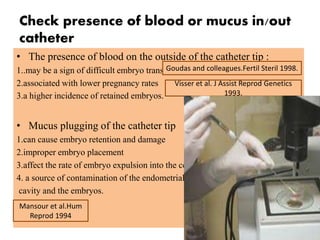
• The presence of blood on the outside of the catheter tip :
1..may be a sign of difficult embryo transfer
2.associated with lower pregnancy rates
3.a higher incidence of retained embryos.
• Mucus plugging of the catheter tip
1.can cause embryo retention and damage
2.improper embryo placement
3.affect the rate of embryo expulsion into the cervix.
4. a source of contamination of the endometrial
cavity and the embryos.
Goudas and colleagues.Fertil Steril 1998.
Visser et al. J Assist Reprod Genetics
1993.
Mansour et al.Hum
Reprod 1994
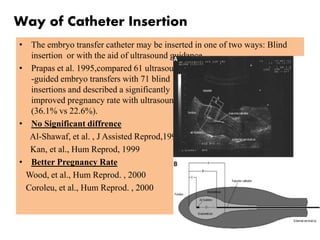
• The embryo transfer catheter may be inserted in one of two ways: Blind
insertion or with the aid of ultrasound guidance.
• Prapas et al. 1995,compared 61 ultrasound
-guided embryo transfers with 71 blind
insertions and described a significantly
improved pregnancy rate with ultrasound
(36.1% vs 22.6%).
• No Significant diffrence
Al-Shawaf, et al. , J Assisted Reprod,1993
Kan, et al., Hum Reprod, 1999
• Better Pregnancy Rate
Wood, et al., Hum Reprod. , 2000
Coroleu, et al., Hum Reprod. , 2000
Way of Catheter Insertion
Trans-Vaginal Embryo Transfer
Blind Insertion
• The clinician feels the internal os and
then either he advances the catheter
till the fundus is felt and withdraw
the catheter for 1 or 2 cm and
position the embryos.
• Alternatively the clinician advances
the inner catheter after feeling the
resistance of the internal os by 3-4
cm based on previous measurement
of the uterine cavity
• Based on Clinician Touch
• inadvertent abutting of the catheter
tip
U.S guidance
• The clinician use of abdominal
ultrasound in addition of visualizing
the catheter is to straighten the
uterovesical angle which my make
the insertion of the catheter easier.
• Full bladder is required
• facilitates the placement of soft
catheters
• avoids touching the fundus
• avoiding disruption of the
endometrium
• plugging of the catheter tip with
endometrium, and the instigation of
bleeding
• confirms that the catheter is beyond
the internal os in cases of an
Thank You
For contact: Yas.magdi@hotmail.com

Embryo transfer

  • 1.
    Embryo Transfer Prepared by:Dr.Yasmin Magdi Abd-Elkereem
  • 2.
    Embryo Transfer • Finaland most crucial step in ART in which embryos are placed in female uterus. • Close collaboration between clinician and embryologist. • A successful transfer is a gentle and nontraumatic procedure. • A number of studies have shown that significant improvements in clinical pregnancy rates can be achieved by giving due attention to ET technique. (Fanchin et al. 1998)
  • 3.
    Factors affecting embryotransfer 1. Implantation capacity of the embryo 2. Endometrial receptivity 3. Embryo Transfer technique
  • 4.
    The Embryo • Failureof the embryo to implant is the major limiting step determining Assisted Reproductive Techniques (ART) success rates. • A number of strategies aimed at increasing the chance of embryo to successfully implant, such as Preimplantation Genetic Diagnosis Assisted hatching Co-culture with human endometrial epithelial cells Embryo Glue
  • 5.
    What is assistedhatching?creating an opening in Zona through which the embryonic cells can hatch out. • The covering layer, or ‘shell’ surrounds embryos called the Zona Pellucida (ZP). The embryos have to “hatch” or break out of the zona in order to embed into the endometrium which lines the uterine cavity. • Types : • Mechanical • Chemical • Lisar • Recommended in cases : -Thick or hard (ZP) -Age> 37 years -Previous implantation failure history for the case -Frozen embryo transfer -High FSH level of woman - Excess embryonic fragmentation
  • 6.
    What is EmbryoGlue ? Embryoglue is a special medium for the embryo transfer which eases the embryo's adhesion to the mucous membrane of the uterus via the use of biochemical signals. This is a culture medium specially developed for the embryo transfer. • The consistency of embryo glue is similar to that of the liquid of the mucous membrane of the uterus and contains an important substance which help the media to wrap itself around the embryo and assists in bonding of the embryo to the mucous membrane via its ‘sticky' properties.
  • 7.
    Media used inEmbryo transfer are primarily based on the role of ions, amino acids, and we must focus on the role of different macromolecules in embryo culture media such as albumin and hyaluronan . Albumin • highly abundant in the female reproduction tract • source of energy • reservoir for the release of hormones, vitamins, and metals. • Gives useful physical properties of lubrication and viscosity • promotes ease of handling the embryos • prevents its adherence to the culture dish. • Source: patient’s own serum, fetal cord serum, commercially pooled human serum albumin (HSA) and lately, recombinant human albumin (rHA). hyaluronan (hyaluronic acid) • major glycosaminoglycans present in the cervical mucus, the cumulus, follicular fluid, and seminal plasma • increases up to the time of implantation (in Vivo) • have an implantation-promoting effect • Increases the viscosity • the adhesion and apposition of embryo can be achieved faster • Source: rooster comb or as a recombinant substance. (Simon A, et all 2003) (Schoolcraft W,et all 2002)
  • 8.
    The endometrium • Uterinereceptivity is defined as a restricted period when the uterus supports blastocyst attachment and this maternally driven ‘window’ of receptivity takes place from approximately day 19-24 in a normal menstrual cycle (Wilcox et al. 1999;Navot et al. 1991)
  • 9.
  • 10.
    Variables Influencing theSuccess of Embryo Transfer Technique Laboratory Part 1. Embryo Selection (Grade, Stage, no. and timing ) 2.Handling of catheter 3.Embryo loaded method of embryo in catheter 4. Check presence of blood or mucus in/out catheter 5.Duration of embryo transfer technique 6. Embryo Loading medium Clinician Part 1. The preparation before embryo transfer 2. Transfer fashion (transfallopian (ZIFT), transmyometrial and transcervical ) 3.Uterine Contractions 4. Fluid dynamics 5.Way of Catheter Insertion 6.Placement of the Catheter Tip 7. Types of catheter
  • 11.
    5.Embryo loaded methodof embryo in catheter • Variations: • Volume of Media • constitution of the medium loaded in the catheter • Loading with using fluid alone, or mixture of air and fluid in the catheter • There are two common techniques in catheter loading : 1. Air loaded method 2. Continuous fluid method
  • 12.
    Types of Catheter •Mock transfer is very important to choose the type of the transfer catheter. Variations are : • Stiff versus soft materials. • End and side openings. • Presence of an outer sheath. • Malleability. • Quality of the materials and finish.
  • 13.
    • The benefitof one catheter over another is controversial. Wisanto et al. : The pregnancy rates difference : Frydman (32%), Wallace (19%), and TDT (19%). Al Shawaf et al. , Englert et al. : no difference : Frydman (31%) and the Wallace (30%).
  • 14.
    Check presence ofblood or mucus in/out catheter • The presence of blood on the outside of the catheter tip : 1..may be a sign of difficult embryo transfer 2.associated with lower pregnancy rates 3.a higher incidence of retained embryos. • Mucus plugging of the catheter tip 1.can cause embryo retention and damage 2.improper embryo placement 3.affect the rate of embryo expulsion into the cervix. 4. a source of contamination of the endometrial cavity and the embryos. Goudas and colleagues.Fertil Steril 1998. Visser et al. J Assist Reprod Genetics 1993. Mansour et al.Hum Reprod 1994
  • 15.
    • The embryotransfer catheter may be inserted in one of two ways: Blind insertion or with the aid of ultrasound guidance. • Prapas et al. 1995,compared 61 ultrasound -guided embryo transfers with 71 blind insertions and described a significantly improved pregnancy rate with ultrasound (36.1% vs 22.6%). • No Significant diffrence Al-Shawaf, et al. , J Assisted Reprod,1993 Kan, et al., Hum Reprod, 1999 • Better Pregnancy Rate Wood, et al., Hum Reprod. , 2000 Coroleu, et al., Hum Reprod. , 2000 Way of Catheter Insertion
  • 16.
    Trans-Vaginal Embryo Transfer BlindInsertion • The clinician feels the internal os and then either he advances the catheter till the fundus is felt and withdraw the catheter for 1 or 2 cm and position the embryos. • Alternatively the clinician advances the inner catheter after feeling the resistance of the internal os by 3-4 cm based on previous measurement of the uterine cavity • Based on Clinician Touch • inadvertent abutting of the catheter tip U.S guidance • The clinician use of abdominal ultrasound in addition of visualizing the catheter is to straighten the uterovesical angle which my make the insertion of the catheter easier. • Full bladder is required • facilitates the placement of soft catheters • avoids touching the fundus • avoiding disruption of the endometrium • plugging of the catheter tip with endometrium, and the instigation of bleeding • confirms that the catheter is beyond the internal os in cases of an
  • 17.
    Thank You For contact:Yas.magdi@hotmail.com

Editor's Notes

  • #10 The technique of embryo transfer marries the efforts of the reproductive biologist and the clinician. Without healthy embryos capable of implanting, embryo transfer is sure to fail. Likewise, the work of embryologists to maintain the viability of embryos is futile if a traumatic embryo transfer follows.