Embryo Transfer
Tips & Tricks
Dr Kaberi Banerjee
Preparation before ET
• History of difficult
IUI/HSG/ET
• Previous Pelvic Surgeries
• Anxiety
• Non consummation
Preparation before ET
• P/S
• Mock ET
• GA
• Scan before ET
• Hormonal levels
Consents – IVF process in Covid Pandemic
Consent – Embryo transfer and Embryo freezing
Documentation
Discuss Embryology Details
• Delayed
• Cleavage/Blastocyst
• Cryopreservation
No. of embryos to transfer
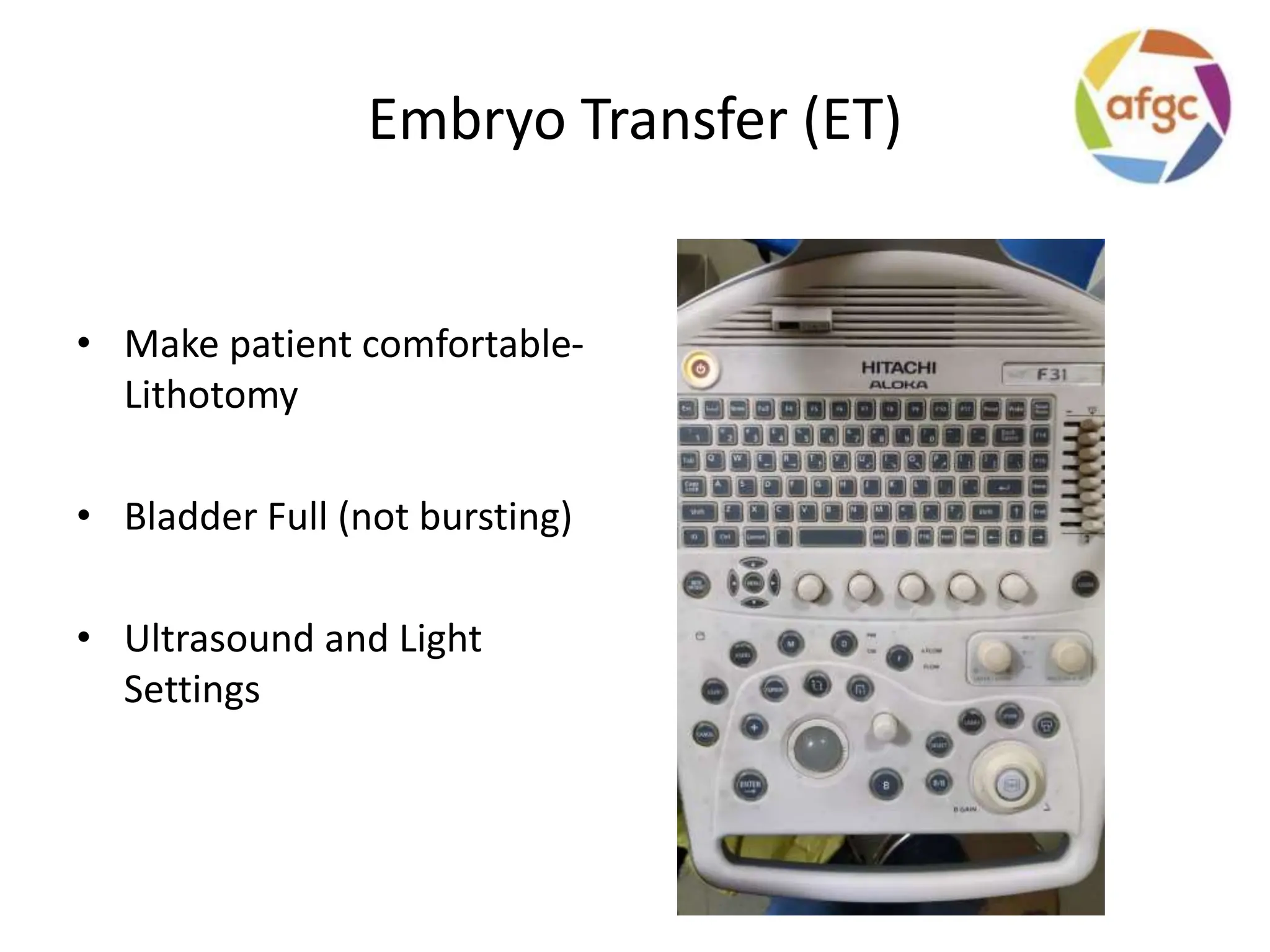
Embryo Transfer (ET)
• Make patient comfortable-
Lithotomy
• Bladder Full (not bursting)
• Ultrasound and Light
Settings
Role of Full Bladder
• Straightening of cervico-
uterine axis
• Clear visualization
Cleaning the cervix
• Gentle speculum insertion
• Cleaning with normal saline/media
• 1 cc syringe
• Sterile cotton buds
Cervical Mucus
• Mucus plug in catheter tip can cause
– Blocking the passage of embryos
through the tip of the catheter
– Pulling embryos back from the site
of the expulsion
– Contaminating intrauterine
environment with cervical flora
– Retention of embryos
– Damage to the embryos
– Improper embryo placement
– Lower pregnancy rate
Type of catheter
• Soft catheter
• Stiff catheter
ET catheter
Cook Gaurdia Access Cook Sydney IVF
ET catheter
Wallace ET catheter Labotect ET catheter
ET Catheters
Steps in ET
• Outer insertion
• Inner Check
• Embryo Loading
Precautions during ET
• Follow Inner
• Distance between tip of
catheter and uterine fundus
= 1.5-2 cm(MIP)
Steps in ET
• Gentle but firm Push
• Flow Pattern
• Withdraw
• Examination of Catheter
and Embryos
Steps in ET
• Operator Performance
• Rest
• Luteal Support
ASRM Standard Embryo Transfer Protocol Template
ASRM
Standard Embryo Transfer Protocol
Systematic Review/Guideline Survey of SART
Medical Directors
Step 1 Prepare for ET procedure by reviewing
prior mock or transfer notes
Step 2 Prepare patient for procedure using
analgesics & other techniques
• Fair evidence - Acupuncture performed
around time of ET does not improve PR
• Insufficient evidence - To recommend
for or against analgesics, massage,
general anesthesia, TEAS whole
systems– traditional Chinese medicine
to improve PR
Routine patient
relaxant for ET
Yes 46%
No 54%
Step 3 Time out process
ASRM
Standard Embryo Transfer Protocol
Systematic Review/Guideline Survey of SART Medical
Directors
Step 4 Use transabdominal scan • Good evidence - based on 9 RCTs
to recommend TA ultrasound
guidance during ET to improve
CPR and LBR
• Insufficient evidence - to
recommend for or against
selective USG guidance
Use of USG guidance
Always 93%
Selectively 4%
Never 3%
Step 5 Practitioner preparation Surgical mask?
Yes 62%
No 38%
Sterile gloves?
Yes 89%
No 11%
ASRM
Standard Embryo Transfer Protocol
Systematic Review/Guideline Survey of SART Medical
Directors
Step 6 Placement of speculum
Cleaning/ flushing of vagina & cervix
Cleanse cervix?
Yes 96%
No 4%
With:
Saline 17%
Media 78%
Other 2%
NA 3%
Step 7 Remove mucus from ECC Fair evidence - benefit to
removing cervical mucus at the
time of ET to improve CPR and
LBR
Remove mucus?
Yes 75%
No 25%
How?
Cotton swab 26%
Flush 20%
Both 31%
Aspirate 6%
ASRM
Standard Embryo Transfer Protocol
Systematic
Review/Guideline
Survey of SART Medical
Directors
Step 8 Prepare ET catheter and traverse cervix by
below techniques –
• Direct transfer
• Trial followed by transfer
• Afterload transfer
• Trial transfer converted into an afterload
transfer
Good evidence - to
recommend the use of a soft
embryo transfer catheter to
improve IVF ET pregnancy
rate
Predominant technique used:
Trial followed by transfer 40%
(includes trial converted to
afterload)
Afterload 31%
Step 9 Place catheter tip at ideal location Fair evidence - placement of
catheter tip in upper or
middle (central) area of
uterine cavity, greater than 1
cm from fundus for embryo
expulsion, optimizes PR
Location of catheter tip:
Upper third 66%
Middle third 29%
Lower third 5%
Closest distance to fundus:
0.5 cm - 7%
1 cm - 47%
1.5 cm - 39%
2 cm - 7%
ASRM
Standard Embryo Transfer Protocol
Systematic Review/Guideline Survey of SART Medical Directors
Step 10 Expel embryos and withdraw catheter
immediately
Fair evidence - to recommend
immediate withdrawal of
embryo transfer catheter after
embryo expulsion
After embryo expulsion catheter
removed:
Immediately 31%
5 – 10 seconds 33%
30 seconds 22%
1 minute 12%
Other 2%
Step 11 Check catheter for retained embryo(s)
If present – reload new catheter and
immediately re-transfer embryo(s)
Fair evidence - Retained
embryos in transfer catheter
and immediate re- transfer do
not affect implantation, CPR or
spontaneous abortion rates
Retained embryos re transferred in:
Same catheter 33%
New catheter 67%
Step 12 Patient gets up from transfer table
(without rest)
Good evidence – not to
recommend bed rest after ET
Patient ambulates after transfer:
Immediately 32%
5 – 10 min 13%
10 – 15 min 13%
15 – 30 min 27%
30 min 14%
>1 hour 2%
Difficult ET
• Obesity
• Retroverted
• Cervical Stenosis
• Cervix pulled up
• Poor visualization
Cervical Canal Findings in Difficult Embryo Transfer
• False passage in the cervix with acute angulation
• Tortuous cervical canal with a fibrotic internal os
• Severely fibrotic internal os
• Fibroid close to cervical canal
Hysteroscopic Procedures
– Cervical canal shaving
– Refashioning of cervical canal
with Versapoint
– Hysteroscopic evaluation and
placement of a Malecot
catheter
– Hysteroscopic myosure
morcellation
Difficult Embryo Transfer
– If anticipated may plan under GA
– Require a firmer catheter
– Stylet
– Tenaculum
– Sounding
– Cervical Dilatation
Difficult ET
Transvaginal Ultrasound Guided ET
Affects Does Not Affect
Remove Cervical Mucus Acupuncture
Tip placement in mid cavity >1cm from
fundus
Routine Antibiotics
Immediate Withdrawal of Catheter Powdered Gloves
Mucus on Catheter
Immediate Retransfer of retained
embryos
Analgesics
Massage
Chinese Medicine
Blood on catheter
Injection speed
If no previous H/o difficult ET
P/S
Require partial full bladder
Afterload technique
Use of Stylet
Labotect Catheter
If previous H/o difficult ET
P/S examination & Mock ET
Hysteroscopy
ET under GA
Labotect Catheter
Hysteroscopic resection
AFGC Protocol
Difficult ET Cases
Under Vision ,Gentle, Fast ,
Thank You!

Embryo Transfer- Tips and Tricks to improve success

  • 1.
    Embryo Transfer Tips &Tricks Dr Kaberi Banerjee
  • 2.
    Preparation before ET •History of difficult IUI/HSG/ET • Previous Pelvic Surgeries • Anxiety • Non consummation
  • 3.
    Preparation before ET •P/S • Mock ET • GA • Scan before ET • Hormonal levels
  • 5.
    Consents – IVFprocess in Covid Pandemic
  • 6.
    Consent – Embryotransfer and Embryo freezing
  • 7.
  • 8.
    Discuss Embryology Details •Delayed • Cleavage/Blastocyst • Cryopreservation
  • 9.
    No. of embryosto transfer
  • 10.
    Embryo Transfer (ET) •Make patient comfortable- Lithotomy • Bladder Full (not bursting) • Ultrasound and Light Settings
  • 11.
    Role of FullBladder • Straightening of cervico- uterine axis • Clear visualization
  • 12.
    Cleaning the cervix •Gentle speculum insertion • Cleaning with normal saline/media • 1 cc syringe • Sterile cotton buds
  • 13.
    Cervical Mucus • Mucusplug in catheter tip can cause – Blocking the passage of embryos through the tip of the catheter – Pulling embryos back from the site of the expulsion – Contaminating intrauterine environment with cervical flora – Retention of embryos – Damage to the embryos – Improper embryo placement – Lower pregnancy rate
  • 14.
    Type of catheter •Soft catheter • Stiff catheter
  • 15.
    ET catheter Cook GaurdiaAccess Cook Sydney IVF
  • 16.
    ET catheter Wallace ETcatheter Labotect ET catheter
  • 17.
  • 18.
    Steps in ET •Outer insertion • Inner Check • Embryo Loading
  • 19.
    Precautions during ET •Follow Inner • Distance between tip of catheter and uterine fundus = 1.5-2 cm(MIP)
  • 20.
    Steps in ET •Gentle but firm Push • Flow Pattern • Withdraw • Examination of Catheter and Embryos
  • 21.
    Steps in ET •Operator Performance • Rest • Luteal Support
  • 22.
    ASRM Standard EmbryoTransfer Protocol Template ASRM Standard Embryo Transfer Protocol Systematic Review/Guideline Survey of SART Medical Directors Step 1 Prepare for ET procedure by reviewing prior mock or transfer notes Step 2 Prepare patient for procedure using analgesics & other techniques • Fair evidence - Acupuncture performed around time of ET does not improve PR • Insufficient evidence - To recommend for or against analgesics, massage, general anesthesia, TEAS whole systems– traditional Chinese medicine to improve PR Routine patient relaxant for ET Yes 46% No 54% Step 3 Time out process
  • 23.
    ASRM Standard Embryo TransferProtocol Systematic Review/Guideline Survey of SART Medical Directors Step 4 Use transabdominal scan • Good evidence - based on 9 RCTs to recommend TA ultrasound guidance during ET to improve CPR and LBR • Insufficient evidence - to recommend for or against selective USG guidance Use of USG guidance Always 93% Selectively 4% Never 3% Step 5 Practitioner preparation Surgical mask? Yes 62% No 38% Sterile gloves? Yes 89% No 11%
  • 24.
    ASRM Standard Embryo TransferProtocol Systematic Review/Guideline Survey of SART Medical Directors Step 6 Placement of speculum Cleaning/ flushing of vagina & cervix Cleanse cervix? Yes 96% No 4% With: Saline 17% Media 78% Other 2% NA 3% Step 7 Remove mucus from ECC Fair evidence - benefit to removing cervical mucus at the time of ET to improve CPR and LBR Remove mucus? Yes 75% No 25% How? Cotton swab 26% Flush 20% Both 31% Aspirate 6%
  • 25.
    ASRM Standard Embryo TransferProtocol Systematic Review/Guideline Survey of SART Medical Directors Step 8 Prepare ET catheter and traverse cervix by below techniques – • Direct transfer • Trial followed by transfer • Afterload transfer • Trial transfer converted into an afterload transfer Good evidence - to recommend the use of a soft embryo transfer catheter to improve IVF ET pregnancy rate Predominant technique used: Trial followed by transfer 40% (includes trial converted to afterload) Afterload 31% Step 9 Place catheter tip at ideal location Fair evidence - placement of catheter tip in upper or middle (central) area of uterine cavity, greater than 1 cm from fundus for embryo expulsion, optimizes PR Location of catheter tip: Upper third 66% Middle third 29% Lower third 5% Closest distance to fundus: 0.5 cm - 7% 1 cm - 47% 1.5 cm - 39% 2 cm - 7%
  • 26.
    ASRM Standard Embryo TransferProtocol Systematic Review/Guideline Survey of SART Medical Directors Step 10 Expel embryos and withdraw catheter immediately Fair evidence - to recommend immediate withdrawal of embryo transfer catheter after embryo expulsion After embryo expulsion catheter removed: Immediately 31% 5 – 10 seconds 33% 30 seconds 22% 1 minute 12% Other 2% Step 11 Check catheter for retained embryo(s) If present – reload new catheter and immediately re-transfer embryo(s) Fair evidence - Retained embryos in transfer catheter and immediate re- transfer do not affect implantation, CPR or spontaneous abortion rates Retained embryos re transferred in: Same catheter 33% New catheter 67% Step 12 Patient gets up from transfer table (without rest) Good evidence – not to recommend bed rest after ET Patient ambulates after transfer: Immediately 32% 5 – 10 min 13% 10 – 15 min 13% 15 – 30 min 27% 30 min 14% >1 hour 2%
  • 27.
    Difficult ET • Obesity •Retroverted • Cervical Stenosis • Cervix pulled up • Poor visualization
  • 28.
    Cervical Canal Findingsin Difficult Embryo Transfer • False passage in the cervix with acute angulation • Tortuous cervical canal with a fibrotic internal os • Severely fibrotic internal os • Fibroid close to cervical canal
  • 29.
    Hysteroscopic Procedures – Cervicalcanal shaving – Refashioning of cervical canal with Versapoint – Hysteroscopic evaluation and placement of a Malecot catheter – Hysteroscopic myosure morcellation
  • 30.
    Difficult Embryo Transfer –If anticipated may plan under GA – Require a firmer catheter – Stylet – Tenaculum – Sounding – Cervical Dilatation
  • 34.
  • 35.
  • 37.
    Affects Does NotAffect Remove Cervical Mucus Acupuncture Tip placement in mid cavity >1cm from fundus Routine Antibiotics Immediate Withdrawal of Catheter Powdered Gloves Mucus on Catheter Immediate Retransfer of retained embryos
  • 38.
  • 39.
    If no previousH/o difficult ET P/S Require partial full bladder Afterload technique Use of Stylet Labotect Catheter If previous H/o difficult ET P/S examination & Mock ET Hysteroscopy ET under GA Labotect Catheter Hysteroscopic resection AFGC Protocol Difficult ET Cases
  • 40.
  • 41.