

Oocyte pick up and
Embryo transfer
Emad Darwish MD
Professor of Obstetrics and Gynecology
Integrated Fertility Centre
Alexandria
Oocyte Pick up
• Equipments
• Technique
• Complications
• Approaches
Equipments
• Ultrasound Machine with trans-vaginal probe.
• Needle guide to be attached to the trans-vaginal probe.
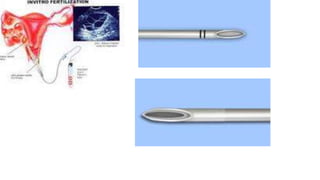
• Aspiration needle: single lumen or double lumen.
• Follicle aspiration set.( ready made needle with tubing and collection
tube) ready to be attached to suction pump.
• Suction pump. ( can be replaced by 10 ml syringes).
Technique
• General anaesthesia. Most common.
• Aspiration of the follicles:
Push needle through needle guide on the guide line.
Push needle tip inside follicle and aspirate.
All follicles to be aspirated.
• Flushing of follicles:
When no. of follicles less than 6-8.
Up to 8 times till oocyte is retrieved.
Important tips
• Tip of the needle should be seen all the times
• Do not move probe side to side while needle inside ovaray.
• Try to aspirate more than one follicle with single puncture in the
vagina or the ovary.
• Do not aspirate chocolate cysts and avoid to puncture it.
• If bleeding from vaginal punctures, usually controlled easily by
pressure and rarely needs diathermy.
• Rotate needle when blocked by follicle wall.
Complications
• Bleeding :
Vaginal
Intr-Abdominal
• Infection
• Pain
• No oocytes
Approaches
• Laparoscopic.
• U/S guided: Trans-vaginal or Trans-abdomonal
Embryo Transfer
• Timing
• Catheters
• Technique
• Ultrasound guided
• Bed rest after ET
• Number of replaced embryos
• Mock ET
Timing
• Day 2-3
• Day 5-6
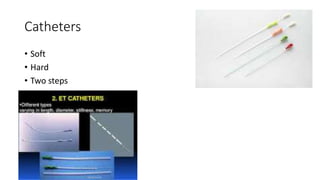
Catheters
• Soft
• Hard
• Two steps
Technique
• No need of anaesthesia. Very rare.
• Clean cervix with saline.
• Remove mucus from cervical canal. Not important
• Flush cervix and cervical canal with culture media
• Gentle manipulation
• Tip of outer catheter just above internal os
• Advance inner catheter to about 1-2 cm below upper end of cavity
• Push piston and keep pressure for about 5-10 seconds
• Withdraw catheter while keeping pressure
If difficult to pass internal os, shift to 2 steps transfer.
• Use outer sheath with stellate and pass it from internal os.
• Remove stellate
• Advance inner catheter with embryos till 1-2 cm below fundus and
replace embryos
Ultrasound
• ET under U/S guidance improves pregnancy rate.
• Full bladder for TAS
• Very important for begginers
• Needs expert assistant
Bed Rest
• No evidence to support bed rest after ET .
Numbers of replaced embryos
• Depends on many factors
Age, history, embryo quality
• 2-3 usual number.
• Problem of multiple pregnancy
• Fetal reduction
• Freezing program
• Cumulative pregnancy rate
Mock embryo transfer
• On day of retrieval
• Just before real ET
• Before starting stimulation
• eg 4+3 at 3 oclock
shoulder of outer catheter at 4 cm, inner catheter pushed for 3 cm
and introduction of catheter direction is at 3 oclock.

Oocyte pick up and Embryo transfer

  • 1.
    Oocyte pick upand Embryo transfer Emad Darwish MD Professor of Obstetrics and Gynecology Integrated Fertility Centre Alexandria
  • 2.
    Oocyte Pick up •Equipments • Technique • Complications • Approaches
  • 3.
    Equipments • Ultrasound Machinewith trans-vaginal probe. • Needle guide to be attached to the trans-vaginal probe. • Aspiration needle: single lumen or double lumen. • Follicle aspiration set.( ready made needle with tubing and collection tube) ready to be attached to suction pump. • Suction pump. ( can be replaced by 10 ml syringes).
  • 4.
    Technique • General anaesthesia.Most common. • Aspiration of the follicles: Push needle through needle guide on the guide line. Push needle tip inside follicle and aspirate. All follicles to be aspirated. • Flushing of follicles: When no. of follicles less than 6-8. Up to 8 times till oocyte is retrieved.
  • 5.
    Important tips • Tipof the needle should be seen all the times • Do not move probe side to side while needle inside ovaray. • Try to aspirate more than one follicle with single puncture in the vagina or the ovary. • Do not aspirate chocolate cysts and avoid to puncture it. • If bleeding from vaginal punctures, usually controlled easily by pressure and rarely needs diathermy. • Rotate needle when blocked by follicle wall.
  • 6.
  • 7.
    Approaches • Laparoscopic. • U/Sguided: Trans-vaginal or Trans-abdomonal
  • 10.
    Embryo Transfer • Timing •Catheters • Technique • Ultrasound guided • Bed rest after ET • Number of replaced embryos • Mock ET
  • 11.
  • 12.
  • 13.
    Technique • No needof anaesthesia. Very rare. • Clean cervix with saline. • Remove mucus from cervical canal. Not important • Flush cervix and cervical canal with culture media • Gentle manipulation • Tip of outer catheter just above internal os • Advance inner catheter to about 1-2 cm below upper end of cavity • Push piston and keep pressure for about 5-10 seconds • Withdraw catheter while keeping pressure
  • 14.
    If difficult topass internal os, shift to 2 steps transfer. • Use outer sheath with stellate and pass it from internal os. • Remove stellate • Advance inner catheter with embryos till 1-2 cm below fundus and replace embryos
  • 15.
    Ultrasound • ET underU/S guidance improves pregnancy rate. • Full bladder for TAS • Very important for begginers • Needs expert assistant
  • 16.
    Bed Rest • Noevidence to support bed rest after ET .
  • 17.
    Numbers of replacedembryos • Depends on many factors Age, history, embryo quality • 2-3 usual number. • Problem of multiple pregnancy • Fetal reduction • Freezing program • Cumulative pregnancy rate
  • 18.
    Mock embryo transfer •On day of retrieval • Just before real ET • Before starting stimulation • eg 4+3 at 3 oclock shoulder of outer catheter at 4 cm, inner catheter pushed for 3 cm and introduction of catheter direction is at 3 oclock.