By:
M.D
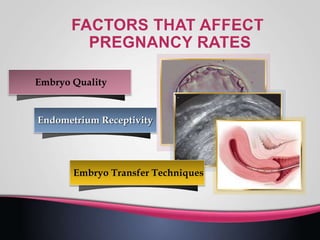
Embryo Quality
Endometrium Receptivity
Embryo Transfer Techniques
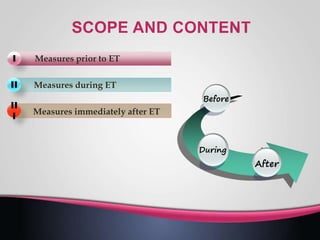
Measures prior to ET
Measures during ET
Measures immediately after ET
I
II
II
I
After
During
Before
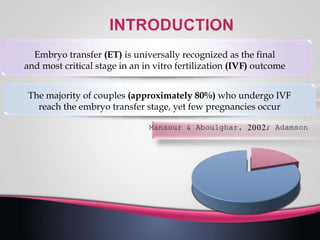
Embryo transfer (ET) is universally recognized as the final
and most critical stage in an in vitro fertilization (IVF) outcome
Neithardt et al., 2The majority of couples (approximately 80%) who undergo IVF
reach the embryo transfer stage, yet few pregnancies occur
Mansour & Aboulghar, 2002; Adamson
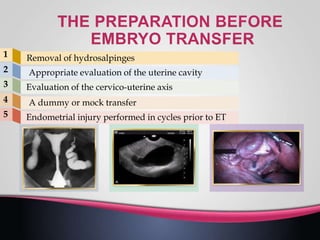
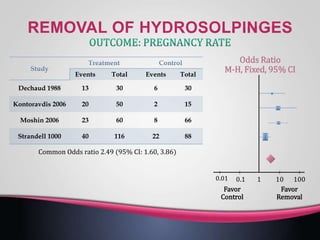
1 Removal of hydrosalpinges
2 Appropriate evaluation of the uterine cavity
3 Evaluation of the cervico-uterine axis
4 A dummy or mock transfer
5 Endometrial injury performed in cycles prior to ET
TotalEventsTotalEvents
3063013Dechaud 1988
1525020Kontoravdis 2006
6686023Moshin 2006
882211640Strandell 1000
Common Odds ratio 2.49 (95% CI: 1.60, 3.86)
0.01 0.1 1 10 100
Odds Ratio
M-H, Fixed, 95% CI
Favor
Control
Favor
Removal
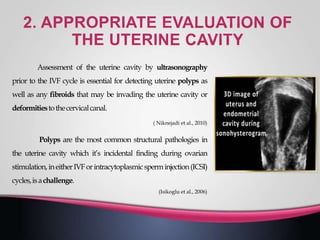
Assessment of the uterine cavity by ultrasonography
prior to the IVF cycle is essential for detecting uterine polyps as
well as any fibroids that may be invading the uterine cavity or
deformitiestothecervicalcanal.
( Niknejadi et al., 2010)
Polyps are the most common structural pathologies in
the uterine cavity which it’s incidental finding during ovarian
stimulation,ineitherIVForintracytoplasmicsperminjection(ICSI)
cycles,isachallenge.
(Isikoglu et al., 2006)
Polyp size (Lass et al., 1999; Isikoglu et al., 2006) and location (Yanaihara et al., 2008)
may influence the success of embryo implantation during assisted
reproductive treatment cycles.
According to some research studies, endometrial polyps less
than 1.5cm do not negatively influence the pregnancy outcome,
whereas increased loss of pregnancy has been reported in others
(Lass et al., 1999; Isikoglu et al., 2006).
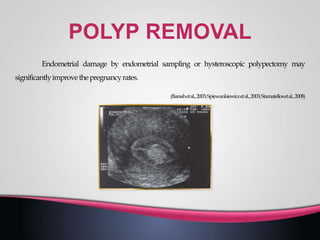
Endometrial damage by endometrial sampling or hysteroscopic polypectomy may
significantlyimprovethepregnancyrates.
(Barashetal.,2003;Spiewankiewiczetal.,2003;Stamatellosetal.,2008)
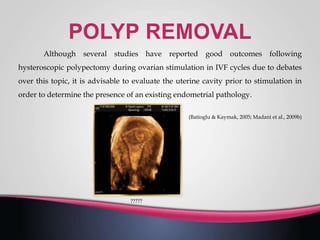
Although several studies have reported good outcomes following
hysteroscopic polypectomy during ovarian stimulation in IVF cycles due to debates
over this topic, it is advisable to evaluate the uterine cavity prior to stimulation in
order to determine the presence of an existing endometrial pathology.
(Batioglu & Kaymak, 2005; Madani et al., 2009b)
?????
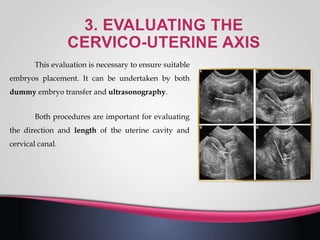
This evaluation is necessary to ensure suitable
embryos placement. It can be undertaken by both
dummy embryo transfer and ultrasonography.
Both procedures are important for evaluating
the direction and length of the uterine cavity and
cervical canal.
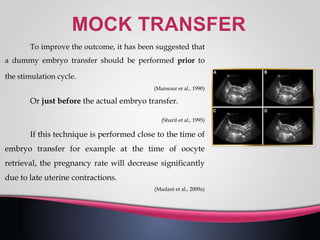
To improve the outcome, it has been suggested that
a dummy embryo transfer should be performed prior to
the stimulation cycle.
(Mansour et al., 1990)
Or just before the actual embryo transfer.
(Sharif et al., 1995)
If this technique is performed close to the time of
embryo transfer for example at the time of oocyte
retrieval, the pregnancy rate will decrease significantly
due to late uterine contractions.
(Madani et al., 2009a)
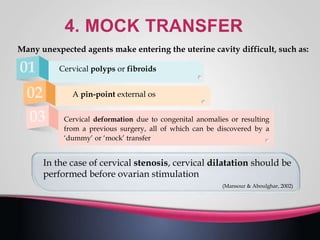
Many unexpected agents make entering the uterine cavity difficult, such as:
Cervical polyps or fibroids
A pin-point external os
Cervical deformation due to congenital anomalies or resulting
from a previous surgery, all of which can be discovered by a
‘dummy’ or ‘mock’ transfer
In the case of cervical stenosis, cervical dilatation should be
performed before ovarian stimulation
(Mansour & Aboulghar, 2002)
WeightTotalEventsTotalEvents
1.1.1 Injury in the pervious cycle
2.54
[0.88, 7.36]
37.4%5154911Narvekar 2010
2.42
[1.06, 5.51]
62.6%50125022
Selcuk University
2011
2.46
[1.28, 4.72]
100.0%10199Subtotal (95%CI)
1733Total events
Heterogeneity: Chi2= 0.01, df= 1 (P= 0.94); I2= 0%
Test for overall effect: Z= 2.71 (P= 0.007)
2.46 [1.28, 4.72]
100.0
%
10199Total (95% CI)
1733Total events
Heterogeneity: Chi2= 0.01, df= 1 (P= 0.94); I2= 0%
Test for overall effect: Z= 2.71 (P= 0.007)
Test for subgroup differences: Not applicable
Peto Odds Ratio
Peto, Fixed, 95% CI
Favor End.
Injury
0.1 0.2 10.5 2 105
Favor Control
NNT= 6
WeightTotalEventsTotalEvents
1.3.1 Injury in the pervious cycle
3.36 [1.20, 9.37]16.9%5748513Karimzadeh 2009
2.88 [1.14, 7.28]20.7%5174916Narvekar 2010
2.01 [0.97, 4.19]33.2%60186028Nastri 2011
2.81 [1.29, 6.14]29.2%50175030Selcuk University 2011
2.61 [1.71, 3.97]100.0%218217Subtotal (95%CI)
4687Total events
Heterogeneity: Chi2= 0.79, df= 3 (P= 0.85); I2= 0%
Test for overall effect: Z= 4.45 (P= 0.00001)
1.3.2 Injury on the day of oocyte retrieval
0.30 [0.14, 0.63]100.0%7926779Karimzade 2010
0.30 [0.14, 0.63]100.0%7977Subtotal (95% CI)
269Total events
Heterogeneity:Not applicable
Test for overall effect: Z= 3.17 (P= 0.002)
Peto Odds Ratio
Peto, Fixed, 95% CI
Favor End.
Injury
0.1 0.2 10.5 2 105
Favor Control
NNT= 5
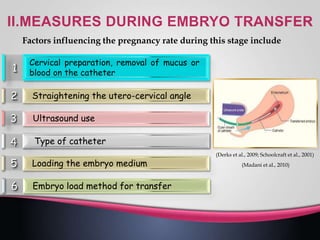
Factors influencing the pregnancy rate during this stage include
1
Cervical preparation, removal of mucus or
blood on the catheter
2 Straightening the utero-cervical angle
3 Ultrasound use
4 Type of catheter
5 Loading the embryo medium
6 Embryo load method for transfer
(Derks et al., 2009; Schoolcraft et al., 2001)
(Madani et al., 2010)
Cervical mucus seems to interfere with embryo entry into the
uterus from the transfer catheter. This interference can be caused by
excess cervical mucus that cover the transfer catheter and make the
injection of the embryos effortless.
(Visschers et al., 2007)
The presence of blood or mucus on the catheter, from tissues
trauma, may also reduce implantation rates.
(Schoolcraft et al., 2001)
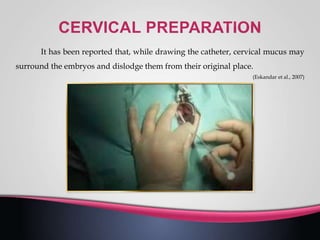
It has been reported that, while drawing the catheter, cervical mucus may
surround the embryos and dislodge them from their original place.
(Eskandar et al., 2007)
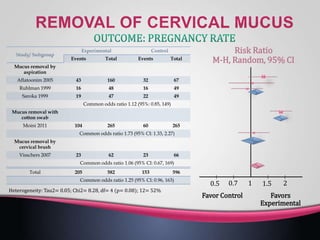
Risk Ratio
M-H, Random, 95% CI
Favors
Experimental
0.5 10.7 1.5 2
Favor Control
TotalEventsTotalEvents
Mucus removal by
aspiration
673216043Aflatoonim 2005
49164816Ruhlman 1999
49224719Saroka 1999
Common odds ratio 1.12 (95%: 0.85, 149)
Mucus removal with
cotton swab
26560265104Moini 2011
Common odds ratio 1.73 (95% CI: 1.33, 2.27)
Mucus removal by
cervical brush
66236223Visschers 2007
Common odds ratio 1.06 (95% CI: 0.67, 169)
596153582205Total
Common odds ratio 1.25 (95% CI: 0.96, 163)
Heterogeneity: Tau2= 0.05; Chi2= 8.28, df= 4 (p= 0.08); 12= 52%
Peto Odds Ratio
Fixed, 95% CI
1.14 [0.80, 1.62]
0.01 0.1 1 10 100
Flushing No Flushing
Empty bladder
72/126
26/93
13/50
269
72/12657/127Glass 2000
26/9328/91Kyono 2001
13/5018/50Sallam 2000
269268Total
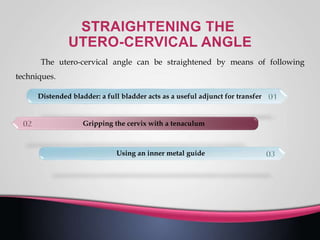
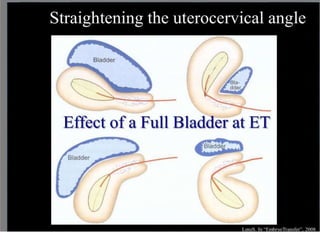
The utero-cervical angle can be straightened by means of following
techniques.
Distended bladder: a full bladder acts as a useful adjunct for transfer
Gripping the cervix with a tenaculum
Using an inner metal guide
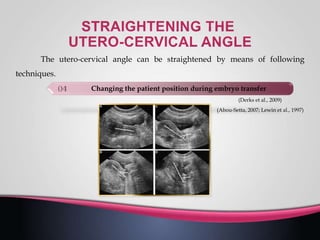
The utero-cervical angle can be straightened by means of following
techniques.
(Abou-Setta, 2007; Lewin et al., 1997)
Changing the patient position during embryo transfer
(Derks et al., 2009)
25/6426/67Lorusso 2005
13/7612/66Mitchell 1989
140133Total
No effect on the pregnancy rate for women
undergoing ET with a full or an empty bladder
Peto Odds Ratio
Fixed, 95% CI
0.98 [0.57, 1.68]
0.02 0.1 1 10 50
Empty bladder
25/64
13/76
140
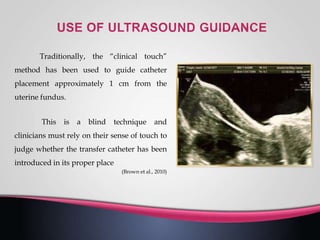
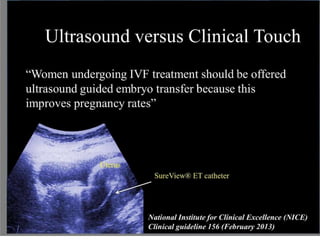
Traditionally, the “clinical touch”
method has been used to guide catheter
placement approximately 1 cm from the
uterine fundus.
This is a blind technique and
clinicians must rely on their sense of touch to
judge whether the transfer catheter has been
introduced in its proper place
(Brown et al., 2010)
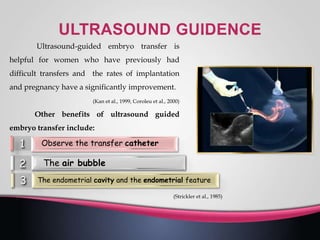
Ultrasound-guided embryo transfer is
helpful for women who have previously had
difficult transfers and the rates of implantation
and pregnancy have a significantly improvement.
(Kan et al., 1999, Coroleu et al., 2000)
Other benefits of ultrasound guided
embryo transfer include:
(Strickler et al., 1985)
1 Observe the transfer catheter
2 The air bubble
3 The endometrial cavity and the endometrial feature
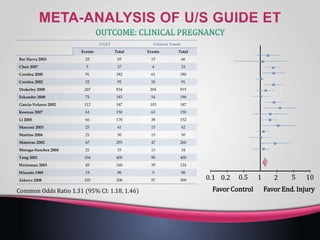
Favor End. Injury
0.1 0.2 10.5 2 105
Favor Control
TotalEventsTotalEvents
66156522Bar Harva 2003
234275Chen 2007
1806118291Coroleu 2000
91189332Coroleu 2002
815204834207Drakeley 2008
1905418375Eskander 2008
187103187112Garcia-Velasco 2002
1506315063Kosmas 2007
1523817866Li 2005
42154125Marconi 2003
50155021Martins 2004
2604725567Matorras 2002
34133321Moraga-Sanchez 2004
40090400104Tang 2001
1243916049Weissman 2003
9899819Wisanto 1989
30997308105Zakova 2008
Common Odds Ratio 1.31 (95% CI: 1.18, 1.46)
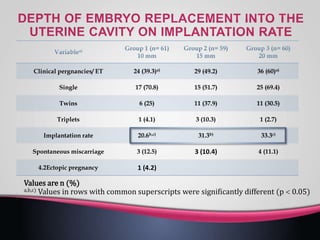
36 (60)a)29 (49.2)24 (39.3)a)Clinical pergnancies/ ET
25 (69.4)15 (51.7)17 (70.8)Single
11 (30.5)11 (37.9)6 (25)Twins
1 (2.7)3 (10.3)1 (4.1)Triplets
33.3c)31.3b)20.6b,c)Implantation rate
4 (11.1)3 (10.4)3 (12.5)Spontaneous miscarriage
1 (4.2)4.2Ectopic pregnancy
Values are n (%)
a,b,c) Values in rows with common superscripts were significantly different (p  0.05)
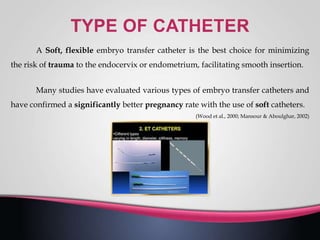
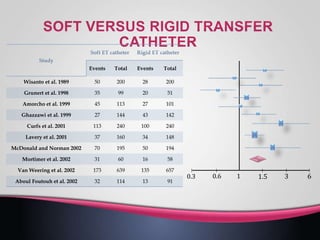
A Soft, flexible embryo transfer catheter is the best choice for minimizing
the risk of trauma to the endocervix or endometrium, facilitating smooth insertion.
Many studies have evaluated various types of embryo transfer catheters and
have confirmed a significantly better pregnancy rate with the use of soft catheters.
(Wood et al., 2000; Mansour & Aboulghar, 2002)
TotalEventsTotalEvents
2002820050Wisanto et al. 1989
51209935Grunert et al. 1998
1012711345Amorcho et al. 1999
1424314427Ghazzawi et al. 1999
240100240113Curfs et al. 2001
1483416037Lavery et al. 2001
1945019570McDonald and Norman 2002
58166031Mortimer et al. 2002
657135639173Van Weering et al. 2002
911311432Aboul Foutouh et al. 2002
0.3 10.6 1.5 3 6
One natural and most important adherent macromolecule recommended to be
introduced into transfer media is hyaluronic acid which is known as an implantation
enhancing-molecule.
(Bontekoe et al., 2010)
Hyaluronic acid improves implantation by increasing cell-to-cell adhesion
and cell-tomatrix adhesion
(Bontekoe et al., 2010)
Hyaluronic acid generates a viscous solution that might improve the embryo
transfer process, preventing embryo expulsion
(Simon et al., 2003).
TotalEventsTotalEvents
193124193137Balaban 2014
4895419Dittmann-Muller 2009
93159443Friedler 2005
5055118Friedler 2007
411655Hazlett 2008
1583013830Korosec 2007
305309Mahani 2007
42214117Morbeck 2007
69217921Ravhon 2005
84439158Schoolcraft 2002
40214025Simon 2003
643312639349Urman 2008
65226426Yakin 2004
Peto Odds Ratio
Fixed, 95% CI
1.14 [0.80, 1.62]
0.01 0.1 1 10 100
Favours no
or low HA
Favours HA
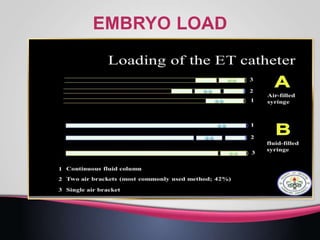
The advantage of using the air and liquid content for catheter loading is to
prevent the embryo from adhering to the wall of the catheter at the time of
injection.
(Eytan et al., 2004)
The presence of two air bubbles on both sides of the medium that contains the
embryo prevents the transfer of the embryo within the catheter (Eytan et al., 2004)
and beside, in the transfer under ultrasonographic guidance, the air bubbles are
often considered a marker for the embryo’s position in the uterus.
(Lambers et al., 2007; Friedman et al., 2011)
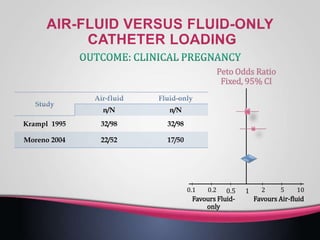
n/Nn/N
32/9832/98Krampl 1995
17/5022/52Moreno 2004
Peto Odds Ratio
Fixed, 95% CI
0.2 0.5 10.1 2 5 10
Favours Air-fluidFavours Fluid-
only
Finally by loading 1 µl of medium on the catheter tip, the
probability of embryo expulsion will be stopped.
It has been reported that larger volumes of fluid transferred (60
µl) correlate with retained embryos, yet it is advisable that a certain
amount of media be loaded to assist with expelling the embryo.
(Hearns-Stokes et al., 2000)
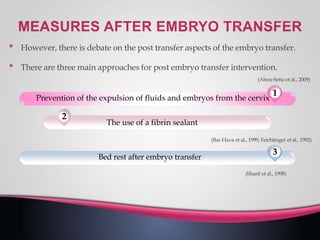
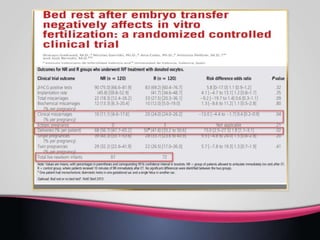
• However, there is debate on the post transfer aspects of the embryo transfer.
• There are three main approaches for post embryo transfer intervention.
(Abou-Setta et al., 2009)
(Bar-Hava et al., 1999, Feichtinger et al., 1992)
1
Prevention of the expulsion of fluids and embryos from the cervix
2
The use of a fibrin sealant
(Sharif et al., 1998)
3
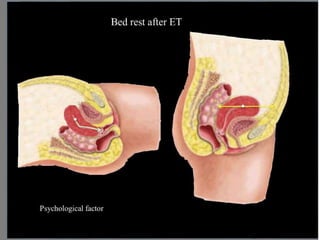
Bed rest after embryo transfer
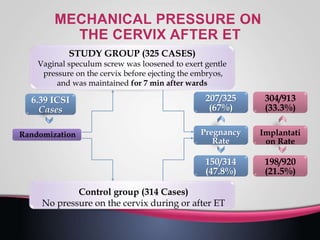
6.39 ICSI
Cases
Randomization
STUDY GROUP (325 CASES)
Vaginal speculum screw was loosened to exert gentle
pressure on the cervix before ejecting the embryos,
and was maintained for 7 min after wards
Control group (314 Cases)
No pressure on the cervix during or after ET
207/325
(67%)
Pregnancy
Rate
150/314
(47.8%)
304/913
(33.3%)
Implantati
on Rate
198/920
(21.5%)
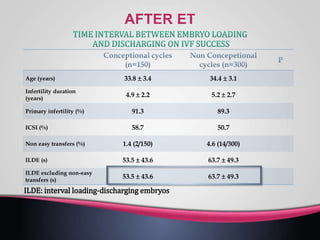
34.4  3.133.8 3.4Age (years)
5.2  2.74.9  2.2
Infertility duration
(years)
89.391.3Primary infertility (%)
50.758.7ICSI (%)
4.6 (14/300)1.4 (2/150)Non easy transfers (%)
63.7  49.353.5  43.6ILDE (s)
63.7  49.353.5  43.6
ILDE excluding non-easy
transfers (s)
ILDE: interval loading-discharging embryos
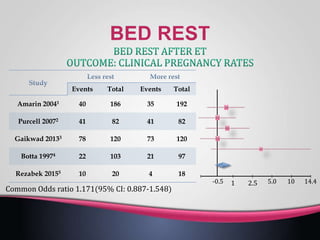
TotalEventsTotalEvents
1923518640Amarin 20041
82418241Purcell 20072
1207312078Gaikwad 20133
972110322Botta 19974
1842010Rezabek 20155
-0.5 1 2.5 5.0 10 14.4
Common Odds ratio 1.171(95% CI: 0.887-1.548)
Embryo transfer must be performed in a gentle and non-
traumatic manner.
Minimizing blood on the catheter tip (cervical trauma), the
cervical mucus, the risk of embryo expulsion or retained embryos, the
frequency and severity of uterine contractions, and performing a trial
embryo transfer before the actual transfer all seems to be useful for
embryo transfer.
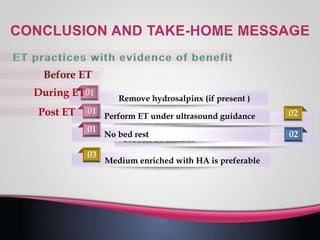
01
Remove hydrosalpinx (if present )
02
Polypectomy if present
01
Perform ET under ultrasound guidance
02
Use soft ET catheter
03
Medium enriched with HA is preferable
01
No bed rest
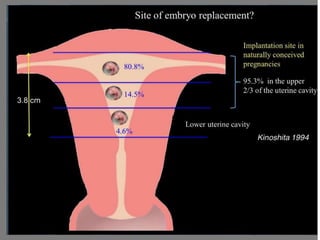
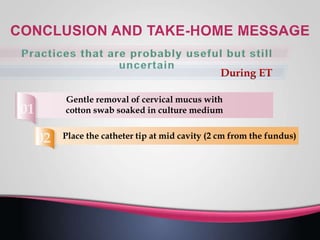
Place the catheter tip at mid cavity (2 cm from the fundus)
Gentle removal of cervical mucus with
cotton swab soaked in culture medium
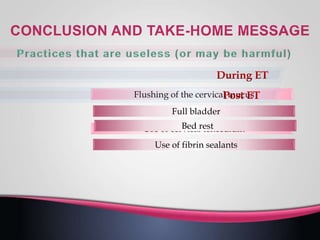
Flushing of the cervical mucus
Use of cervical teneculum
Full bladder
Use of fibrin sealants
Bed rest

Embryo transfer

  • 1.
  • 2.
  • 3.
    Measures prior toET Measures during ET Measures immediately after ET I II II I After During Before
  • 4.
    Embryo transfer (ET)is universally recognized as the final and most critical stage in an in vitro fertilization (IVF) outcome Neithardt et al., 2The majority of couples (approximately 80%) who undergo IVF reach the embryo transfer stage, yet few pregnancies occur Mansour & Aboulghar, 2002; Adamson
  • 6.
    1 Removal ofhydrosalpinges 2 Appropriate evaluation of the uterine cavity 3 Evaluation of the cervico-uterine axis 4 A dummy or mock transfer 5 Endometrial injury performed in cycles prior to ET
  • 7.
    TotalEventsTotalEvents 3063013Dechaud 1988 1525020Kontoravdis 2006 6686023Moshin2006 882211640Strandell 1000 Common Odds ratio 2.49 (95% CI: 1.60, 3.86) 0.01 0.1 1 10 100 Odds Ratio M-H, Fixed, 95% CI Favor Control Favor Removal
  • 8.
    Assessment of theuterine cavity by ultrasonography prior to the IVF cycle is essential for detecting uterine polyps as well as any fibroids that may be invading the uterine cavity or deformitiestothecervicalcanal. ( Niknejadi et al., 2010) Polyps are the most common structural pathologies in the uterine cavity which it’s incidental finding during ovarian stimulation,ineitherIVForintracytoplasmicsperminjection(ICSI) cycles,isachallenge. (Isikoglu et al., 2006)
  • 9.
    Polyp size (Lasset al., 1999; Isikoglu et al., 2006) and location (Yanaihara et al., 2008) may influence the success of embryo implantation during assisted reproductive treatment cycles. According to some research studies, endometrial polyps less than 1.5cm do not negatively influence the pregnancy outcome, whereas increased loss of pregnancy has been reported in others (Lass et al., 1999; Isikoglu et al., 2006).
  • 10.
    Endometrial damage byendometrial sampling or hysteroscopic polypectomy may significantlyimprovethepregnancyrates. (Barashetal.,2003;Spiewankiewiczetal.,2003;Stamatellosetal.,2008)
  • 11.
    Although several studieshave reported good outcomes following hysteroscopic polypectomy during ovarian stimulation in IVF cycles due to debates over this topic, it is advisable to evaluate the uterine cavity prior to stimulation in order to determine the presence of an existing endometrial pathology. (Batioglu & Kaymak, 2005; Madani et al., 2009b) ?????
  • 12.
    This evaluation isnecessary to ensure suitable embryos placement. It can be undertaken by both dummy embryo transfer and ultrasonography. Both procedures are important for evaluating the direction and length of the uterine cavity and cervical canal.
  • 13.
    To improve theoutcome, it has been suggested that a dummy embryo transfer should be performed prior to the stimulation cycle. (Mansour et al., 1990) Or just before the actual embryo transfer. (Sharif et al., 1995) If this technique is performed close to the time of embryo transfer for example at the time of oocyte retrieval, the pregnancy rate will decrease significantly due to late uterine contractions. (Madani et al., 2009a)
  • 14.
    Many unexpected agentsmake entering the uterine cavity difficult, such as: Cervical polyps or fibroids A pin-point external os Cervical deformation due to congenital anomalies or resulting from a previous surgery, all of which can be discovered by a ‘dummy’ or ‘mock’ transfer In the case of cervical stenosis, cervical dilatation should be performed before ovarian stimulation (Mansour & Aboulghar, 2002)
  • 15.
    WeightTotalEventsTotalEvents 1.1.1 Injury inthe pervious cycle 2.54 [0.88, 7.36] 37.4%5154911Narvekar 2010 2.42 [1.06, 5.51] 62.6%50125022 Selcuk University 2011 2.46 [1.28, 4.72] 100.0%10199Subtotal (95%CI) 1733Total events Heterogeneity: Chi2= 0.01, df= 1 (P= 0.94); I2= 0% Test for overall effect: Z= 2.71 (P= 0.007) 2.46 [1.28, 4.72] 100.0 % 10199Total (95% CI) 1733Total events Heterogeneity: Chi2= 0.01, df= 1 (P= 0.94); I2= 0% Test for overall effect: Z= 2.71 (P= 0.007) Test for subgroup differences: Not applicable Peto Odds Ratio Peto, Fixed, 95% CI Favor End. Injury 0.1 0.2 10.5 2 105 Favor Control NNT= 6
  • 16.
    WeightTotalEventsTotalEvents 1.3.1 Injury inthe pervious cycle 3.36 [1.20, 9.37]16.9%5748513Karimzadeh 2009 2.88 [1.14, 7.28]20.7%5174916Narvekar 2010 2.01 [0.97, 4.19]33.2%60186028Nastri 2011 2.81 [1.29, 6.14]29.2%50175030Selcuk University 2011 2.61 [1.71, 3.97]100.0%218217Subtotal (95%CI) 4687Total events Heterogeneity: Chi2= 0.79, df= 3 (P= 0.85); I2= 0% Test for overall effect: Z= 4.45 (P= 0.00001) 1.3.2 Injury on the day of oocyte retrieval 0.30 [0.14, 0.63]100.0%7926779Karimzade 2010 0.30 [0.14, 0.63]100.0%7977Subtotal (95% CI) 269Total events Heterogeneity:Not applicable Test for overall effect: Z= 3.17 (P= 0.002) Peto Odds Ratio Peto, Fixed, 95% CI Favor End. Injury 0.1 0.2 10.5 2 105 Favor Control NNT= 5
  • 17.
    Factors influencing thepregnancy rate during this stage include 1 Cervical preparation, removal of mucus or blood on the catheter 2 Straightening the utero-cervical angle 3 Ultrasound use 4 Type of catheter 5 Loading the embryo medium 6 Embryo load method for transfer (Derks et al., 2009; Schoolcraft et al., 2001) (Madani et al., 2010)
  • 18.
    Cervical mucus seemsto interfere with embryo entry into the uterus from the transfer catheter. This interference can be caused by excess cervical mucus that cover the transfer catheter and make the injection of the embryos effortless. (Visschers et al., 2007) The presence of blood or mucus on the catheter, from tissues trauma, may also reduce implantation rates. (Schoolcraft et al., 2001)
  • 19.
    It has beenreported that, while drawing the catheter, cervical mucus may surround the embryos and dislodge them from their original place. (Eskandar et al., 2007)
  • 20.
    Risk Ratio M-H, Random,95% CI Favors Experimental 0.5 10.7 1.5 2 Favor Control TotalEventsTotalEvents Mucus removal by aspiration 673216043Aflatoonim 2005 49164816Ruhlman 1999 49224719Saroka 1999 Common odds ratio 1.12 (95%: 0.85, 149) Mucus removal with cotton swab 26560265104Moini 2011 Common odds ratio 1.73 (95% CI: 1.33, 2.27) Mucus removal by cervical brush 66236223Visschers 2007 Common odds ratio 1.06 (95% CI: 0.67, 169) 596153582205Total Common odds ratio 1.25 (95% CI: 0.96, 163) Heterogeneity: Tau2= 0.05; Chi2= 8.28, df= 4 (p= 0.08); 12= 52%
  • 21.
    Peto Odds Ratio Fixed,95% CI 1.14 [0.80, 1.62] 0.01 0.1 1 10 100 Flushing No Flushing Empty bladder 72/126 26/93 13/50 269 72/12657/127Glass 2000 26/9328/91Kyono 2001 13/5018/50Sallam 2000 269268Total
  • 22.
    The utero-cervical anglecan be straightened by means of following techniques. Distended bladder: a full bladder acts as a useful adjunct for transfer Gripping the cervix with a tenaculum Using an inner metal guide
  • 23.
    The utero-cervical anglecan be straightened by means of following techniques. (Abou-Setta, 2007; Lewin et al., 1997) Changing the patient position during embryo transfer (Derks et al., 2009)
  • 25.
    25/6426/67Lorusso 2005 13/7612/66Mitchell 1989 140133Total Noeffect on the pregnancy rate for women undergoing ET with a full or an empty bladder Peto Odds Ratio Fixed, 95% CI 0.98 [0.57, 1.68] 0.02 0.1 1 10 50 Empty bladder 25/64 13/76 140
  • 26.
    Traditionally, the “clinicaltouch” method has been used to guide catheter placement approximately 1 cm from the uterine fundus. This is a blind technique and clinicians must rely on their sense of touch to judge whether the transfer catheter has been introduced in its proper place (Brown et al., 2010)
  • 27.
    Ultrasound-guided embryo transferis helpful for women who have previously had difficult transfers and the rates of implantation and pregnancy have a significantly improvement. (Kan et al., 1999, Coroleu et al., 2000) Other benefits of ultrasound guided embryo transfer include: (Strickler et al., 1985) 1 Observe the transfer catheter 2 The air bubble 3 The endometrial cavity and the endometrial feature
  • 28.
    Favor End. Injury 0.10.2 10.5 2 105 Favor Control TotalEventsTotalEvents 66156522Bar Harva 2003 234275Chen 2007 1806118291Coroleu 2000 91189332Coroleu 2002 815204834207Drakeley 2008 1905418375Eskander 2008 187103187112Garcia-Velasco 2002 1506315063Kosmas 2007 1523817866Li 2005 42154125Marconi 2003 50155021Martins 2004 2604725567Matorras 2002 34133321Moraga-Sanchez 2004 40090400104Tang 2001 1243916049Weissman 2003 9899819Wisanto 1989 30997308105Zakova 2008 Common Odds Ratio 1.31 (95% CI: 1.18, 1.46)
  • 31.
    36 (60)a)29 (49.2)24(39.3)a)Clinical pergnancies/ ET 25 (69.4)15 (51.7)17 (70.8)Single 11 (30.5)11 (37.9)6 (25)Twins 1 (2.7)3 (10.3)1 (4.1)Triplets 33.3c)31.3b)20.6b,c)Implantation rate 4 (11.1)3 (10.4)3 (12.5)Spontaneous miscarriage 1 (4.2)4.2Ectopic pregnancy Values are n (%) a,b,c) Values in rows with common superscripts were significantly different (p  0.05)
  • 32.
    A Soft, flexibleembryo transfer catheter is the best choice for minimizing the risk of trauma to the endocervix or endometrium, facilitating smooth insertion. Many studies have evaluated various types of embryo transfer catheters and have confirmed a significantly better pregnancy rate with the use of soft catheters. (Wood et al., 2000; Mansour & Aboulghar, 2002)
  • 33.
    TotalEventsTotalEvents 2002820050Wisanto et al.1989 51209935Grunert et al. 1998 1012711345Amorcho et al. 1999 1424314427Ghazzawi et al. 1999 240100240113Curfs et al. 2001 1483416037Lavery et al. 2001 1945019570McDonald and Norman 2002 58166031Mortimer et al. 2002 657135639173Van Weering et al. 2002 911311432Aboul Foutouh et al. 2002 0.3 10.6 1.5 3 6
  • 34.
    One natural andmost important adherent macromolecule recommended to be introduced into transfer media is hyaluronic acid which is known as an implantation enhancing-molecule. (Bontekoe et al., 2010) Hyaluronic acid improves implantation by increasing cell-to-cell adhesion and cell-tomatrix adhesion (Bontekoe et al., 2010) Hyaluronic acid generates a viscous solution that might improve the embryo transfer process, preventing embryo expulsion (Simon et al., 2003).
  • 35.
    TotalEventsTotalEvents 193124193137Balaban 2014 4895419Dittmann-Muller 2009 93159443Friedler2005 5055118Friedler 2007 411655Hazlett 2008 1583013830Korosec 2007 305309Mahani 2007 42214117Morbeck 2007 69217921Ravhon 2005 84439158Schoolcraft 2002 40214025Simon 2003 643312639349Urman 2008 65226426Yakin 2004 Peto Odds Ratio Fixed, 95% CI 1.14 [0.80, 1.62] 0.01 0.1 1 10 100 Favours no or low HA Favours HA
  • 36.
    The advantage ofusing the air and liquid content for catheter loading is to prevent the embryo from adhering to the wall of the catheter at the time of injection. (Eytan et al., 2004) The presence of two air bubbles on both sides of the medium that contains the embryo prevents the transfer of the embryo within the catheter (Eytan et al., 2004) and beside, in the transfer under ultrasonographic guidance, the air bubbles are often considered a marker for the embryo’s position in the uterus. (Lambers et al., 2007; Friedman et al., 2011)
  • 38.
    n/Nn/N 32/9832/98Krampl 1995 17/5022/52Moreno 2004 PetoOdds Ratio Fixed, 95% CI 0.2 0.5 10.1 2 5 10 Favours Air-fluidFavours Fluid- only
  • 39.
    Finally by loading1 µl of medium on the catheter tip, the probability of embryo expulsion will be stopped. It has been reported that larger volumes of fluid transferred (60 µl) correlate with retained embryos, yet it is advisable that a certain amount of media be loaded to assist with expelling the embryo. (Hearns-Stokes et al., 2000)
  • 40.
    • However, thereis debate on the post transfer aspects of the embryo transfer. • There are three main approaches for post embryo transfer intervention. (Abou-Setta et al., 2009) (Bar-Hava et al., 1999, Feichtinger et al., 1992) 1 Prevention of the expulsion of fluids and embryos from the cervix 2 The use of a fibrin sealant (Sharif et al., 1998) 3 Bed rest after embryo transfer
  • 41.
    6.39 ICSI Cases Randomization STUDY GROUP(325 CASES) Vaginal speculum screw was loosened to exert gentle pressure on the cervix before ejecting the embryos, and was maintained for 7 min after wards Control group (314 Cases) No pressure on the cervix during or after ET 207/325 (67%) Pregnancy Rate 150/314 (47.8%) 304/913 (33.3%) Implantati on Rate 198/920 (21.5%)
  • 42.
    34.4  3.133.83.4Age (years) 5.2  2.74.9  2.2 Infertility duration (years) 89.391.3Primary infertility (%) 50.758.7ICSI (%) 4.6 (14/300)1.4 (2/150)Non easy transfers (%) 63.7  49.353.5  43.6ILDE (s) 63.7  49.353.5  43.6 ILDE excluding non-easy transfers (s) ILDE: interval loading-discharging embryos
  • 43.
    TotalEventsTotalEvents 1923518640Amarin 20041 82418241Purcell 20072 1207312078Gaikwad20133 972110322Botta 19974 1842010Rezabek 20155 -0.5 1 2.5 5.0 10 14.4 Common Odds ratio 1.171(95% CI: 0.887-1.548)
  • 46.
    Embryo transfer mustbe performed in a gentle and non- traumatic manner. Minimizing blood on the catheter tip (cervical trauma), the cervical mucus, the risk of embryo expulsion or retained embryos, the frequency and severity of uterine contractions, and performing a trial embryo transfer before the actual transfer all seems to be useful for embryo transfer.
  • 47.
    01 Remove hydrosalpinx (ifpresent ) 02 Polypectomy if present 01 Perform ET under ultrasound guidance 02 Use soft ET catheter 03 Medium enriched with HA is preferable 01 No bed rest
  • 48.
    Place the cathetertip at mid cavity (2 cm from the fundus) Gentle removal of cervical mucus with cotton swab soaked in culture medium
  • 49.
    Flushing of thecervical mucus Use of cervical teneculum Full bladder Use of fibrin sealants Bed rest