A seminar on


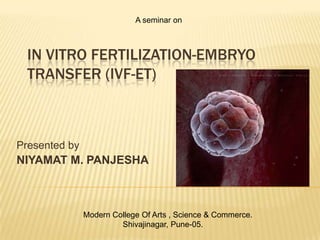
  IN VITRO FERTILIZATION-EMBRYO
  TRANSFER (IVF-ET)


Presented by
NIYAMAT M. PANJESHA


               Modern College Of Arts , Science & Commerce.
                        Shivajinagar, Pune-05.
WHAT IS IVF?

   In vitro fertilization broadly deals with “the
    removal of egg’s from a women, fertilizing
    them in the laboratory, and transferring the
    fertilized eggs (zygotes) into the uterus a few
    days later.
WHY IVF?

 Infertility: Extremely Prevalent
 Definition: inability to achieve pregnancy

 17-26% of couples worldwide (90 million
  women)
 27-47% of infertile couples have impaired
  male fertility; decline in semen quality
  worldwide over last 50 years
WHY THE INCREASE IN INFERTILITY?

 Delayed marriage and child-bearing
 Sexually transmitted diseases

 Hormonal contraception

 Abortion

 Obesity

 Environmental Pollution
 Male infertility
 Female infertility
IVF: HISTORY

   In vitro fertilization (IVF) is a fertility
    procedure which first succeeded as recently
    as 1978 by Dr. Edwards ( an embryologist)
    and Dr. Steptoe ( a gynecologist) in England.
    Since then the technology has been further
    refined and developed by physicians and
    embryologists, with over 20,000 babies born
    worldwide.
METHODOLOGY OF IVF

 The ivf broadly involves the fowllowig
  stages:-
1. Ovarian stimulation and monitoring
2. Egg (oocyte) retrieval
3. Fertilization
4. Intracytoplasmic Sperm Injection
5. Embryo transfer
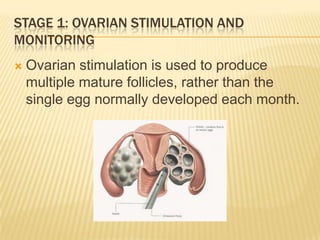
STAGE 1: OVARIAN STIMULATION AND
MONITORING
   Ovarian stimulation is used to produce
    multiple mature follicles, rather than the
    single egg normally developed each month.
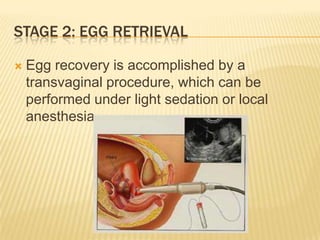
STAGE 2: EGG RETRIEVAL

   Egg recovery is accomplished by a
    transvaginal procedure, which can be
    performed under light sedation or local
    anesthesia.
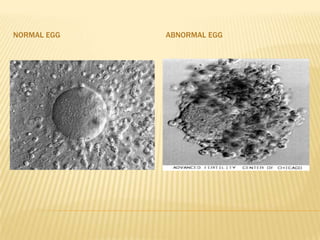
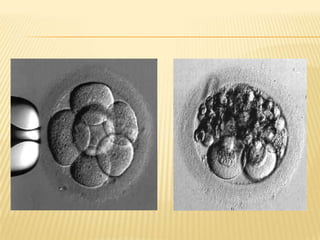
NORMAL EGG   ABNORMAL EGG
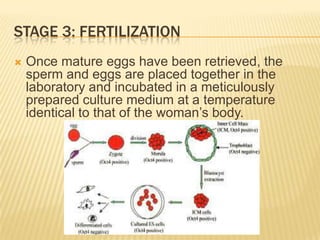
STAGE 3: FERTILIZATION
   Once mature eggs have been retrieved, the
    sperm and eggs are placed together in the
    laboratory and incubated in a meticulously
    prepared culture medium at a temperature
    identical to that of the woman’s body.
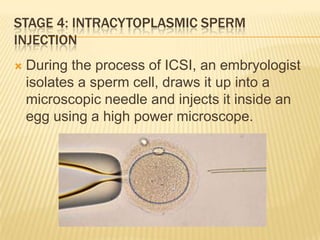
STAGE 4: INTRACYTOPLASMIC SPERM
INJECTION
   During the process of ICSI, an embryologist
    isolates a sperm cell, draws it up into a
    microscopic needle and injects it inside an
    egg using a high power microscope.
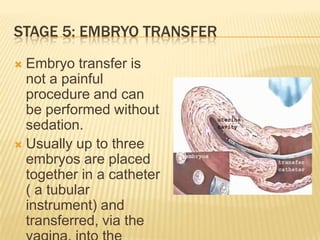
STAGE 5: EMBRYO TRANSFER
 Embryo transfer is
  not a painful
  procedure and can
  be performed without
  sedation.
 Usually up to three
  embryos are placed
  together in a catheter
  ( a tubular
  instrument) and
  transferred, via the
SUCCESS RATE OF IVF

 Varies from programme to programme.
 It is dependent upon correct diagnosis of
  patient, and age.
 Pregnancy rate is in the range of 25-30% per
  oocyte retrieval.
 The take home is about 15-20% per
  procedure.
FACTORS

 Increased risk of abortion.
 Multiple pregnancy.

 Ectopic pregnancy.

 Low birth weigh baby.

 Premature delivery.
LIMITATION OF IVF


 Genetic defect in oocytes.
 Genetic defect in fertilizing sperm.

 Environmental mutagenesis.

 Inadequate supply of nutrients and
  hormones.
 Exposure to toxic agents and free radicals.
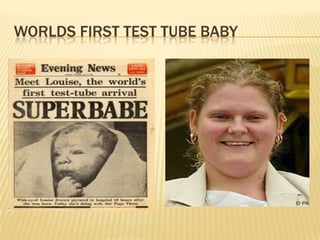
WORLDS FIRST TEST TUBE BABY
REFERENCES
ANY QUESTION
THANK YOU

In vitro fertilization embryo transfer

  • 1.
    A seminar on IN VITRO FERTILIZATION-EMBRYO TRANSFER (IVF-ET) Presented by NIYAMAT M. PANJESHA Modern College Of Arts , Science & Commerce. Shivajinagar, Pune-05.
  • 2.
    WHAT IS IVF?  In vitro fertilization broadly deals with “the removal of egg’s from a women, fertilizing them in the laboratory, and transferring the fertilized eggs (zygotes) into the uterus a few days later.
  • 3.
    WHY IVF?  Infertility:Extremely Prevalent  Definition: inability to achieve pregnancy  17-26% of couples worldwide (90 million women)  27-47% of infertile couples have impaired male fertility; decline in semen quality worldwide over last 50 years
  • 4.
    WHY THE INCREASEIN INFERTILITY?  Delayed marriage and child-bearing  Sexually transmitted diseases  Hormonal contraception  Abortion  Obesity  Environmental Pollution
  • 5.
     Male infertility Female infertility
  • 6.
    IVF: HISTORY  In vitro fertilization (IVF) is a fertility procedure which first succeeded as recently as 1978 by Dr. Edwards ( an embryologist) and Dr. Steptoe ( a gynecologist) in England. Since then the technology has been further refined and developed by physicians and embryologists, with over 20,000 babies born worldwide.
  • 7.
    METHODOLOGY OF IVF The ivf broadly involves the fowllowig stages:- 1. Ovarian stimulation and monitoring 2. Egg (oocyte) retrieval 3. Fertilization 4. Intracytoplasmic Sperm Injection 5. Embryo transfer
  • 8.
    STAGE 1: OVARIANSTIMULATION AND MONITORING  Ovarian stimulation is used to produce multiple mature follicles, rather than the single egg normally developed each month.
  • 9.
    STAGE 2: EGGRETRIEVAL  Egg recovery is accomplished by a transvaginal procedure, which can be performed under light sedation or local anesthesia.
  • 10.
    NORMAL EGG ABNORMAL EGG
  • 11.
    STAGE 3: FERTILIZATION  Once mature eggs have been retrieved, the sperm and eggs are placed together in the laboratory and incubated in a meticulously prepared culture medium at a temperature identical to that of the woman’s body.
  • 12.
    STAGE 4: INTRACYTOPLASMICSPERM INJECTION  During the process of ICSI, an embryologist isolates a sperm cell, draws it up into a microscopic needle and injects it inside an egg using a high power microscope.
  • 14.
    STAGE 5: EMBRYOTRANSFER  Embryo transfer is not a painful procedure and can be performed without sedation.  Usually up to three embryos are placed together in a catheter ( a tubular instrument) and transferred, via the
  • 15.
    SUCCESS RATE OFIVF  Varies from programme to programme.  It is dependent upon correct diagnosis of patient, and age.  Pregnancy rate is in the range of 25-30% per oocyte retrieval.  The take home is about 15-20% per procedure.
  • 16.
    FACTORS  Increased riskof abortion.  Multiple pregnancy.  Ectopic pregnancy.  Low birth weigh baby.  Premature delivery.
  • 17.
    LIMITATION OF IVF Genetic defect in oocytes.  Genetic defect in fertilizing sperm.  Environmental mutagenesis.  Inadequate supply of nutrients and hormones.  Exposure to toxic agents and free radicals.
  • 18.
  • 19.
  • 20.
  • 21.