
Dr. Rahul Sen
Ph.D
Chief Embryologist
Vasundhara Hospital Limited
Johdpur, Jaipur
SPERM
FREEZING
INTRODUCTION
• the idea of freezing human male gametes has been
experimented since the late 1700s,
• The first reported observations of the effects of low
temperatures on spermatozoa were performed by Lazaro
Spallanzani in 1776,
• the first to discuss the possible uses of sperm banks was the
Italian Paolo Mantegazza, who wrote the following sentence
in 1866: “It might even be that a husband who has died on a
battle field can fecundate his own wife after he has been red
uced to a corpse”
• However, sperm cryopreservation did not become a realistic
until the discovery potent Cryoprotectant's
LEARNINGOBJECTIVES
• Concept of sperm cryopreservation
• Different procedures, storage devices,
advantages & disadvantages for each
procedure
• Effect of cryopreservation upon semen
quality & outcomes
THE SPERM CELL
The term sperm is derived from the Greek meaning "seed" and
refers to the male reproductive cells.
SPERM FREEZING
Cryopreservation of semen enables it to conserve at
low or ultra-low temperatures for future use and later
thawed for fertility purpose.
SPERM FREEZING…
• Human spermatozoa can tolerate a range of
temperature. They are not very sensitive to damage
caused by cooling (cold shock), possibly because of
high membrane fluidity (Clarke et al., 2003).
• They may also be more resistant than other cells in
cryopreservation damage because of their low water
content (about 50%)
• However, cryopreservation does have an adverse effect
on human sperm function, particularly motility.
• On average, only about 50% of the motile spermatozoa
survive freezing and thawing (Keel & Webster, 1993).
• Optimizing the cryopreservation process will minimize
this damage and may increase pregnancy rates (Woods
et al., 2004).
INDICATIONS OF SPERM FREEZING
• Inability to produce ejaculate on demand.
• man may be absent on the day of procedure.
• decreased sperm count and sperm functions
• Exposed to Gonadotoxic medication or treatment
• Sperm Donation
• Social Fertility Preservation
GENERAL PROCEDURE FOR SPERM FREEZING
• Semen Collection- Ejaculate or surgical
• Post liquefaction perform semen analysis
• Dilution with cryoprotectant
• Balancing & cooling
• Freezing and maintenance at low temperature
• Thawing and assessment before use
CRYOPROTECTANTS
• In 1949 Glycerol was identified as a potent agent
showing cryoprotective properties and can be used as a
major CPA for sperm cryopreservation
• The first human birth resulting from artificial insemination
of cryopreserved semen were reported by Bunge and She
rman in 1953
• Theoretical considerations suggested that long-term cryo
storage would require the use of temperatures lower than
−130°C, the glassy-transition temperature, below which ic
e-crystal growth is inhibited.
• Consequently, liquid nitrogen (−196°C) storage became th
e standard very early in the history of sperm banking
CRYOPROTECTANTSTYPES
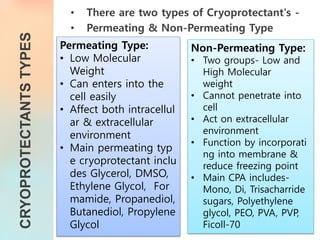
• There are two types of Cryoprotectant's -
• Permeating & Non-Permeating Type
Permeating Type:
• Low Molecular
Weight
• Can enters into the
cell easily
• Affect both intracellul
ar & extracellular
environment
• Main permeating typ
e cryoprotectant inclu
des Glycerol, DMSO,
Ethylene Glycol, For
mamide, Propanediol,
Butanediol, Propylene
Glycol
Non-Permeating Type:
• Two groups- Low and
High Molecular
weight
• Cannot penetrate into
cell
• Act on extracellular
environment
• Function by incorporati
ng into membrane &
reduce freezing point
• Main CPA includes-
Mono, Di, Trisacharride
sugars, Polyethylene
glycol, PEO, PVA, PVP,
Ficoll-70
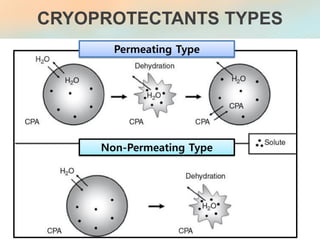
CRYOPROTECTANTS TYPES
Permeating Type
Non-Permeating Type
SPERM FREEZING MEDIA PROVIDERS &
MANUFACTURERS
Semen freezing media components
CaCl2,
Gentamicin,
glucose,
glycerol,
HEPES
human albumin solution,
Milli Rx water,
MgSO4,
Phenol red,
KCl,
NaHCO3,
NaCl,
Sodium L- lactate,
Na3PO4,
SSR (synthetic serum
replacement),
Sucrose
Commercial semen freezing media contains:
SPERM FREEZING METHODS
• MANUAL
• SOFTWARE BASED
SLOW
FREEZING
• FAST COOLING
• VITRIFICATION
RAPID
FREEZING
SLOW FREEZING METHOD
• Thaw the cryoprotectant, warm to room temperature and
mix. Initial warming to 37 °C may be beneficial.
• High concentrations of glycerol are detrimental to sperma
tozoa. It is thus vital to take special care when adding an
d mixing the cryoprotectant with the semen.
• Add one volume of GEYC to two volumes of semen, eithe
r drop by drop with swirling, or by gentle pipetting up an
d down, or gradually in five additions with gentle mixing
over approximately 10 minutes at room temperature.
• incubate the mixture at 30–35 °C for 5 minutes.
• Loading into a proper labelled storage device
PROGRAMMABLE FREEZING METHOD
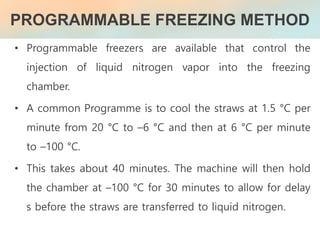
• Programmable freezers are available that control the
injection of liquid nitrogen vapor into the freezing
chamber.
• A common Programme is to cool the straws at 1.5 °C per
minute from 20 °C to –6 °C and then at 6 °C per minute
to –100 °C.
• This takes about 40 minutes. The machine will then hold
the chamber at –100 °C for 30 minutes to allow for delay
s before the straws are transferred to liquid nitrogen.
PROGRAMMABLE FREEZING METHOD
• more complicated, may be used depending on
experience in individual laboratories (Pérez-Sánchez et al.,
1994).
Method is as follows
• Place the straws in a refrigerator freezer (2-4 °C) for 20 m
inutes
• Then into the deep freezer (below freezing temperature)
for 20 minutes
• Before placing into the liquid nitrogen they can be placed
5-10cms above LN2 in a container, waiting till 5 minutes
• Then directly plunge into liquid nitrogen
Controlled freezing cannot be achieved in either slow or rapid freezing.
This can be overcome by using a programmable freezer where the
desired temperature is achieved.
RAPID FREEZING
• The aim of utilizing rapid freezing technique is to
minimize the toxicity caused by the cryoprotectant and to
lessen the osmotic membrane damage
• This is achieved by bringing the samples in direct contact
with nitrogen vapours (–80 °C) or directly into liquid
nitrogen (-196 °C).
RAPID FREEZING – VAPOR PHASE
• The entire volume of cryoprotectant with sample is added
drop by drop in a 1:1 freezing ratio.
• The mixture is then transferred to a cryo storage device.
• Static vapor exposure is performed directly by placing the
devices 3 cm above the liquid nitrogen surface or in speci
ally made refrigerator that can maintain (–80 °C) for a 30
min before plunging directly into liquid nitrogen.
SPERM VITRIFICATION
• Vitrification method does not require either the use of
specially devised cooling programs or CPAs and is much
faster, simpler and cheaper.
• The method is based on cooling of sperms by direct
immersion into LN2, thereby avoiding intracellular ice
crystal formation.
• Optimal cooling rates are obtained with the following
specifically designed packaging systems: Open pulled
straws, the Flexipet denuding pipette, micro-drops, electr
on microscope copper grids, the Hemi-straw system, Cryo
top, Cryoleaf, Cryotip and other carrier devices.
The vitrification protocols still require a lot of work and standardization
SPERM VITRIFICATION
• The basic principle underlying the vitrification technique
is to create high viscosity in the solution and produce a
glass like solidification without the formation of ice crysta
ls.
• Cryoprotectant free vitrification using sucrose is associate
d with better outcomes of post-thaw sperms motility,
plasma membrane integrity and acrosome integrity.
• Small volume of sperm suspension is mixed with sperm
wash media supplemented with 5% HSA and sucrose.
Cryoprotectant-free vitrification using sucrose is associate
d with better outcomes. (Isachenko V et al, Meth Mol Biol 2017;1568:79–84.)
Freezing Surgically Retrieved Sperms
• Patients with obstructive azoospermia can also freeze their specimen
obtained from the testis or epididymis.
• Micro-TESE has the highest sperm retrieval rate compared to multiple
fine-needle aspirate, and the success rates ranges from 50–60%.
• After mixing the aspirate with HEPES media, the mixture is centrifuge
d, pellet is resuspended. After mixing the suspension with an equal vo
lume of cryoprotectant, the sample aliquots can be loaded in the cryo
devices.
• In case TESA, tissue biopsies are obtained and shredded into small pi
eces using a sterile needle or fine scissor. Enzymatic digestion can als
o be used which will later allow cryoprotectant to fully penetrate testi
cular homogenate.
• Freezing can be done as per protocol of slow or rapid methods.
Conventional freezing of testicular sperm results in a sperm recovery rate of
only 1%-10%.
Cryopreservation of small number of
spermatozoa
• Conventional methods of sperm cryopreservation are not suitable for preservi
ng very small numbers of spermatozoa, such as epididymal or testicular sper
matozoa obtained after surgical sperm retrieval.
• Hence, various novel methods have been devised to store limited numbers of
such spermatozoa in a small volume.
• Though both biological and non-biological carriers have been used for this p
urpose, no prospective randomized trials have been conducted to show the s
uperiority of one technique over the other.
Special Sperm Cryopreservation
techniques
• Spermatozoa have been successfully cryopreserved using empty z
ona pellucida by various groups and this has the advantage of red
ucing the time in screening to locate motile sperm but carries a p
otential risk of biological contamination.
• Similarly, others have used microdroplets for freezing spermatozoa
. This method avoids sperm loss due to adherence to the vessel b
ut potentially carries the risk of cross contamination.
• Other methods used for storing a limited number of spermatozoa
include ICSI pipette, Volvox globator spheres, Alginate beads, Cryo
loop, Agarose microspheres, and straws.
Ideal Sperm Freezing Technique
• Good sperm survival rate post thawing
• Good clinical outcomes
• Cost and efficacy of the process
SPERM PREPRATION
• Normospermic samples can be prepared as easily with
available techniques like Swim-Up, Swim-Down, Density
Gradient Methods to eliminate the contaminating round
cells, leukocytes, dead cells.
• Semen specimens with poor sperm quality are washed
after rather than before freezing, to prevent sperm loss
during the wash procedure.
• If the TMS count is greater than 20 × 106, wash before
cryopreservation is recommended.
Sperm Storage
• After completion of the freezing process, store specimen
in liquid nitrogen containers safely.
• Viruses such as HIV , hepatitis B and C and other
microbial agents can survive in LN2 for a long period of
time.
• The loss rate of LN2 in the Dewar depends on the
static evaporation rate and the frequency of opening.
• Maintain detailed records including patient identification,
semen parameters, reason for storage etc
Sperm Thawing
• Remove the sample from the canister, where storage was done.
• Check that the donor data are correct
• Dry the cryotube with a sterile gauze.
• Gently unscrew the cap of the cryotube to release the pressure.
• Incubate the cryotube in a 37°C water bath for 5 minutes.
• Dry the cryotube with a sterile gauze.
• Proceed with semen analysis.
Damage due to sperm freezing
• Risks & Causes
• Evident damages: loss of motility, viability, variability
• Non-evident damages: Molecular alterations, ROS generation,
DNA damage
• Clinical Damage: Poor outcomes, lower ART Success
Risks and Causes
• Generally, sperms undergoing cryopreservation are
subjected to major factors that are responsible for
cryoinjury are
a) low temperature
b) crystallization of intracellular & extracellular water.
c) Cryopreservation toxicity
d) Osmotic or Oxidative shock
Evident damages
• Freezing significantly increases abnormally dead, immotile sper
matozoa
• sperm freezing can also result in apoptosis and necrotic cell d
eath. Most of these negative effects occur during thawing stag
e. After thawing, these factors are responsible for a 25–75% lo
ss of sperm motility, decrease in sperm cryosurvival.
• These factors have deleterious effects on the sperm plasm
a membrane are in turn responsible for cell leakage of many in
tracellular components.
Non-Evident damages
• Some of the negative effects of sperm freezing and thawi
ng resulting in cell injury, production of ROS which in tur
n has a negative effect on sperm motility, alteration in lipi
d phase, membrane integrity, mitochondrial function, DN
A integrity, cell signalling and metabolism.
• DNA fragmentation that varies with the sample.
• sperm proteome changes have been reported at every st
age of the cryopreservation process. This ultimately impai
rs the fertilizing ability of the sperm.
Disadvantages of sperm freezing
• Decrease in sperm quality i.e mainly reflected in quality of
spermatozoa with progressive motility
• High variability in survival of spermatozoa post thawing
• Inability to predict influential factors in cases of poor post
thaw survival
• ART success and outcomes. Cannot differential between p
oor and worst
CONCLUSION
• Nowadays, human semen cryopreservation is an extensively
performed as routine technique in fertility clinics worldwide.
With opportunity for future fertility in a variety of situations
• human spermatozoa have unusual cryobiological behavior, an
d improvements in their survival have been achieved
• Scientific literature shows conclusively that sperm motility, via
bility and morphology are not affected by proper long-term
cryopreservation.
SPERM FREEZING

SPERM FREEZING

  • 1.
    Dr. Rahul Sen Ph.D ChiefEmbryologist Vasundhara Hospital Limited Johdpur, Jaipur SPERM FREEZING
  • 2.
    INTRODUCTION • the ideaof freezing human male gametes has been experimented since the late 1700s, • The first reported observations of the effects of low temperatures on spermatozoa were performed by Lazaro Spallanzani in 1776, • the first to discuss the possible uses of sperm banks was the Italian Paolo Mantegazza, who wrote the following sentence in 1866: “It might even be that a husband who has died on a battle field can fecundate his own wife after he has been red uced to a corpse” • However, sperm cryopreservation did not become a realistic until the discovery potent Cryoprotectant's
  • 3.
    LEARNINGOBJECTIVES • Concept ofsperm cryopreservation • Different procedures, storage devices, advantages & disadvantages for each procedure • Effect of cryopreservation upon semen quality & outcomes
  • 4.
    THE SPERM CELL Theterm sperm is derived from the Greek meaning "seed" and refers to the male reproductive cells.
  • 5.
    SPERM FREEZING Cryopreservation ofsemen enables it to conserve at low or ultra-low temperatures for future use and later thawed for fertility purpose.
  • 6.
    SPERM FREEZING… • Humanspermatozoa can tolerate a range of temperature. They are not very sensitive to damage caused by cooling (cold shock), possibly because of high membrane fluidity (Clarke et al., 2003). • They may also be more resistant than other cells in cryopreservation damage because of their low water content (about 50%) • However, cryopreservation does have an adverse effect on human sperm function, particularly motility. • On average, only about 50% of the motile spermatozoa survive freezing and thawing (Keel & Webster, 1993). • Optimizing the cryopreservation process will minimize this damage and may increase pregnancy rates (Woods et al., 2004).
  • 7.
    INDICATIONS OF SPERMFREEZING • Inability to produce ejaculate on demand. • man may be absent on the day of procedure. • decreased sperm count and sperm functions • Exposed to Gonadotoxic medication or treatment • Sperm Donation • Social Fertility Preservation
  • 8.
    GENERAL PROCEDURE FORSPERM FREEZING • Semen Collection- Ejaculate or surgical • Post liquefaction perform semen analysis • Dilution with cryoprotectant • Balancing & cooling • Freezing and maintenance at low temperature • Thawing and assessment before use
  • 9.
    CRYOPROTECTANTS • In 1949Glycerol was identified as a potent agent showing cryoprotective properties and can be used as a major CPA for sperm cryopreservation • The first human birth resulting from artificial insemination of cryopreserved semen were reported by Bunge and She rman in 1953 • Theoretical considerations suggested that long-term cryo storage would require the use of temperatures lower than −130°C, the glassy-transition temperature, below which ic e-crystal growth is inhibited. • Consequently, liquid nitrogen (−196°C) storage became th e standard very early in the history of sperm banking
  • 10.
    CRYOPROTECTANTSTYPES • There aretwo types of Cryoprotectant's - • Permeating & Non-Permeating Type Permeating Type: • Low Molecular Weight • Can enters into the cell easily • Affect both intracellul ar & extracellular environment • Main permeating typ e cryoprotectant inclu des Glycerol, DMSO, Ethylene Glycol, For mamide, Propanediol, Butanediol, Propylene Glycol Non-Permeating Type: • Two groups- Low and High Molecular weight • Cannot penetrate into cell • Act on extracellular environment • Function by incorporati ng into membrane & reduce freezing point • Main CPA includes- Mono, Di, Trisacharride sugars, Polyethylene glycol, PEO, PVA, PVP, Ficoll-70
  • 11.
  • 12.
    SPERM FREEZING MEDIAPROVIDERS & MANUFACTURERS
  • 13.
    Semen freezing mediacomponents CaCl2, Gentamicin, glucose, glycerol, HEPES human albumin solution, Milli Rx water, MgSO4, Phenol red, KCl, NaHCO3, NaCl, Sodium L- lactate, Na3PO4, SSR (synthetic serum replacement), Sucrose Commercial semen freezing media contains:
  • 14.
    SPERM FREEZING METHODS •MANUAL • SOFTWARE BASED SLOW FREEZING • FAST COOLING • VITRIFICATION RAPID FREEZING
  • 15.
    SLOW FREEZING METHOD •Thaw the cryoprotectant, warm to room temperature and mix. Initial warming to 37 °C may be beneficial. • High concentrations of glycerol are detrimental to sperma tozoa. It is thus vital to take special care when adding an d mixing the cryoprotectant with the semen. • Add one volume of GEYC to two volumes of semen, eithe r drop by drop with swirling, or by gentle pipetting up an d down, or gradually in five additions with gentle mixing over approximately 10 minutes at room temperature. • incubate the mixture at 30–35 °C for 5 minutes. • Loading into a proper labelled storage device
  • 16.
    PROGRAMMABLE FREEZING METHOD •Programmable freezers are available that control the injection of liquid nitrogen vapor into the freezing chamber. • A common Programme is to cool the straws at 1.5 °C per minute from 20 °C to –6 °C and then at 6 °C per minute to –100 °C. • This takes about 40 minutes. The machine will then hold the chamber at –100 °C for 30 minutes to allow for delay s before the straws are transferred to liquid nitrogen.
  • 17.
    PROGRAMMABLE FREEZING METHOD •more complicated, may be used depending on experience in individual laboratories (Pérez-Sánchez et al., 1994). Method is as follows • Place the straws in a refrigerator freezer (2-4 °C) for 20 m inutes • Then into the deep freezer (below freezing temperature) for 20 minutes • Before placing into the liquid nitrogen they can be placed 5-10cms above LN2 in a container, waiting till 5 minutes • Then directly plunge into liquid nitrogen Controlled freezing cannot be achieved in either slow or rapid freezing. This can be overcome by using a programmable freezer where the desired temperature is achieved.
  • 18.
    RAPID FREEZING • Theaim of utilizing rapid freezing technique is to minimize the toxicity caused by the cryoprotectant and to lessen the osmotic membrane damage • This is achieved by bringing the samples in direct contact with nitrogen vapours (–80 °C) or directly into liquid nitrogen (-196 °C).
  • 19.
    RAPID FREEZING –VAPOR PHASE • The entire volume of cryoprotectant with sample is added drop by drop in a 1:1 freezing ratio. • The mixture is then transferred to a cryo storage device. • Static vapor exposure is performed directly by placing the devices 3 cm above the liquid nitrogen surface or in speci ally made refrigerator that can maintain (–80 °C) for a 30 min before plunging directly into liquid nitrogen.
  • 20.
    SPERM VITRIFICATION • Vitrificationmethod does not require either the use of specially devised cooling programs or CPAs and is much faster, simpler and cheaper. • The method is based on cooling of sperms by direct immersion into LN2, thereby avoiding intracellular ice crystal formation. • Optimal cooling rates are obtained with the following specifically designed packaging systems: Open pulled straws, the Flexipet denuding pipette, micro-drops, electr on microscope copper grids, the Hemi-straw system, Cryo top, Cryoleaf, Cryotip and other carrier devices. The vitrification protocols still require a lot of work and standardization
  • 21.
    SPERM VITRIFICATION • Thebasic principle underlying the vitrification technique is to create high viscosity in the solution and produce a glass like solidification without the formation of ice crysta ls. • Cryoprotectant free vitrification using sucrose is associate d with better outcomes of post-thaw sperms motility, plasma membrane integrity and acrosome integrity. • Small volume of sperm suspension is mixed with sperm wash media supplemented with 5% HSA and sucrose. Cryoprotectant-free vitrification using sucrose is associate d with better outcomes. (Isachenko V et al, Meth Mol Biol 2017;1568:79–84.)
  • 22.
    Freezing Surgically RetrievedSperms • Patients with obstructive azoospermia can also freeze their specimen obtained from the testis or epididymis. • Micro-TESE has the highest sperm retrieval rate compared to multiple fine-needle aspirate, and the success rates ranges from 50–60%. • After mixing the aspirate with HEPES media, the mixture is centrifuge d, pellet is resuspended. After mixing the suspension with an equal vo lume of cryoprotectant, the sample aliquots can be loaded in the cryo devices. • In case TESA, tissue biopsies are obtained and shredded into small pi eces using a sterile needle or fine scissor. Enzymatic digestion can als o be used which will later allow cryoprotectant to fully penetrate testi cular homogenate. • Freezing can be done as per protocol of slow or rapid methods. Conventional freezing of testicular sperm results in a sperm recovery rate of only 1%-10%.
  • 23.
    Cryopreservation of smallnumber of spermatozoa • Conventional methods of sperm cryopreservation are not suitable for preservi ng very small numbers of spermatozoa, such as epididymal or testicular sper matozoa obtained after surgical sperm retrieval. • Hence, various novel methods have been devised to store limited numbers of such spermatozoa in a small volume. • Though both biological and non-biological carriers have been used for this p urpose, no prospective randomized trials have been conducted to show the s uperiority of one technique over the other.
  • 24.
    Special Sperm Cryopreservation techniques •Spermatozoa have been successfully cryopreserved using empty z ona pellucida by various groups and this has the advantage of red ucing the time in screening to locate motile sperm but carries a p otential risk of biological contamination. • Similarly, others have used microdroplets for freezing spermatozoa . This method avoids sperm loss due to adherence to the vessel b ut potentially carries the risk of cross contamination. • Other methods used for storing a limited number of spermatozoa include ICSI pipette, Volvox globator spheres, Alginate beads, Cryo loop, Agarose microspheres, and straws.
  • 25.
    Ideal Sperm FreezingTechnique • Good sperm survival rate post thawing • Good clinical outcomes • Cost and efficacy of the process
  • 26.
    SPERM PREPRATION • Normospermicsamples can be prepared as easily with available techniques like Swim-Up, Swim-Down, Density Gradient Methods to eliminate the contaminating round cells, leukocytes, dead cells. • Semen specimens with poor sperm quality are washed after rather than before freezing, to prevent sperm loss during the wash procedure. • If the TMS count is greater than 20 × 106, wash before cryopreservation is recommended.
  • 27.
    Sperm Storage • Aftercompletion of the freezing process, store specimen in liquid nitrogen containers safely. • Viruses such as HIV , hepatitis B and C and other microbial agents can survive in LN2 for a long period of time. • The loss rate of LN2 in the Dewar depends on the static evaporation rate and the frequency of opening. • Maintain detailed records including patient identification, semen parameters, reason for storage etc
  • 28.
    Sperm Thawing • Removethe sample from the canister, where storage was done. • Check that the donor data are correct • Dry the cryotube with a sterile gauze. • Gently unscrew the cap of the cryotube to release the pressure. • Incubate the cryotube in a 37°C water bath for 5 minutes. • Dry the cryotube with a sterile gauze. • Proceed with semen analysis.
  • 29.
    Damage due tosperm freezing • Risks & Causes • Evident damages: loss of motility, viability, variability • Non-evident damages: Molecular alterations, ROS generation, DNA damage • Clinical Damage: Poor outcomes, lower ART Success
  • 30.
    Risks and Causes •Generally, sperms undergoing cryopreservation are subjected to major factors that are responsible for cryoinjury are a) low temperature b) crystallization of intracellular & extracellular water. c) Cryopreservation toxicity d) Osmotic or Oxidative shock
  • 31.
    Evident damages • Freezingsignificantly increases abnormally dead, immotile sper matozoa • sperm freezing can also result in apoptosis and necrotic cell d eath. Most of these negative effects occur during thawing stag e. After thawing, these factors are responsible for a 25–75% lo ss of sperm motility, decrease in sperm cryosurvival. • These factors have deleterious effects on the sperm plasm a membrane are in turn responsible for cell leakage of many in tracellular components.
  • 32.
    Non-Evident damages • Someof the negative effects of sperm freezing and thawi ng resulting in cell injury, production of ROS which in tur n has a negative effect on sperm motility, alteration in lipi d phase, membrane integrity, mitochondrial function, DN A integrity, cell signalling and metabolism. • DNA fragmentation that varies with the sample. • sperm proteome changes have been reported at every st age of the cryopreservation process. This ultimately impai rs the fertilizing ability of the sperm.
  • 33.
    Disadvantages of spermfreezing • Decrease in sperm quality i.e mainly reflected in quality of spermatozoa with progressive motility • High variability in survival of spermatozoa post thawing • Inability to predict influential factors in cases of poor post thaw survival • ART success and outcomes. Cannot differential between p oor and worst
  • 34.
    CONCLUSION • Nowadays, humansemen cryopreservation is an extensively performed as routine technique in fertility clinics worldwide. With opportunity for future fertility in a variety of situations • human spermatozoa have unusual cryobiological behavior, an d improvements in their survival have been achieved • Scientific literature shows conclusively that sperm motility, via bility and morphology are not affected by proper long-term cryopreservation.